In the early days, the blockchain industry was largely centered around individual public chains. But with the rapid growth of Layer1s, Layer2s, appchains, and modular blockchains, the Web3 ecosystem has gradually entered a “multichain era.” Networks such as Ethereum, Cosmos, Avalanche, Solana, and Base have each developed their own applications and liquidity ecosystems, yet these chains often cannot communicate directly with one another.
This fragmented structure has created new problems. Users need to switch wallets and networks frequently, while developers must deploy applications and liquidity systems separately across different chains. Although traditional cross-chain bridges can transfer assets, they usually only solve the problem of “moving tokens from Chain A to Chain B” and cannot support more complex cross-chain application logic.
As a result, cross-chain interoperability protocols have become an important direction for Web3 infrastructure. The market now needs an underlying network that allows blockchains to communicate with one another like internet servers, rather than just a simple asset bridging tool.
What Is Axelar?
Axelar Network is a decentralized network for blockchain interoperability. It enables asset and data communication between different blockchains through a validator network and cross-chain messaging protocol.
Compared with traditional cross-chain bridges, Axelar’s key feature is its support for “General Message Passing (GMP).” This means developers can not only transfer tokens across chains, but also directly trigger smart contract calls between different blockchains.
Functionally, Axelar is closer to a “cross-chain communication layer.” Developers can think of it as an API network for the Web3 world, allowing different blockchains to send requests and responses to each other much like internet services.
Axelar currently connects multiple major ecosystems, including Ethereum, Arbitrum, Optimism, Avalanche, Cosmos, Base, and Polygon.
What Is Axelar’s Core Architecture?
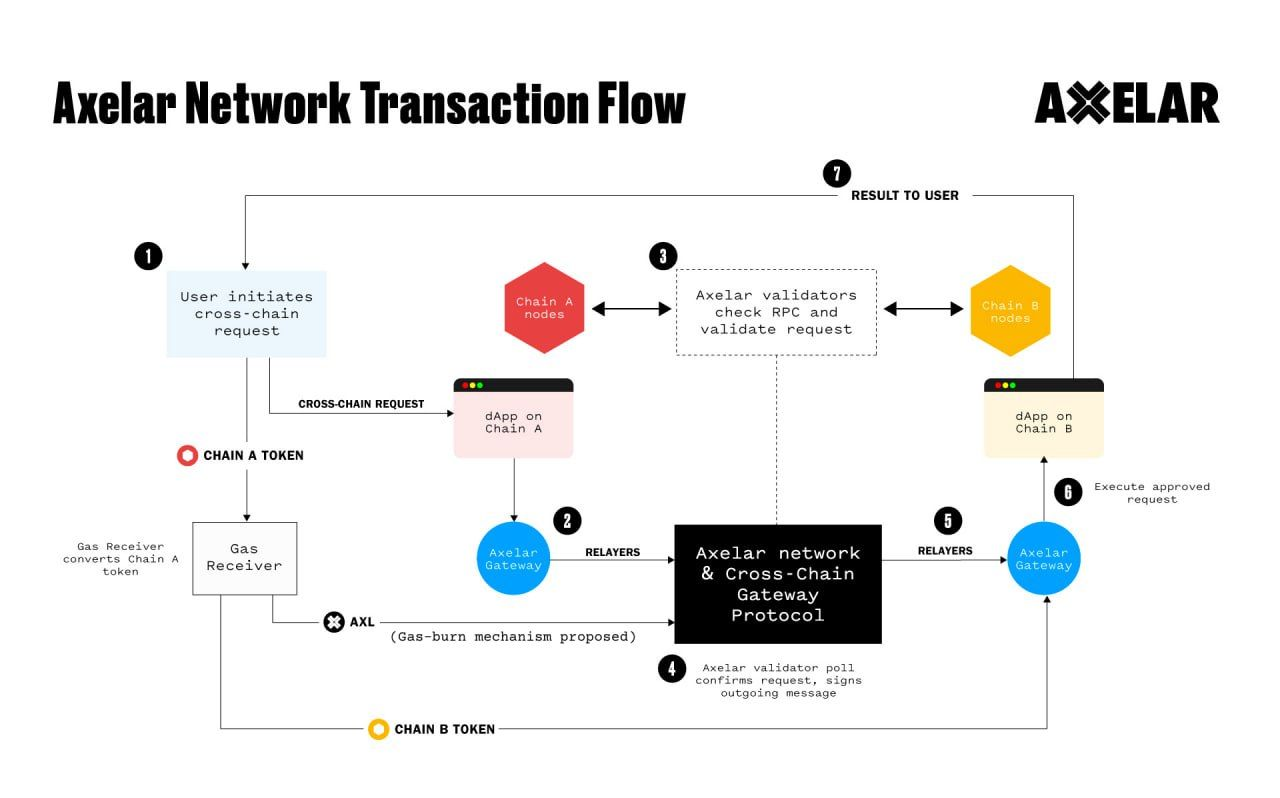
Axelar’s network mainly consists of a validator network, Gateway contracts, and cross-chain communication protocols.
Axelar Network
Axelar has its own independent PoS blockchain network, which coordinates cross-chain messages and the validation process. Validators confirm cross-chain requests from different chains and collectively maintain network security.
Gateway
Each blockchain connected to Axelar deploys a corresponding Gateway. A Gateway works like an interchain communication interface, receiving and sending cross-chain messages.
When a user or application initiates a cross-chain request, the Gateway first receives the message and sends it to the Axelar validator network.
Validator Network
Axelar uses a PoS validation mechanism to maintain cross-chain security. Validators need to stake AXL tokens and jointly verify whether cross-chain events have actually occurred.
This design makes Axelar’s security model closer to that of a public blockchain network, rather than a traditional bridge that relies on a small group of multisig nodes.
What Is General Message Passing (GMP)?
General Message Passing (GMP) is one of Axelar’s core mechanisms and is used for cross-chain smart contract communication.
Traditional cross-chain bridges usually only complete a “lock and mint” process, where users lock tokens on the source chain and receive corresponding assets on the destination chain. GMP, however, is not just about transferring assets. Its purpose is to transfer “messages.”
For example, a user can initiate an operation on Ethereum and directly call a smart contract function on Avalanche. This means cross-chain interaction is no longer limited to asset movement. It can support real collaboration between applications on different chains.
For this reason, GMP is seen as one of the key pieces of infrastructure for Web3 chain abstraction.
How Does Axelar’s Cross-Chain Communication Process Work?
A typical Axelar cross-chain message goes through a complete validation and execution process.
First, a user or application calls the Gateway contract on the source chain and submits a cross-chain message. The Axelar validator network then listens for the on-chain event and confirms that the request has actually occurred.
After validators reach consensus, the network generates the corresponding cross-chain execution request and sends it to the Gateway on the destination chain. Once the destination-chain Gateway receives the verified message, it calls the relevant smart contract and completes the function execution.
This mechanism allows Axelar not only to transfer assets across chains, but also to support complex interchain application logic, such as cross-chain DeFi, cross-chain governance, and interchain automated operations.
What Is the AXL Token Used For?
AXL is the native token of the Axelar network. It is mainly used for network security, governance, and fee payments.
Validators need to stake AXL to participate in network consensus. If malicious behavior occurs, the network can slash the staked assets to maintain the security of the cross-chain system.
AXL holders can also participate in network governance, including protocol upgrades, parameter adjustments, and ecosystem proposal voting. In addition, part of the gas and network fees generated during cross-chain message execution may also be settled through AXL.
What Is Interchain Token Service (ITS)?
Interchain Token Service (ITS) is cross-chain token infrastructure launched by Axelar.
Traditional cross-chain bridges usually create wrapped assets on the destination chain, but this model can lead to fragmented liquidity and security risks. ITS aims to enable unified native token deployment and management across chains.
Project teams only need to deploy a token once, then synchronize its asset state across multiple blockchains. This model can reduce the complexity of managing multichain assets and improve cross-chain liquidity efficiency.
ITS is now widely used in scenarios such as stablecoins, multichain DeFi, and real-world assets (RWA).
What Are Axelar’s Main Use Cases?
Axelar’s applications are mainly concentrated in cross-chain finance and multichain infrastructure.
In DeFi, users can perform swaps, lending, and liquidity operations across different blockchains. Wallets and applications can also use Axelar to create a unified account experience, reducing the complexity of users having to switch networks repeatedly.
As the concept of chain abstraction gains traction, Axelar is also seen as important underlying infrastructure for the multichain user experience. Developers can hide the underlying chain structure, allowing users to interact without needing to know which specific blockchain they are using.
Beyond that, Axelar is increasingly being used in stablecoins, RWA, and institutional cross-chain settlement.
How Is Axelar Different From Other Cross-Chain Protocols?
Axelar is often compared with interoperability protocols such as LayerZero, Wormhole, and Cosmos IBC.
Compared with traditional bridging protocols, Axelar places more emphasis on decentralized validation and general messaging capabilities. Its GMP mechanism supports not only token transfers, but also interchain smart contract calls.
Compared with solutions that rely on relayers or light client validation, Axelar uses an independent PoS validator network to maintain cross-chain security, making its architecture closer to a “cross-chain layer.”
Axelar’s Strengths and Limitations
Axelar’s core strength is that it supports cross-chain smart contract communication and offers strong multichain compatibility. Compared with protocols that only support asset bridging, Axelar helps developers build more complex interchain application logic.
Its decentralized validation mechanism also improves the security of the cross-chain system. At the same time, developer tools built around APIs, ITS, and GMP lower the barrier for developers to connect with multichain ecosystems.
On the other hand, cross-chain systems remain highly complex. Differences in synchronization speed, gas structures, and security models between blockchains can also affect cross-chain execution efficiency. In addition, security risks in multichain environments remain an ongoing challenge for cross-chain protocols.
Conclusion
As a cross-chain interoperability protocol in the Web3 multichain ecosystem, Axelar enables asset, data, and smart contract communication between different blockchains through a decentralized validator network and General Message Passing (GMP).
As the blockchain industry gradually moves from single-chain applications toward multichain coordination, cross-chain communication is becoming an important part of infrastructure. Compared with traditional bridging solutions, Axelar places greater emphasis on “interchain application coordination.” Its goal is not simply to transfer assets, but to allow different blockchains to interact like internet services.
FAQs
What Does GMP Mean?
GMP stands for General Message Passing. It is a cross-chain messaging mechanism that enables smart contract calls between chains.
How Is Axelar Different From Traditional Cross-Chain Bridges?
Traditional cross-chain bridges are mainly used for asset transfers, while Axelar focuses more on cross-chain messaging and smart contract interaction.
What Is the AXL Token Used For?
AXL is used for network staking, security validation, governance, and cross-chain fee payments.
Is Axelar Part of the Cosmos Ecosystem?
Axelar has close ties to the Cosmos ecosystem and uses a PoS validation mechanism, but its goal is to connect multiple blockchain ecosystems, not just Cosmos.
What Is ITS?
ITS stands for Interchain Token Service. It is cross-chain token infrastructure launched by Axelar and is used for native multichain asset management.
Which Blockchains Does Axelar Support?
Axelar supports multiple EVM chains and Cosmos ecosystem chains, including Ethereum, Avalanche, Arbitrum, Polygon, and Base.
Does Axelar Support Cross-Chain Smart Contract Calls?
Yes. Axelar’s GMP mechanism allows developers to call smart contracts directly between different blockchains.