As the blockchain ecosystem evolves from a simple transaction network into a system of AI Agent, automated finance, and multi protocol collaboration, the role of on-chain analytics platforms is also beginning to change. Traditional on-chain tools mainly solve the problem of “data visibility,” while a new generation of AI driven platforms places greater emphasis on “risk understanding” and “automated decision support.”
Against this backdrop, Wallitelli is seen as one representative direction of AI native on-chain Intelligence. Its core goal is not simply to display data, but to enable AI Agents and automated systems to directly understand on-chain risk and behavioral signals.
What Is Wallitelli?
Wallitelli is an on-chain intelligence system built for AI Agent and Autonomous Finance scenarios, with a focus on wallet behavior analysis, risk identification, and AI driven structured intelligence output.
Compared with traditional on-chain analytics platforms, Wallitelli places greater emphasis on “intelligent risk understanding.” The system analyzes not only transaction data, but also protocol exposure, liquidity changes, liquidation pressure, and abnormal behavioral patterns.
Wallitelli’s goal is to allow AI Agents to call this risk intelligence directly, supporting automated risk control and on-chain decision making.
What Is Nansen?
Nansen is one of the earlier on-chain data analytics platforms to gain market influence. Its core features are Smart Money analysis and wallet labeling.
Nansen mainly uses on-chain address labels and fund flow analysis to help users observe large wallets, institutional addresses, and popular capital trends. For example, users can track which wallets are buying a certain asset or which protocols are attracting inflows.
As a result, Nansen is closer to an on-chain market observation tool, with a focus on fund flow analysis, wallet labeling, and market trend monitoring. This model is more suitable for human research and market analysis.
What Is Arkham?
Arkham is a platform that emphasizes address identity resolution and on-chain entity relationship analysis.
Arkham’s core direction is to link anonymous on-chain addresses with real world entities. For example, the system attempts to identify which addresses belong to exchanges, funds, project teams, or institutions.
Compared with Nansen’s focus on fund flow analysis, Arkham places more emphasis on on-chain investigation and entity intelligence, so it is often used to track fund movements and address ownership relationships.
What Are the Core Differences Between Wallitelli, Nansen, and Arkham?
Although Wallitelli, Nansen, and Arkham all belong to the on-chain intelligence category, they operate at different levels of purpose.
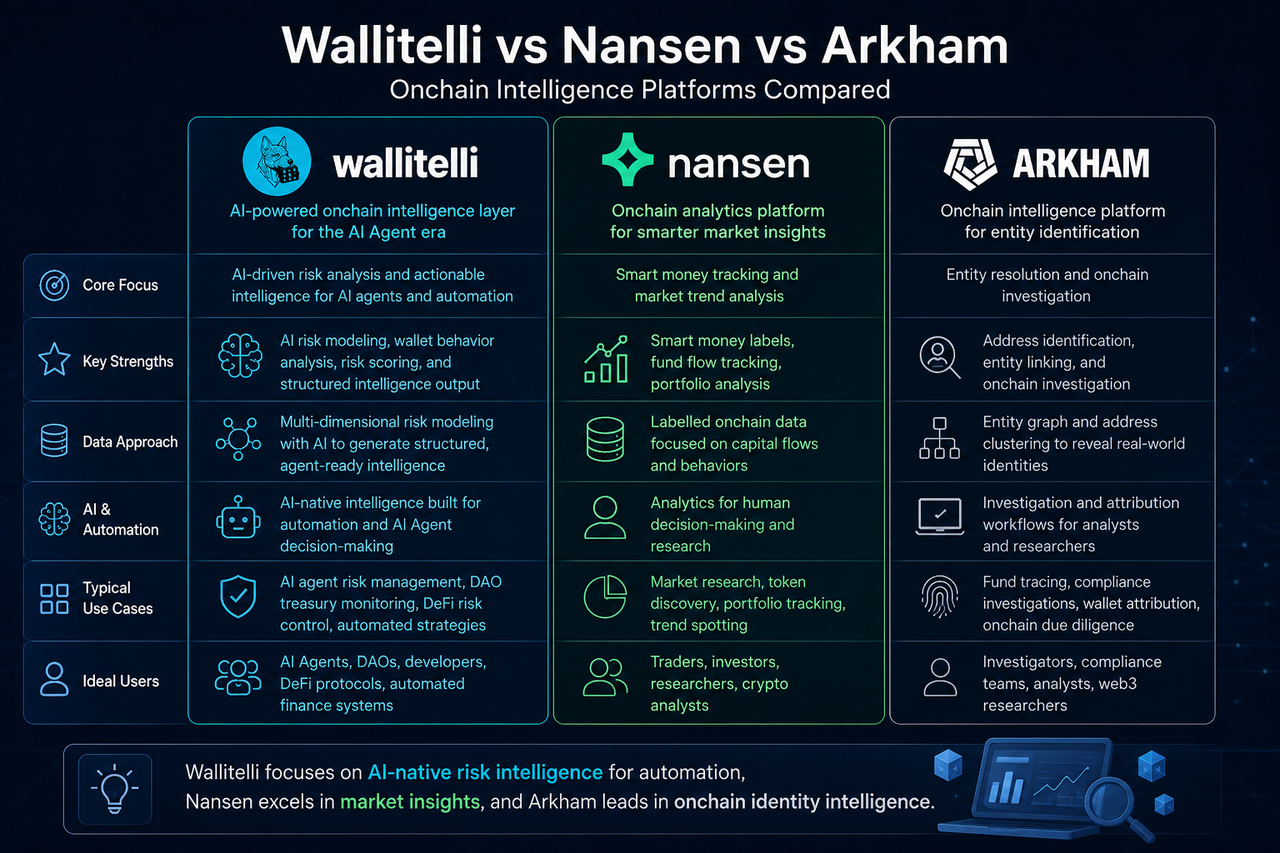
Nansen mainly addresses the question of “market fund flows,” Arkham focuses on “address identity recognition,” while Wallitelli places more emphasis on “AI risk understanding and automated decision support.”
Put simply, Nansen is more like an on-chain market data terminal, Arkham is more like an on-chain investigation and intelligence system, and Wallitelli is closer to an AI driven on-chain risk decision layer.
This difference also reflects the broader evolution of the on-chain analytics industry from “data display” toward “intelligent analysis.”
How Do Wallitelli, Nansen, and Arkham Differ in Their Data Analysis Methods?
The three platforms differ clearly in how they analyze data.
Nansen places greater emphasis on on-chain fund flows and market hotspots, so its analytical logic leans toward capital trends and Smart Money behavior.
Arkham focuses more on address ownership and entity relationships, using on-chain clustering analysis to build address identity networks.
Wallitelli, by contrast, focuses on risk modeling and behavioral understanding. The system does not only analyze fund flows. It also considers protocol exposure, asset concentration, liquidation risk, and abnormal behavioral patterns.
For that reason, Wallitelli is closer to an AI risk analysis system than a traditional data platform.
What Use Cases Are Wallitelli, Nansen, and Arkham Best Suited For?
Different platforms are suited to different scenarios.
Nansen is better suited for market research, fund flow analysis, and Smart Money observation.
Arkham is better suited for on-chain investigations, address ownership identification, and entity relationship analysis.
Wallitelli is better suited for AI Agent risk management, Autonomous Finance, DAO Treasury risk control, and automated strategy systems.
As the Agentic Economy develops, demand for automated risk understanding in on-chain financial systems may continue to grow.
Comparison Summary
| Platform |
Core Positioning |
Main Focus |
Best Suited For |
| Wallitelli |
AI on-chain intelligence layer |
Risk analysis and AI intelligence |
AI Agents, DAOs, automated finance |
| Nansen |
Smart Money data platform |
Fund flows and market trends |
Market research and trading analysis |
| Arkham |
on-chain entity intelligence platform |
Address identification and on-chain investigation |
Entity analysis and fund tracking |
Conclusion
Wallitelli, Nansen, and Arkham are all on-chain data and intelligence analytics platforms, but their core directions are not the same.
Nansen leans more toward fund flows and Smart Money analysis, Arkham emphasizes address identity and on-chain investigation, while Wallitelli focuses more on AI native Intelligence and automated risk analysis.
FAQs
What Is the Biggest Difference Between Wallitelli and Nansen?
Wallitelli places greater emphasis on AI risk analysis and automated decision support, while Nansen focuses more on Smart Money fund flows and market trend analysis.
How Is Arkham Different From Wallitelli?
Arkham focuses more on address identity recognition and on-chain entity relationships, while Wallitelli focuses more on AI risk modeling, behavior analysis, and structured intelligence output.
Who Is Nansen Mainly Suitable For?
Nansen is more suitable for traders, on-chain researchers, and market analysts who want to observe fund flows and Smart Money behavior.
What Is Arkham’s Core Function?
Arkham’s core functions include address identity resolution, on-chain entity relationship analysis, and fund flow investigation.