The rise of stablecoins has made digital dollars the backbone settlement asset of the blockchain economy. Yet, vast sums of capital remain parked in on-chain accounts, often serving only payment and transaction functions, without generating returns like cash management tools in traditional finance. As real-world asset (RWA) tokenization gains momentum, the market is actively seeking new on-chain assets that combine liquidity and yield.
USYC stands out as a flagship product in this evolving landscape. As a yield-bearing asset within the Circle ecosystem, USYC introduces traditional money market funds onto the blockchain. It provides institutional investors, DAOs, and DeFi protocols with richer capital management options. As on-chain financial infrastructure matures, USYC is becoming an important yield and collateral layer in the digital asset market.
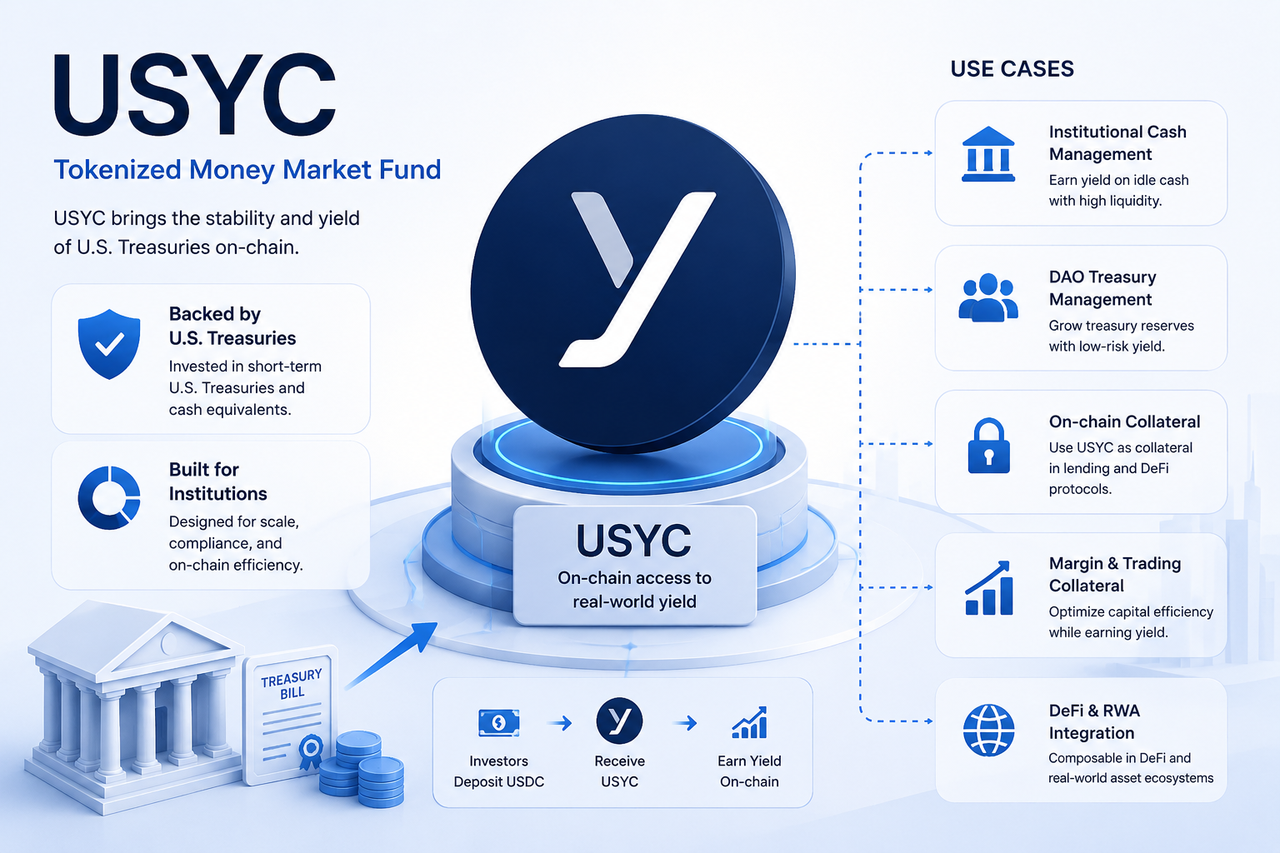
What Drives USYC's Value Proposition?
USYC's core value comes from the yield generated by its underlying assets.
Its portfolio consists primarily of short-term U.S. Treasuries, reverse repurchase agreements, and cash equivalents—all mainstays of institutional cash management in traditional finance.
Through tokenization, USYC bridges these yield-bearing assets from the traditional financial system to the blockchain, allowing capital to earn yield without sacrificing liquidity.
Compared to merely holding stablecoins, USYC offers a more efficient way to deploy on-chain capital.
How Do Institutions Use USYC for Treasury Management?
Institutional treasury management is one of the most important use cases for USYC.
Large corporations, funds, exchanges, and financial institutions routinely manage substantial cash reserves. In traditional markets, these funds are typically placed in money market funds or short-term Treasuries.
USYC brings a similar solution to digital assets, enabling institutions to convert idle on-chain funds into USYC and capture Treasury yields while maintaining liquidity.
This approach gradually aligns on-chain cash management with the treasury management system of traditional finance.
What Role Does USYC Play in DAO Treasuries?
DAO treasuries represent another critical application for USYC.
Many DAOs hold large stablecoin reserves for development, operations, and ecosystem incentives. However, simply holding stablecoins yields no returns.
By allocating a portion of their treasury to USYC, DAOs can improve capital efficiency without compromising asset safety or liquidity.
For decentralized organizations focused on long-term sustainability, this strategy helps reduce the opportunity cost of idle reserves.
How Is USYC Used as On-Chain Collateral?
On-chain collateral is one of USYC's most promising growth areas.
In traditional DeFi markets, users typically post ETH, BTC, or stablecoins as collateral. While liquid, these assets don't naturally generate yields.
USYC introduces the concept of yield-bearing collateral. When protocols accept USYC as collateral, they gain not only asset value backing but also indirect exposure to U.S. Treasury yields.
As RWA infrastructure evolves, an increasing number of lending protocols are exploring the inclusion of tokenized Treasury assets in their collateral frameworks.
USYC in Margin Management
Margin management is a key focus for institutional players.
In traditional finance, margin assets typically include cash, Treasuries, and money market funds. Yield-bearing assets improve capital efficiency compared to idle cash.
USYC plays a similar role in on-chain markets. Trading firms can hold USYC to meet margin requirements while earning returns, reducing the cost of capital that would otherwise sit idle.
This model is especially relevant for derivatives trading, OTC transactions, and institutional-grade capital management.
How Does USYC Enhance DeFi Capital Efficiency?
Capital efficiency is an important direction for the continuous optimization of the DeFi ecosystem.
In early DeFi, stablecoins were commonly deposited in liquidity pools, lending protocols, or collateral positions—but these assets themselves didn't generate base yield.
USYC brings the risk-free rate from traditional markets into the on-chain environment, enabling protocols to design innovative financial products around yield-bearing assets.
For example, lending platforms, structured products, and yield aggregators can integrate USYC into their underlying asset base, thereby improving overall capital utilization.
How Do USYC and USDC Differ in Use Cases?
USYC and USDC are often mentioned together, but they serve distinct roles.

USDC is optimized for payments, transfers, settlement, and liquidity management, with a core focus on price stability.
USYC is built for capital management and yield generation, with the primary goal of bringing U.S. Treasury yields into the on-chain financial system.
| Use Case |
USYC |
USDC |
| Payment Settlement |
Limited Use |
Core Use |
| Cross-Border Transfers |
Limited |
Widely Used |
| Capital Management |
Core Use |
Auxiliary Use |
| Collateral |
Growing |
Widely Adopted |
| Yield Generation |
Core Function |
No Active Yield |
| DAO Treasury |
Suitable for Long-Term Allocation |
Suitable for Operating Funds |
These two assets are not competitors—they represent different layers of the digital dollar ecosystem.
What Does USYC Mean for the RWA Market?
USYC illustrates how real-world asset tokenization is moving from concept to real-world application.
Early RWA projects focused mainly on putting assets on-chain. USYC goes further by deeply integrating traditional cash management tools with on-chain financial infrastructure.
This model allows traditional financial assets to participate in DeFi—enabling lending, collateralization, settlement, and liquidity management.
As more institutions enter the on-chain space, tokenized Treasury funds like USYC are likely to become one of the most important foundational assets in the RWA sector.
Conclusion
USYC's utility extends far beyond simple yield generation—it is becoming an essential building block of on-chain financial infrastructure. Institutional capital management, DAO treasury allocation, on-chain collateral, margin management, and DeFi capital efficiency are all key application areas.
By bridging traditional money markets with blockchain networks, USYC brings real-world assets like U.S. Treasuries into the digital ecosystem, giving the digital asset market its first yield-layer tool comparable to traditional cash management systems.
FAQs
What is USYC's primary use case?
USYC's primary use case is institutional capital management and cash reserve management. Its underlying assets are U.S. Treasuries and money market instruments, making it an ideal tool for deploying idle funds.
Can USYC be used as DeFi collateral?
Yes. Several on-chain protocols are exploring the inclusion of tokenized Treasury funds like USYC as collateral, allowing yield-bearing assets to participate in lending and margin management.
Why would a DAO hold USYC?
DAOs often hold large treasury reserves. USYC provides Treasury yields while maintaining liquidity, making it suitable as a long-term reserve asset.
Is USYC suitable for payments and transfers?
No. USYC is not designed for payment settlement. USDC is better suited for payments, transfers, and trading, while USYC is optimized for capital management.
How does USYC improve capital efficiency?
USYC brings Treasury yields from traditional financial markets into the on-chain environment, enabling idle funds to generate continuous returns and thus improve overall capital utilization.