As the RWA market rapidly expands, more institutions are now allocating both stablecoins and tokenized Treasury funds. Understanding the differences between USYC and USDC is key to grasping Circle's ecosystem strategy—where USYC and USDC are shaping a "payment layer + yield layer" dual structure—and to appreciating the future division of labor between payment assets and yield assets in on-chain finance.
What Is USYC?
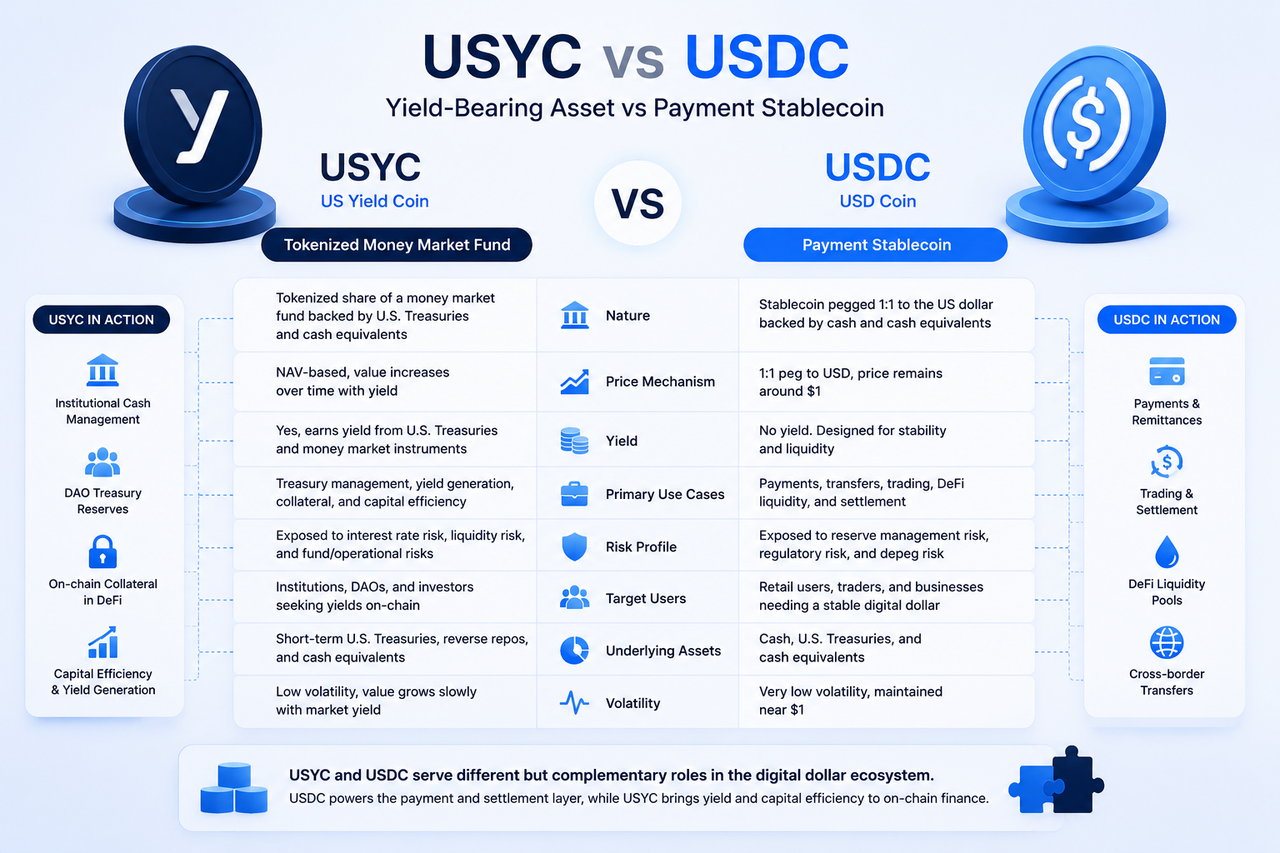
USYC is a tokenized money market fund whose underlying assets consist of short-term U.S. Treasury bonds, reverse repurchase agreements, and cash equivalents.
Its value derives from the real-world asset portfolio held by the fund. Investors hold fund shares, not U.S. dollars directly. As the underlying assets generate interest income, the fund's net asset value (NAV) gradually rises, reflecting returns.
From an asset standpoint, USYC is more akin to a traditional money market fund than a payment instrument.
What Is USDC?
USDC is a U.S. dollar stablecoin issued by Circle, designed to maintain a 1:1 peg to the dollar. Each USDC is backed by cash and cash-equivalent reserves, enabling it to function as a medium for payment, settlement, and value transfer on blockchain networks.
USDC's core value lies in price stability, not yield generation. Consequently, holding USDC does not automatically earn interest.
What Is the Core Difference Between USYC and USDC?
The fundamental difference lies in asset structure. USDC represents digitized U.S. dollars, while USYC represents digitized money market fund shares.
Holding USDC means holding a stable asset tethered to the U.S. dollar, whereas holding USYC means holding a yield-bearing financial product backed by U.S. Treasuries. This intrinsic difference drives all subsequent disparities in functionality and use cases.

How Do Yield Mechanisms Differ?
Yield generation is one of the most prominent differences between USYC and USDC.
USDC Yield Logic
USDC does not distribute yields to holders. Although the reserves backing USDC may earn interest, those returns are not passed on to USDC holders. USDC's value remains anchored near $1, with price stability as its core objective.
USYC Yield Logic
USYC generates yields from its underlying U.S. Treasuries and money market instruments.
As these assets earn interest, the fund's NAV increases over time, and the value of USYC held by investors rises accordingly. Thus, USYC is better suited as a tool for capital management and yield generation.
How Do Price Mechanisms Differ?
Price formation determines the market behavior of each asset.
USDC uses a fixed peg model. Under normal conditions, 1 USDC corresponds to approximately $1, with minimal price fluctuation. This feature makes USDC suitable as a medium of exchange and unit of account.
USYC employs a net asset value (NAV) model. As the fund's assets yield returns, the NAV per USYC gradually increases.
Therefore, USYC's price does not stay fixed near $1; it adjusts in line with changes in asset value.
How Do Use Cases Differ?
USYC and USDC serve distinct needs.
USDC is widely used for on-chain payments, trade settlements, cross-border transfers, DeFi liquidity pools, and digital dollar storage. Its strengths are liquidity and stability.
USYC's primary applications include institutional treasury management, DAO treasury allocation, on-chain yield management, collateral systems, and margin management. Its advantages lie in capital efficiency and yield generation.
How Do Risk Structures Differ?
The risk profiles of USYC and USDC differ in nature.
USDC's main risks involve reserve management, issuer operations, and liquidity pressure under extreme market conditions. In addition to operational and custodial risks, USYC is also exposed to interest rate fluctuations, fund portfolio performance, and redemption mechanisms.
Thus, the difference is not simply one of high versus low risk, but different types of risk.
Why Does Circle Issue Both USYC and USDC?
USYC and USDC together form a critical part of Circle's digital dollar strategy.
USDC addresses the on-chain circulation of U.S. dollars, enabling digital dollars to be used for payments and settlements. USYC addresses on-chain capital yield, allowing digital assets to earn returns similar to traditional money market funds.
This structure closely mirrors the "cash account + money market fund" model in traditional finance.
As on-chain financial infrastructure matures, the two are becoming complementary rather than competitive.
USYC vs USDC Comparison Table
| Dimension |
USYC |
USDC |
| Asset Nature |
Money market fund shares |
U.S. dollar stablecoin |
| Underlying Assets |
U.S. Treasuries and money market instruments |
Cash and cash equivalents |
| Price Mechanism |
NAV growth |
1:1 USD peg |
| Yield Generation |
Yes |
No |
| Core Use Case |
Capital management |
Payment and settlement |
| Target Users |
Institutions and treasury managers |
General users and institutions |
| Liquidity Positioning |
Yield asset |
Digital cash |
| RWA Attribute |
Yes |
Partially has reserve asset attributes |
Summary
Although USYC and USDC both belong to the Circle ecosystem, they represent two fundamentally different financial assets. USDC is the circulation layer of digital dollars, primarily serving payment, settlement, and value transfer. USYC is the yield layer of digital dollars, bringing U.S. Treasury returns onto the blockchain through a tokenized money market fund structure.
As the RWA market evolves, the two are forming a complementary relationship. USDC provides liquidity and stability; USYC provides yield generation and capital management. Together, they form a key component of on-chain financial infrastructure.
FAQs
Which one is a stablecoin: USYC or USDC?
USDC is a stablecoin designed to maintain a 1:1 peg to the U.S. dollar. USYC is a tokenized money market fund share and is not classified as a stablecoin.
Why can USYC generate yields?
USYC's underlying assets are primarily invested in U.S. Treasuries and money market instruments. The interest income from these assets is reflected in the fund's NAV growth.
Does USDC automatically generate yields?
USDC does not automatically distribute yields to holders. The primary purpose of holding USDC is to maintain a stable digital dollar value, not to earn interest.
Does USYC's price stay at $1?
USYC is not designed to stay at $1. Its price adjusts based on the fund's NAV, making it different from the fixed peg of USDC.
Why might institutions hold both USYC and USDC?
USDC is suitable for payments, settlements, and daily operational funds, while USYC is suitable for idle capital allocation and yield management. Together, they meet different capital needs.
What is the relationship between USYC and traditional money market funds?
USYC is essentially a tokenized version of a money market fund. Its underlying asset structure is similar to that of traditional money market funds, but issuance, transfer, and settlement all occur via blockchain.