The core focus of Factom is to use a Bitcoin anchoring mechanism for enterprise-grade data attestation. During its operation, Factom accumulated extensive experience in data verification, on-chain structures, and network coordination. However, Factom’s architecture was not well suited to complex identity systems or large scale account management.
Accumulate builds on Factom’s data model by introducing on-chain identity, account hierarchy, and multi-chain verification structures. ADI, BVN, DN, and the Chain-of-Chains architecture all directly shape the technical differences between Accumulate and Factom.
Overall, Factom is more of an enterprise-grade data integrity protocol, while Accumulate is closer to an identity-focused Layer 1 network.
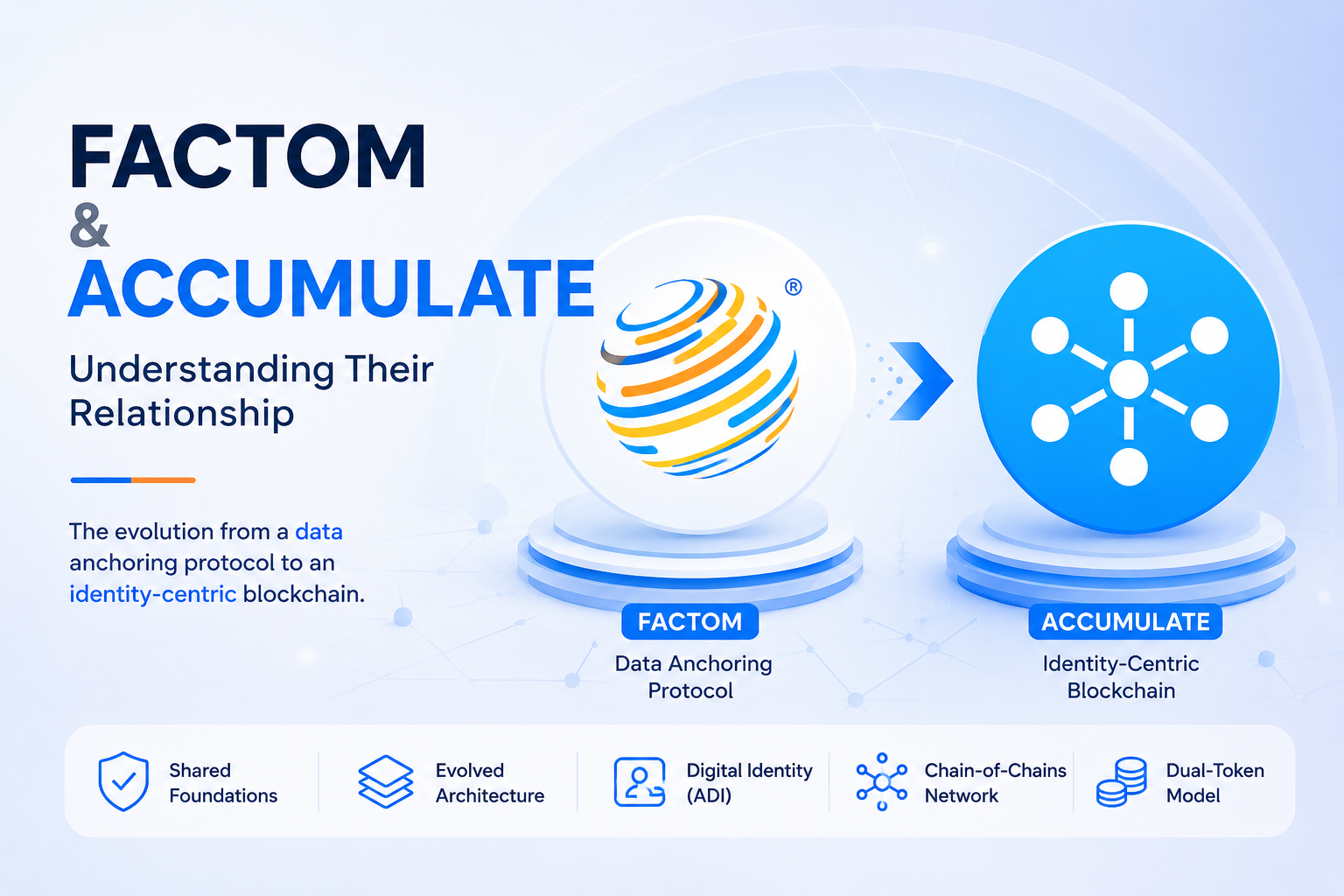
What Are Factom and Accumulate
Factom’s network positioning is closer to an enterprise-grade data attestation protocol. It verifies data authenticity through hash structures and a Bitcoin anchoring mechanism, so its main focus is data integrity and tamper resistant records.
Factom does not write complete data directly to the Bitcoin blockchain. Instead, it generates data hashes and anchors the final verification results to the Bitcoin network. This structure allows Factom to use Bitcoin’s security while reducing data storage costs.
Accumulate’s network positioning is closer to an identity-focused blockchain protocol. Accumulate is built around digital identity, account structures, and interchain collaboration, so its focus is no longer limited to data attestation.
Factom’s operating logic mainly revolves around data records. First, users submit data. Then, the Factom network generates a hash. Next, Factom anchors the result to Bitcoin. Finally, enterprises can verify the authenticity of the data.
Accumulate’s operating logic is more complex. First, users create an ADI identity. Then, the Accumulate network synchronizes account chain states. Next, different validation networks process the data. Finally, the system completes identity and account coordination.
This difference means Factom is closer to a data verification protocol, while Accumulate is closer to identity-focused blockchain infrastructure.
Why Did Accumulate Develop from Factom
The emergence of Accumulate is directly related to the structural limitations that became clear during Factom’s long operation. Although Factom is well suited to data attestation, it lacks a complex account system and a native identity structure.
Factom’s enterprise data model mainly operates around Entry Chains and data hashes, making it better suited to file verification and record auditing. As demand for on-chain identity grew, Factom’s structure became increasingly difficult to adapt to more complex account systems.
Accumulate developed from Factom in order to expand the boundaries of Factom’s capabilities. First, Factom provided the data structure foundation. Then, Accumulate introduced an identity system. Next, Accumulate built a multi-chain account model. Finally, Accumulate became able to support more complex on-chain collaboration logic.
This evolution means Accumulate is not a completely separate new protocol. It is more like a next generation identity network built on Factom’s technical experience.
Official materials show that some of Accumulate’s core design ideas are directly connected to Factom, including dual token logic, chain based data structures, and on-chain verification models.
Which Core Factom Technologies Did Accumulate Inherit
Accumulate inherited several underlying design ideas from Factom, including layered chain structures, data organization models, and a dual token mechanism.
Factom’s core focus is organizing large volumes of data through different chain structures. Factom does not write all data directly into a single block. Instead, it manages data states through Entry Chains and Directory Blocks.
Accumulate continues this layered design logic. First, Accumulate establishes different identity chains. Then, each account chain maintains its own state. Next, the system synchronizes data across chains. Finally, the network completes unified verification.
The main areas inherited by Accumulate include:
-
Layered chain structure
-
Dual token logic
-
Data verification model
-
Hash organization method
-
on-chain audit mechanism
These structures show that Accumulate did not completely replace Factom’s model, but expanded on top of it.
Accumulate also retains Factom’s emphasis on enterprise-grade structures, so Accumulate’s architecture likewise values verifiability and stability.
How Factom’s Data Architecture Influenced Accumulate
Factom’s data architecture focuses on improving the efficiency of on-chain records. Factom organizes large volumes of data through Entry Chains, Directory Blocks, and hash structures, making its network more suitable for enterprise record systems.
Accumulate adds identity and account structures on top of this foundation. Accumulate no longer focuses only on data records. Instead, it continuously maintains identity chains, Token chains, and account states.
Official materials show that Accumulate uses Chain-of-Chains architecture. This means different accounts and identities each have independent chain structures, allowing the network to process many account states at the same time.
The table below shows the architectural differences between Factom and Accumulate:
| Architecture Direction |
Factom |
Accumulate |
| Core focus |
Data attestation |
Identity network |
| Chain structure |
Entry Chain |
Chain-of-Chains |
| Security logic |
Bitcoin anchoring |
Multi-chain verification |
| Account system |
Relatively weak |
Native support |
This difference means Factom is more focused on data integrity, while Accumulate places greater emphasis on on-chain identity collaboration.
Factom’s layered chain design provided an important foundation for Accumulate’s Chain-of-Chains architecture. Accumulate further expands interchain relationships to improve network scalability.
How Accumulate’s ADI Differs from Factom’s Data Structure
ADI, or Accumulate Digital Identifier, is one of Accumulate’s most important identity structures and one of the biggest differences between Accumulate and Factom.
Factom’s network focuses on data records and hash verification, so it lacks a native identity system. Users typically manage record states only through data chain structures.
Accumulate introduces the ADI structure to manage accounts, keys, and on-chain identities in a unified way. ADI is essentially an on-chain digital identity system, allowing users to manage multiple account chains through a readable identity.
Accumulate’s ADI process mainly revolves around identity management. First, users create an ADI. Then, the system establishes the corresponding identity chain. Next, different account chains are linked to the ADI. Finally, users can manage their digital identity in a unified way.
This mechanism means Accumulate is no longer just a data protocol. It begins to support enterprise-grade identity collaboration.
Unlike traditional wallet addresses, ADI places more emphasis on:
These capabilities did not exist in Factom’s original architecture.
How BVN and DN Extend Factom’s Verification Model
BVN, or Block Validator Network, and DN, or Directory Network, are Accumulate’s core validation structures and an important extension of Factom’s verification model.
Although Factom’s federated server architecture can process data verification, Factom lacks a complex multi-layer validation network, which limits its scalability.
Accumulate introduces a multi-layer validation system. BVN is responsible for local chain validation, while DN handles network-wide coordination and unified confirmation.
Accumulate’s validation process mainly operates through a multi-layer network. First, BVN processes local transactions. Then, the system synchronizes the validation results. Next, DN coordinates the global state. Finally, the network completes unified confirmation.
This structure means Accumulate can process many identity chains and account chains at the same time, giving it clearly stronger scalability than Factom.
Compared with Factom’s single layer validation structure, Accumulate is closer to a modular identity network.
Factom’s dual token model consists of FCT and Entry Credits. Factom uses FCT to coordinate network value, then uses Entry Credits to pay data writing fees.
Accumulate uses a similar logic. In the Accumulate network, the ACME token supports value coordination, while Credits are used to pay for on-chain operations.
The focus of Factom’s dual token model is to reduce volatility in enterprise data costs. Entry Credits cannot be freely traded, allowing enterprises to calculate data costs more predictably.
Accumulate continues this approach. First, users hold ACME. Then, the system converts ACME into Credits. Next, Credits are used to pay for on-chain operations. Finally, the network synchronizes account states.
This mechanism shows that Accumulate’s economic model was clearly influenced by Factom. Both use a dual layer structure to reduce volatility in on-chain usage costs.
What Upgrades Did Accumulate Make Compared with Factom
Accumulate’s upgrades focus on identity systems, account structures, and interchain collaboration. Factom is more of a data protocol, while Accumulate places greater emphasis on identity and account networks.
Accumulate introduces the ADI structure, allowing users to manage on-chain accounts through readable identities instead of relying on complex wallet addresses.
Accumulate’s network also adds multi-chain collaboration capabilities. First, users establish an ADI. Then, different account chains synchronize their states. Next, the BVN network processes validation. Finally, the DN network completes unified coordination.
Official materials show that Accumulate also supports:
This mechanism means Accumulate can support more complex on-chain applications. Factom is better suited to enterprise records, while Accumulate is better suited to identity collaboration and account management.
How Do Factom and Accumulate Differ in Application Positioning
Factom’s application positioning mainly centers on enterprise data verification, file auditing, and tamper resistant records. Healthcare, finance, and government data verification are typical use cases for Factom.
Accumulate’s application positioning is more focused on on-chain identity and multi-chain account collaboration. Accumulate is built around digital identity, institutional accounts, and cross-chain management.
Factom’s data model is better suited to attestation systems. First, enterprises submit data. Then, Factom generates a hash. Next, Bitcoin provides the final audit layer. Finally, enterprises can verify record authenticity.
Accumulate’s structure is better suited to identity-focused applications. First, users establish an ADI. Then, the system maintains account chains. Next, different networks synchronize states. Finally, users can coordinate identity and assets.
This difference means Factom is more like an enterprise data layer, while Accumulate is more like an identity-focused Layer 1 network.
Conclusion
Factom and Accumulate share a direct technical lineage. Factom’s data structure, dual token model, and chain based organization logic provided an important architectural foundation for Accumulate.
Factom is more of an enterprise-grade data attestation protocol, while Accumulate places greater emphasis on digital identity, account structures, and multi-chain collaboration. ADI, BVN, DN, and the Chain-of-Chains architecture further extend Factom’s original design ideas.
Overall, Factom focuses on data integrity, while Accumulate focuses on identity collaboration and account management. Although the two share some underlying concepts, their application positioning has become clearly different.
FAQ
What Is the Relationship Between Factom and Accumulate?
Accumulate and Factom share a direct technical lineage. Part of Accumulate’s architecture and economic model design comes from Factom’s long operating experience.
Why Did Accumulate Evolve from Factom?
Factom is better suited to data attestation, but it lacks complex identity and account structures. Accumulate expands on-chain identity and multi-chain collaboration capabilities.
What Is ADI?
ADI, or Accumulate Digital Identifier, is Accumulate’s on-chain digital identity system. It is used to manage accounts, keys, and permission structures in a unified way.
What Do BVN and DN Do?
BVN is responsible for local validation, while DN handles network-wide coordination. Together, they form Accumulate’s multi-layer validation system.
What Is the Main Difference Between Factom and Accumulate?
Factom is more of an enterprise-grade data attestation protocol, while Accumulate is more of an identity-focused Layer 1 blockchain network.