Pons fits paths that need an instant locked DEX pool with graduation that does not swap pools; typical bonding-curve launchpads fit a staged lifecycle of curve pricing first, then liquidity migration to a DEX. Both are launch interfaces, but pricing origin and what Graduation means are not interchangeable.
That split maps directly to the Pons (PONS) design of instant pool, no curve, and no migration. Pump.fun-style curve-then-migrate models are often cited as a neutral reference for the bonding-curve path; platform rules vary, and horizontal comparison clarifies path differences without ranking which approach is better.
| Dimension |
Pons (instant pool) |
Typical bonding-curve launchpad |
| Launch form |
Single tx deploys token + Uniswap V3 / WETH pool |
Curve trading first |
| Pricing source |
Locked-pool trades |
Curve formula, then DEX pool after graduation |
| Supply |
Fixed 1e9 |
Often minted/released along the curve (varies) |
| Graduation |
WETH threshold; same-pool trading continues |
Often tied to liquidity migration |
| Migration |
None |
Common at graduation |
The table is the extractable contrast: both look like “launch + trade,” but when liquidity enters the DEX and whether graduation swaps pools change what users must verify on-chain. Compare pricing origin, migration, and graduation meaning—not which path is “better.”
The Pons Path
Pons on Robinhood Chain follows an instant-pool path: creation deploys a fixed-supply token (1 billion) and WETH trading pool in one transaction, built on Uniswap V3 with a 1% pool fee and 0.0005 ETH launch fee; liquidity locks automatically. Buys and sells run in that locked pool from the start; price moves with pool trades, not a separate bonding-curve formula.
The path is Create → Trade → Graduate, but all three stages share one pool: Create deploys the token and pool; Trade executes in that pool; Graduate applies a status label when paired WETH hits the default 4.2 ETH threshold—trading remains in the original pool. Create → Trade → Graduate walks through what happens at each step on-chain and in the interface. Pons does not custody funds; each action requires wallet approval.
Launch protection runs for the first two blocks after creation: only the creator may buy in the launch block; during the window, each wallet may hold at most 5% of supply and buy up to 5.5%; sells and transfers are unrestricted. After the window, buy and hold caps lift. Protection narrows early concentration windows but does not remove information asymmetry or impersonation risk.
The Bonding-Curve Launch Path
Bonding-curve launchpads describe a common launch pattern: tokens trade on a bonding curve first, with price moving under curve rules as volume accumulates; when progress hits graduation conditions, liquidity migrates to a DEX pool and trading shifts to the new pool. Pump.fun-style curve-then-migrate flows are frequently used to illustrate this structure; graduation thresholds, quote assets, and target DEXes differ by platform.
The defining trait is that early liquidity and pricing come from the curve contract, not a full DEX pool at launch. Graduation is often tied to migration; users must verify contract addresses, pool parameters, and slippage rules before and after migration. Curve phase and pool phase are two lifecycle segments—not a status-label change within one pool.
Supply mechanics vary: some platforms mint along the curve; others release tokens by progress. Quote assets may be native chain tokens, wrapped assets, or stablecoins depending on the platform. Target DEX after migration may be Uniswap, Raydium, or a proprietary AMM. None of those details transfer automatically from one curve launchpad to another; each platform's public rules must be read separately.
Liquidity and Pricing at Launch
Liquidity and pricing origin are the most direct way to separate the two paths. On Pons, liquidity enters a locked Uniswap V3 pool in the creation transaction; the quote asset is WETH; price comes from live pool quotes, and market cap is typically estimated as price times circulating supply. Slippage and price impact depend on pool depth and trade size.
On bonding-curve launchpads, opening-phase pricing follows curve parameters; after graduation, assets inside the curve are often migrated into a DEX pool and the pricing benchmark switches from the curve formula to AMM pool price. At migration, pool depth, price anchor, and tradable addresses can change. Verification shifts from "curve progress" to "new pool contract and LP structure."
Pons price discovery starts in a locked AMM from block one; curve paths start in a formula-driven contract and may only reach a stable AMM structure after migration. Comparing the two without naming which pricing stage is active leads to misreading progress bars, pool addresses, or implied market cap.
Graduation and Migration: Side-by-Side
Graduation means different things on each path and should not be used interchangeably. On Pons, Graduation means paired WETH in the locked pool reaches a threshold (default 4.2 ETH): the token is marked graduated, but trading continues in the same Uniswap V3 pool—no migration, no new pool. Graduation confirms threshold progress only; it is not a quality or safety signal. Non-graduated tokens trade in the same pool.
On typical bonding-curve launchpads, graduation is often bound to migration: when conditions are met, liquidity moves from the curve to a DEX and subsequent trades occur in the new pool. Users must confirm migration success, that the target pool address matches the interface, and whether fee and slippage rules change. Pons has no migration event; graduation status can be read on-chain while trades always target the original pool.
| Comparison dimension |
Pons |
Typical bonding curve → migrate path |
| Bonding curve |
None |
Yes (launch phase) |
| Graduation meaning |
WETH threshold confirmation |
Often triggers or accompanies liquidity migration |
| Post-graduation venue |
Same Uniswap V3 pool |
Usually a new DEX pool |
| Migration |
Does not occur |
Usually occurs |
| When pool structure is fixed |
At creation, locked |
Often finalized after graduation migration |
The table's single takeaway: Pons treats graduation as a threshold label; curve launch paths often treat graduation as a lifecycle switch. That distinction determines how to read progress indicators and status copy in the interface.
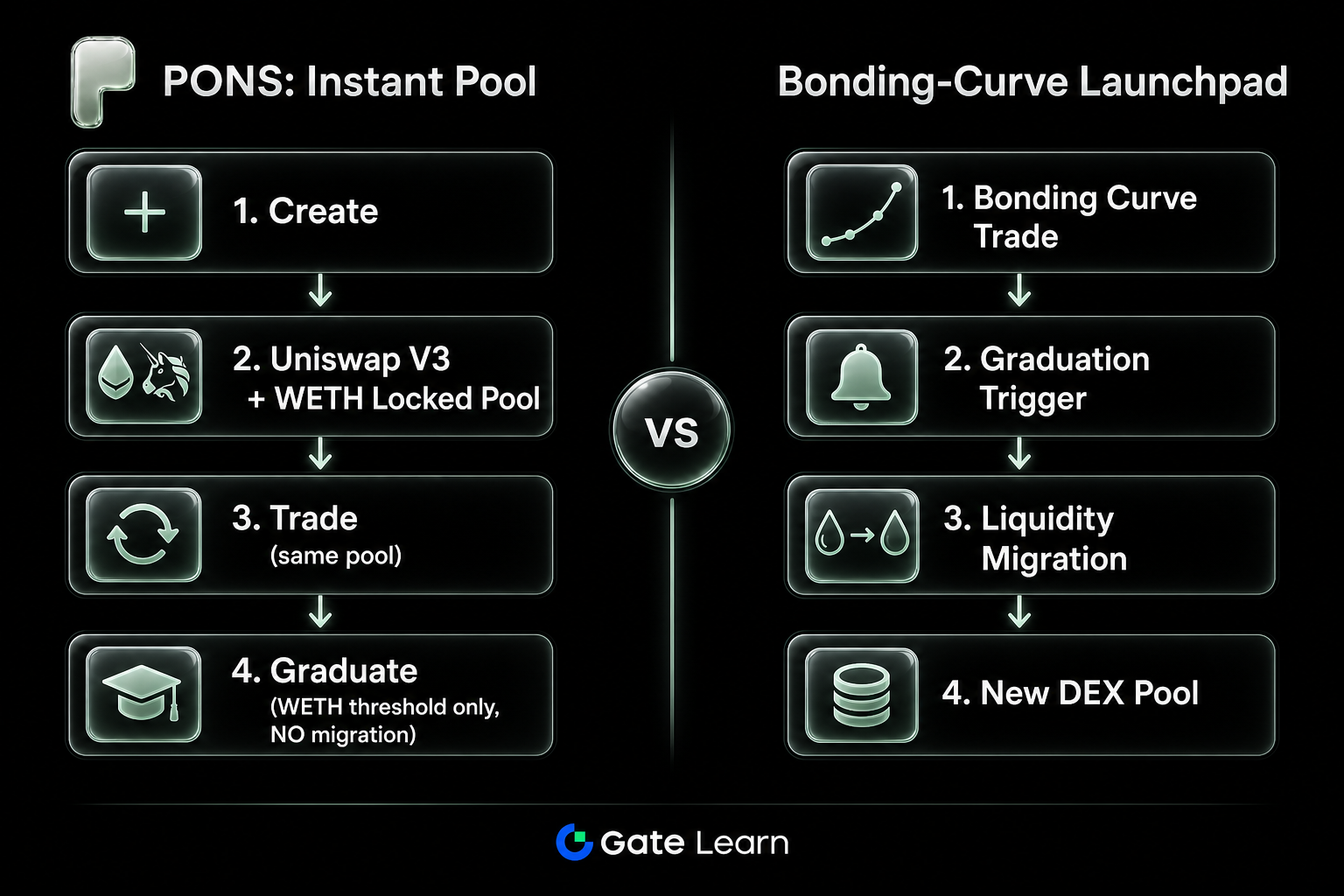 Figure 1. Pons instant Uniswap V3 / WETH pool versus a typical bonding-curve path: curve trading first, then migration.
Fees, Locks, and Launch Protection
Fee and protection mechanics should not be compared with one shared set of numbers across paths. On Pons: the pool fee is 1%, split at launch snapshot between creator and protocol (Active factory commonly 70%/30%; legacy 90%/10%); protocol share may buy back PONS and send to a burn address—burn does not guarantee price performance. Fee split and buyback burn breaks down snapshot splits and burn routing. Liquidity locks at creation; Launch protection covers the first two blocks with creator-only buying in the launch block and per-wallet hold ≤5% / buy ≤5.5% caps; sells and transfers stay open.
Bonding-curve launchpads usually split fees into a curve-phase fee and a post-migration DEX pool fee; ratios vary by platform, and some charge a migration fee at graduation. Locks may apply to curve-held assets, post-migration LP, or both. Anti-snipe and hold-cap language resembles Pons's two-block protection, but thresholds are not universal—each platform's published rules apply.
| Mechanism |
Pons |
Typical bonding-curve launchpad |
| Primary trade fee |
Uniswap V3 pool fee 1% (launch snapshot split) |
Curve fee + post-migration DEX pool fee (varies) |
| Liquidity lock |
Auto-locked at creation; same pool throughout |
Curve phase and post-migration LP rules may differ |
| Early protection |
First 2 blocks; hold ≤5%, buy ≤5.5% |
Common anti-snipe / hold caps; parameters vary |
| Native token tie-in |
Protocol fees may buy back and burn PONS |
Varies; not always tied to native-token buyback |
Mechanism comparison highlights different verification targets: Pons users focus on factory address, pool address, locker, and fee snapshot; curve-launch users also verify curve progress, graduation conditions, and migration target pool.
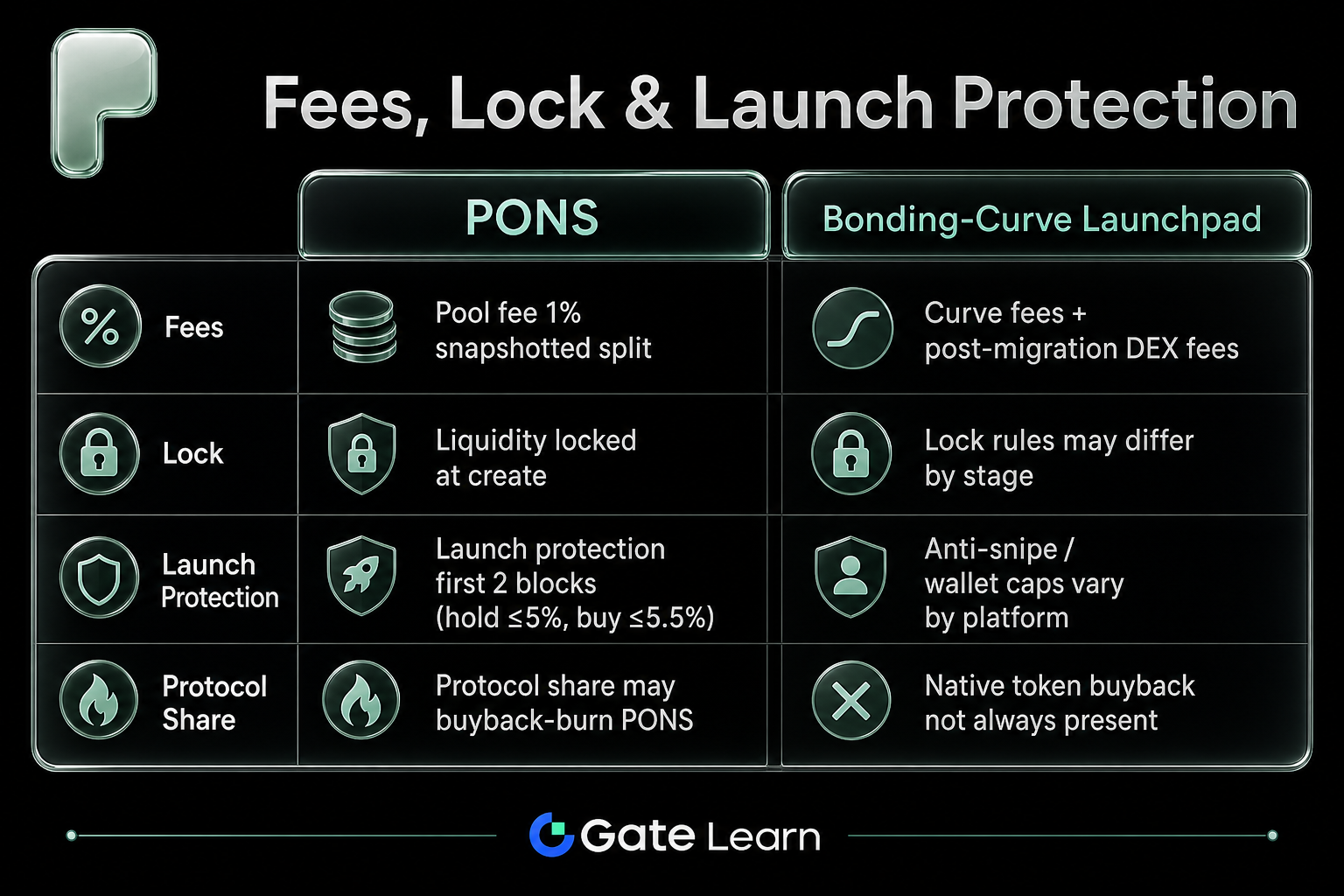 Figure 2. Fee split, liquidity lock, and early launch protection across instant-pool and curve-then-migrate paths.
Limitations of This Comparison
Horizontal comparison has structural limits. Bonding-curve launchpad is a path category, not one product: supply minting, graduation thresholds, target DEX, and quote assets differ widely—a single platform's rules cannot be extrapolated to every curve launchpad. Pons is bound to Robinhood Chain and WETH quote depth; curve launchpads on other chains sit on a different comparison plane.
Conclusions that should not be exported include: instant pool is inherently safer, curve migration always means better liquidity, Graduation signals project quality, no migration equals no risk, or either path is better for investment. Both paths carry smart-contract risk, information asymmetry on new tokens, impersonation and phishing interfaces, and slippage when liquidity is thin. Graduation and buyback burn do not replace address verification and do not constitute return or price promises.
When choosing what to verify: for instant locked pool with graduation that does not change pools, check Pons factory, pool address, and 4.2 ETH threshold meaning; for curve progress → post-migration DEX trading, verify curve rules, graduation conditions, and target pool address. Both paths require independent contract and liquidity checks; neither substitutes for the other.
Summary
Pons and typical bonding-curve launchpads differ not in whether tokens can launch, but in when liquidity enters a DEX, where pricing comes from, and whether Graduation changes pools. Pons uses an instant Uniswap V3 + WETH pool with no bonding curve and no migration; Graduation is WETH threshold confirmation only. Curve launch paths commonly run curve trading → graduation migration → new-pool trading. Compare published parameters separately and avoid reading status labels as safety rankings or buy signals.
FAQ
Does Pons use a bonding curve?
No. Pons deploys a fixed-supply token and WETH Uniswap V3 pool in one creation transaction; buys and sells run in that locked pool from the start. There is no bonding-curve phase and no post-graduation liquidity migration.
How is Pons different from pump.fun-style launchpads?
Path structure is the core difference: pump.fun-style platforms typically trade on a bonding curve first, then migrate liquidity to a DEX when conditions are met. Pons deploys a Uniswap V3 / WETH pool at creation with no curve and no migration; Graduation only marks whether paired WETH reached a threshold. Both are launch interfaces, but pricing origin and graduation meaning differ.
What does Graduation mean on Pons?
On Pons, Graduation means paired WETH in the locked pool reached a threshold (default 4.2 ETH) and the token status is marked graduated. The label confirms threshold progress only; it is not a quality or safety endorsement. Non-graduated tokens trade in the same pool.
Does liquidity migrate after graduation on Pons?
No. After graduation, trading continues in the same Uniswap V3 pool. Pons does not trigger liquidity migration or switch to a new pool. Typical bonding-curve launchpads often migrate at graduation; those paths require separate verification of target pool address and parameters.
What risks apply on either launch path?
Both instant-pool and curve-then-migrate paths share risks: smart-contract and factory risk, information asymmetry on new tokens, impersonation assets and phishing interfaces, and slippage when liquidity is thin. Graduation and buyback burn do not replace independent address verification and do not promise returns or price outcomes.