On Pons (PONS), a token launch follows Create → Trade → Graduate: Create deploys a fixed-supply token with a locked WETH pool, Trade executes buys and sells in that same pool, and Graduate only marks whether paired WETH reached the default threshold. With Robinhood Chain and a wallet signer ready, metadata and fees prepared, the main flow can usually be completed in one session.

The point is not any single launch outcome but the on-chain order of operations: how the factory writes the token and pool in one transaction, how the protection window constrains buys, and how the graduation label changes when paired WETH hits the threshold. There is no bonding curve and no pool migration; Launch protection applies only in the first 2 blocks.
Breaking Create, Trade, and Graduate into checkable steps makes it easier to match wallet previews, pool addresses, and graduation progress on Robinhood Chain instead of treating UI progress bars as quality signals. The main path is: (1) prepare Robinhood Chain (4663), WETH/ETH, metadata, and a fee wallet, and reserve 0.0005 ETH launch fee plus gas; (2) Create deploys a fixed-supply 1e9 token and WETH Uniswap V3 pool (1% fee) with automatic liquidity lock in one transaction; (3) Trade buys and sells against WETH in that same pool; (4) Launch protection for the first 2 blocks limits buys (creator-only initial buy in the launch block; hold ≤5%, buy ≤5.5%); (5) Graduate marks the default 4.2 ETH WETH threshold with no new pool and no migration. There is no bonding curve end-to-end.
What Do You Need Before Launching on Pons?
Before Create, confirm network, assets, and metadata. The network must be Robinhood Chain (Chain ID 4663) with a wallet that can sign transactions. The quote asset is WETH; the underlying DEX is Uniswap V3. Creators also need token name, symbol, image, description, external links, and a fee wallet to receive creator fees. Pons sits among Meme and token-launch entry points on that chain and can be read alongside trading, lending, and infrastructure apps in the Robinhood Chain ecosystem.
The launch fee is 0.0005 ETH; keep enough native ETH for that fee and gas. Names and symbols can be spoofed—verify identity by token contract address, not UI labels alone.
| Preparation item |
Requirement |
Notes |
| Network |
Robinhood Chain (4663) |
Launch and trading both occur on this chain |
| Quote asset |
WETH |
Each token pairs with WETH in its own pool |
| Underlying DEX |
Uniswap V3 |
Pool fee tier 10000 (1%) |
| Launch fee |
0.0005 ETH |
Gas is additional |
| Metadata |
Name, symbol, image, description, links, fee wallet |
Set at creation; affects display and fee routing |
The table summarizes the pre-Create checklist. Missing network or WETH/ETH balance blocks the transaction preview; bad metadata does not stop deployment but can break display and creator fee collection.
How Does Create Deploy the Token and WETH Pool?
Create completes two actions in one transaction: mint a fixed supply of 1,000,000,000 (1e9) tokens and deploy a Uniswap V3 pool paired with WETH. The pool fee is 1% (fee tier 10000); liquidity locks at creation. Trading can begin as soon as the pool is live—there is no bonding-curve phase and no later liquidity migration.
The creator can include an initial buy in the same transaction; in the launch block, only the creator’s initial buy can execute from the pool. The factory records deployer, paired asset, pool address, restriction end block, and related state for Trade and Graduation queries. The active factory has used current rules since block 8991118; an earlier legacy factory still serves historical launches, but the path remains “instant pool at open.”
That path differs from typical bonding curve launchpads—see Pons vs bonding curve launchpads for open-pool shape, graduation without pool change, and related dimensions. After Create, price discovery runs in the locked Uniswap V3 pool; liquidity structure is fixed at launch.
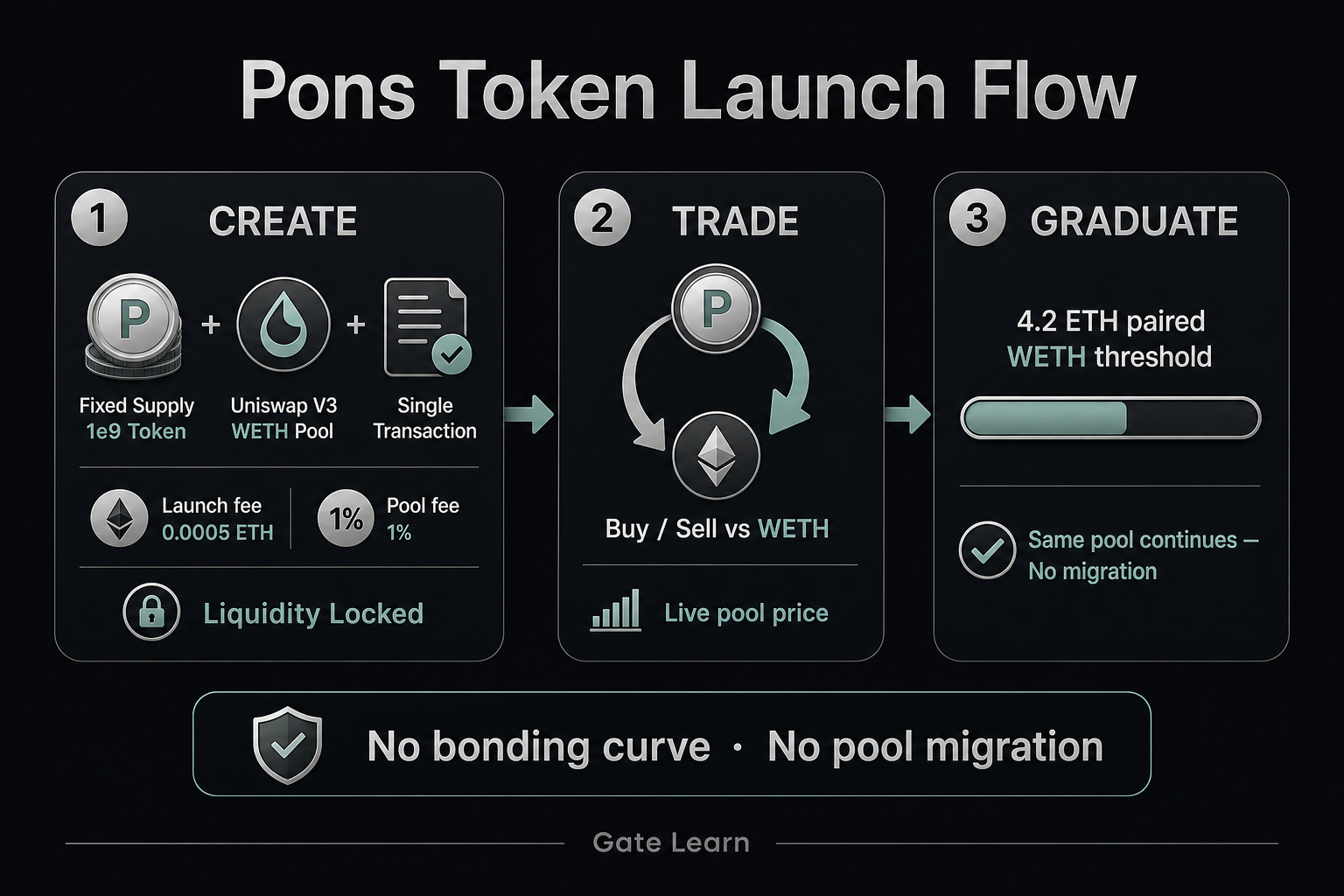 Figure 1. Pons launch in three stages: Create deploys token and WETH pool in one tx, Trade uses the same pool, Graduate keeps trading there with no migration.
How Does Trade Pricing Work on Pons?
During Trade, buys and sells execute against WETH in the same locked pool. UI price reflects live pool state and moves with each swap. Filled amounts may differ slightly from quotes; slippage sets the maximum execution deviation you accept.
Common UI fields include: Price (per-token pool price), Market cap (price × circulating supply), FDV (price × total supply; with fixed supply this usually aligns with market-cap framing unless tokens were burned), Price impact (pool price shift from this trade size), Slippage (max acceptable execution deviation), and Liquidity (assets available near the current price). When token and WETH both use 18 decimals, pricing does not need extra decimal scaling.
Pool fees accrue on swaps and split per the snapshot at launch—active factory deployments commonly use 70% creator / 30% protocol. Protocol share can feed buyback and burn paths; see Fee split, buyback, and burn. Trade does not change the pool contract address and does not trigger migration.
| UI field |
Meaning |
| Price |
Current per-token price in the pool |
| Market cap |
Price × circulating supply |
| FDV |
Price × total supply |
| Price impact |
Pool price move caused by this trade |
| Slippage |
Maximum execution deviation you accept |
| Liquidity |
Available liquidity near the current price |
The table maps common quote fields. Confirm fills via wallet transaction preview and on-chain Swap events; UI valuations are estimates, not execution guarantees.
How Does Launch Protection Work in the First Two Blocks?
Launch protection runs for the first 2 blocks after launch and applies only to buys from the pool. In the launch block (protection window start), only the creator’s initial buy can execute; other buys are rejected. For the rest of the window, each wallet may hold at most 5% of supply and buy at most 5.5% of supply.
Sells and wallet-to-wallet transfers are not restricted by Launch protection. After the window ends, buy and hold caps lift and rules revert to standard Uniswap V3 pool behavior. Protection shortens early concentrated-buy windows but does not remove information asymmetry, spoofed assets, or thin liquidity.
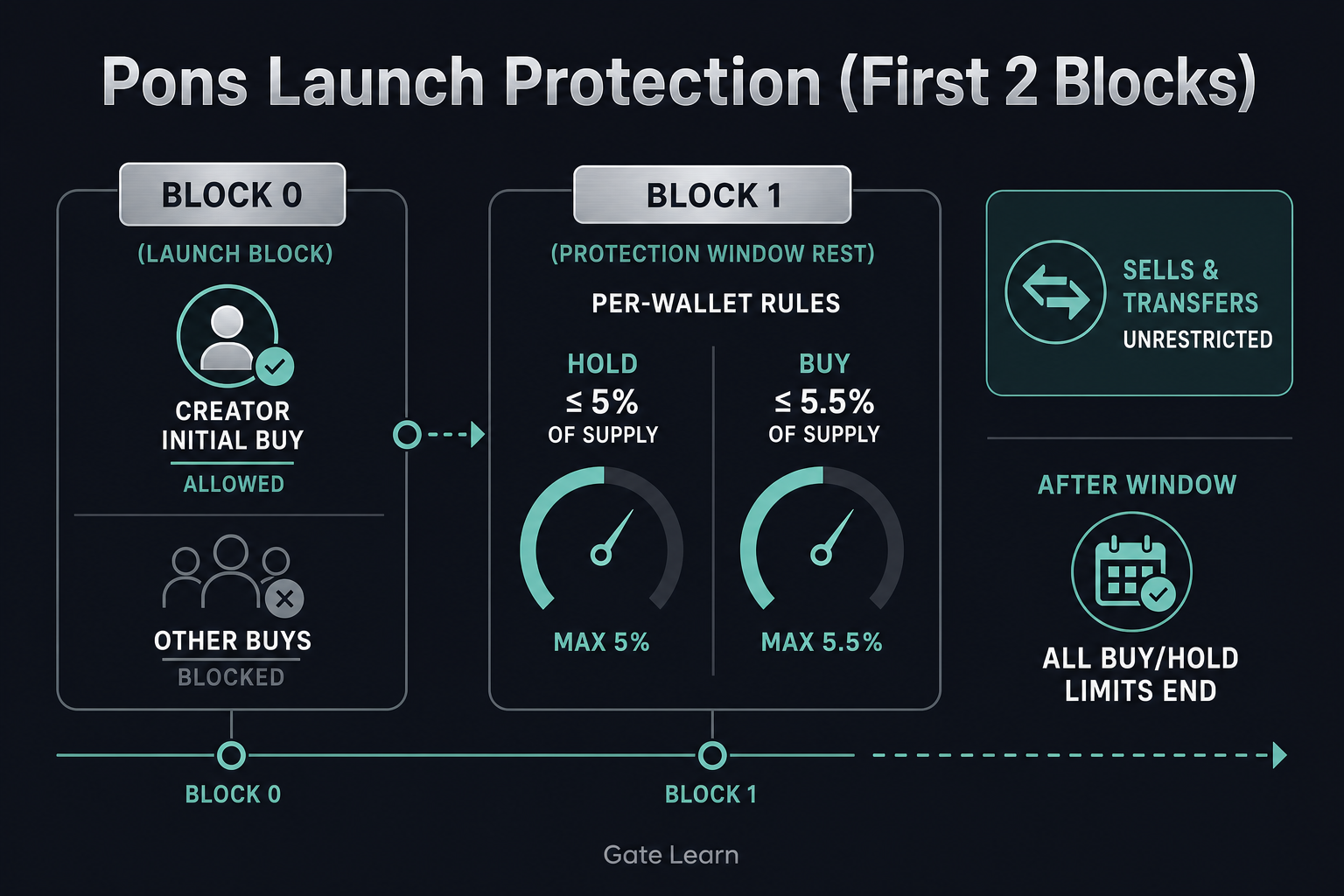 Figure 2. Launch protection: launch block allows creator initial buy only; within the window per-wallet hold ≤5% and buy ≤5.5%; sells and transfers unrestricted.
How Is Graduation Determined? Does the Pool Change After Graduation?
Graduation triggers when paired WETH in the locked liquidity pool reaches the configured threshold. The default threshold is 4.2 ETH WETH; UI progress bars usually show paired principal relative to that threshold. Once reached, the token status marks as graduated.
Trading continues in the same Uniswap V3 pool after graduation—no new pool deploys and no bonding-curve-style migration occurs. On-chain reads through the factory’s graduation views confirm paired principal, threshold, and graduated status; there is no separate migration event to index.
Graduation confirms threshold contact only. It is not a quality, compliance, or security signal and does not guarantee future liquidity, price, or exit paths. Non-graduated tokens trade in the same pool; graduation changes status labels and progress display, not the pool contract. When verifying, separate three facts: whether the threshold was hit, whether trading still uses the same pool, and whether UI display matches the on-chain pool address.
What Risks and Limitations Apply When Completing the Flow?
A repeatable flow does not imply predictable outcomes. Structural limits include dependence on Robinhood Chain and WETH quote depth; Create parameters (supply, pool fee, launch fee) follow platform rules—creators cannot switch to a bonding curve path at launch; Graduation is a threshold label, not a substitute for independent checks on contracts, liquidity, and issuers.
Risk factors include smart contract and factory risk, information asymmetry on new launches, spoofed names/symbols and phishing UIs, concentrated holdings after the protection window, slippage in thin pools, and operational risk from RPC, indexer, or preview failures. Before signing, verify token address, pool address, creator, and fee recipient; the platform does not custody funds—each action needs wallet approval.
| Risk / limitation |
Mechanism |
| Spoofed name and symbol |
Verify the asset by contract address |
| Graduation label |
WETH threshold only—not a quality endorsement |
| Liquidity and slippage |
Large trades in thin pools can move execution price sharply |
| Contract and factory risk |
Deploy and fee logic depend on on-chain correctness |
| UI valuation |
Display values are estimates; use transaction preview |
The table lists items still worth checking after walking Create → Trade → Graduate. A transparent path without “curve then migrate” reduces structural complexity but front-loads price discovery and liquidity risk to instant-pool open—verification focus shifts to pool address, protection window, and threshold meaning.
Summary
Pons token launches progress Create → Trade → Graduate: one transaction deploys fixed-supply tokens and a WETH Uniswap V3 pool with locked liquidity; buys and sells always use that same WETH pool; paired WETH reaching the default 4.2 ETH marks Graduation with no pool change. Launch protection restricts buys and hold caps only in the first 2 blocks; sells and transfers stay unrestricted. Aligning network, contract addresses, pool state, and graduation threshold meaning with on-chain facts helps separate UI flow from safety conclusions.
FAQ
How does a token launch on Pons?
Launch uses one transaction to deploy a fixed 1e9 token supply and a WETH Uniswap V3 pool at 1% pool fee, with a 0.0005 ETH launch fee and automatic liquidity lock. Buys and sells then run in the same pool; when paired WETH reaches the default 4.2 ETH, the token marks as graduated—still with no pool migration.
Does Pons use a bonding curve?
No. Pons does not price through a bonding curve and does not migrate liquidity after graduation. Price discovery begins in the locked Uniswap V3 pool as soon as Create completes.
What does Graduation mean on Pons?
Graduation means paired WETH in the locked pool reached the threshold (default 4.2 ETH WETH). The status describes threshold contact only—not project quality, compliance, or security.
Does Pons migrate to a different pool after graduation?
No. Trading continues in the same Uniswap V3 pool; no new pool deploys and no migration runs. Non-graduated tokens can still trade in that pool.
What risks apply when trading on Pons?
Risks include smart contract and factory risk, information asymmetry on new tokens, spoofed assets and phishing interfaces, liquidity and slippage, and operational issues with network or transaction previews. Graduation and fee-split mechanics do not replace independent verification and are not return promises.