PONS is the native token of the Pons (PONS) ecosystem on Robinhood Chain, connecting post-launch trading fees to protocol buybacks and burns. Pool fees of 1% split at the launch snapshot; the protocol share can buy PONS and send it to a burn address to adjust circulating-supply metrics. Burns reduce reported supply but do not guarantee price increases.
Fixed-supply launch tokens enter a locked WETH Uniswap V3 pool at creation, so fees accumulate in the same pool from day one. Unlike bonding-curve paths that migrate liquidity later, fee rules attach to the instant-pool model—Active launches commonly use 70% / 30%, Legacy uses 90% / 10%. Pons vs bonding-curve launchpads contrasts pricing and liquidity structure; fee mechanics are the companion constraints of that design.
From a digital-asset perspective, fee parameters—launch snapshot splits, claim paths, and burn-address receipts—are verifiable on-chain. Checking contract addresses and locker reads matters more than treating “buybacks” as a standalone quality signal. The 0.0005 ETH launch fee is separate from pool-fee splits; burn-adjusted market cap is roughly price × (total − burned) and is not a price promise; CTO may change social presentation and, when applicable, creator payout routing, but never the token, pool, or locked liquidity.
What Role Does PONS Play in the Ecosystem?
PONS serves as the ecosystem native token at reference contract address 0x39dBED3a2bd333467115dE45665cC57F813C4571. Users launch individual fixed-supply tokens through the interface; PONS sits in the protocol fee loop as the buyback-and-burn target when protocol share is allocated to repurchase and destroy supply.
PONS does not replace per-launch token pricing inside each Uniswap V3 pool, nor does it alter how individual buys and sells execute. Trades happen in each launch token’s WETH pool; PONS appears when protocol fees are reallocated and burned. When reading burn-adjusted market cap, separate full-supply metrics from circulating supply after burns.
Active factory (0xA5aAb3F0c6EeadF30Ef1D3Eb997108E976351feB, from block 8991118) and Active locker (0x736D76699C26D0d966744cAe304C000d471f7F35) are the contract references for current launch splits and fee-claim entry points. Legacy factory still serves earlier launches; each token follows the factory and locker bound at its launch block.
Pool Fee vs Launch Fee: What Gets Charged When?
Pool fees and launch fees are two distinct charge paths. Pool fees come from Uniswap V3 trading: the pool fee is 1% (fee parameter 10000), accruing on both the launch token and WETH sides whenever the pool trades. Launch fees are a one-time 0.0005 ETH charge at token creation, separate from ongoing pool-fee splits.
The launch fee covers the Create step that deploys the token and pool; pool fees cover continuous Trade activity afterward. On the Create → Trade → Graduate path, Create fixes supply, locks liquidity, and pays the launch fee; Trade generates the 1% pool fees that later split between creator and protocol.
| Fee type |
Rate / rule |
When charged |
What it applies to |
| Pool fee |
1% (10000) |
Every pool trade |
Accrues on token and WETH sides, then splits per snapshot |
| Launch fee |
0.0005 ETH |
At token creation |
One-time Create cost, not part of pool-fee split math |
The table separates one-time deployment cost from recurring trading fees. Before discussing splits or claims, confirm trades occur in the token’s locked Uniswap V3 pool—do not treat the launch fee as part of the pool-fee denominator.
Creator vs Protocol Split: Active 70/30 vs Legacy 90/10
Split ratios snapshot at launch and do not retroactively change when factory rules update. Active factory launches (from block 8991118) use creator 70% and protocol 30%. Legacy factory launches (from block 8600612) retain creator 90% and protocol 10%. Each token keeps its launch-time ratio permanently.
Creator share accumulates in the token’s locked position. Creators can claim from the interface; if unclaimed for extended periods, automation may claim on their behalf and route to the creator payout wallet, still honoring the snapshot. Protocol share enters protocol collection paths and then follows the buyback-and-operations allocation described below.
| Launch source |
Start block |
Creator |
Protocol |
Can existing tokens be rewritten? |
| Active factory |
8991118 |
70% |
30% |
No; locked at launch snapshot |
| Legacy factory |
8600612 |
90% |
10% |
No; locked at launch snapshot |
Always verify splits per token launch batch, not by today’s global factory default. To inspect protocol share and payout addresses for a given token, read snapshot parameters from the corresponding locker; when no redirect is set, creator payout typically falls back to the deployer.
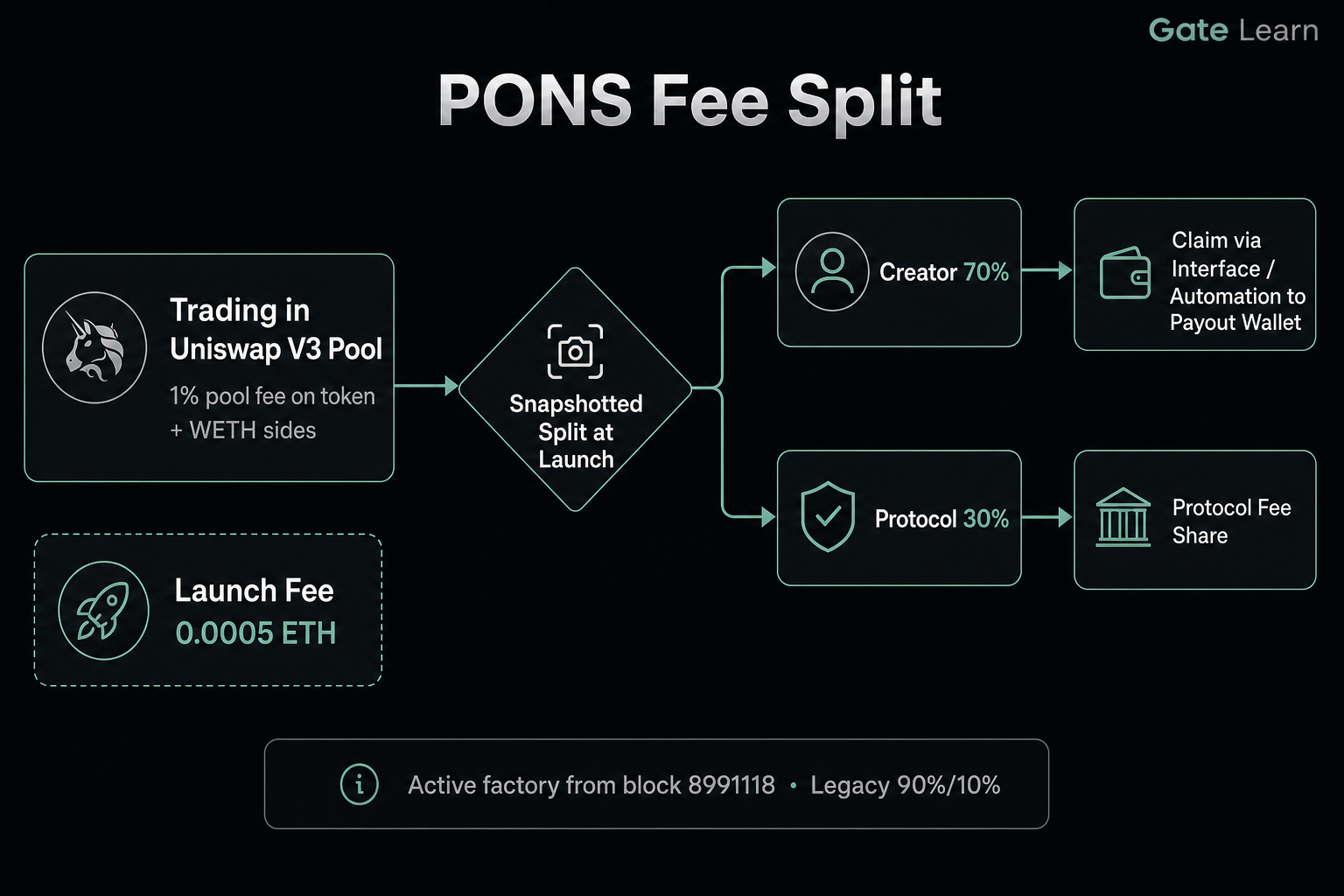 Figure 1. Pool fees accrue on token and WETH sides, then split per launch snapshot into creator and protocol shares; creators claim via the interface.
How Do Protocol Buybacks and Burns Work?
Protocol buybacks use protocol funds to purchase PONS and send tokens to a burn address, permanently removing them from circulating-supply metrics. Burns reduce reported float but burn ≠ price guarantee: market price still reflects live bids and asks; destruction only changes the supply side of valuation math.
Burn-adjusted market cap uses: price × (total − burned). That formula multiplies price by total supply minus burned amount—a way to express market cap on a post-burn circulating basis. It describes measurement, not a promise of future price.
Protocol fees follow a directional allocation split: roughly ~80% toward PONS buybacks (often via TWAP-style execution) and ~20% toward operations and infrastructure. Treat these as structural allocation targets, not guarantees of timing or on-chain visibility for every execution.
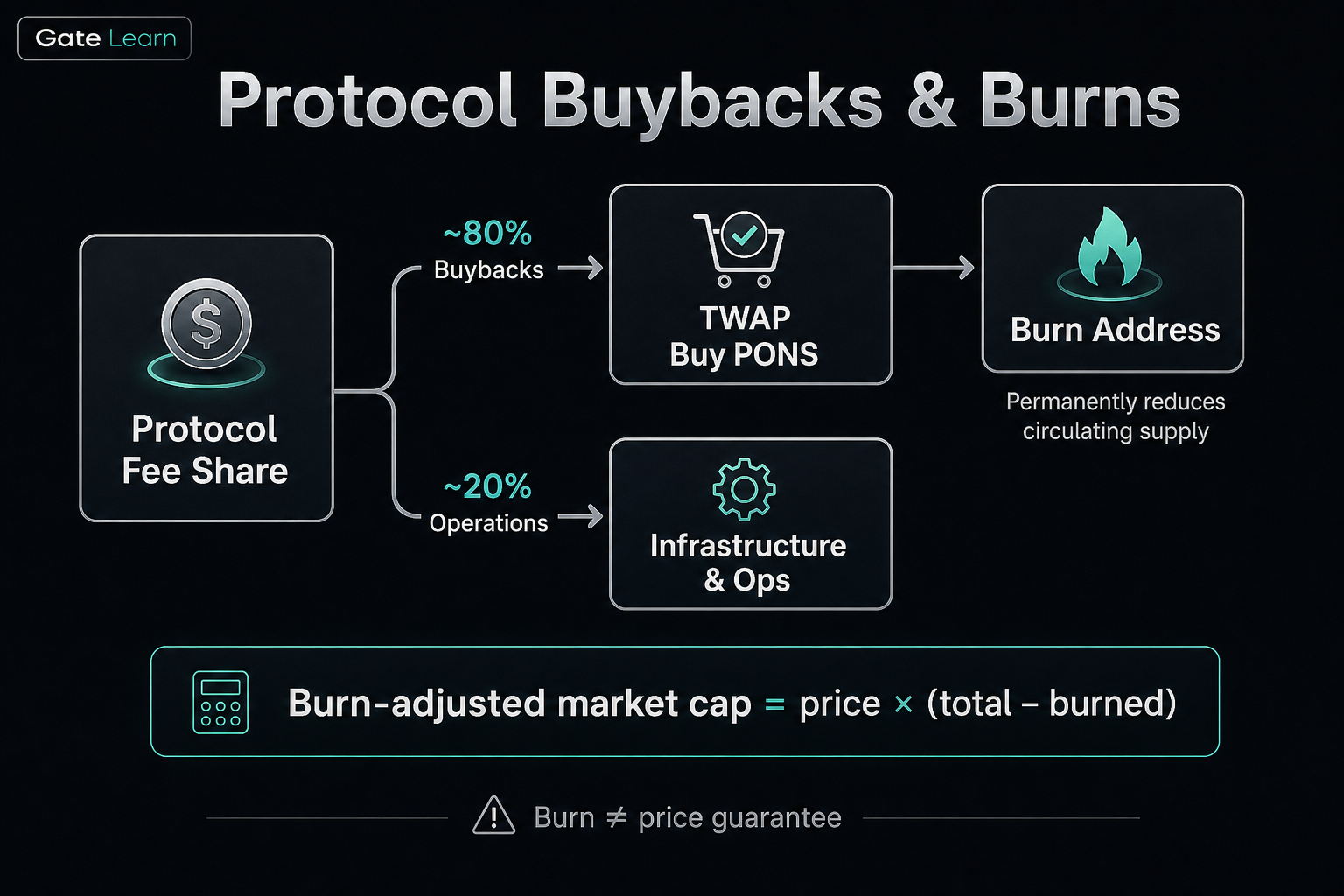 Figure 2. Protocol fees route toward buybacks and operations; buybacks purchase PONS and send tokens to a burn address to adjust circulating-supply metrics.
What Does Community Takeover (CTO) Change—and What Stays the Same?
Community takeover (CTO) applies when the original creator clearly exits and an active community requests control of creator-facing presentation and, where applicable, fee payout routing. Applications go through a CTO review process; approval depends on whether contracts permit the adjustment and whether submitted materials meet stated criteria.
CTO can change social presentation and, when applicable, the creator fee payout wallet. It does not change the token contract, trading pool, or locked liquidity. Approval is an administrative routing change—not an endorsement of token safety, quality, or value. Private keys and seed phrases should never be shared with any application flow; legitimate processes do not require transferring funds to process an application.
| Dimension |
Does CTO change it? |
Notes |
| Social presentation |
Yes |
Community-facing creator entry can transfer |
| Creator fee payout |
Sometimes |
Future creator share can route to a new wallet |
| Token / pool / locked liquidity |
No |
On-chain asset structure stays the same |
| Quality or safety endorsement |
No |
Approval is not a project endorsement |
Separate “display and payout routing” from “pool and liquidity structure.” After CTO, still verify addresses, liquidity depth, and holder concentration independently—takeover status is not a signal that risk has been removed.
What Are the Risks and Limitations of Fees and Token Mechanics?
Mechanism strengths include verifiable pool and launch fee parameters; launch-time snapshot splits that can be checked per token; traceable creator claims and automation-assisted claims; and a public burn-address path for circulating-supply adjustment. CTO, when applicable, can reroute payouts without rewriting pool structure.
Structural limits include fee depth tied to real pool volume; coexistence of Legacy and Active factories requiring batch-specific checks; describable but variably observable execution pacing for protocol allocation; and independence of Graduation from fee snapshots—hitting the WETH threshold does not alter the split locked at launch.
Risk factors cover smart-contract and factory / locker risk, counterfeit tokens and phishing interfaces, information asymmetry on new launches, slippage in thin pools, and misreading burns or CTO as price or safety guarantees. Before launching or trading, confirm contract addresses and transaction previews rather than relying on status labels as return promises.
| Risk type |
Primary source |
What to verify |
| Contract / factory |
Factory, pool, locker contracts |
Active vs Legacy addresses and token contract |
| Information / impersonation |
Same symbol, fake sites |
Contract address and official entry points |
| Liquidity / slippage |
Thin pools, large trades |
Quotes, price impact, slippage tolerance |
| Label misread |
Graduation / buyback / burn / CTO |
Threshold tags and burns are not quality or price guarantees |
Summary
PONS connects pool-fee splits, protocol buybacks, and burns on Pons: trading generates a 1% pool fee on token and WETH sides, while creation charges a separate 0.0005 ETH launch fee. Splits lock at launch snapshot—Active 70% / 30%, Legacy 90% / 10%. Protocol fees directionally allocate toward buybacks and operations; buybacks purchase PONS and send tokens to a burn address. Burns adjust circulating-supply metrics but do not guarantee price performance. CTO can transfer social presentation and applicable creator payout routing without changing the token, pool, or locked liquidity, and without constituting an endorsement.
FAQ
What is PONS used for?
PONS is the native token of the Pons ecosystem at 0x39dBED3a2bd333467115dE45665cC57F813C4571. Protocol fee share can buy PONS and send it to a burn address, reducing circulating-supply metrics. PONS does not replace pricing or execution inside each launch token’s Uniswap V3 pool.
How are trading fees split between creator and protocol?
The 1% pool fee splits per launch snapshot: Active factory (from block 8991118) uses creator 70% / protocol 30%; Legacy (from block 8600612) uses 90% / 10%. Creators claim via the interface; unclaimed balances may be claimed by automation to the payout wallet. The 0.0005 ETH launch fee is separate from pool-fee splits.
Does Pons buy back and burn PONS?
Protocol fees directionally allocate toward buybacks and operations—roughly ~80% buyback and ~20% operations. Buybacks purchase PONS and send tokens to a burn address. Burn-adjusted market cap is price × (total − burned). Burns do not guarantee price increases; price still reflects market trading.
What is Pons?
Pons is a decentralized interface on Robinhood Chain for launching and trading fixed-supply tokens without custodial fund holding; each trade requires wallet approval. Creation deploys a token and WETH Uniswap V3 pool with no bonding curve and no migration. PONS is the ecosystem native token linked to fee splits and buyback-burn mechanics.
What risks should traders know about Pons fees?
Risks include smart-contract and factory / locker risk, impersonation and phishing, information asymmetry on new tokens, liquidity and slippage, and misreading burns, Graduation, or CTO as safety or return signals. Verify token addresses, pool liquidity, and transaction previews rather than status labels alone.
No. CTO can change social presentation and, when applicable, creator fee payout routing. The token, pool, and locked liquidity stay unchanged. Approval is not an endorsement of token safety or value, and legitimate processes do not request private keys or fund transfers to process an application.