As DePIN, AI Agent, and Internet of Things, or IoT, concepts develop rapidly, the blockchain industry is beginning to move beyond purely digital finance and into real-world infrastructure. More projects are trying to connect devices, robots, vehicles, and sensors to on-chain networks, using token incentives to build open collaboration systems.
Against this backdrop, IoTeX and peaq have become two of the more closely watched projects in the machine economy sector. Both aim to bring real-world devices on-chain, but their technical paths and ecosystem priorities are not exactly the same. IoTeX leans more toward IoT and trusted device networks, while peaq emphasizes the machine economy and autonomous economic behavior between devices. So although both belong to the broader DePIN and machine economy space, their actual positioning is clearly different.
What Is peaq?
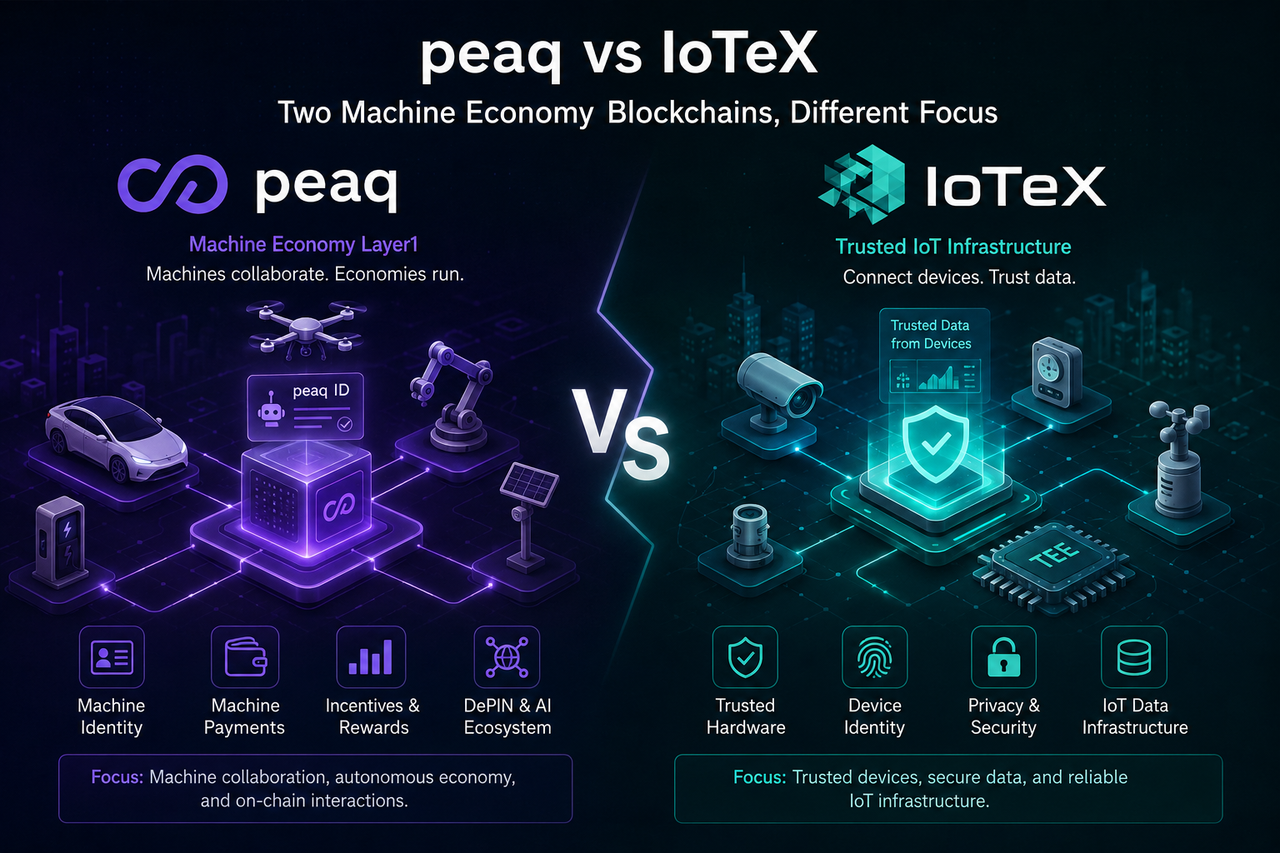
As a Layer1 blockchain focused on the machine economy and DePIN, peaq’s core goal is to allow machines, devices, and AI Agents to participate independently in on-chain economic activity.
In peaq’s architecture, real-world devices can do more than upload data. They can also have on-chain identities, payment capabilities, and automated coordination abilities. For example, an autonomous vehicle can automatically pay charging fees, a robot can receive on-chain rewards based on completed tasks, and an environmental sensor can sell real-time data.
To support this model, peaq provides a machine identity system, peaq ID, data verification modules, and machine payment capabilities. It mainly serves use cases such as DePIN, AI data networks, and Machine DeFi.
Compared with traditional public blockchains, peaq does not center its design around DeFi or NFTs. Instead, it aims to become the infrastructure layer for real-world machine coordination networks.
What Is IoTeX?
As a blockchain project focused on IoT and trusted device networks, IoTeX aims to provide trusted data and decentralized connectivity for real-world devices.
IoTeX’s core directions include device identity, trusted execution environments, or TEE, privacy-preserving computation, and machine data verification. Its long-term focus is to solve the problem of trusted data from real-world devices and enable IoT networks to connect securely to Web3.
Compared with peaq, IoTeX places more emphasis on devices and data themselves, rather than economic coordination between machines.
The IoTeX ecosystem includes multiple projects related to hardware, data collection, and trusted computing, such as on-chain device authentication, environmental data networks, and real-world data oracles.
IoTeX is therefore often seen as a blockchain leaning toward IoT infrastructure, while peaq leans more toward the machine economy and DePIN coordination networks.
Why Are peaq and IoTeX Both Entering the Machine Economy Sector?
The core logic of the machine economy is to allow real-world devices to participate in value exchange and network coordination much like internet accounts.
Traditional IoT networks can connect devices, but they lack an open value settlement system. For example, devices often struggle to complete payments on their own or directly earn revenue from data contributions.
Blockchain gives machines:
-
On-chain identity
-
Automated payment capabilities
-
Data incentive mechanisms
-
Decentralized coordination capabilities
This is why IoTeX and peaq both aim to use blockchain to solve trusted coordination problems in real-world device networks.
However, they approach the sector from different angles. IoTeX focuses more on whether a device can be trusted, while peaq focuses more on how machines can form economic networks.
What Are the Technical Architecture Differences Between peaq and IoTeX?
From a technical architecture perspective, both are designed around real-world devices, but their priorities are different.
IoTeX places greater emphasis on trusted hardware and device data verification. Its architecture centers on trusted execution environments, TEE, device authentication, and privacy protection. This means IoTeX is more concerned with whether the data generated by a device is authentic and trustworthy.
peaq, by contrast, focuses on machine coordination and economic behavior. Its architecture includes machine identity, machine payments, and device incentive modules, allowing machines to participate in network activity autonomously like on-chain accounts.
Put simply:
In addition, peaq places more emphasis on DePIN and AI Agent use cases, while IoTeX has long focused on IoT data and hardware infrastructure.
How Do peaq and IoTeX Differ in the DePIN Ecosystem?
The core goal of DePIN is to build real-world infrastructure networks through token incentives.
IoTeX and peaq both support DePIN projects, but their ecosystem directions are not the same.
IoTeX leans more toward data and device networks, such as:
peaq’s DePIN ecosystem is broader, covering areas such as:
-
Decentralized mapping networks
-
Autonomous driving coordination networks
-
Robotics economy
-
AI data networks
-
Decentralized energy networks
As a result, IoTeX is more oriented toward IoT data infrastructure, while peaq puts more emphasis on economic coordination between real-world devices.
How Do peaq and IoTeX Differ in Machine Identity Mechanisms?
Machine identity is an important part of the machine economy.
IoTeX’s device identity system places more emphasis on hardware trust. Its focus is on confirming that a device truly exists and verifying the source of the data it generates.
peaq’s peaq ID, on the other hand, does more than verify device identity. It also allows devices to directly participate in on-chain economic activity. For example, a device can upload data, receive rewards, make payments, and participate in coordination networks.
This means:
These two approaches do not conflict, but they are aimed at different application directions.
How Do peaq and IoTeX Differ in Their Relationship with AI Agents?
As the concept of AI Agents gains traction, the machine economy is beginning to converge with artificial intelligence.
peaq clearly places more emphasis on AI Agent and machine coordination scenarios. Its ecosystem directions include automated robotics networks, AI data markets, and autonomous payment systems.
IoTeX, by contrast, is still more oriented toward the device and data trust layer. Its AI direction is more focused on data reliability and device data input.
So within the AI Agent narrative, peaq is closer to an AI-driven machine economy network, while IoTeX is more like trusted device data infrastructure for AI.
Core Differences Between peaq and IoTeX
| Dimension |
peaq |
IoTeX |
| Core Positioning |
Machine Economy Layer1 |
IoT and trusted device network |
| Key Focus |
DePIN / AI Agent / Machine DeFi |
IoT / trusted hardware / data verification |
| Core Capability |
Machine payments and coordination |
Device trust and data verification |
| Machine Identity |
peaq ID |
Device authentication system |
| AI Agent Support |
Stronger |
Relatively limited |
| Typical Use Cases |
Autonomous driving, robotics, energy networks |
Device data, sensor networks |
| Ecosystem Focus |
Machine economy |
IoT infrastructure |
Conclusion
peaq and IoTeX are both important projects in the machine economy and DePIN sector, but their development directions are different.
IoTeX places greater emphasis on IoT, trusted devices, and data verification, aiming to provide trusted infrastructure for real-world devices. peaq, by contrast, focuses more on the machine economy, device payments, and on-chain coordination, with the goal of enabling machines to become real participants in the on-chain economy.
FAQs
Is peaq an IoT Blockchain?
peaq is more oriented toward machine economy and DePIN infrastructure, rather than being only a traditional IoT blockchain.
What Is IoTeX’s Core Direction?
IoTeX mainly focuses on trusted devices, IoT data verification, and real-world device connectivity.
Why Are Both Classified as Machine Economy Projects?
Because both aim to connect real-world devices to blockchain networks and allow them to participate in decentralized network coordination.
What Use Cases Is peaq Better Suited For?
peaq is better suited for use cases such as autonomous driving, robotics networks, AI Agents, and DePIN economic systems.
What Use Cases Is IoTeX Better Suited For?
IoTeX is better suited for IoT network scenarios that require trusted device data and hardware verification.