When users search for this topic, they're usually trying to determine whether MEGA offers real network utility, rather than serving solely as a price symbol in the trading marketplace. For high-performance blockchain networks, the token model is often fundamental to how the ecosystem operates and directly shapes long-term supply and demand.
This question typically covers six aspects: token positioning, usage scenarios, total supply structure, distribution mechanism, sources of value, and risk factors. Understanding these areas provides a systematic perspective on the MegaETH economic model.
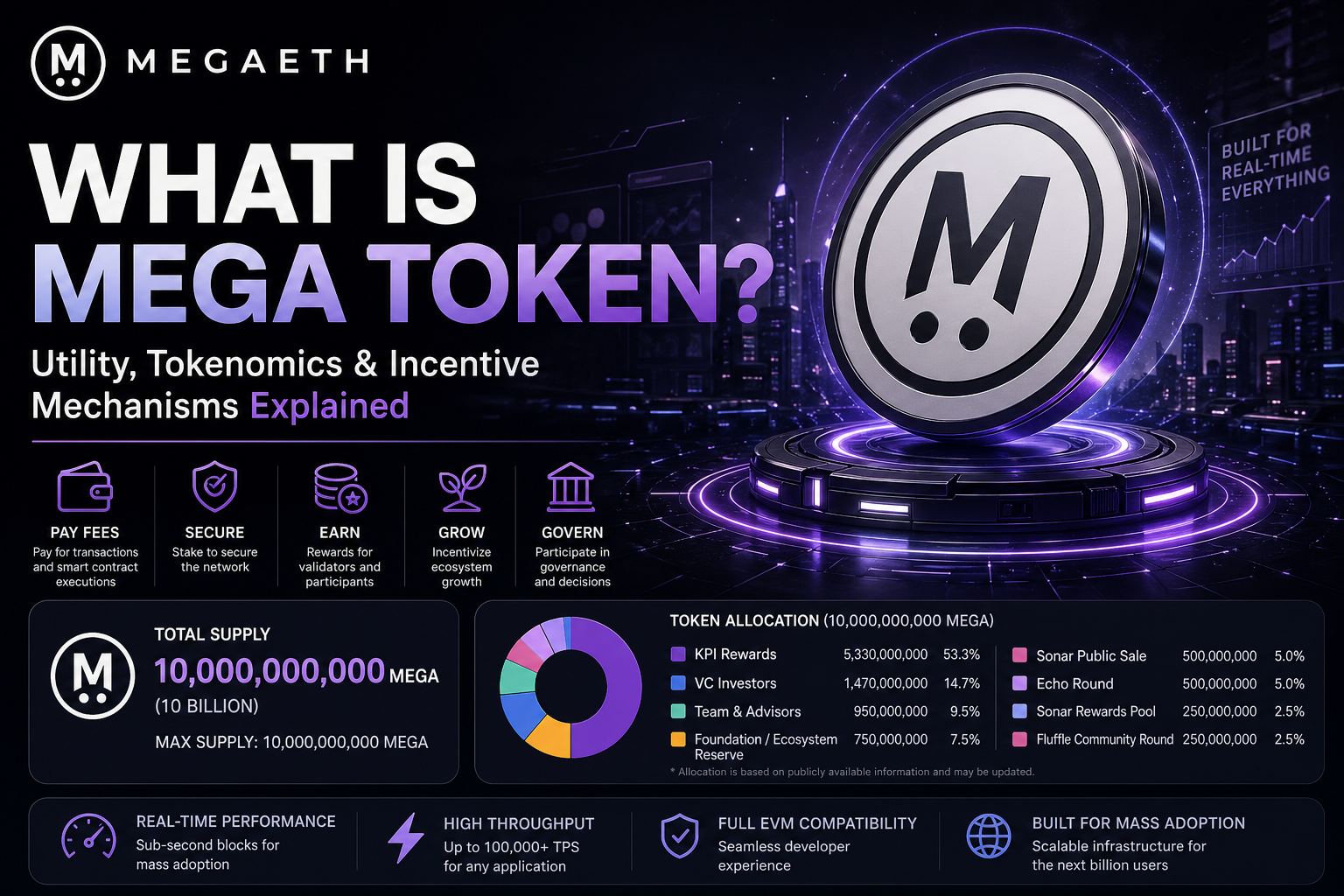
What Is the MEGA Token
MEGA is the foundational token powering the MegaETH network, serving as the bridge between user demand, on-chain resources, and the network’s incentive system.
In practice, users pay for computing resources with MEGA whenever they transfer assets, trade, or interact with applications on MegaETH. This makes MEGA the settlement medium for on-chain activities, rather than just a tradable asset in the market.
Structurally, MEGA plays three main roles: payment utility, security incentive, and ecosystem coordination. Most high-performance networks rely on their native token to fulfill these core functions.
The key takeaway is that as network usage increases, so does the demand for the token in trading fees, staking, and ecosystem activity.
What Functions Does MEGA Serve in the Network
MEGA’s role extends well beyond Gas fees, touching every critical aspect of network operations.
First, users must pay trading fees in MEGA to initiate on-chain transactions. The system uses this fee mechanism to allocate computing resources and prevent network congestion.
Node operators who contribute by sequencing, validating, or supporting infrastructure services can earn MEGA as protocol incentives, ensuring ongoing network maintenance and participation.
Ecosystem projects may also use token incentives to attract developers, users, and liquidity. Additionally, governance modules may allow token holders to participate in protocol parameter adjustments.
Key functions include:
- Paying for transaction and execution costs
- Incentivizing node participation
- Staking to enhance network security
- Supporting ecosystem growth initiatives
- Participating in governance decision-making
Together, these functions create a direct link between the token and network activity.
How Is MEGA Used for Trading Fees and Settlement
MEGA translates on-chain resource consumption into a quantifiable cost for network activity.
Users submit requests for transfers, trade matching, or Smart Contract calls. The system calculates required fees based on transaction complexity, data usage, and network load.
Users then pay these fees in MEGA. Depending on network design, a portion of the fee may go to the protocol revenue pool, while another portion rewards nodes or other mechanisms.
Transactions are sequenced and executed, and users receive updated balances, order fulfillment, or application results.
The core of the fee mechanism is not simply charging users, but using price signals to allocate scarce computing resources. As network activity increases, demand for MEGA typically rises.
How Does MEGA Incentivize Validators and Ecosystem Participants
MEGA’s incentive mechanism relies on token distribution to maintain network security and drive ecosystem growth.
Validators and infrastructure nodes contribute computing, storage, and validation services to the network, earning MEGA rewards based on their contributions. This provides ongoing motivation for node operators.
Developers may receive MEGA through ecosystem funds, subsidy programs, or application rewards to build trading, gaming, or data protocols.
Regular users may also be rewarded for providing liquidity, participating in testnets, or using on-chain products. Ultimately, tokens circulate back into trading, fee payments, and staking, creating a self-sustaining ecosystem.
This mechanism ensures that tokens reward both capital holders and active contributors.
MEGA Total Supply and Distribution Data
MEGA’s total supply and distribution are key to understanding token supply pressure and the long-term incentive structure.
Public data shows MEGA’s total and maximum supply is 10,000,000,000 tokens (10 billion). With a fixed cap, new circulating supply comes from a predetermined release schedule, not unlimited issuance.
Current distribution is as follows:
| Distribution Category |
Amount |
Percentage |
| KPI Incentive Pool |
5.33 billion |
53.30% |
| VC Investors |
1.47 billion |
14.70% |
| Team and Advisors |
950 million |
9.50% |
| Foundation and Ecosystem Reserve |
750 million |
7.50% |
| Sonar Public Sale |
500 million |
5.00% |
| Echo Fundraising Round |
500 million |
5.00% |
| Sonar Incentive Pool |
250 million |
2.50% |
| Fluffle Community Round |
250 million |
2.50% |
More than half of all tokens are allocated to the KPI incentive pool, showing a strong focus on ecosystem growth outcomes rather than simple linear time-based vesting. This approach is relatively rare for new projects.
Relationship Between MEGA Token Value and Network Usage
The core of MEGA’s value proposition is whether network demand can consistently translate into token demand.
As MegaETH’s trading volume, application count, and active addresses grow, demand for fee payments, staking, and ecosystem participation rises in parallel—giving the token clear, real-world use cases.
Tokens driven by genuine network usage tend to be more sustainable than those fueled by narrative alone. If the network only supports token trading without real on-chain activity, value support is weak.
MEGA’s value is influenced by four main factors: network trading volume, ecosystem scale, token release schedule, and market liquidity.
When evaluating token price, consider not only market sentiment but also on-chain fundamentals.
What Risks Should Holders Watch
MEGA holders should be aware of risks related to supply release, ecosystem growth, and market volatility.
If team, investor, or foundation tokens unlock, increased circulation may create short-term supply pressure.
If MegaETH’s application growth lags expectations, token demand may weaken, impacting value.
Competition among high-performance networks is intense—other Layer2 or execution networks can also divert users and developer resources.
Finally, overall crypto market volatility, liquidity changes, and regulatory shifts may all impact token performance.
Token value depends not just on project fundamentals, but also on broader market cycles.
Summary
MEGA is the native token of the MegaETH network, serving multiple roles—trading fee payment, node incentives, ecosystem expansion, and governance coordination. Its total supply is 10 billion tokens, with 53.3% allocated to the KPI incentive pool, highlighting a focus on ecosystem growth and long-term incentives. To truly understand MEGA, monitor the token model, on-chain activity, and release mechanisms—not just price swings.
FAQ
What Is the Function of the MEGA Token
MEGA is primarily used to pay trading fees, stake for network security, reward node participants, and support ecosystem development and governance.
What Is the Total Supply of MEGA
Public data shows MEGA’s total and maximum supply is 10 billion tokens.
What Is MEGA’s Largest Allocation
The largest allocation is the KPI incentive pool, which accounts for 53.3% of total supply.
Why Is MEGA Linked to Network Usage
As user numbers and trading frequency increase, demand for fee payments and staking rises, driving token demand higher.
What Risks Does MEGA Face
Key risks include token unlock pressure, the pace of ecosystem growth, competition from other networks, and overall market volatility.