As AI video, real-time live streaming, and generative media develop rapidly, video infrastructure requires more GPU computing power and bandwidth resources. Traditional video platforms usually rely on centralized cloud services to handle these workloads, but high operating costs and closed resource systems have pushed decentralized video networks forward.
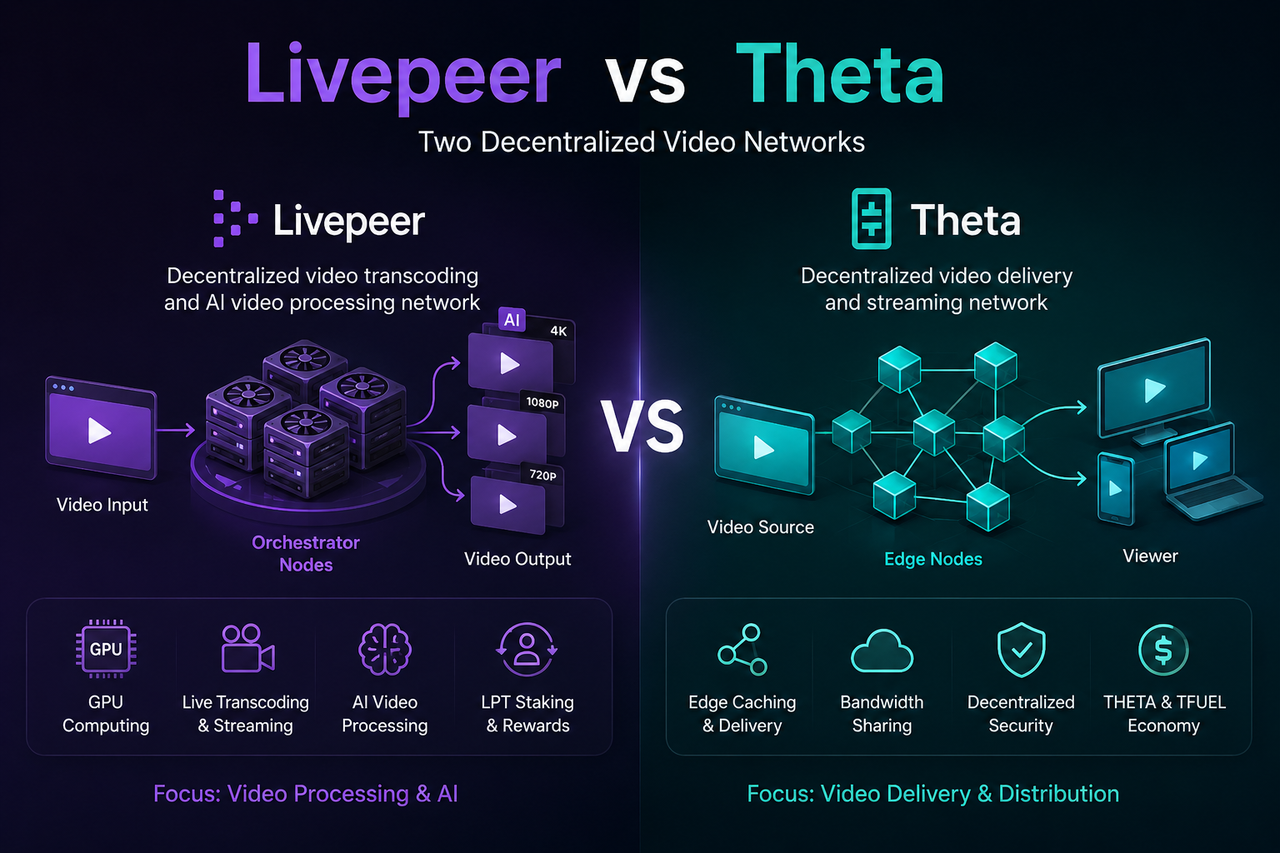
Livepeer and Theta are both decentralized video infrastructure projects, yet they represent two different technical paths. The former is closer to a GPU video computing network, while the latter is more like a decentralized CDN and streaming distribution network.
A Brief Look at Livepeer and Theta
Livepeer is a decentralized video and AI video infrastructure network built on Ethereum. Its core capabilities are centered on video transcoding, live stream processing, and real-time AI video computation.
Theta is a decentralized network designed for video content distribution and streaming transmission. Its focus is on using edge nodes to reduce video delivery costs and improve streaming distribution efficiency.
Unlike Livepeer, Theta’s core resource is not GPU-based video computation, but bandwidth and edge caching capacity. Users can run Edge Nodes to share network resources and help platforms distribute video content.
How Do Livepeer and Theta Differ in Their Core Goals?
Although Livepeer and Theta are both video infrastructure projects, they solve different problems.
Livepeer focuses more on how video is processed. Its core capabilities lie in video transcoding, GPU video computation, and AI video inference, so the key resource in the network is GPU computing power.
Theta focuses more on how video is delivered. Its goal is to reduce streaming transmission costs through edge nodes and bandwidth sharing, so the key resources in the network are bandwidth and caching capacity.
From an industry positioning perspective, Livepeer is closer to AI video infrastructure, while Theta leans more toward decentralized streaming and content distribution networks.
How Do Livepeer and Theta Differ in Network Structure?
Livepeer’s network structure revolves around video computation. Its core node is the Orchestrator, which receives video tasks and uses GPU resources to complete video processing. The Gateway connects applications with the network and sends tasks to different nodes.
Theta’s structure places greater emphasis on content distribution efficiency. Its network consists of Validator Nodes, Guardian Nodes, and Edge Nodes, among which the Edge Node is responsible for video caching and bandwidth sharing.
Functionally, Livepeer’s Orchestrator is more like a distributed GPU computing node, while Theta’s Edge Node is closer to a decentralized CDN node.
This difference determines their distinct roles within the video ecosystem.
How Do Livepeer and Theta Handle Video Tasks?
In the Livepeer network, after a video is uploaded, it is distributed to Orchestrator nodes. The nodes use GPU resources to complete video transcoding and generate video outputs suitable for different devices and network conditions.
As AI video develops, Livepeer’s GPU nodes can also perform real-time AI video tasks, such as video style transfer, AI avatar driving, and video enhancement.
Theta’s task processing logic is different. Theta focuses more on improving the caching and distribution efficiency of video content. Edge Nodes cache video content and provide users with video delivery services closer to their local environment, reducing pressure on platform servers.
As a result, Livepeer leans more toward the video computation layer, while Theta leans more toward the video distribution layer.
Why Have AI Video Capabilities Become an Important Difference?
AI video has become an important trend in the Web3 video sector, and it is also one of the key reasons why the differences between Livepeer and Theta have become more pronounced.
Livepeer has continued to expand in the direction of real-time AI video in recent years, including capabilities such as AI avatars, video generation, real-time inference, and video enhancement. These tasks usually require substantial GPU computing power, so Livepeer’s network structure is naturally suited to AI video use cases.
Although Theta is also exploring AI and edge computing, its overall network design still centers on video distribution and the streaming ecosystem.
Therefore, in the field of AI video infrastructure, Livepeer usually has a clearer position.
How Do Livepeer and Theta Differ in Their Token Models?
Livepeer uses LPT as its core coordination token. LPT is mainly used for node staking, network security, and task allocation. Orchestrators need to stake LPT to receive video tasks, while Delegators can participate in network incentives through delegation.
Theta uses a dual-token model. THETA mainly supports governance and validation, while TFUEL is used to pay for network resources and video distribution costs.
By comparison, Livepeer’s token structure places more emphasis on coordinating GPU computation, while Theta’s token system is better suited to streaming and content distribution scenarios.
How Do Livepeer and Theta Differ in Ecosystem Direction?
As the industry has developed, the two projects have gradually formed different ecosystem paths.
| Comparison Dimension |
Livepeer |
Theta |
| Core positioning |
Video transcoding and AI video |
Video distribution and CDN |
| Core resource |
GPU computing power |
Bandwidth and caching |
| Network role |
Orchestrator |
Edge Node |
| AI video capability |
Strong |
Moderate |
| Main applications |
AI video, live stream transcoding |
Streaming platforms |
| DePIN attributes |
Strong |
Moderate |
At present, Livepeer is more frequently categorized under AI video infrastructure and decentralized GPU networks, while Theta continues to expand around the decentralized streaming ecosystem.
Conclusion
Livepeer and Theta are both decentralized video infrastructure projects, but they represent different technical paths.
Livepeer focuses more on video transcoding, GPU video computation, and real-time AI video processing, with its core capabilities built on Orchestrators and a GPU network. Theta places greater emphasis on video content distribution, edge caching, and streaming transmission efficiency.
As demand for AI video grows, Livepeer’s positioning as AI video infrastructure is becoming stronger, while Theta continues to develop mainly around video distribution and the content ecosystem.
FAQs
What Is the Biggest Difference Between Livepeer and Theta?
Livepeer focuses more on video transcoding and AI video processing, while Theta focuses more on video content distribution and edge networks.
Is Livepeer Part of AI Infrastructure?
With the development of AI avatars, real-time video inference, and AI video generation, Livepeer has gradually expanded into AI video infrastructure.
Does Theta Provide GPU Video Computation?
Theta’s core focus is video distribution and edge caching, so its GPU video computation capability is relatively weaker.
Why Does Livepeer Need GPU Nodes?
Video transcoding and AI video inference usually require substantial GPU computing power, so Livepeer needs GPU nodes to provide computing resources.
What Does Theta’s Edge Node Do?
Edge Nodes are mainly used for video caching, content distribution, and bandwidth sharing.
Are Livepeer and Theta Both DePIN Projects?
Both are related to decentralized infrastructure, but Livepeer’s GPU network attributes are usually more aligned with the definition of DePIN.