On-chain lending protocols are among the most complex financial systems in DeFi from a risk perspective. Compared with simple token transfers or spot trading, lending protocols must handle asset custody, interest rate markets, liquidation logic, Oracle pricing, and protocol solvency all at once. If any one of these modules fails, the entire system may be affected.
As the Kaspa ecosystem expands into Layer2 and smart contract infrastructure, Kaskad has become one of its core lending protocols. Its security design matters not only for the protocol itself, but also for the overall liquidity and financial stability of the future Kaspa DeFi ecosystem.
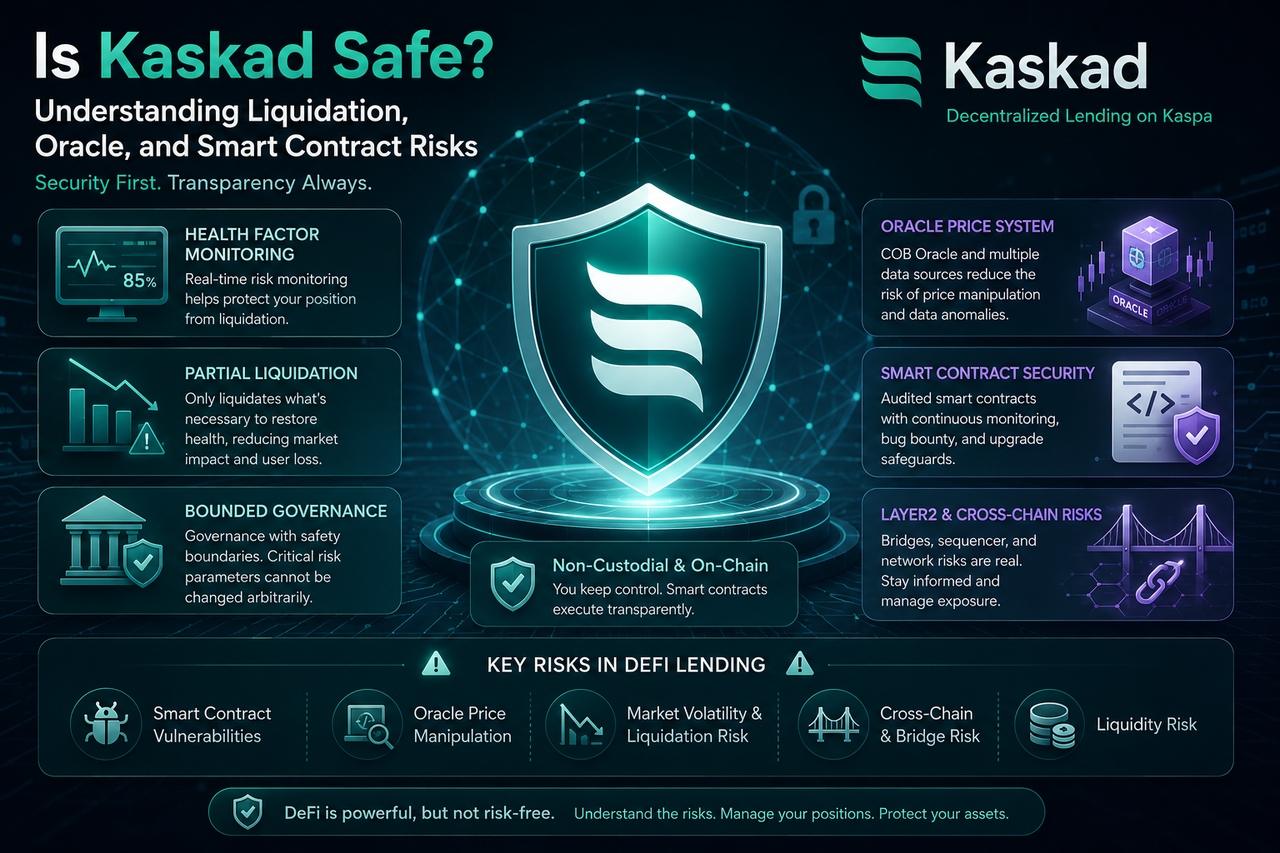
What Is Kaskad’s Security Architecture?
Kaskad uses non-custodial smart contract architecture, meaning the protocol does not directly control user assets in the way a centralized platform would. All deposit, borrowing, interest accrual, and liquidation logic is executed automatically by on-chain smart contracts.
The advantage of this model is greater transparency. All rules are public and verifiable, while centralized custody risk is reduced. At the same time, it also means the protocol’s security depends heavily on the smart contract code itself.
Kaskad’s overall security structure mainly includes:
-
An overcollateralized lending model
-
Health Factor risk monitoring
-
Partial liquidation mechanism
-
Oracle price system
-
Governance permission boundaries, or Bounded Governance
-
Smart contract audits
Together, these modules determine whether the protocol can remain solvent during periods of market volatility.
| Risk Type |
Risk Source |
Possible Impact |
Kaskad’s Mitigation Mechanism |
| Liquidation risk |
Rapid decline in collateral asset prices |
User positions are forcibly closed |
Partial Liquidation |
| Oracle risk |
Abnormal or manipulated price data |
Incorrect liquidations, protocol bad debt |
COB Oracle and multi-source pricing mechanism |
| Liquidity risk |
Insufficient market depth |
Liquidations cannot be completed in time |
Dynamic interest rates to incentivize liquidity |
| Layer2 risk |
Network outage or abnormal state |
Withdrawal delays, failed transactions |
Igra Layer2 infrastructure optimization |
| Cross-chain risk |
Bridge or asset mapping issues |
Asset freezes or losses |
Hyperlane cross-chain framework |
| Market volatility risk |
Sharp crypto market fluctuations |
Large-scale cascading liquidations |
Real-time Health Factor monitoring |
Why Do Lending Protocols Need Overcollateralization?
Kaskad uses an overcollateralization mechanism, which is currently the core risk control method used by most DeFi lending protocols.
Because on-chain lending cannot assess user credit in the same way as traditional banks, the protocol must require users to provide collateral worth more than the amount borrowed. For example, when an asset has a Loan-to-Value, or LTV, of 70%, users can borrow up to 70% of the collateral asset’s value.
This mechanism can reduce the probability of protocol bad debt.
If the price of the collateral asset falls, the system still has a chance to recover the debt through liquidation. However, during periods of extreme market volatility, risks may still arise even with overcollateralization, due to sharp price drops or insufficient liquidity.
Therefore, overcollateralization does not mean “absolute safety.” It is a mechanism designed to reduce systemic risk.
How Does Kaskad’s Partial Liquidation Mechanism Reduce Risk?
Traditional lending protocols usually use a full liquidation model. When a user’s position falls below the safety threshold, the system may sell a large amount of collateral all at once.
Although this model can quickly reduce bad debt risk, it can also create cascading liquidations during periods of sharp market volatility, pushing prices even lower.
Kaskad instead uses a Partial Liquidation mechanism.
When position risk becomes too high, the protocol does not immediately liquidate all collateral. Instead, it first repays part of the debt, bringing the position back into a safe range. This design can reduce immediate selling pressure in the market while limiting the user’s one-time loss.
For the protocol as a whole, partial liquidation helps improve market stability, especially in environments with weaker liquidity or larger price swings.
Why Is Oracle Risk One of the Biggest Risks for Lending Protocols?
An Oracle is one of the most critical pieces of infrastructure in a lending protocol.
Kaskad relies on Oracles to obtain real-time asset prices. Without them, the system cannot assess collateral value, borrowing limits, or liquidation conditions.
If Oracle data becomes abnormal, it may lead to:
-
Users being incorrectly liquidated
-
Incorrect borrowing limit calculations
-
Protocol bad debt
-
Attackers profiting from price manipulation
In DeFi history, many lending protocol security incidents have been linked to Oracle manipulation. For example, attackers may briefly push prices up or down in low-liquidity markets, thereby affecting how the protocol evaluates positions.
Kaskad currently integrates price systems such as COB Oracle, aiming to improve the reliability of price data and resistance to manipulation. Still, Oracle risk can never be fully eliminated.
What Problems Can Smart Contract Vulnerabilities Cause?
Because all of Kaskad’s fund logic is executed automatically by smart contracts, code security is critical.
If a contract contains vulnerabilities, attackers may exploit code flaws to steal funds, bypass liquidation logic, or manipulate the protocol state.
Common smart contract risks in DeFi history include:
Kaskad has undergone smart contract audits, but an audit does not mean vulnerabilities are impossible. Smart contract security can usually reduce risk, but it cannot eliminate risk entirely.
For this reason, most DeFi protocols continue to run security testing, bug bounty programs, and code upgrades.
What Risks Come with Layer2 and Cross-Chain Mechanisms?
Kaskad currently runs on Igra EVM Layer2, so in addition to the risks of the lending protocol itself, it must also face risks related to Layer2 and cross-chain infrastructure.
For example:
If a cross-chain bridge or Layer2 system experiences problems, users may be unable to withdraw assets or execute liquidation operations in time.
In addition, because the Kaspa DeFi ecosystem is still in an early stage, its overall liquidity depth may be lower than that of mainstream Ethereum DeFi markets. In extreme market conditions, insufficient market liquidity may amplify liquidation risk.
How Can Users Reduce the Risks of Using Kaskad?
For ordinary users, risk management is usually more important than yield.
When participating in Kaskad lending, users generally need to pay close attention to:
-
Whether the Health Factor is approaching a dangerous range
-
Collateral asset volatility
-
Changes in borrowing rates
-
Market liquidity
-
Layer2 network status
-
Abnormal Oracle prices
In addition, many users choose to maintain a higher collateral ratio to reduce liquidation risk.
In highly volatile markets, even if the protocol itself operates normally, users may still suffer losses due to poor position management.
Summary
Kaskad is a decentralized lending protocol running on Igra Layer2 within the Kaspa ecosystem. Its security model mainly includes overcollateralization, Health Factor, partial liquidation, Oracle price systems, and Bounded Governance.
Compared with traditional full liquidation models, Kaskad places greater emphasis on market stability and risk buffering. However, like all DeFi lending protocols, Kaskad still faces smart contract vulnerabilities, Oracle manipulation, Layer2 risks, and market volatility.
FAQs
Is Kaskad Safe?
Kaskad uses non-custodial smart contracts, partial liquidation, and Oracle-based risk controls, but smart contract, market volatility, and Layer2 risks still exist.
Has Kaskad Been Audited?
Kaskad has undergone smart contract audits, but audits cannot fully eliminate all potential vulnerability risks.
What Is the Biggest Risk of Using Kaskad?
The main risks include smart contract vulnerabilities, abnormal Oracle data, sharp market volatility, insufficient liquidity, and cross-chain infrastructure risks.
How Can Users Reduce Liquidation Risk?
Users can generally reduce liquidation risk by increasing their collateral ratio, reducing their borrowing size, and continuously monitoring their Health Factor.