The core challenge of real-time cloud gaming is not simply running the game. It is completing resource allocation, instance launch, and visual transmission within an extremely short window. As game graphics continue to improve and users increasingly expect instant access, the traditional data center model faces pressure in cost, scalability, and geographic coverage.
As one of the important projects in the DePIN, or decentralized physical infrastructure network, sector, YOM aims to use idle GPU resources around the world to build a real-time computing network. Compared with GPU networks that mainly serve AI training tasks, YOM focuses more on low-latency interactive experiences. As a result, its scheduling logic, node architecture, and streaming system are all designed around real-time gaming scenarios.
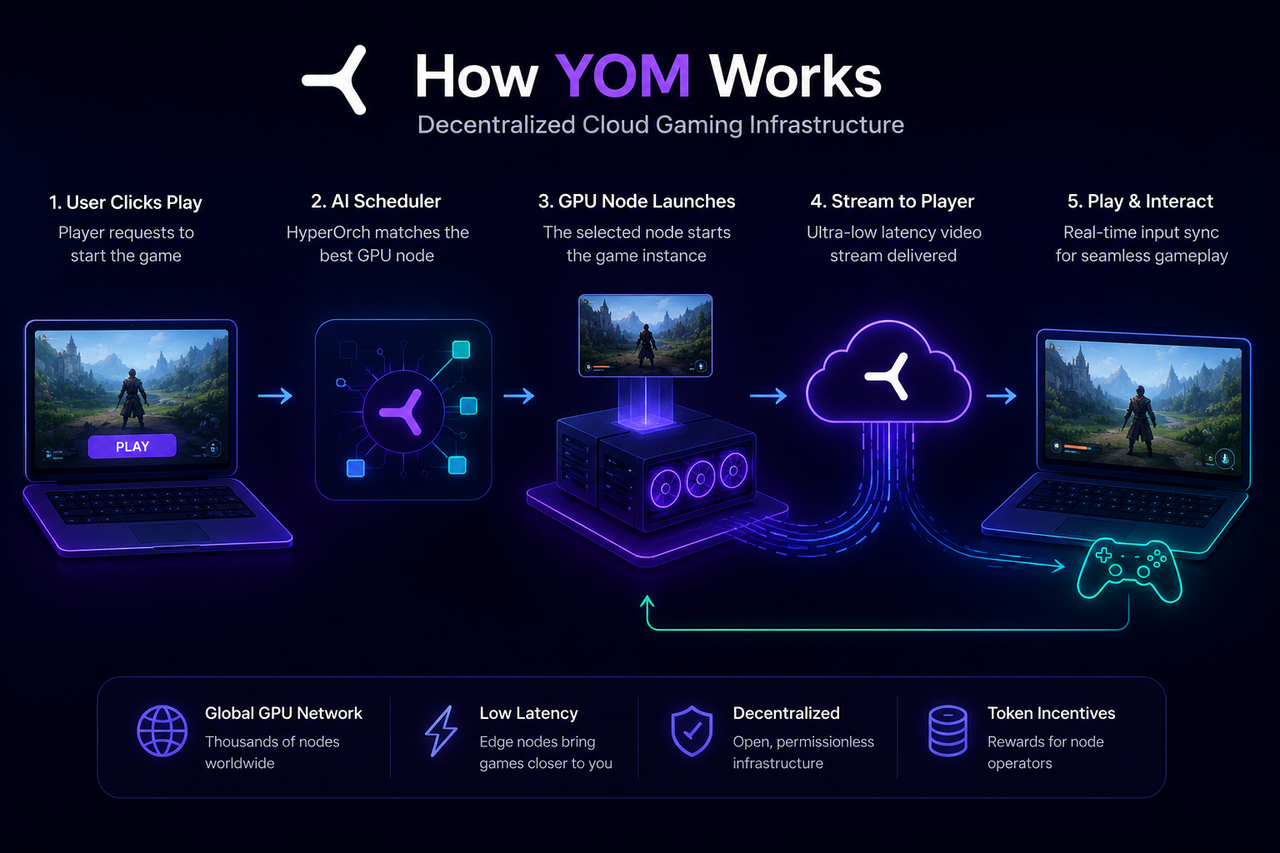
What Is YOM’s Cloud Gaming Operating Model?
YOM’s cloud gaming model means that games run on remote GPU nodes rather than on the player’s local device. The user’s device is only responsible for displaying visuals and sending control inputs, while all computing and graphics rendering are handled by remote nodes.
This model reduces the hardware requirements for end-user devices. Even with an ordinary laptop, tablet, or browser, users can access large games that would otherwise require a high-performance graphics card.
For developers, YOM provides a unified cloud-based runtime environment, allowing applications to be delivered directly to users over the network without complex adaptation for different devices.
What Happens After a User Clicks Play?
When a player enters a game page and clicks the Play button, the system first creates a new session request.
This request carries basic information such as the user’s location, network quality, device type, and game resource requirements, then sends it to the YOM network’s scheduling system.
At this point, the game has not yet started. The system must first determine which node will provide the service before it can allocate computing resources.
This process is different from visiting a video streaming website, because cloud gaming not only needs to transmit visuals but also continuously process user input and maintain real-time interaction.
How HyperOrch Finds the Best GPU Node
HyperOrch is the intelligent resource orchestration system in the YOM network.
After receiving a session request, HyperOrch evaluates the available nodes in the network. The evaluation criteria usually include the distance between the node and the user, current latency, GPU performance, resource utilization, and node operating status.
The system does not select nodes randomly. Instead, it prioritizes nodes that can provide the best experience.
If node resources in a certain region are insufficient, HyperOrch can also automatically migrate tasks to nearby regions to maintain service continuity.
How GPU Nodes Launch Game Instances
After a node receives a task, it automatically creates the corresponding game instance.
A game instance is essentially an independent execution environment running on a GPU server. It is responsible for loading game files, starting the engine, and preparing the runtime state.
At this stage, the node allocates CPU, GPU, memory, and network resources to the game.
Once the game starts successfully, the system enters the real-time streaming stage and begins sending the first frame of visuals to the user’s device.
The instantiation process is one of the key factors affecting launch speed, so the YOM network continuously optimizes resource scheduling and preloading mechanisms.
How Universal Streamer Transmits Game Visuals
After the game starts running, the GPU continuously generates rendered frames.
Universal Streamer’s job is to encode these frames into a video stream in real time and send it to the user’s device.
Unlike regular video platforms, cloud gaming needs to complete encoding, transmission, and decoding within an extremely short period; otherwise, users will clearly feel input lag.
To reduce latency, YOM uses a transmission mechanism optimized for real-time interactive scenarios, allowing visuals to reach end-user devices quickly.
Users do not need to download a large client. They can receive and display game content directly through a browser.
The interactive experience of cloud gaming depends on two-way data transmission.
When a player clicks a mouse, presses a keyboard key, or uses a controller, the input information is immediately sent back to the GPU node running the game.
After the game engine receives the command, it updates the visual state and generates the next frame.
The new frame is then sent back to the user’s device through Universal Streamer.
This loop repeats dozens or even hundreds of times per second, so network latency directly affects the gameplay experience.
How the System Handles Node Failures
Real-time gaming cannot tolerate long interruptions, so the network needs fault recovery capabilities.
If a GPU node encounters an abnormal issue, HyperOrch detects the change in node status.
Depending on the situation, the system can reallocate resources, migrate tasks, or switch to a backup node.
This mechanism helps reduce the impact of a single node failure on the user experience and is an important part of how decentralized infrastructure delivers stable service.
Both YOM and traditional cloud gaming platforms use remote servers to run games, but there are clear differences in how their underlying resources are organized.
Traditional platforms usually rely on a small number of large data centers to provide services, while YOM builds its computing layer with a distributed GPU node network.
| Comparison Dimension |
YOM |
Traditional Cloud Gaming Platforms |
| Node Source |
Community GPU nodes |
Enterprise servers |
| Scheduling Method |
Distributed orchestration |
Centralized management |
| Network Structure |
Decentralized |
Centralized |
| Scalability |
Scales through node growth |
Scales through data center expansion |
| Incentive Mechanism |
Token rewards |
Enterprise operations |
This difference means YOM is closer to an open infrastructure network, while traditional cloud gaming platforms are more like closed service platforms.
Summary of YOM’s Full Operating Process
From the moment a user clicks Play to the point where the game officially runs, YOM’s workflow can be summarized in six steps:
-
The user sends a game request;
-
HyperOrch receives and analyzes the request;
-
The system matches the optimal GPU node;
-
The node launches the game instance;
-
Universal Streamer transmits real-time visuals;
-
User input is continuously sent back, creating an interactive loop.
This process integrates globally distributed GPU resources into a unified service network, allowing developers and users to get an experience close to that of traditional cloud gaming platforms while preserving the scalability and resource utilization advantages of decentralized infrastructure.
Conclusion
YOM’s core value is not simply moving games to the cloud. It lies in enabling dynamic resource scheduling and real-time delivery through a decentralized GPU network. From the moment a user clicks Play, the HyperOrch scheduling layer finds the best node, the GPU server runs the game instance, and Universal Streamer handles low-latency visual transmission and input synchronization.
This architecture is not only suitable for cloud gaming, but also provides a new infrastructure model for real-time 3D rendering, virtual worlds, AI inference, and similar scenarios.
FAQs
How long does it take for YOM to launch a game after clicking Play?
YOM aims to complete node matching and game instance launch within a few seconds. The actual launch time depends on node resource conditions, the network environment, and the loading requirements of the game itself.
What does HyperOrch do in the YOM network?
HyperOrch is YOM’s intelligent resource orchestration system. It is responsible for evaluating node status, matching computing resources, and optimizing the connection path between users and GPU nodes.
What is the role of Universal Streamer?
Universal Streamer converts game visuals rendered by GPU nodes into a real-time video stream and synchronizes user input, creating a complete interactive experience.
How does YOM reduce game latency?
YOM reduces the distance between users and computing resources through edge GPU node deployment, intelligent node selection, and real-time streaming technology, thereby lowering overall network latency.
Who provides the GPU nodes in YOM?
GPU nodes in the YOM network are mainly provided by community operators. After contributing computing resources, nodes can participate in network services and receive corresponding incentives.