To start Gate CrossEx, users usually move through four practical steps: apply to enable the CrossEx account, transfer funds into that account, create an API key with Gate CrossEx permissions, and begin strategy execution through the API. After the strategy runs stably, users can contact customer service to request a higher account limit. That workflow shows that Gate CrossEx is positioned as professional cross-exchange trading infrastructure rather than a casual manual trading screen.

This guide explains the setup path in order. The core idea is not just to list buttons, but to show why account approval, funding structure, API permissions, and risk monitoring matter before a cross-exchange crypto trading strategy goes live. It can be read as a practical checklist before moving into the product itself. For background on the product itself, start with What Is Gate CrossEx.
Key takeaways
- Gate CrossEx usually starts with a dedicated account application rather than default access from a standard trading account.
- Funding the CrossEx account is a separate setup step because the strategy runs from the CrossEx account layer, not from an ordinary isolated venue account.
- API permissions are central to Gate CrossEx because the product is built for programmatic cross-exchange execution.
- Requesting a higher account limit typically comes after the strategy proves stable, which means rollout is staged rather than unlimited from day one.
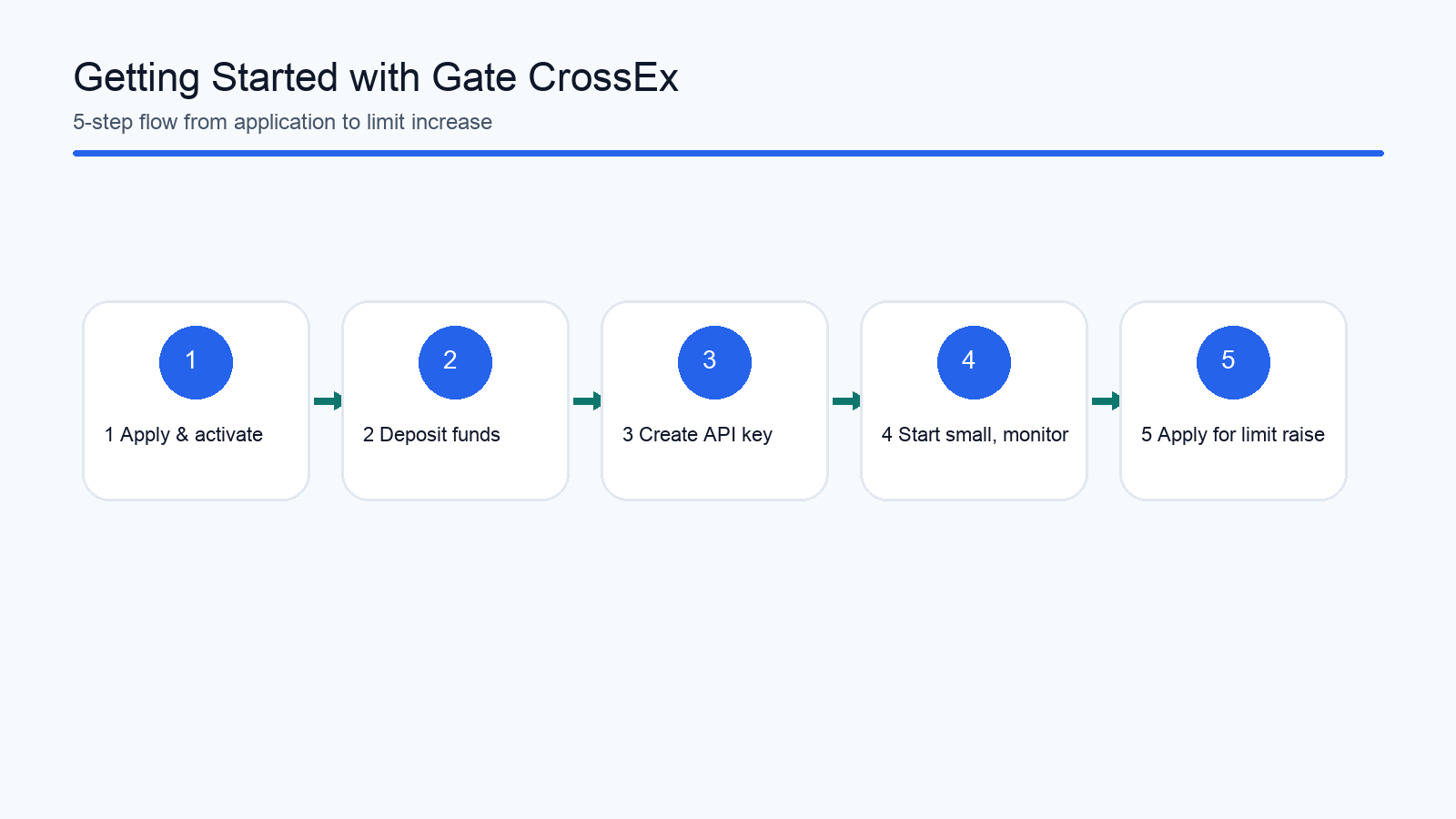
Image note: This flowchart outlines the five key steps to start using Gate CrossEx, from account application to scaling up.
What do you need before you start?
Before starting Gate CrossEx, users should confirm three preparation areas: account readiness, funding readiness, and API readiness. Account readiness means understanding that CrossEx is a dedicated cross-exchange account mode rather than a default extension of an ordinary trading account. Funding readiness means deciding which assets will support the strategy and whether the planned capital fits the intended workflow. API readiness means planning permissions, monitoring, and response steps before the first live order is sent.
That preparation matters because Gate CrossEx is not only a screen for manual trading. It is a workflow product for account management, funding, permissions, and multi-venue execution. A team that enters the process without aligning those pieces may still complete setup, but it is more likely to discover avoidable gaps during live trading.
The easiest way to think about the preparation stage is to treat it as a launch checklist. Users should know why they need CrossEx, what strategy the account is meant to support, which assets they plan to transfer, and who will monitor the first live phase. That makes the later steps easier to understand because each one belongs to a larger operating process instead of feeling like an isolated button click.
Step 1: Apply for a Gate CrossEx account
Gate CrossEx starts with account enablement. The product page instructs users to click Apply to request access and activate a CrossEx account. That is an important distinction from standard exchange features that are often available immediately after account registration. CrossEx appears to be a dedicated account mode with its own rules, access controls, and operational expectations.
Before applying, users should understand what type of workflow CrossEx supports. It is designed for cross-exchange strategy execution, not only for placing occasional manual trades. That means the account application is effectively the first risk filter: users should already know whether they need unified API access, shared margin, and multi-exchange routing before they open the account.
That early check helps ensure the account is being opened for the right purpose. A crypto trading team that wants one view across products, balances, and permissions will read the setup differently from a user who only wants a simple spot account. If the true need is single-venue spot trading, CrossEx may add a bottleneck instead of removing one. The product is more suitable when a team wants unified account management and a consistent workflow across connected exchanges.
Step 2: Transfer funds into the CrossEx account
After the account is enabled, the next step is to transfer funds into the Gate CrossEx account. The official product page lists Transfer as the second step because the account must hold usable funds before any cross-exchange strategy can be executed. In practice, this means traders need to think about the CrossEx account as its own operating capital base rather than assuming capital will be pulled automatically from unrelated account balances.
Funding matters because Gate CrossEx is built around shared margin and portfolio-level management. A strategy cannot use those advantages if the account is underfunded or funded without a clear capital plan. Before transferring, users should review which assets are supported, how account rules apply, and how the planned strategy will use margin across connected exchanges. The mechanism side is explained in shared margin and PnL offset mechanics.
This is also the point where users should read the relevant terms and product documentation carefully. In crypto trading, funding rules, supported collateral, and asset terms can affect how the workflow behaves after launch. If a strategy depends on assets such as BTC or stablecoins to support execution, the team should ensure the transfer plan matches the actual account setup rather than assuming all products behave the same way.
It also helps to note whether the setup is meant to support spot activity, derivatives routing, or a broader cross exchange margin workflow. Even if the article focuses on account setup rather than instrument detail, the funding source and collateral plan should still match the actual products the team intends to run.
Step 3: Create an API key with Gate CrossEx permissions
Gate CrossEx is designed for API-based execution, so creating the correct API key is a core setup step. The product page states that users should enable Gate CrossEx permissions when creating the API key. This matters because the strategy needs programmatic access to market data, account state, and trading actions under the CrossEx framework.
The role of the API key also reveals the product's intended user profile. Gate CrossEx is not mainly optimized for clicking around a retail UI. It is built for users who need automation, programmatic order flow, or quantitative execution across multiple exchange venues. A well-scoped API key is therefore part of both functionality and risk control: it grants access while also defining which operations the strategy is allowed to perform.
Users should also think about API setup as part of a wider product workflow. The API is not only a technical checkbox; it helps provide the account state, permissions, and execution path that automated crypto trading systems need. Taking time to read the API-related terms, confirm the source of permissions, and ensure monitoring is attached early can prevent avoidable workflow issues later.
For some teams, this API step is where the real operational bottleneck appears. A desk may already understand the strategy, but still need to ensure the right account view, source systems, and products are aligned before the first live order is sent. That is why this setup guide is best read as a process article, not only as a short checklist.
Once the account is funded and API access is configured, the strategy can begin running through Gate CrossEx. The first live phase should be treated as a monitored rollout rather than as a fully scaled production deployment. Early execution is where users confirm whether routing, shared margin usage, latency expectations, and risk visibility behave as expected in practice.
This stage is also where new product updates become relevant. CrossEx now includes market-data REST endpoints, ADL rank push on the private WebSocket channel, and updated risk parameters for major pairs. Those features matter most after the strategy starts running, because they support monitoring and operational adjustments. A trader using CrossEx should watch not only PnL, but also risk signals, symbol rules, and execution conditions across connected markets.
A practical launch plan usually starts small. Rather than deploying the full intended capital immediately, users can test whether funding flows, API permissions, order routing, and monitoring alerts work the way they expect. This lower-scale stage helps reveal gaps in logging, permission scope, or execution assumptions before the strategy reaches a larger account limit. For a cross-exchange system, that kind of staged testing is usually more useful than treating the first live day as a full production launch.
This testing phase is especially useful when more than one product view is involved. A strategy team may need to confirm whether account balances, position states, and risk signals appear clearly in the expected view before expanding size. In crypto trading, even a small mismatch between the intended setup and the observed account view can become a larger bottleneck once the strategy scales.
During this phase, desks should ensure the monitoring view is practical for the intended workflow. If the team expects to move from BTC-funded collateral to broader cross exchange margin usage, or from spot-oriented observation to multi-venue execution, the early launch window is the right time to read those signals carefully rather than after size has already increased.
Step 5: Request a higher account limit after stability is proven
The final step in the official workflow is to request a higher account limit after the strategy is running stably. This indicates that Gate CrossEx is designed to scale in phases. Instead of assuming full limits from the start, users are expected to prove that their setup is behaving reliably before asking for larger capacity.
This staged approach is common in professional trading environments because execution stability matters as much as raw strategy intent. A strategy that works in theory still needs to show that it can handle routing, risk monitoring, and account operations consistently. Asking for a higher limit only after stable performance helps align capacity with demonstrated operational readiness rather than with assumptions.
Before asking for a higher limit, users should be able to explain how the strategy behaves under normal and stressed conditions. That may include showing stable API execution, acceptable error handling, clear monitoring of risk signals, and consistent capital usage inside the CrossEx account. A limit increase is easier to justify when the trading workflow already looks operationally mature rather than experimental.
Common errors and how to fix them
The most common mistake is treating Gate CrossEx like a normal single-exchange account. Users may assume they can skip application, ignore account rules, or start trading before understanding funding and API permissions. That usually creates confusion because CrossEx is built on a different operating model.
Another common mistake is scaling too quickly. A strategy may look sound on paper but still fail in live multi-exchange execution if routing assumptions, venue behavior, or internal monitoring are not ready. Gate CrossEx is more useful when setup is deliberate: account first, capital second, API permissions third, monitored launch fourth, and scaling only after stability is proven.
It is also a mistake to think of the setup steps as isolated tasks. In reality, account approval, funding, API scope, strategy logic, and monitoring all depend on each other. A user who sets up the API but does not confirm funding logic, or who funds the account without clarifying the intended risk workflow, may still end up with an incomplete deployment. The smoother approach is to treat the whole setup as one connected process from approval through first stable execution.
One more practical check is documentation. Before going live, users should know where to find the CrossEx fee schedule, account rules, common questions, and operation guide listed in the Help Center. These references are useful when a strategy needs clarification on limits, permissions, or operating behavior. In a professional setup, knowing where the product rules live is part of being ready to trade, not an afterthought once the strategy is already active.
Finally, users should confirm who will respond if something in the workflow does not behave as expected. Because Gate CrossEx includes account approval, funding, API permissions, and limit management, operational readiness often depends on knowing whether the next step belongs to the strategy team, customer support, or the account manager. That simple escalation clarity can save time when the strategy moves from setup into live cross-exchange trading.
Taken together, these checks help ensure the setup is understood as an operating process rather than as a single activation step. That is especially important in crypto trading environments where products, permissions, and account terms may interact more closely than they do in a basic spot workflow.
| Common error |
Likely cause |
How to fix it |
| The strategy cannot start after application |
Account approval or permissions do not match the intended workflow |
Recheck account status, account rules, and the exact CrossEx permissions required |
| Funds are transferred but the setup still cannot run smoothly |
Capital was moved without a clear collateral or strategy plan |
Review supported assets, margin usage, and whether the account funding matches the live strategy |
| API access exists but execution quality is unstable |
Permission scope, monitoring, or account mapping is incomplete |
Reconfirm API scopes, monitoring coverage, and whether the strategy reads the correct account state |
| The team wants a higher limit too early |
Stability has not yet been demonstrated in live conditions |
Keep the rollout small, collect stable operating evidence, then request the higher limit |
Is starting Gate CrossEx safe?
Starting Gate CrossEx can be safer when users treat setup as a staged process rather than as an instant activation. The official workflow itself follows that logic: apply first, fund the account, configure API access, launch the strategy carefully, and only then request a higher limit. That sequence encourages users to validate permissions, funding, and monitoring before scaling exposure.
That does not mean the product removes trading risk. Cross-exchange strategies still face market volatility, liquidity constraints, routing issues, and operational mistakes. The safer approach is to keep the first live rollout small, confirm that account views and API permissions behave as expected, and watch risk signals closely before adding size.
In practice, "safe" here means disciplined setup rather than guaranteed outcomes. A team that treats Gate CrossEx as professional infrastructure and keeps clear limits on funding, permissions, monitoring, and escalation paths is usually better positioned than a team that assumes the product behaves like a basic single-venue account.
Summary
Starting Gate CrossEx is a structured workflow: apply for account access, transfer funds, create an API key with CrossEx permissions, launch the strategy, and request a higher limit after stable performance. Each step exists because Gate CrossEx is designed as cross-exchange trading infrastructure, not as a lightweight manual trading feature.
The key to a smooth start is understanding the product's operating model before the first live order is placed. Users who approach Gate CrossEx as a professional setup process will usually make better sense of the account, funding, API, and limit structure than users who expect an instant single-exchange experience. For a detailed comparison of the two account models, see CrossEx vs single-exchange account.
FAQ
Do I need to apply before using Gate CrossEx?
Yes. The official workflow begins with an application to enable the Gate CrossEx account, which suggests that access is not simply turned on by default for every ordinary trading account.
Why does Gate CrossEx emphasize API permissions?
Because the product is built for programmatic cross-exchange execution. API permissions let users connect strategies, trading logic, and monitoring systems to the CrossEx account framework.
Do I fund Gate CrossEx separately from other accounts?
In practice, yes. The official workflow includes transferring funds into the CrossEx account before trading begins, which means the account needs dedicated usable capital for strategy execution.
When should I request a higher CrossEx account limit?
The official guidance is to request a higher limit after the strategy is running stably, not before. That suggests scaling is expected to follow proven operational stability.