Gate CrossEx is a Gate cross-exchange trading platform built around a unified cross-exchange account system. It lets traders connect multiple exchange markets through one Gate CrossEx account, use shared margin across exchanges, aggregate cross-exchange profit and loss, and manage execution through a unified API and risk framework. In practice, Gate CrossEx is designed for quantitative trading, arbitrage, and multi-market strategies rather than simple single-exchange manual trading.
Instead of treating each exchange as a separate account, separate margin pool, and separate risk engine, Gate CrossEx puts cross-exchange trading into one operating layer. That matters for traders who want to route orders across venues, monitor strategy risk from one account view, and improve capital efficiency when positions on different exchanges interact with each other. The product page presents Gate CrossEx as a one-stop cross-exchange trading platform rather than just another trading interface.

Key takeaways
- Gate CrossEx uses a unified cross-exchange account so traders can access multiple exchange markets through one account structure instead of managing isolated venue accounts.
- Shared margin and cross-exchange PnL aggregation aim to break capital silos and improve capital efficiency for quantitative trading and arbitrage workflows.
- Gate CrossEx combines a unified API standard, unified clearing and settlement, and global risk control for multi-exchange strategy execution.
- Recent product updates added REST market-data endpoints, private WebSocket ADL rank push, RPI order support, and higher leverage limits for major pairs, showing that the platform is still expanding.
What is Gate CrossEx?
Gate CrossEx is Gate's cross-exchange trading platform. According to the official product page, the core design is a unified cross-exchange account system that supports shared margin across exchanges and centralized profit aggregation. That means Gate CrossEx is not only a dashboard that shows prices from different venues. It is an account and execution framework built to let one trading account operate across several exchange markets under one ruleset.
For traders, the practical difference is that multi-exchange execution no longer needs to be managed as a set of fully separate trading accounts. With Gate CrossEx, order routing, positions, margin usage, and profit and loss can be viewed from one strategy layer. For quantitative teams, arbitrage desks, and API-driven traders, a unified cross-exchange model can be easier to operate than stitching together many exchange-specific account systems and risk checks.
What is Gate CrossEx used for?
Gate CrossEx is most useful in strategies that need more than one exchange venue. Typical examples include cross-exchange arbitrage, quantitative spread trading, systematic market making, and multi-market portfolio execution. These workflows often need to compare prices, move exposure, and manage risk across several venues at the same time. The official Gate CrossEx positioning around quantitative arbitrage and shared margin reflects that use case.
For users with only occasional single-market trades, the value of Gate CrossEx may be limited. But for traders who care about venue coverage, capital efficiency, and unified controls, the product solves a different problem from a standard exchange account. The point is not simply to trade more symbols. The point is to run cross-exchange trading with one account, one API standard, and one risk framework.
How does the Gate CrossEx unified account work?
The Gate CrossEx account is designed as a unified account layer above multiple exchange markets. Instead of opening and managing isolated margin pools for every underlying venue, traders use one CrossEx account to access connected markets. The official product page highlights compatibility across underlying financial rules, a unified API standard, and a low-latency routing engine that helps bypass single-point rate limits.
This unified account structure changes how strategy operations feel in practice. Traders can focus more on the strategy logic and less on maintaining separate venue-specific account workflows. A single integration can handle assets, positions, and execution across connected markets. That is one reason Gate CrossEx is more relevant to API-based and quantitative trading than to occasional manual order placement.
How do shared margin and PnL offset work in Gate CrossEx?
Shared margin is one of the main features of Gate CrossEx. The product page says CrossEx breaks capital silos by letting a single margin balance be shared across exchanges, while cross-exchange PnL is aggregated so that position profit and loss can offset each other at the portfolio level. The goal is to increase capital efficiency rather than forcing traders to reserve separate collateral for every venue.
This matters because fragmented margin often wastes capital in multi-exchange trading. A strategy can be net balanced at the portfolio level while still tying up duplicated collateral on separate venues. Shared margin and PnL offset aim to reduce that inefficiency. They do not remove market risk, liquidity risk, or strategy risk, but they can improve how capital is allocated and monitored when several venues are involved. A deeper mechanism discussion belongs in the shared margin and PnL offset mechanics.
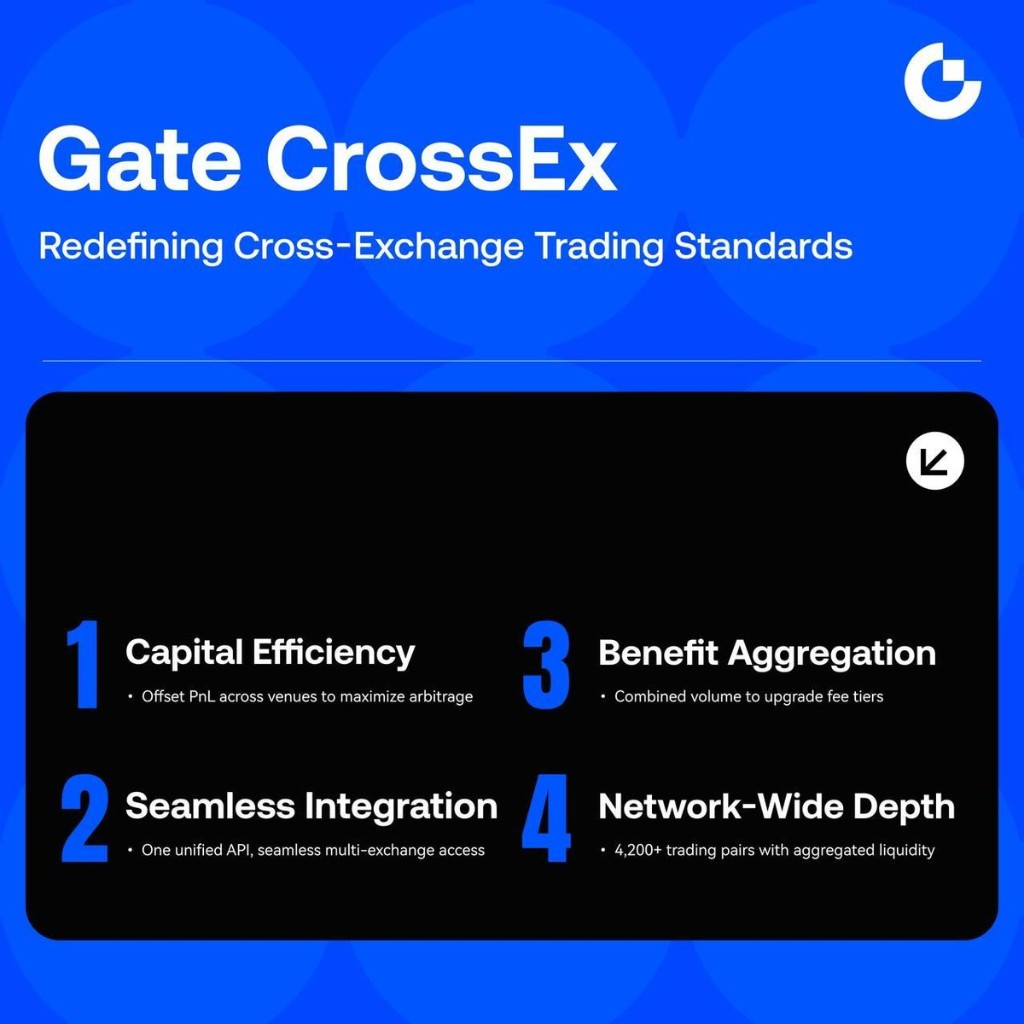
Image note: Gate's official feature graphic summarizes the product's core selling points, including capital efficiency, unified access, benefit aggregation, and network-wide depth.
How is Gate CrossEx different from a single-exchange trading account?
The biggest difference between Gate CrossEx and a standard single-exchange trading account is the operating model. A normal exchange account follows one venue's own trading rules, margin system, API conventions, and risk controls. Gate CrossEx tries to abstract that complexity into a unified cross-exchange framework, so the trader works from one account model while connected to several venues.
That makes Gate CrossEx better suited to strategy execution across markets, while a single-exchange account remains more straightforward for users who only need direct trading on one platform. The choice depends on strategy requirements rather than on interface preference. Traders who need shared margin, unified risk control, and centralized monitoring may benefit from Gate CrossEx. Traders who only need a standard venue workflow may prefer a normal account. The full comparison is expanded in the CrossEx vs single-exchange account article.
| Dimension |
Gate CrossEx |
Single-exchange trading account |
| Account scope |
One unified cross-exchange account |
One account tied to one exchange |
| Margin model |
Shared margin across exchanges |
Margin usually isolated by platform |
| PnL management |
Cross-exchange aggregation and offset |
PnL tracked separately by venue |
| API access |
Unified API standard |
Venue-specific API rules |
| Risk framework |
Unified global risk control |
Native single-venue risk rules |
| Best fit |
Arbitrage, quant, multi-market execution |
Standard single-market trading |
What APIs, market data, and risk features does Gate CrossEx provide?
Gate announced a product upgrade on July 30, 2026 that added new market-data REST endpoints and private WebSocket risk data to Gate CrossEx. The new GET endpoints include /api/v4/crossex/market/funding_info for funding information and /api/v4/crossex/market/tickers for ticker market data. The same update added private WebSocket ADL rank push so users can monitor auto-deleveraging rank changes for their account in real time.
The announcement also says Gate CrossEx now supports RPI orders for eligible users and that users can check symbol support through the symbol rules endpoint. Risk parameters for major pairs were updated as well, including higher max leverage up to 25x and lower maintenance margin rates. These details show that Gate CrossEx is not just a trading page. It is a programmatic trading environment with expanding data, risk, and order-management capabilities for cross-exchange trading.
How do you start using Gate CrossEx?
The official Gate CrossEx product page describes a simple high-level workflow: apply to enable a CrossEx account, transfer funds into the account, create an API key with CrossEx permissions to trade through the API, and request a higher account limit from customer service after the strategy is running stably. The Help Center also lists account fee schedules, account rules, common questions, and an account operation guide under the CrossEx Trading section.
This setup path shows that Gate CrossEx behaves more like a professional trading capability than a default account mode for every user. Before using it, traders should understand account rules, supported transfer assets, API permissions, and the role of shared margin in the strategy. If the product is viewed as trading infrastructure rather than a simple button-based feature, the workflow makes more sense. A step-by-step operational guide fits the CrossEx account setup and API workflow article.
What are the advantages and limits of Gate CrossEx?
The main advantages of Gate CrossEx are unified market access, shared margin, centralized PnL visibility, unified API access, and a single risk framework across connected exchanges. For quantitative trading and arbitrage teams, this can reduce operational complexity and improve capital efficiency. Unified clearing, settlement, and reconciliation also make it easier to monitor cross-exchange strategies from one place instead of reconciling every venue independently.
The limits are equally important. Gate CrossEx is more useful for traders with real multi-exchange strategy needs than for users who only want a basic account for one market. Some features may depend on permission scope, symbol support, or whitelist access. Unified management also does not eliminate cross-market risk, execution differences, or liquidity constraints. The platform can simplify cross-exchange trading operations, but the strategy still has to handle market risk and implementation risk.
Summary
Gate CrossEx is Gate's cross-exchange trading platform for traders who need one account, one API framework, and one risk view across multiple exchange markets. Its key ideas are a unified cross-exchange account, shared margin across exchanges, PnL aggregation and offset, unified clearing and settlement, and global risk control. Those features make Gate CrossEx especially relevant for quantitative trading, arbitrage, and multi-market strategy execution.
Understanding Gate CrossEx starts with seeing it as trading infrastructure instead of a standard exchange account. It is designed to coordinate accounts, capital, routing, and risk across venues rather than only to place isolated orders on one market. For readers who want to go deeper, the most useful next questions are how to start using the product, how shared margin and PnL offset work, and how Gate CrossEx differs from a standard single-exchange trading account.
FAQ
What is Gate CrossEx?
Gate CrossEx is Gate's cross-exchange trading platform that lets traders access multiple exchange markets through a unified account with shared margin, centralized PnL aggregation, unified risk control, and API-based execution.
What is Gate CrossEx used for?
Gate CrossEx is mainly used for quantitative trading, cross-exchange arbitrage, market making, and other multi-market strategies that benefit from unified margin, one API standard, and centralized risk management.
How does Gate CrossEx shared margin work?
Gate CrossEx shared margin allows one margin balance to be used across connected exchanges, while cross-exchange PnL is aggregated so profits and losses can be managed at the portfolio level instead of only at each separate venue.
Does Gate CrossEx support API trading?
Yes. The official workflow includes creating an API key with Gate CrossEx permissions, and product updates show expanding REST market-data endpoints, private WebSocket risk feeds, and order features.
How is Gate CrossEx different from a standard exchange account?
Gate CrossEx uses a unified cross-exchange account and risk framework for multiple venues, while a standard exchange account usually follows one platform's own margin system, APIs, and risk rules.
How do you start using Gate CrossEx?
Users generally apply to enable a Gate CrossEx account, transfer funds into it, create an API key with CrossEx permissions, start trading through the API, and request a higher limit after the strategy proves stable.