Gate CrossEx shared margin and PnL offset are two of the product's most important ideas. Shared margin means one margin balance can be used across connected exchanges inside the Gate CrossEx framework. PnL offset means profits and losses from positions across those connected venues can be aggregated and evaluated at the portfolio level rather than only as isolated venue-level numbers. Together, these mechanisms are intended to break capital silos and improve capital efficiency for cross-exchange trading strategies.
For traders who run strategies on more than one exchange, capital fragmentation is often a bigger problem than order entry itself. A portfolio may be balanced overall but still lock up separate collateral in separate venue accounts. Gate CrossEx addresses that problem by treating capital, margin, and PnL through a more unified lens. This is one reason the feature matters in crypto trading, where desks often need to add new positions, read risk quickly, and move across a series of venues without treating each venue as a separate capital island. For product background, see What Is Gate CrossEx.
Key takeaways
- Shared margin means Gate CrossEx can use one margin framework across connected exchanges instead of forcing each venue to hold its own fully isolated pool.
- PnL offset aggregates profits and losses across exchanges so risk can be viewed closer to the portfolio level rather than only at the venue level.
- These features are especially useful for arbitrage, hedging, market making, and other quantitative strategies that span multiple venues.
- Shared margin improves capital efficiency, but it does not remove market risk, liquidity risk, or implementation risk.
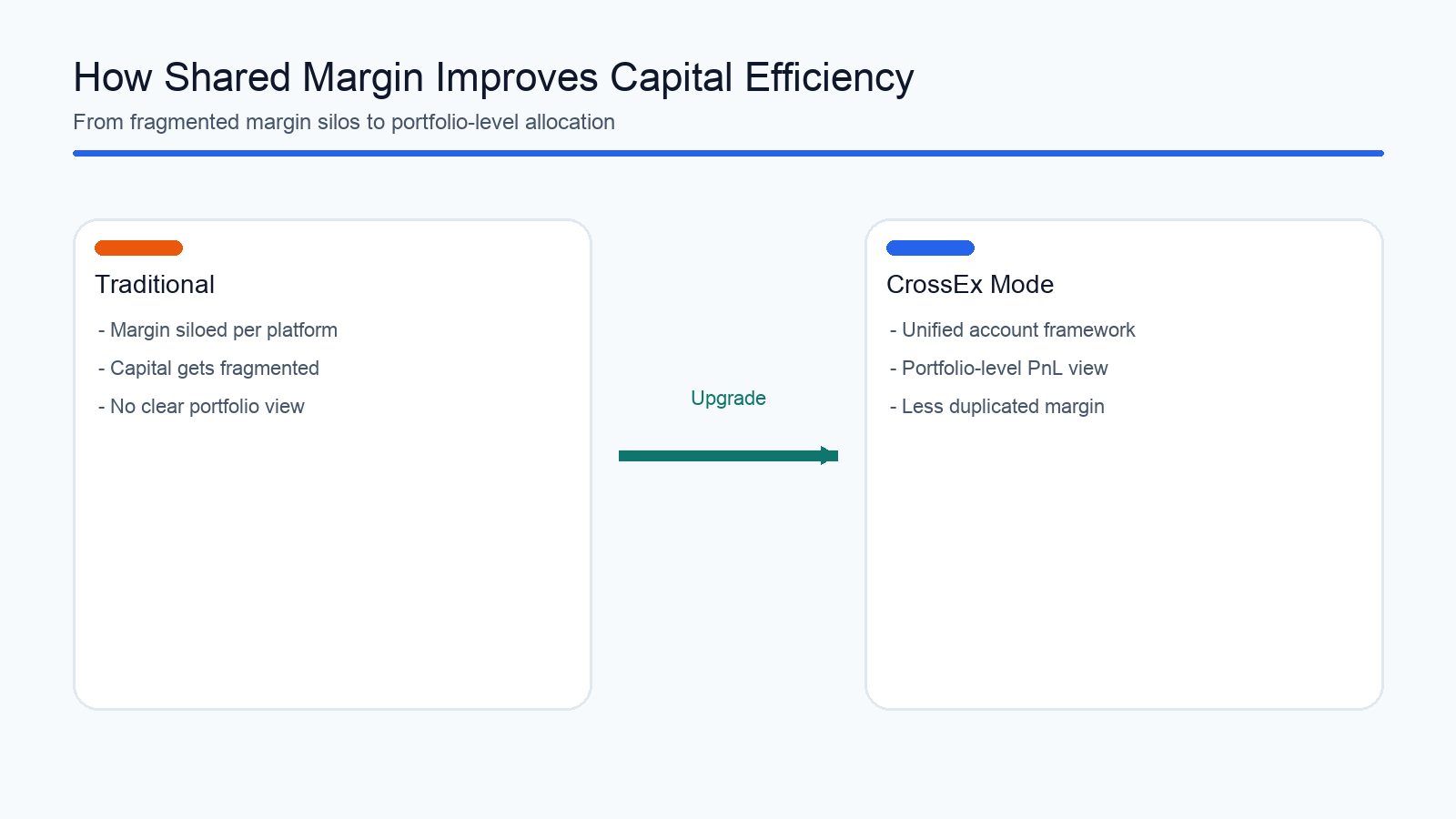
Image note: This visual compares fragmented venue-by-venue collateral use with a unified CrossEx account structure that improves capital efficiency through shared margin.
What does shared margin mean in Gate CrossEx?
Shared margin in Gate CrossEx means the platform does not treat every connected exchange as a fully isolated collateral island. Instead, one margin balance can support cross-exchange trading activity inside the unified Gate CrossEx account system. The official product page describes this as breaking capital silos and allowing margin to be shared across exchanges in real time.
That matters because isolated collateral creates friction. If a trader runs positions on several venues, each venue may otherwise require its own capital reserve even when the total strategy is balanced at the portfolio level. Shared margin is designed to reduce that duplication. In other words, the feature is not about increasing risk blindly; it is about letting capital serve a broader multi-exchange strategy more efficiently.
Another way to understand shared margin is to compare it with the familiar experience of funding separate venue accounts. In a fragmented setup, a trader may hold excess collateral on one venue while another venue is the one that actually needs usable margin for the live strategy. Shared margin changes that logic by placing the emphasis on the CrossEx account as the capital center. That can reduce the amount of idle capital sitting in disconnected pools.
For a cross-exchange arbitrage desk, that shift is mechanical rather than theoretical. The desk may need to add exposure on one venue while reducing it on another, yet the strategy still belongs to one portfolio. Shared margin helps the system read available resources at that portfolio level. It is particularly useful in crypto trading when execution timing matters and the strategy team wants less friction between capital planning and live routing.
What does PnL offset mean in Gate CrossEx?
PnL offset in Gate CrossEx means profits and losses from positions across connected exchanges can be aggregated when evaluating the overall account state. The product page highlights centralized profit aggregation and cross-exchange PnL offset because multi-venue strategies often generate gains in one place while carrying temporary losses in another.
Without an offset view, those positions may look disconnected even if they are parts of one logical trade or one hedged portfolio. With a portfolio-level perspective, the trader can evaluate whether the overall strategy is balanced rather than overreacting to one venue in isolation. That makes PnL offset particularly relevant in arbitrage and spread workflows where one leg may temporarily look weak while the broader position is functioning as designed.
PnL offset is especially useful when the strategy is supposed to work as a combined structure rather than as a list of unrelated trades. A temporary loss on one venue may reflect the cost of carrying the hedge or the timing of a price dislocation, while gains on another venue capture the other side of the same logic. Evaluating those legs together gives a more accurate view of what the strategy is actually doing.
This is also where the fee-sensitive desk and the volume-maintenance desk may see value. A strategy team that needs to maintain venue activity, add or reduce positions, and note whether the portfolio is improving overall does not want to read each exchange in isolation. PnL offset helps turn a scattered series of venue outcomes into one portfolio-level picture that is easier to interpret.
Why do shared margin and PnL offset improve capital efficiency?
Capital efficiency improves when margin and PnL are not trapped inside venue-specific silos. A trader using separate exchange accounts often has to over-allocate collateral because each venue wants its own safety buffer. That can leave capital idle even when the broader strategy is net balanced. Shared margin and PnL offset attempt to reduce that mismatch between strategy reality and account structure.
The benefit is operational as well as financial. When capital is easier to monitor at the portfolio level, a strategy team can spend less time manually reconciling isolated accounts and more time managing actual risk. That does not mean every strategy automatically becomes safer, but it can mean the same capital base is used more effectively in a multi-market environment.
For many trading teams, capital efficiency is not only about reducing unused funds. It is also about making decisions faster. A unified view of available margin and net portfolio performance makes it easier to decide whether a strategy should scale, hedge, reduce exposure, or pause. In a fragmented setup, those decisions can be delayed because the relevant information is spread across several separate account contexts.
In crypto trading, that speed of interpretation can matter as much as the balance sheet effect. A desk that can read whether more collateral is needed, note whether one venue is draining resources, and add capital only where it is actually needed is working from a more coherent control model. That does not guarantee performance, but it improves the mechanics of how a multi-venue strategy is managed.
Which strategies depend most on shared margin and PnL offset?
These features matter most in strategies that naturally span more than one exchange. Cross-exchange arbitrage is the clearest example because the strategy usually holds related positions on different venues at the same time. Market making, hedging, spread trading, and other quantitative workflows can also benefit because they often need to compare, balance, and rebalance exposure across connected markets.
In those settings, the question is not only whether a strategy can place orders. The deeper question is whether the account system reflects how the strategy actually works. Gate CrossEx shared margin and PnL offset are valuable precisely because they are closer to the way multi-venue strategies think: portfolio first, venue second.
This is one reason CrossEx is better understood as trading infrastructure than as a retail convenience feature. The user benefit is strongest when the strategy already has a real operational need for unified capital treatment. If the strategy only trades one market or does not require cross-venue coordination, the efficiency gain from shared margin may not be meaningful enough to matter.
Seen this way, Gate CrossEx shared margin sits in the execution and account-management layer of the stack rather than in the research or signal-generation layer. It does not tell traders what to trade. Instead, it changes how capital, margin, and risk are handled once the desk already knows what it is trying to do. That positioning helps explain why the feature is most relevant to institutional-style crypto trading workflows instead of casual single-venue use.
How do shared margin, clearing, settlement, and risk control fit together?
Shared margin does not stand alone. Gate CrossEx also emphasizes unified clearing and settlement together with global risk control. These pieces support each other. If a platform wants to let traders share margin and evaluate PnL across exchanges, it also needs a consistent way to reconcile positions, monitor risk, and intervene when risk thresholds are breached.
That is why Gate CrossEx looks more like infrastructure than a simple feature toggle. Shared margin changes how capital is used, PnL offset changes how performance is interpreted, and unified clearing and risk control change how the whole system stays coherent. The design only works if those components reinforce each other.
This relationship is important because a shared-margin system without coordinated risk controls could create confusion instead of efficiency. If capital is treated as shared, then liquidation logic, maintenance thresholds, account warnings, and reconciliation all need to align with that model. Gate CrossEx presents those elements as part of one architecture rather than as separate add-ons.
What are the limits or misunderstandings around shared margin?
The biggest misunderstanding is to treat shared margin as free risk reduction. It is not. Shared margin improves capital efficiency, but market moves, liquidity gaps, correlation shocks, and strategy failure can still produce losses. PnL offset also does not mean every losing leg is harmless. It simply means the platform can evaluate a broader portfolio picture rather than only one isolated account line.
Another misunderstanding is to assume the product removes all operational complexity. Gate CrossEx may simplify multi-exchange management, but strategy teams still need robust monitoring, API discipline, and risk controls. Shared margin is most useful when the trader already understands why capital fragmentation is a problem and how portfolio-level trading logic differs from isolated venue trading.
It is also easy to confuse efficiency with safety. Shared margin may allow capital to be used more flexibly, but that does not make a weak strategy strong. If the underlying model is poorly designed, uses excessive size, or depends on fragile execution assumptions, a more efficient capital structure can still lose money. The feature improves the operating framework, not the quality of the strategy itself.
One useful note is that users should separate three questions: whether shared margin is needed, whether the desk can read and monitor the portfolio correctly, and whether the strategy logic itself is sound. Gate CrossEx can help with the first two by improving the account framework for crypto trading, but it does not solve the third. A stronger operating model is valuable, yet it still depends on disciplined execution and realistic assumptions. For teams ready to configure the account, the CrossEx account setup and API workflow article covers the operational steps.
Summary
Gate CrossEx shared margin and PnL offset are designed to solve one of the main problems in cross-exchange trading: capital fragmentation. Shared margin lets one balance support positions across connected exchanges, while PnL offset aggregates profits and losses so the strategy can be viewed closer to the portfolio level.
These features are most valuable for arbitrage, hedging, market making, and other multi-venue quantitative strategies. They improve capital efficiency and operational clarity, but they do not remove market or execution risk. Understanding that distinction is the key to understanding why Gate CrossEx is structured the way it is. For a side-by-side look at account models, see CrossEx vs single-exchange account.
FAQ
What is Gate CrossEx shared margin?
Gate CrossEx shared margin means one margin balance can be used across connected exchanges inside the CrossEx account framework instead of forcing every venue to rely on a fully isolated collateral pool.
What is PnL offset in Gate CrossEx?
PnL offset means profits and losses from positions across connected exchanges can be aggregated at the portfolio level, helping traders interpret the full strategy rather than each venue in isolation.
Why does shared margin matter for arbitrage?
Arbitrage strategies often hold related positions on different exchanges at the same time. Shared margin helps those strategies use capital more efficiently than a setup where each venue requires a separate isolated reserve.
Does shared margin remove trading risk?
No. It improves capital efficiency, but it does not remove market risk, liquidity risk, correlation risk, or strategy execution risk.