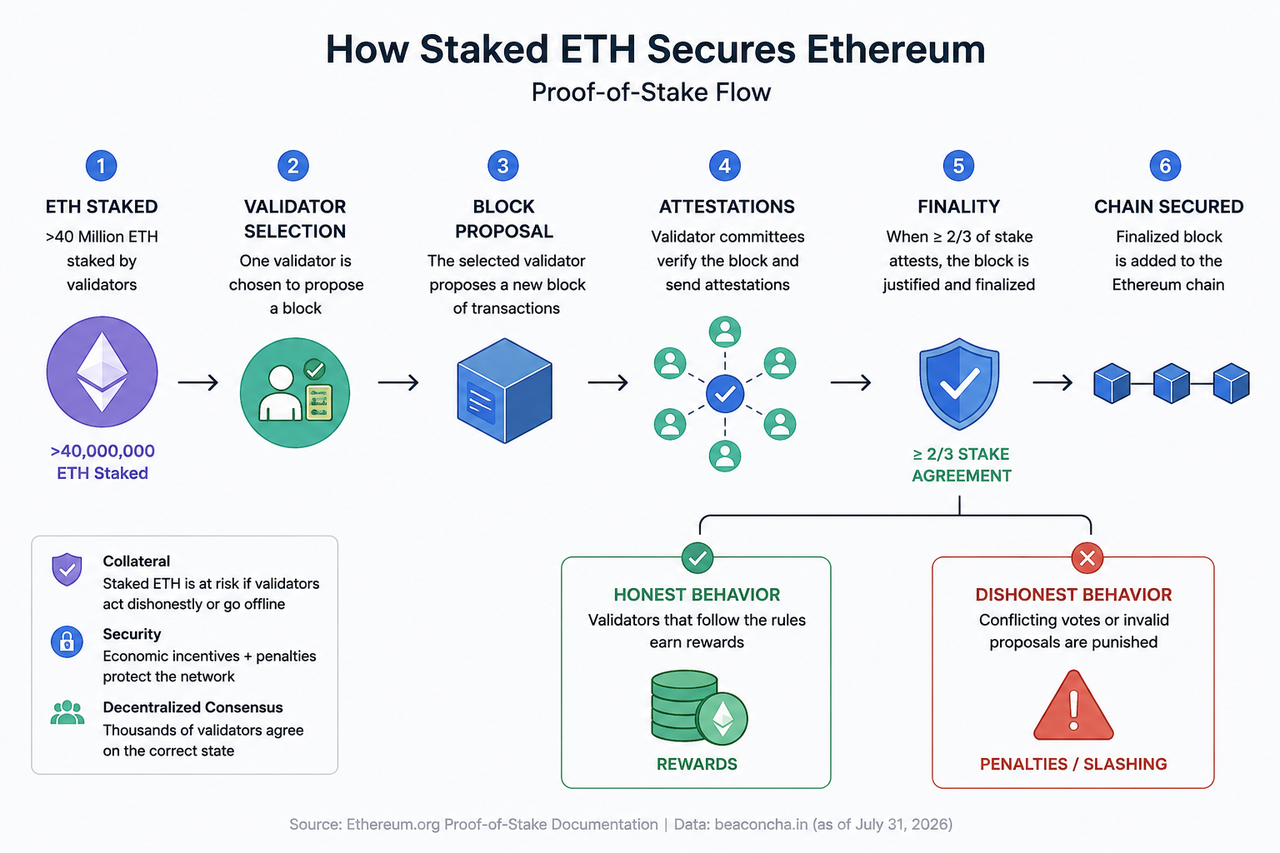
Ethereum relies on validators that commit ETH as collateral before participating in consensus. Since more than 40 million ETH now supports the Proof-of-Stake system, manipulating the blockchain would require extraordinary financial resources, with any malicious stake remaining vulnerable to penalties, ejection and slashing.
TL;DR
-
More than 40 million staked ETH now serves as economic collateral behind Ethereum’s consensus mechanism.
-
Validators propose blocks, verify signed transactions and attest to the chain state they consider valid.
-
Ethereum reaches finality when validators representing at least two-thirds of the relevant stake support compatible checkpoints.
-
Honest participation earns rewards, while inactivity and provably conflicting votes can reduce a validator’s ETH.
-
More stake raises the economic cost of an attack, but operator, client and geographic diversity remain essential to Mainnet security.
What Does the 40-Million ETH Milestone Mean for Ethereum Mainnet Operation?
The milestone means that validators have committed more than 40 million ETH to securing Ethereum Mainnet operation. This ETH is not simply deposited to produce yield. It acts as economic collateral behind decisions about which blocks and transactions become part of the canonical Ethereum blockchain.
Ethereum Mainnet is the live network where real transactions happen and assets carry real monetary value. Unlike testnets, which use valueless tokens so developers can test a user interface, debug application development and trial smart contracts without risking real funds, Mainnet processes real ETH, ERC-20 tokens, non-fungible tokens and tokenized real-world assets.
Ethereum Mainnet launched on July 30, 2015, when the genesis block established the main network. It has since developed into a public blockchain supporting smart contract execution, decentralized finance, NFT marketplaces and other decentralized applications. Thousands of independently operated nodes maintain and verify copies of blockchain data rather than relying on one central authority.
The wider architecture behind this continuity is examined in Ethereum Mainnet Operation: The Secrets to 11 Years of Zero Downtime.
How Does Proof of Stake Secure the Ethereum Network?
Proof of Stake secures the Ethereum network by connecting consensus influence to ETH that can be financially penalized. Validators are selected to propose blocks, while committees of other validators check those blocks and publish attestations.
Ethereum divides time into 12-second slots. During a slot, a selected validator proposes a block containing signed transactions. Other validators check whether the block follows the Ethereum protocol, whether transaction signatures are authentic and whether each Ethereum account has sufficient balance and a valid nonce.
Every normal Ethereum transaction is cryptographically signed with the sender’s private key. Nodes use that signature to verify authorization before a transaction can be considered valid. Once included in a block, additional blocks and consensus votes provide increasing confidence, while protocol finality offers a stronger guarantee than merely counting confirmations.
Validators normally perform four connected functions:
-
Propose blocks: A selected validator assembles valid transactions into a candidate block.
-
Verify execution: Nodes independently check the proposed block and its resulting state.
-
Publish attestations: Other validators vote for the chain head and relevant checkpoints.
-
Create finality: Checkpoints become finalized when at least two-thirds of the participating stake supports the required votes.
A validator cannot make an invalid transfer valid merely by including it in a block. Other validators and nodes execute the same rules and reject blocks that violate the protocol.
Why Did Ethereum Replace Proof of Work?
Ethereum replaced Proof of Work because Proof of Stake could preserve blockchain security without requiring miners to compete through large-scale energy consumption.
The Merge occurred on September 15, 2022, joining the Beacon Chain consensus layer with the existing Ethereum Mainnet execution layer. Ethereum’s consensus mechanism has used Proof of Stake since that date, reducing estimated network energy consumption by about 99.95%. Proof of Work was deprecated, but the Ethereum Virtual Machine, smart contracts, user accounts and transaction history continued on the same main chain.
This differs from the Bitcoin network, which continues to use Proof of Work. Bitcoin miners secure its blockchain by expending computational energy, whereas Ethereum validators secure the network by placing native cryptocurrency at risk.
The transition formed part of Ethereum’s broader upgrade roadmap rather than creating a new asset or resetting the chain. Token holders retained the same ETH, and existing ERC-20 assets and decentralized applications continued operating.
How Does the Ethereum Virtual Machine Execute Smart Contracts?
The Ethereum Virtual Machine executes smart contracts consistently across the decentralized network. Each validating node processes the same instructions, checks the resulting data and determines whether a transaction follows Ethereum protocol rules.
Developers commonly write Ethereum smart contracts in Solidity, a programming language specifically designed for EVM-compatible application development. After compilation and deployment, the contract receives an on-chain Ethereum account and can hold assets, update its state or interact with other contracts according to its code.
Smart contracts reduce dependence on third-party intermediaries, but they do not automatically eliminate every form of trust. Users still depend on correct contract code, secure interfaces, reliable data sources and appropriate governance. Common examples include:
-
decentralized exchanges and lending markets;
-
ERC-20 token contracts;
-
NFT marketplaces and digital art ownership records;
-
stablecoins and tokenized real-world assets;
-
decentralized autonomous organizations;
-
blockchain games and digital identity systems.
The EVM gives these applications shared functionality and composability. One DeFi protocol can interact with another because both operate within the same execution environment and use compatible token standards.
How Do ERC-20 Tokens and Digital Assets Use Mainnet Security?
ERC-20 tokens inherit Ethereum Mainnet security because transfers and contract updates are executed within blocks confirmed by Ethereum validators. ERC-20 defines common token functionality, such as checking balances, transferring assets and authorizing another account to spend tokens.
Non-fungible tokens use different standards to represent distinguishable assets. An NFT may establish control of a token recorded on chain, although true ownership of associated digital art or intellectual-property rights still depends on the contract and legal terms.
Ethereum’s native cryptocurrency is Ether, or ETH. ETH pays transaction fees, provides staking collateral and carries transaction value across the network. ERC-20 tokens are smart-contract assets rather than native tokens at the protocol level.
This distinction matters during network congestion. Users cannot normally pay Ethereum Mainnet gas fees directly with an arbitrary ERC-20 token. They need ETH because protocol-level transaction fees are denominated in the network’s native cryptocurrency.
How Do Gas Fees and EIP-1559 Affect Ethereum Mainnet?
Gas fees price the computation and block space consumed by each transaction. A basic ETH transfer normally needs less gas than a complex interaction with DeFi applications because smart contract execution requires more operations.
Gas prices are commonly expressed in gwei. One gwei equals one-billionth of an ETH. The total fee depends broadly on the gas consumed multiplied by the effective gas price.
EIP-1559, activated through the London upgrade in August 2021, introduced a dynamically adjusting base fee. The protocol burns that base fee, while an optional priority fee rewards the validator proposing the block. This design improved fee estimation and predictability, but it did not guarantee low transaction fees.
When network demand exceeds available block space, the base fee rises and users may pay more gas for timely inclusion. When demand declines, gas prices generally fall. The amount of ETH burned since EIP-1559 is no longer accurately described by the older 1.9-million-ETH figure; cumulative burning changes continuously and should be checked through a current supply or burn dashboard rather than embedded as a permanent statistic.
An Ethereum Improvement Proposal is a technical design document describing a proposed standard, protocol feature or process. An EIP does not alter Ethereum merely because it has been published. Core changes still require review, implementation, testing and network agreement.
How Do Layer 2 Networks Reduce Transaction Fees?
Layer 2 networks process many transactions outside Ethereum’s main execution environment and submit compressed data or proofs back to Ethereum. This allows more transactions to happen faster and more cheaply while using Ethereum Mainnet for settlement and data availability.
Rollups are now central to Ethereum’s scaling roadmap. Earlier plans often described shard chains that would directly execute transactions in parallel. Ethereum’s current direction instead emphasizes rollup scaling and upgrades that expand the data capacity available to Layer 2 systems.
Polygon illustrates why scaling terminology requires precision. Polygon PoS is commonly categorized as an Ethereum-linked sidechain, while Polygon zkEVM is a Layer 2 rollup. Referring to every Polygon network as the same type of Ethereum Layer 2 obscures important security and settlement differences.
A claim that Ethereum has a maximum theoretical throughput of exactly 238 transactions per second also needs qualification. Ethereum Mainnet throughput varies with transaction complexity and gas limits, while much higher figures generally combine Mainnet with Layer 2 activity. Ethereum’s official anniversary material describes the wider ecosystem as processing more than 250 transactions per second, not the base layer alone.
Why Does More Staked ETH Increase Mainnet Security?
More staked ETH generally increases the monetary value an attacker must control or corrupt to influence Ethereum consensus.
| Share of participating stake |
Potential effect |
Main defence |
| Less than one-third |
Limited ability to disrupt finality alone |
Honest supermajority continues consensus |
| About one-third |
Can obstruct finality under certain conditions |
Inactivity leak, penalties and coordinated recovery |
| More than one-half |
Can exert substantial influence over chain-head selection |
Large capital requirement and observable behaviour |
| At least two-thirds |
Could attempt to finalize conflicting history |
Extensive slashable exposure and community recovery measures |
These thresholds are simplified consensus boundaries, not guarantees that an attack would succeed. Client software, network conditions, validator coordination and social recovery can affect the result.
Staking security also depends on distribution. Forty million ETH controlled through many independent validators, clients, hosting environments and jurisdictions produces stronger decentralization than the same total concentrated under a small number of operators.
The ETH staking guide explains how solo staking, pooled staking and managed services distribute responsibility differently. Liquid staking can make staked capital usable in decentralized finance, but it adds smart contract, governance, liquidity and concentration risks. Restaking extends collateral to additional services and introduces another set of dependencies, as outlined in Re-Staking Explained: EigenLayer Protocol and Security Risks.
How Can Users Access the Ethereum Network?
Users can access the Ethereum network through a wallet, decentralized application or software connected to an Ethereum node through an RPC endpoint. The RPC interface lets a user interface request account balances, read on-chain data, estimate gas fees and broadcast signed transactions.
Wallets such as MetaMask simplify this process, but the wallet does not contain assets in the same way that a physical wallet contains cash. Assets remain recorded on the blockchain, while the wallet manages the keys used to control an account.
Before users send ETH, they should verify:
-
that the selected network is Ethereum Mainnet rather than a testnet or another EVM network;
-
that the recipient address is correct;
-
that sufficient ETH is available for gas fees;
-
that the smart contract and user interface are authentic;
-
that an RPC endpoint is reliable and reporting the expected chain ID.
Users obtaining ETH for transaction fees or staking can view the ETH/USDT market and current Ethereum market data. Those who prefer a liquid staking structure can stake ETH for GTETH, although redemption terms, reward estimates, custody arrangements and product risks should be checked before committing assets.
What Risks Remain for Ethereum Staking?
The 40-million ETH milestone raises Ethereum’s economic security budget, but it does not remove validator or network risk.
Validators can lose rewards through downtime and may face larger penalties during correlated failures. Slashing applies to specific provable violations, such as signing conflicting attestations or proposing two blocks for one slot. Ordinary downtime is generally penalized but should not automatically be described as slashing.
Participants using pooled or liquid staking also face smart contract vulnerabilities, custody exposure, withdrawal delays and price differences between a liquid staking token and its underlying ETH. Concentrated operators may create censorship or governance concerns even when they do not violate a slashable protocol rule.
Ethereum Mainnet security therefore depends on more than the total value staked. Resilience improves when stake is spread across independent operators, multiple execution and consensus clients, varied infrastructure providers and geographically distributed nodes.
Conclusion
Ethereum staking converts real ETH into economic security by requiring validators to back block proposals and attestations with slashable collateral. More than 40 million staked ETH substantially raises the resources needed to disrupt consensus while rewards and penalties encourage validators to keep the live network accurate and available.
The milestone is strongest when quantity is matched by diversity. Ethereum Mainnet becomes harder to censor, disrupt or manipulate when stake, nodes, client software and infrastructure remain distributed rather than concentrated behind a few organizations.
FAQ
How does staking secure Ethereum Mainnet?
Staking secures Ethereum Mainnet by making validators commit ETH before participating in consensus. Honest validators earn rewards, while offline or dishonest validators may lose ETH through penalties or slashing.
Does Ethereum still use Proof of Work?
No. Ethereum transitioned from Proof of Work to Proof of Stake through The Merge on September 15, 2022. The Bitcoin network continues to use Proof of Work.
What is Ethereum’s native cryptocurrency?
Ether, represented by ETH, is Ethereum’s native cryptocurrency. ETH pays gas fees, transfers value and provides the collateral used to secure Proof-of-Stake consensus.
Does more staked ETH reduce gas fees?
No. More staked ETH can raise the economic cost of attacking consensus, but gas fees mainly respond to network demand, transaction complexity and available block space.
A valid signature authorizes a transaction, but inclusion in one block does not provide the same certainty as finality. Additional confirmations increase confidence, and finalized checkpoints provide Ethereum’s strongest protocol-level settlement assurance.
Do Ethereum testnets use real ETH?
No. Ethereum testnets use tokens without real monetary value so developers can deploy contracts, test transactions and debug applications without risking real ETH.
Can Layer 2 networks make Ethereum transactions cheaper?
Yes. Layer 2 rollups process transactions more efficiently and settle compressed results or proofs through Ethereum, typically reducing fees while preserving a defined relationship with Mainnet security.







