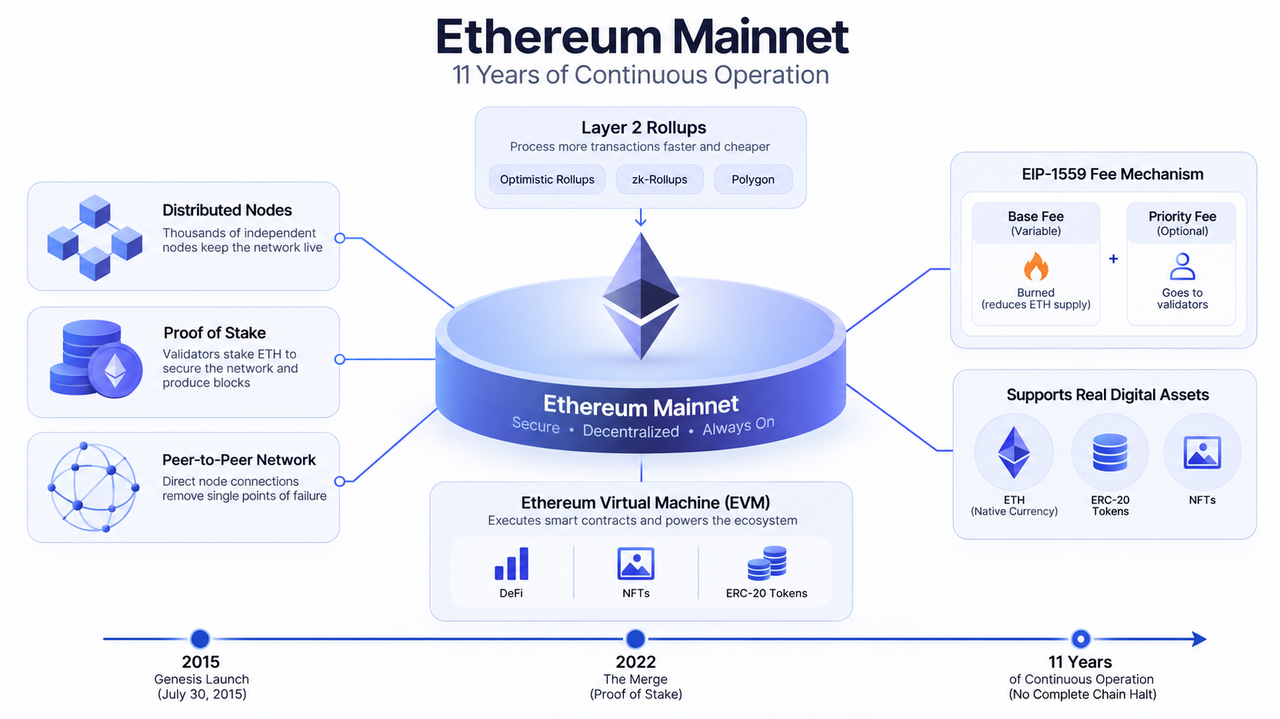
Distributed nodes, a Proof of Stake consensus mechanism, multiple software clients and peer-to-peer networking help the main network absorb isolated failures while processing ETH, the native cryptocurrency of Ethereum and the asset behind the world’s second largest cryptocurrency network. For users, developers and token holders, this reliability matters because uninterrupted access supports real digital assets, smart contracts and financial activity without dependence on a single operator or central shutdown point.
TL;DR
-
Ethereum Mainnet is the live network where real ETH, ERC-20 tokens, non-fungible tokens and decentralized applications carry economic value.
-
Ethereum has produced blocks continuously since its launch, although individual validators, clients, applications and infrastructure providers have experienced failures.
-
Proof of Stake distributes block proposal and verification duties among independent validators instead of relying on a central authority.
-
The Ethereum Virtual Machine provides deterministic smart contract execution across nodes that follow the same Ethereum protocol.
-
EIP-1559 introduced a variable base fee that is burned, while total gas fees still change with network demand and transaction complexity.
-
Ethereum now follows a rollup-centric scaling roadmap. Traditional execution shard chains are no longer part of the current plan.
What Does Ethereum Mainnet Operation Mean?
Ethereum Mainnet is the public blockchain where real transactions happen, ETH pays transaction fees and deployed smart contracts can control assets with monetary value. It is the main chain of the Ethereum ecosystem rather than a development environment using valueless test tokens.
The network launched on July 30, 2015, when the Genesis block began Ethereum’s permanent on-chain history. Ethereum describes its infrastructure as continuously operational since 2015, supported by thousands of independent operators rather than one company capable of shutting it down.
This uptime claim needs context. Ethereum has experienced missed slots, software defects, congestion, temporary finality problems and outages affecting individual services. However, these events did not produce a complete Mainnet shutdown in which the entire blockchain network stopped producing blocks.
Mainnet uptime also differs from application uptime. A decentralized finance interface may become unavailable while its smart contracts continue operating. An RPC endpoint may fail while other nodes remain synchronized. A wallet can display an error even though the Ethereum network is still processing signed transactions.
A broader introduction to Ethereum and ETH explains the platform’s origins and functionality, while Ethereum Mainnet operation focuses on the engineering mechanisms that keep its shared global state available.
Ethereum Mainnet Versus Testnets
Ethereum Mainnet is the live economic environment, whereas testnets are designed for application development, debugging and protocol experimentation without putting real funds at risk.
| Feature |
Ethereum Mainnet |
Ethereum testnet |
| Primary purpose |
Real settlement and application use |
Development and testing |
| Native currency |
Real ETH with market value |
Test ETH without intended monetary value |
| Assets |
Real digital assets and deployed protocols |
Experimental contracts and test assets |
| Transaction cost |
Variable gas fees paid in ETH |
Test gas paid with faucet-distributed tokens |
| Consequences |
Transactions can transfer real value |
Designed to reduce financial risk during testing |
| Security assumptions |
Protected by Mainnet validators and economic stake |
Smaller validator set and different operating conditions |
| Typical users |
Asset holders, applications, institutions and developers |
Developers, researchers and infrastructure teams |
A testnet can help developers detect errors before deployment, but successful testing does not guarantee that a contract will remain safe under real-world Mainnet conditions. Mainnet introduces real users, valuable assets, adversarial behavior and network demand that may not exist during testing.
How the Ethereum Network Maintains Zero Downtime
The Ethereum network stays operational through overlapping layers of redundancy rather than one flawless component.
| Operational layer |
Function |
Contribution to uptime |
| Distributed nodes |
Store and verify blockchain data |
Prevent one database from controlling the ledger |
| Proof of Stake validators |
Propose blocks and submit attestations |
Continue consensus when individual operators fail |
| Execution clients |
Process transactions and EVM state changes |
Provide independently developed implementations |
| Consensus clients |
Coordinate validators and finality |
Determine the canonical chain |
| Peer-to-peer networking |
Propagate blocks and transactions |
Creates alternative communication routes |
| Economic penalties |
Penalize inactivity or malicious conduct |
Align validator behavior with protocol security |
| Testnets and upgrade rehearsals |
Test new protocol rules |
Reduce Mainnet deployment risk |
No layer provides absolute protection. Ethereum’s resilience comes from combining them so that failure in one machine, program, operator or location does not automatically become a failure of the entire decentralized network.
How Proof of Stake Secures Ethereum Mainnet
Proof of Stake secures Ethereum by assigning block proposal and verification responsibilities to validators that deposit ETH as collateral.
Ethereum originally used Proof of Work, similar to the Bitcoin network. The Merge, completed on September 15, 2022, replaced Ethereum’s Proof of Work production consensus with Proof of Stake and reduced the network’s energy consumption by approximately 99.95%. Any claim that current Ethereum Mainnet still uses Proof of Work is outdated.
A validator generally deposits 32 ETH to activate an individual validator key. During approximately 12-second slots, the Ethereum protocol selects a validator to propose a block while committees of other validators attest to their view of the chain. A block is considered valid only when it follows the protocol’s transaction, execution and consensus rules.
If one proposer goes offline, Ethereum may miss a slot, but another validator receives the next opportunity. The blockchain does not depend on one permanent block producer.
Validators can receive rewards for correct participation and penalties for inactivity. Provably contradictory voting or other malicious behavior may trigger slashing, which destroys part of the validator’s stake. These economic consequences make attacking Mainnet security costly.
The interaction between staking infrastructure, validator duties and operational risk is developed further in Ethereum staking as a service.
How Nodes Protect the Decentralized Network
Nodes protect Ethereum by maintaining copies of blockchain data and independently checking whether transactions and blocks follow the protocol.
A centralized service may rely on one database administered by one company. Ethereum distributes data among nodes operated from homes, universities, staking businesses, cloud platforms and private data centers. No single central authority owns the canonical ledger.
When a node receives a block, it does not accept the data merely because another participant sent it. The node applies Ethereum’s rules to verify signatures, balances, gas use and state transitions. Invalid information is rejected rather than added to the local copy of the blockchain.
Nodes communicate over the internet through peer-to-peer protocols. When one connection disappears, a node can receive information from other peers. This routing redundancy reduces dependence on a single server, internet path or RPC provider.
Most users do not operate full nodes. A wallet or application commonly connects to a node through an RPC interface. An RPC endpoint translates user-interface requests into calls that read blockchain data, estimate gas or broadcast signed transactions.
RPC access improves usability but can create a local point of failure. An unavailable endpoint may prevent one application from loading even while Ethereum Mainnet remains healthy.
How the Ethereum Virtual Machine Executes Smart Contracts
The Ethereum Virtual Machine, or EVM, provides the shared execution environment in which Ethereum nodes process smart contracts and calculate the same resulting state.
Developers commonly write Ethereum smart contracts in the Solidity programming language. The source code is compiled into bytecode that the EVM can execute. When users submit signed transactions calling a contract, nodes process the same instructions according to the Ethereum protocol.
Smart contracts can perform predefined actions such as:
-
transferring ERC-20 tokens;
-
exchanging assets through DeFi protocols;
-
recording ownership of non-fungible tokens;
-
managing collateral in lending applications;
-
distributing native tokens;
-
enforcing decentralized application rules.
Smart contracts are often described as self-executing because their functions run when specified conditions and valid calls are present. They can reduce dependence on traditional intermediaries, but they do not independently initiate every action or guarantee that their business logic is correct.
Deterministic execution is central to Mainnet security. Each node should calculate the same state change from the same valid transaction. A transaction that changes an Ethereum account balance on one conforming node must produce the same result on other conforming nodes.
Why Signed Transactions Matter on Ethereum Mainnet
Every ordinary Ethereum transaction must be cryptographically signed by the account controlling the relevant private key.
The signature proves authorization without exposing the private key itself. Nodes use the signature and transaction data to recover the sending account, check its balance and nonce, and determine whether the transaction is considered valid.
A signed transaction can include:
When users send ETH, transfer an ERC-20 token or call a decentralized application, the wallet assembles this information and requests a signature. The transaction then travels to the Ethereum network for inclusion in a block.
Blockchain finality does not protect users from signing malicious instructions. A fraudulent token approval or compromised user interface may still produce a technically valid transaction. Users should confirm the destination, transaction value, network and requested permissions before signing.
A Web3 wallet can provide access to Ethereum applications and NFT marketplaces, but wallet access does not remove private-key, phishing or smart-contract risk.
How Gas Fees and EIP-1559 Manage Block Space
Gas fees allocate limited Ethereum block space and compensate for the computational work and storage required by transactions.
Gas is a measurement unit rather than a separate asset. Users pay gas fees in ETH, and gas prices are commonly denominated in Gwei. One Gwei equals one-billionth of an ETH.
A simple ETH transfer normally requires less gas than complex smart contract execution. The final transaction fee depends on the gas consumed and the price paid for each unit:
Transaction fee = gas used × effective gas price
Network demand also affects the result. When more transactions compete for limited block space, the base fee and priority fees can rise. Users may therefore pay more gas during periods of heavy decentralized finance activity, popular NFT launches or rapid market movements.
EIP-1559, activated through the London upgrade in August 2021, introduced a protocol-calculated base fee and optional priority fee. The base fee adjusts according to block usage and is burned rather than paid to validators. This structure made fee estimation more predictable, although it did not make gas prices fixed or consistently low.
The amount of ETH burned is not a permanent fixed figure. It rises with every eligible transaction and should be checked through current on-chain data rather than repeated as an undated total. The balance between ETH issuance and fee burning can also change according to network demand.
Developers can reduce inefficient execution through Ethereum smart contract gas optimization.
Why ERC-20 Tokens and Non-Fungible Tokens Depend on Mainnet
ERC-20 and NFT token standards allow different Ethereum applications to interact with digital assets through predictable contract interfaces.
ERC-20 defines common functionality for fungible tokens, including balance queries, transfers and spending approvals. Token holders can use compatible wallets and decentralized applications because contracts follow recognizable methods.
Non-fungible tokens represent individually distinguishable records rather than interchangeable units. Common examples include digital art, game items, membership credentials and tokenized claims connected to real-world assets.
Token standards create compatibility, but they do not guarantee asset quality, true ownership of an off-chain object or legal enforceability. An NFT can establish control over an on-chain token while the associated image, intellectual-property rights or physical asset remains subject to separate arrangements.
Ethereum Mainnet provides the execution and settlement environment for these assets. Real ETH pays for transactions, while smart contracts update ownership records on chain.
How Decentralized Finance Uses Ethereum Mainnet
Decentralized finance uses Ethereum smart contracts to create financial functionality without requiring one institution to maintain the complete application ledger.
DeFi applications can support asset exchange, lending, collateral management, derivatives, stablecoins and liquidity provision. Because protocols share Ethereum’s public state, one application may integrate tokens or functionality created by another.
This composability helped Ethereum become a major base layer for decentralized finance. It also creates dependency risk. A failure in one contract, oracle, stablecoin or liquidity pool may affect several connected DeFi protocols even when Ethereum Mainnet itself remains fully operational.
Mainnet uptime therefore protects access to the underlying blockchain, not the solvency or safety of every application. Users must still consider smart contract audits, admin-key permissions, oracle design, liquidity and bridge dependencies.
How Layer 2 Networks Expand Ethereum Capacity
Layer 2 solutions process transactions faster and more cheaply by moving substantial execution away from Ethereum Mainnet while using Mainnet for data, proofs or settlement.
Optimistic rollups and zero-knowledge rollups can combine many user transactions into compressed submissions. This reduces the amount of expensive Layer 1 block space required per user action.
Polygon is a prominent Ethereum scaling ecosystem, but its products use different security models. Polygon PoS has traditionally operated as an Ethereum-compatible sidechain, while Polygon zkEVM and other rollup-based systems fit more directly within the Layer 2 category. Calling every Polygon product an Ethereum Layer 2 hides these architectural differences.
Ethereum’s current roadmap does not plan to introduce the older form of execution shard chains. The community shifted toward rollup-centric scaling and Danksharding, which expands data capacity for rollups. Ethereum’s own roadmap states that shard chains are no longer part of the plan.
EIP-4844 introduced blob-carrying transactions to provide temporary data space specifically designed for rollups. This development lowered Layer 2 data costs and prepared Ethereum for further Danksharding upgrades.
The EIP-4844 blob mechanism and Optimism Layer 2 architecture show how Ethereum increasingly separates Mainnet settlement from higher-volume application execution.
A fixed claim that Ethereum Mainnet has a maximum theoretical throughput of exactly 238 transactions per second is misleading. Throughput changes with transaction complexity, gas limits, block configuration and the distinction between Layer 1 execution and rollup activity. Simple token transfers and complex DeFi transactions consume different amounts of gas, so one universal transaction-per-second limit cannot describe all workloads accurately.
How the Ethereum Foundation Supports the Ecosystem
The Ethereum Foundation supports research, development, education and ecosystem coordination, but it does not operate Ethereum Mainnet as a central owner.
Ethereum’s open-source development involves independent client teams, researchers, application developers, validators and community organizations. The Ethereum Foundation can fund projects and contribute to protocol research, but it cannot unilaterally force node operators to adopt incompatible software.
Protocol changes are commonly introduced through an Ethereum Improvement Proposal. EIPs document standards involving core protocol behavior, client interfaces and smart contract conventions. Proposals undergo technical discussion and implementation work before eligible changes can become part of a network upgrade.
The Ethereum Foundation’s structure and ecosystem role illustrates the difference between supporting protocol development and controlling a decentralized network.
What Ethereum Mainnet Zero Downtime Does Not Guarantee
Ethereum’s uptime record does not make every connected activity safe or continuously available.
Smart contract risk: Code can contain exploitable errors even when the EVM executes it correctly.
Application risk: A user interface, API, indexer or RPC endpoint may fail while contracts remain live.
Bridge risk: Cross-chain bridges introduce separate contracts, validators, relayers or custodians.
Validator concentration: Reliance on dominant clients, staking providers or hosting platforms can create correlated failures.
Wallet risk: Lost keys, phishing and malicious approvals can lead to irreversible asset transfers.
Gas risk: Increasing demand can make transactions expensive or temporarily uneconomic.
Asset risk: Network reliability does not guarantee the real value, monetary value or liquidity of ETH, ERC-20 tokens or NFTs.
Users checking the ETH market page or accessing the ETH/USDT spot market should separate Ethereum’s technical operation from ETH price performance. A reliable blockchain network does not eliminate market volatility.
Conclusion
Ethereum Mainnet’s 11 years of continuous operation result from fault tolerance rather than perfect hardware or software. Thousands of nodes replicate blockchain data, Proof of Stake validators rotate block-production duties, independent clients reduce correlated software risk and peer-to-peer networking provides alternative communication paths.
The Ethereum Virtual Machine keeps smart contract execution consistent, cryptographic signatures authorize transactions and EIP-1559 allocates scarce block space through a variable base fee. Layer 2 rollups extend capacity while Ethereum Mainnet remains the settlement and data foundation for real digital assets.
Ethereum has experienced congestion, client defects, missed slots and temporary finality problems. What distinguishes the network is its ability to absorb these disruptions without a full chain halt. Ethereum Mainnet operation demonstrates that a decentralized network can remain live without requiring every participant, application or infrastructure provider to work perfectly.
FAQ
What is Ethereum Mainnet?
Ethereum Mainnet is the live public blockchain where real ETH transactions, smart contracts, ERC-20 tokens, NFTs and decentralized applications operate. Unlike a testnet, Mainnet uses assets with real economic value and charges transaction fees in ETH.
Has Ethereum Mainnet ever gone offline?
Ethereum Mainnet has not experienced a complete chain halt since launching on July 30, 2015. Individual validators, clients, applications and RPC providers have failed, and finality has temporarily paused, but the blockchain continued producing blocks.
Does Ethereum currently use Proof of Work?
No. Ethereum transitioned from Proof of Work to Proof of Stake through The Merge on September 15, 2022. The Bitcoin network still uses Proof of Work, but current Ethereum Mainnet security depends on staked ETH and validator participation.
How long does an Ethereum Mainnet transaction take?
Ethereum organizes block production into approximately 12-second slots, but a transaction’s actual confirmation time depends on gas settings, network demand, validator inclusion and the number of confirmations required. Finality takes longer than initial block inclusion.
Why do Ethereum gas fees change?
Ethereum gas fees vary because transactions consume different amounts of computation and compete for limited block space. Under EIP-1559, the base fee adjusts according to block usage, while users can add a priority fee for validators.
Are Ethereum transactions irreversible?
Confirmed Ethereum transactions generally cannot be cancelled or edited by a central administrator. Economic finality provides stronger settlement confidence, but users should still wait for appropriate confirmation or finality when transferring substantial value.
What is the Ethereum Virtual Machine?
The Ethereum Virtual Machine is the execution environment that processes smart contract instructions across Ethereum nodes. It ensures that conforming nodes calculate the same state transition from the same valid transaction.







