On-chain lending protocols are among the most important pieces of financial infrastructure in the DeFi ecosystem. Their role is similar to money markets in traditional finance. Users can earn yield by supplying assets, or access liquidity by using assets as collateral, all without relying on a bank or centralized platform. In the Ethereum DeFi ecosystem, protocols such as Aave and Compound have already proven the viability of this model, while the Kaspa ecosystem had long lacked a mature on-chain lending system.
The launch of Kaskad means Kaspa is beginning to build out a complete DeFi capital market structure. As a lending protocol running on Igra EVM Layer2, Kaskad not only supports basic lending and borrowing functions, but also introduces Partial Liquidation, dynamic interest rates, AI Agent interfaces, and cross-chain liquidity mechanisms.
What Components Make Up Kaskad’s Lending System?
Kaskad’s overall architecture mainly consists of Liquidity Pools, a collateral system, lending markets, an interest rate model, a liquidation module, and a governance system.
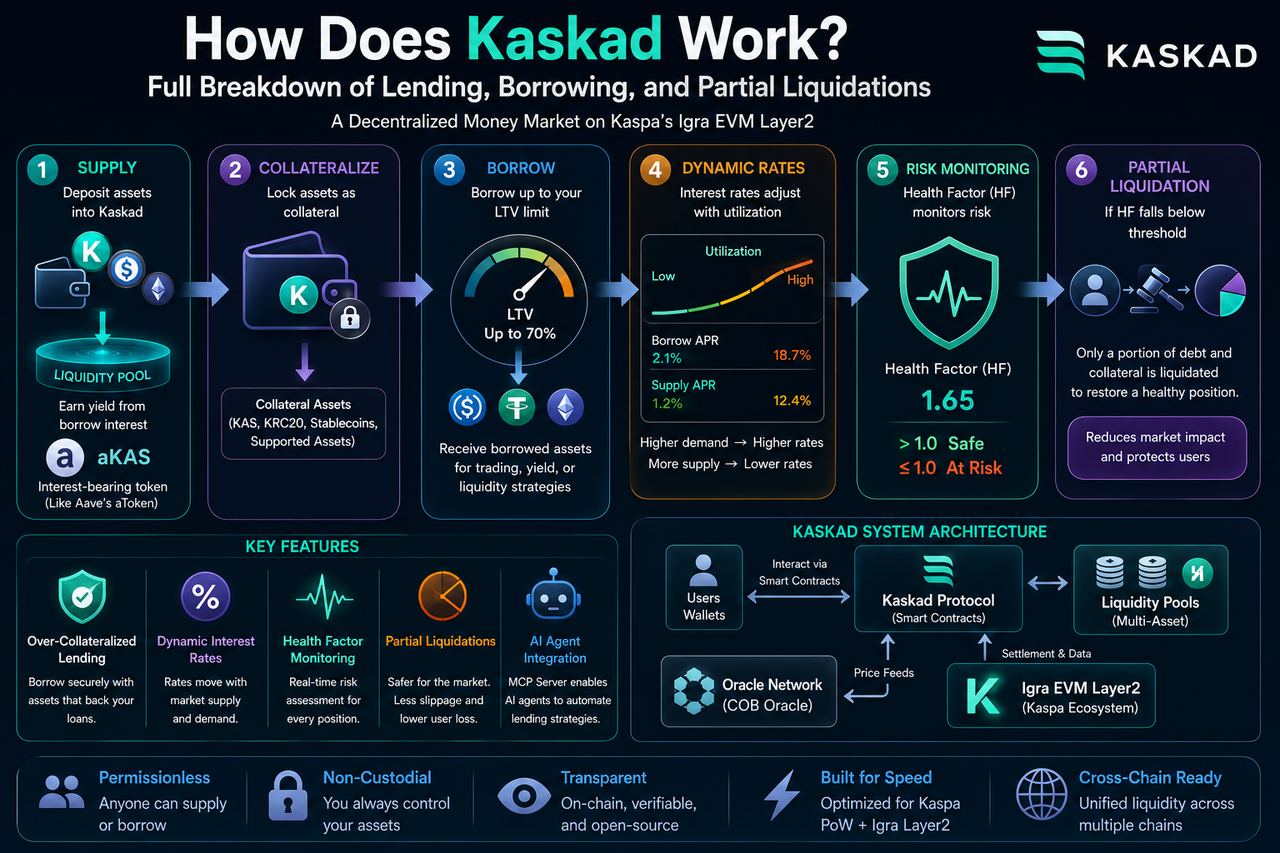
After users supply assets, those funds enter the protocol’s liquidity pools and become available for other users to borrow. At the same time, the protocol issues interest-bearing asset certificates to depositors, representing their share of the pool and their right to earn yield.
Borrowers must first provide overcollateralized assets before they can borrow other assets. The protocol tracks collateral value and borrowing risk in real time, and dynamically evaluates position safety through the Health Factor.
The entire process is executed automatically by on-chain smart contracts and does not rely on any centralized custodian.
How Do Users Supply Assets to Kaskad?
In Kaskad, supplying assets is the foundation that keeps the entire lending system running.
After connecting a wallet, users can deposit supported digital assets into the protocol. For example, they may supply KAS, stablecoins, or other supported assets. Once those assets enter the liquidity pool, they can be used by borrowers, while suppliers earn the corresponding yield.
The protocol issues interest-bearing assets that represent the user’s supplied position, following a logic similar to Aave’s aToken. These assets automatically accrue yield over time, so users do not need to manually claim interest.
Supply yield mainly comes from the interest paid by borrowers. When borrowing demand increases, pool utilization rises, and supply APY usually rises as well.
This model allows idle assets to continuously generate on-chain yield while providing liquidity for the broader lending market.
How Does the Borrowing Process Work on Kaskad?
After supplying assets, users can enable collateralized borrowing.
Kaskad uses an overcollateralization mechanism, meaning the value of a user’s collateral must be higher than the value of the assets borrowed. For example, if an asset has a Loan-to-Value, or LTV, of 70%, the user can borrow up to 70% of the collateral’s value.
When a user initiates a loan, the protocol automatically calculates the maximum borrowable amount based on the collateral asset’s price, market liquidity, and risk parameters. After borrowing, the user keeps exposure to the original asset while gaining additional liquidity.
This model is widely used in DeFi for leveraged trading, stablecoin financing, liquidity management, and yield strategies.
Unlike lending in traditional finance, Kaskad does not require credit checks, bank approval, or identity verification. All lending conditions are determined by on-chain rules.
Why Do Kaskad’s Interest Rates Change Dynamically?
Kaskad’s interest rate model is not fixed. Instead, rates adjust dynamically according to the utilization of funds in the market.
When many users borrow and available liquidity in the pool decreases, borrowing rates automatically rise to encourage more users to supply assets. Conversely, when market borrowing demand declines, interest rates also fall.
At its core, this mechanism is an automated market balancing system.
For example, when demand for stablecoins suddenly rises, borrowing rates may increase quickly, and supply yields may rise at the same time. This can attract more liquidity into the protocol and help ease capital shortages.
A dynamic interest rate model is a key component of most on-chain money markets. Its goal is to balance supply and demand without manual intervention.
How Does Kaskad’s Partial Liquidation Mechanism Work?
Partial Liquidation is one of the key differences between Kaskad and many traditional lending protocols.
In a traditional full liquidation model, once a user’s position falls below the safety threshold, the system may directly liquidate most or even all of the collateral. While this mechanism can reduce protocol risk quickly, it can also trigger cascading sell-offs during periods of sharp market volatility.
Kaskad instead uses a partial liquidation mechanism. When a position’s risk exceeds the threshold, the protocol first liquidates only part of the debt and collateral, bringing the user’s position back into a safe range.
This design can reduce immediate market selling pressure while also limiting the user’s one-time loss.
For the lending market as a whole, partial liquidation helps improve system stability, especially in highly volatile market conditions.
What Role Does the Oracle Play in Kaskad?
Lending protocols must access asset prices in real time. Otherwise, they cannot assess collateral value or liquidation risk.
Kaskad uses an Oracle system to provide the protocol with on-chain price data. The protocol’s LTV, Health Factor, and liquidation logic all depend on this pricing information.
If an Oracle provides incorrect data, it may lead to mistaken liquidations or bad debt risk. For this reason, the price system is one of the most critical security modules in any lending protocol.
Kaskad currently integrates pricing systems such as COB Oracle to improve the reliability of price data and resistance to manipulation.
In the DeFi market, Oracle risk is generally viewed as one of the largest systemic risks for lending protocols.
The biggest differences between Kaskad and traditional centralized lending platforms are asset control and system transparency.
On centralized platforms, user assets are usually held in custody by the platform, and lending rules, risk management, and fund flows may lack transparency. In Kaskad, all lending logic is executed automatically by smart contracts, while users remain in control of the assets in their own wallets.
In addition, Kaskad’s lending market is fully open. Any user who meets the collateral requirements can participate in lending and borrowing without credit checks or manual approval.
However, this fully on-chain model also means users need to manage their own risks, including collateral ratios, market volatility, and liquidation risk.
Summary
As a decentralized lending protocol running on Igra Layer2 within the Kaspa ecosystem, Kaskad provides on-chain liquidity through an overcollateralized model.
Its operating process includes asset supply, collateralized borrowing, dynamic interest rate adjustments, Health Factor risk monitoring, and partial liquidations. Compared with traditional DeFi lending protocols, Kaskad places greater emphasis on adapting to a high-speed PoW ecosystem, improving system stability, and moving toward AI-native DeFi.
FAQs
What Is Health Factor?
Health Factor is an indicator used to assess the risk level of a user’s position. When it drops into a dangerous range, the protocol may trigger liquidation.
Why Does Kaskad Use Partial Liquidation?
Partial liquidation can reduce the risk of cascading sell-offs during sharp market volatility while also limiting a user’s one-time asset loss.
Why Do Kaskad’s Interest Rates Change?
The protocol’s interest rates change dynamically based on market fund utilization, allowing it to automatically balance borrowing demand and supplied liquidity.
Does Kaskad Support AI Agent?
Yes. Kaskad provides an MCP Server interface, allowing AI Agents to automatically execute lending, borrowing, and asset management operations.