As the internet enters the stage of “information financialization,” markets are no longer limited to trading stocks, commodities, and crypto assets. More platforms are beginning to experiment with trading “future events themselves.” The core purpose of a Prediction Market is to use real money and market competition to let the crowd form real time probability judgments about the future. For example, U.S. presidential elections, Federal Reserve interest rate decisions, inflation data, and even weather changes can all be turned into tradable market objects.
Kalshi is one of the most representative regulated prediction market platforms in the United States, and one of the few Event Contracts Exchanges approved by the U.S. CFTC. Unlike traditional betting websites, Kalshi does not use a fixed odds model. Instead, it has built a market system for trading around future events.
What Is Kalshi’s Core Mechanism?
Kalshi’s core product is called “Event Contracts.”
Each market is built around a real world event. For example:
“Will the Federal Reserve cut interest rates this year?”
Users can choose to buy YES or buy NO.
If the event ultimately happens, the YES contract settles at $1. If the event does not happen, the NO contract settles at $1.
In practice, users are trading “the probability that a specific event will occur.”
Why Do Kalshi Prices Represent Probability?
Kalshi contract prices always range between $0 and $1.
For example:
When market expectations change, prices move with them.
For example, after a piece of economic data is released, the market may suddenly believe the Federal Reserve is more likely to cut interest rates. In that case, the YES contract price might quickly rise from 0.45 to 0.75.
As a result, Kalshi’s pricing system is essentially a real time probability market.
How Does Kalshi Match Trades?
Kalshi uses an Order Book mechanism rather than the fixed odds model commonly found on betting websites.
This means users can place their own orders and decide their buying price, selling price, and position size. The system then automatically matches buy and sell orders.
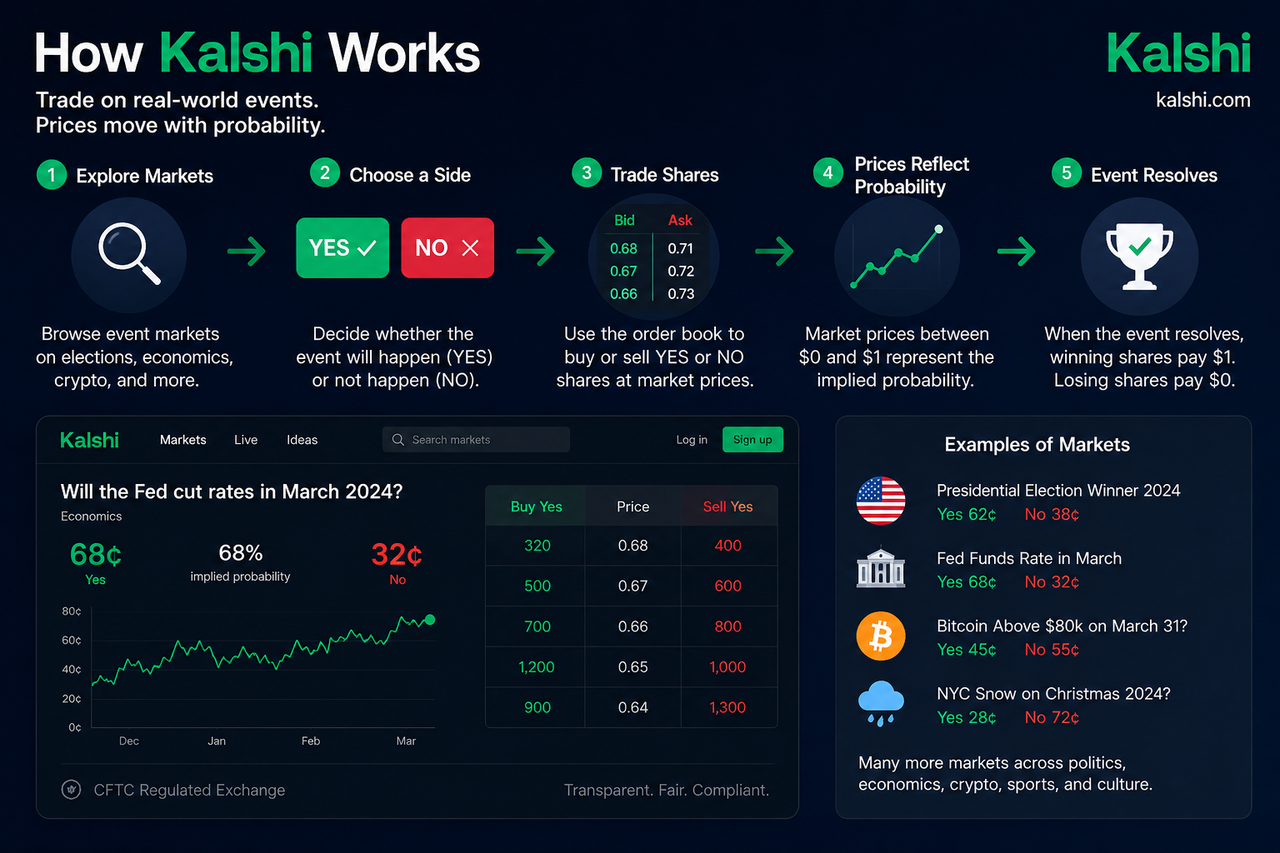
For example:
Once the two sides match, a market price is formed.
This structure is closer to a stock exchange or futures market. Kalshi’s prices are therefore not decided by the platform, but formed collectively by market participants.
How Are Kalshi Markets Settled?
After an event outcome is officially announced, Kalshi settles the market according to its market rules.
Each market defines in advance:
For example, a market asking, “Will U.S. CPI be above 3%?” may use data published by the U.S. Bureau of Labor Statistics, or BLS, as the final source of the result.
If YES is correct, the YES contract settles at $1, while the NO contract becomes worthless. If the event does not happen, the outcome is reversed.
This clear rule design is an important foundation that allows Prediction Markets to operate reliably.
Why Can Users Exit Trades Early?
Kalshi does not require users to hold contracts until settlement.
Because the market uses real time trading, users can sell at any point after prices change.
For example, a user may buy YES at 40¢. If the market price later rises to 70¢, the user can sell early and take a profit, even if the event has not yet ended.
As a result, Kalshi combines several market characteristics, including probability trading, short term speculation, and risk hedging.
Although Kalshi markets may look similar to betting, the underlying logic is clearly different.
Traditional betting platforms usually set the odds themselves. Users bet against the house, and the odds are fixed.
Kalshi is closer to a financial market:
Users trade with one another, the market forms the price, and probabilities change in real time.
For this reason, Kalshi is more like a real world event derivatives market than a casino.
This is also one of the important reasons why it has been able to receive approval from U.S. financial regulators.
Why Does Kalshi’s Operating Model Matter?
Kalshi’s significance goes beyond prediction markets.
More importantly, it is trying to turn future events into tradable financial objects.
This means future markets may no longer trade only the assets themselves, but directly trade probabilities and expectations in the real world.
From AI to macro finance to information markets, Prediction Markets may become an important part of the next generation of the digital economy. Kalshi is one of the earliest regulated experiments in this direction.
Conclusion
Kalshi uses YES / NO Event Contracts to turn real world events into tradable probability markets. Users can trade around events such as elections, economic data, cryptocurrencies, and sports events, while market prices reflect the crowd’s real time judgment about future outcomes.
Unlike traditional betting platforms, Kalshi uses an order book structure and market based pricing mechanism, and it is regulated by the U.S. CFTC. As a result, it is closer to a financial trading market.
FAQs
What do Kalshi’s YES and NO contracts mean?
YES means the user believes the event will happen. NO means the user believes the event will not happen.
Why do Kalshi prices represent probability?
Because contract prices always range between $0 and $1, they can directly map the market’s judgment of the probability that an event will occur.
What trading mechanism does Kalshi use?
Kalshi uses an Order Book mechanism, where users freely place orders with one another and form the market price.
Can users sell early on Kalshi?
Yes. Users can close or sell their positions at any time before the event is settled.
How does Kalshi settle markets?
Kalshi makes the final determination and settlement based on predefined data sources and rules.
How is Kalshi different from betting websites?
Betting platforms usually have odds set by the house, while Kalshi uses a market based probability trading mechanism that is closer to a financial market structure.