As decentralized finance continues to evolve, on-chain trading has expanded beyond simple token swaps to include margin trading and Perpetual Futures. However, traditional decentralized exchanges often suffer from fragmented liquidity, high slippage, and inefficient price discovery. GMX introduces a novel trading architecture distinct from both AMMs and order books, making it a standout project in the DeFi derivatives space.
Understanding GMX's Trading Architecture
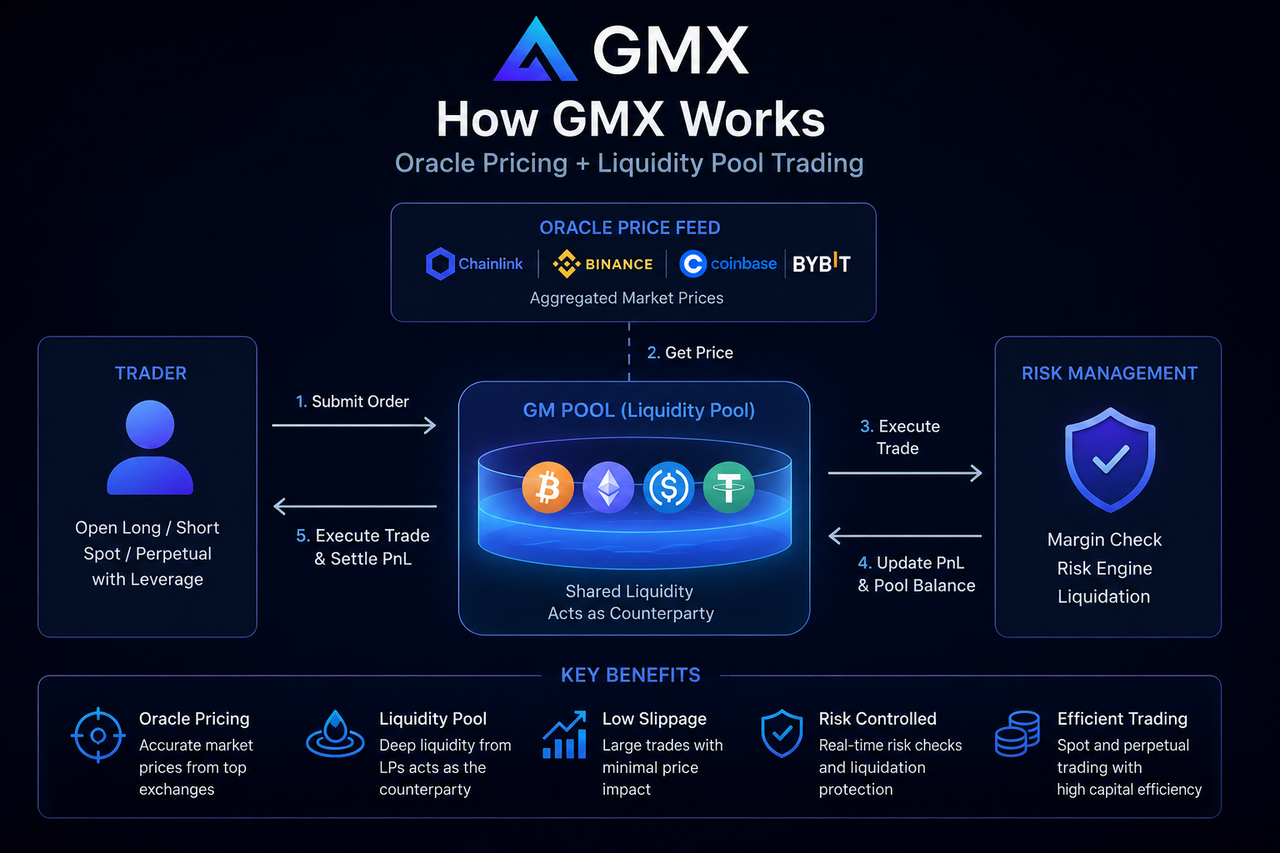
GMX's trading architecture operates on a dual-layer structure: oracle pricing and liquidity pool execution. By separating price discovery from trade execution, the system minimizes the impact of low liquidity on market prices.
Traditional order book exchanges require real-time matching between buyers and sellers to complete trades. GMX, in contrast, eliminates the need for counterparty matching. When a user submits an order, the system calculates based on the oracle-provided market price, and the liquidity pool handles execution.
GMX's core components include traders, the GM liquidity pool, price oracles, a risk management system, and a governance module. Together, these elements form a comprehensive on-chain derivatives trading infrastructure.
What Is the Oracle Pricing Mechanism?
The oracle pricing mechanism is the key to GMX operating without an order book. In traditional exchanges, asset prices are determined by matching buy and sell orders. GMX, however, derives its trade prices primarily from off-chain market data.
Oracles transmit price information from multiple markets onto the blockchain, serving as the basis for protocol trade execution. Because prices come from external markets, GMX's prices remain unaffected by internal trading activity.
This approach reduces price manipulation risk and helps users achieve execution prices closer to the broader market average.
Where Does GMX Get Its Price Data?
GMX aggregates prices from multiple mainstream markets. The protocol collects, verifies, and synchronizes price data on-chain through an oracle network.
This design prevents unusual execution prices from low-liquidity markets from impacting trade outcomes, while also reducing exposure to flash loan attacks and malicious price manipulation.
Since prices originate from external markets, GMX focuses on reflecting true market prices rather than relying on internal price formation.
How Does the GM Pool Act as a Counterparty?
The GM Pool is GMX's core liquidity source and the key infrastructure enabling order-book-free trading.
In a traditional order book market, every buy order must be matched with a sell order. GMX, on the other hand, doesn't need to find another trader to take the opposite side. The system directly uses the GM Pool to complete the trade, with the liquidity pool absorbing market risk exposure.
For example, when a user opens a long BTC position, the GM Pool takes on the corresponding short risk. When traders profit, those gains come from the liquidity pool; when traders lose, the funds flow into the pool. In effect, liquidity providers serve as the market's counterparty.
What Is GMX's Order Execution Process?
GMX's trading process consists of five stages: order submission, price retrieval, risk verification, position creation, and settlement.
First, the trader selects the trade direction, margin size, and leverage multiple, then submits an order request to the protocol. The system retrieves the latest market price from the oracle and checks whether the account margin meets the opening requirements.
After verification, the smart contract records the position size, entry price, and margin details. When the user voluntarily closes the position or a liquidation is triggered, the system recalculates profit and loss and completes fund settlement. The entire process runs automatically via on-chain smart contracts.
How Does GMX Control Slippage and Price Deviation?
Slippage typically occurs when market depth is insufficient or trade sizes are large. Since GMX prices trades using external market data, individual large orders don't directly cause sharp price movements.
To further maintain market stability, GMX implements a dynamic fee mechanism, a liquidity balancing mechanism, and a risk exposure management system. The protocol adjusts certain parameters based on market conditions to reduce systemic risk.
Compared to traditional AMMs, GMX generally offers more stable pricing for large trades.
How Is GMX Different from a Traditional AMM?
GMX is often categorized as a DEX, but its operation differs significantly from traditional AMMs. AMMs determine prices based on asset ratios within the pool, whereas GMX relies on oracles for price discovery.
Additionally, traditional AMM liquidity is primarily used for asset swaps, while the GM Pool serves as a unified counterparty for derivatives trading. So while both models use liquidity pools, their functions are entirely different.
| Comparison Dimension |
GMX |
Traditional AMM |
| Pricing Method |
Oracle Price |
Asset Ratio in Pool |
| Liquidity Use |
Trade Counterparty |
Asset Swaps |
| Price Discovery |
External Market |
Within Protocol |
| Slippage Impact |
Relatively Low |
Tied to Pool Depth |
| Primary Use Case |
Perpetual Futures |
Spot Swaps |
Advantages and Limitations of GMX's Mechanism
GMX's design boosts trading efficiency in the on-chain derivatives market. The oracle pricing model reduces price manipulation risk, while the shared liquidity pool provides a stable source of market funds.
However, the model also has its drawbacks. The protocol is heavily dependent on oracle security; liquidity providers must assume the risk of trader profits; and under extreme market conditions, risk management becomes significantly more complex.
These features collectively define GMX's unique market structure and have driven the growth of liquidity-pool-driven derivatives trading.
Summary
By combining oracle pricing with a liquidity pool execution mechanism, GMX creates an on-chain trading model that diverges from traditional order books and AMMs. In this architecture, oracles handle price discovery, the GM Pool provides unified liquidity, and smart contracts manage risk control and position management.
This design allows GMX to support both spot and perpetual futures trading without a centralized matching engine, establishing it as a cornerstone infrastructure in the DeFi derivatives landscape.
FAQs
Who Determines GMX's Prices?
GMX's prices are sourced from multiple external market feeds and transmitted on-chain via an oracle network. The price discovery process does not rely on internal trade records.
What Role Does the GM Pool Play in GMX?
The GM Pool provides liquidity for the trading market and acts as a unified counterparty for all traders. Traders' profits and losses are ultimately reflected in the pool's assets.
How Is GMX Different from Uniswap?
Uniswap is primarily designed for spot asset swaps and relies on an AMM pricing mechanism. GMX focuses on spot and perpetual futures trading, using oracle pricing and a liquidity pool execution model.
How Does GMX Reduce Slippage?
GMX uses external market prices as the reference for trades rather than pricing based on internal pool ratios. As a result, large orders typically do not cause drastic price swings.
What Are the Risks of GMX's Mechanism?
GMX faces oracle risk, liquidity pool risk, and extreme market volatility risk. Liquidity providers must be prepared to absorb potential losses from trader profits.







