The development of the on-chain derivatives market has pushed decentralized trading platforms beyond simple token swaps. As demand for options, perpetual contracts, and leveraged trading continues to grow, on-chain protocols are gradually introducing traditional financial infrastructure such as order books, risk engines, and margin systems.
In the on-chain derivatives sector, Derive is positioned more like a professional trading platform. Its core goal is to provide a trading experience in a self custodial environment that comes close to what centralized exchanges offer. To achieve this, Derive combines a Layer2 network, a central limit order book, or CLOB, portfolio margin, and an on-chain settlement system to build a complete trading infrastructure covering order matching, risk assessment, and capital management.
What Components Make Up Derive’s Trading System?
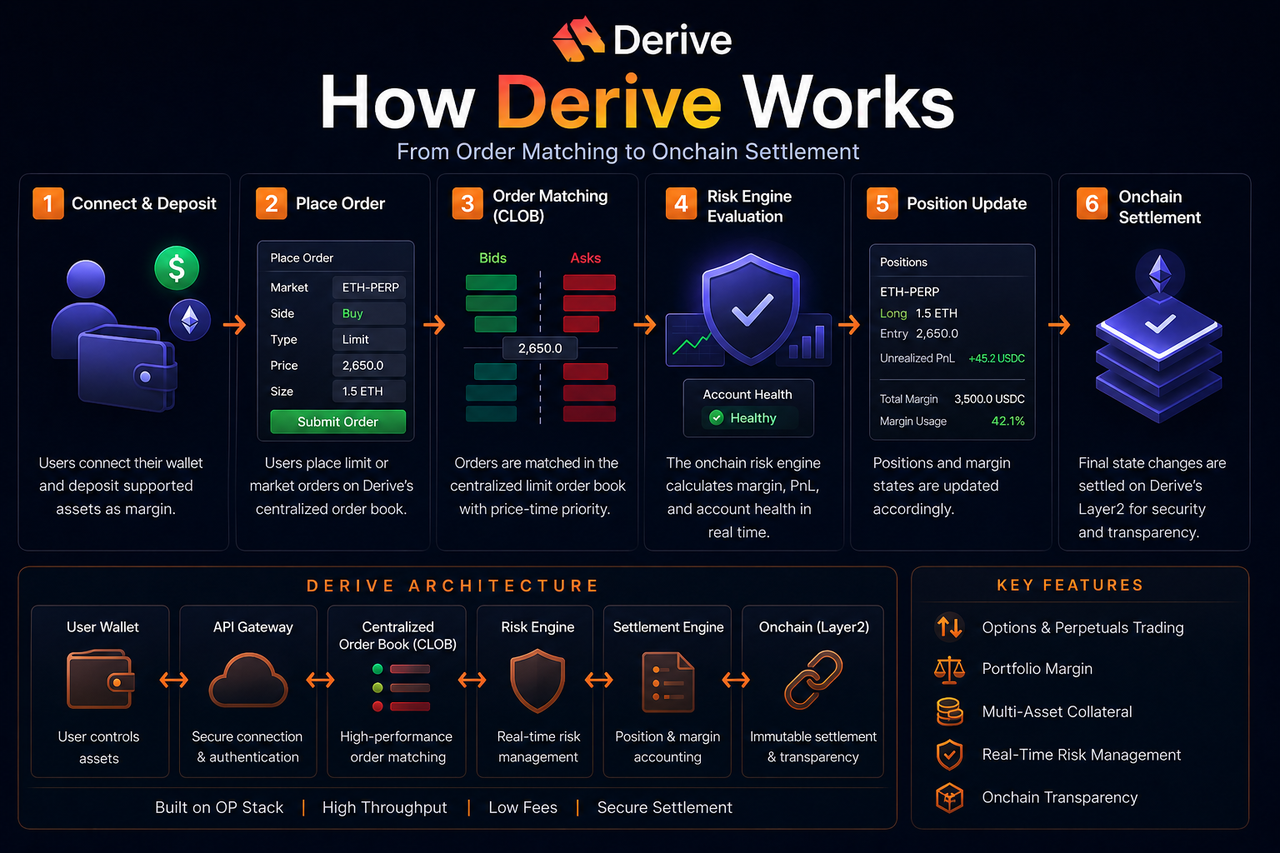
Derive’s trading system mainly consists of an order book, risk engine, margin system, settlement module, and Layer2 network. Together, these components form the full process for on-chain derivatives trading.
The order book manages user orders and matching logic, the risk engine assesses account risk and margin requirements in real time, and the settlement system handles position updates, asset transfers, and on-chain state synchronization.
Unlike the traditional AMM model, Derive places more emphasis on an order driven market structure. The order book model is usually better suited to derivatives trading because it can support more complex pricing mechanisms and more efficient liquidity management.
In addition, Derive’s underlying network is built on the OP Stack, allowing the protocol to achieve lower gas costs and higher trading throughput in a Layer2 environment.
How Do Users Start Trading on Derive?
Before trading on Derive, users first need to create an account and deposit collateral.
Because Derive is a self custodial protocol, users still control their assets through an on-chain wallet. Users typically deposit stablecoins or other supported collateral assets into the protocol as their margin account balance.
Derive supports multi asset collateral, which means users are not limited to using a single stablecoin as margin. The system calculates the corresponding collateral value and risk exposure based on the risk parameters of each asset.
Once the margin deposit is complete, users can enter the order book market and trade options or perpetual contracts. The available margin in the account adjusts dynamically as positions change.
How Are Orders Matched on Derive?
Derive uses a central limit order book, or CLOB, mechanism for order matching.
During trading, users can submit limit orders or market orders. Once an order enters the order book, the system matches it according to price priority and time priority. When the prices of buyers and sellers match, the order is executed and both sides’ positions are updated.
Compared with the AMM model, the advantage of an order book is that it provides more precise price discovery. This is especially important in options markets, where different strike prices, expiration dates, and volatility levels create complex pricing structures. For that reason, order books are better suited to professional derivatives trading.
Although Derive’s order matching relies on a high performance matching system, the final position status and fund changes are still synchronized to the on-chain network, ensuring asset transparency and verifiability.
How Does Derive’s Risk Engine Assess Account Risk?
The risk engine is one of Derive’s most important modules.
Because users may hold multiple perpetual contract and options positions at the same time, the system cannot calculate risk based on a single position alone. Derive uses a Portfolio Margin mechanism, which evaluates the net risk exposure of the entire account.
For example, when a user holds both long and short positions, some risks may offset each other, so the system can reduce the overall margin requirement. Compared with a traditional isolated margin model, this mechanism improves capital efficiency.
The risk engine monitors several indicators in real time, including:
| Risk Indicator |
Function |
| Account Equity |
Measures the overall asset condition |
| Initial Margin |
Minimum margin required to open a position |
| Maintenance Margin |
Minimum balance required to avoid liquidation |
| Volatility Parameters |
Adjusts risk weights for different assets |
| Liquidity Depth |
Assesses market impact risk |
The system dynamically adjusts risk parameters based on market volatility to reduce systemic risk during extreme market conditions.
When Is Derive’s Liquidation Mechanism Triggered?
Derive triggers liquidation when an account’s margin falls below the maintenance margin requirement.
The main goal of the liquidation system is to prevent accounts from becoming insolvent. If rapid market movements cause account losses to expand, the system automatically reduces or closes part of the positions to restore the account to a safer level.
Under the portfolio margin model, the system first evaluates the overall account risk rather than liquidating one individual position in isolation. This means certain hedged positions may help users reduce the likelihood of liquidation.
However, during highly volatile market conditions, insufficient market liquidity may still lead to wider slippage and larger liquidation losses. For this reason, risk management remains a key part of on-chain derivatives trading.
How Does the Funding Rate for Perpetual Contracts Work?
Perpetual contracts do not have an expiration date, so they need a funding rate mechanism to keep the contract price aligned with the spot market.
When the perpetual contract price is higher than the spot price, longs usually pay funding to shorts. When the opposite is true, shorts pay funding to longs.
The funding rate mechanism encourages market participants to adjust the direction of their positions, helping reduce price deviations.
On Derive, the funding rate changes dynamically based on market supply and demand as well as open interest structure. High leverage and extreme market conditions often cause funding rates to rise quickly.
How Is Derive’s Trading Process Different From Traditional Centralized Exchanges?
The biggest difference between Derive and traditional centralized exchanges lies in asset custody and settlement.
On centralized exchanges, users typically deposit assets into platform accounts, where the platform holds custody of them. On Derive, users still control their assets through on-chain wallets, while the protocol is mainly responsible for trading logic and risk management.
Centralized exchanges also typically use fully offline matching and database updates, whereas Derive needs to synchronize the final trading state to the on-chain network. As a result, it must balance performance with decentralization.
Still, through its Layer2 network and high performance order book architecture, Derive has narrowed the experience gap between on-chain trading and centralized exchanges to some extent.
Derive’s Advantages and Potential Limitations
Derive’s core advantages lie in high capital efficiency and professional trading capabilities. Portfolio margin, multi asset collateral, and the order book model allow it to support more complex trading strategies.
In addition, the Layer2 network can reduce trading costs and increase order processing speed, which is especially important for high frequency derivatives markets.
However, Derive’s architecture also brings higher system complexity. Options, margin, and risk management mechanisms can be difficult for ordinary users to understand at first.
At the same time, on-chain derivatives protocols still face smart contract risk, cross chain risk, and liquidity dependence. If market depth is insufficient, the order book trading experience may be affected.
Conclusion
As a professional trading protocol for the on-chain derivatives market, Derive’s core trading process covers order matching, margin management, risk assessment, liquidation, and on-chain settlement. Through its Layer2 network, central limit order book, and portfolio margin mechanism, Derive aims to deliver a trading experience in a self custodial environment that is close to traditional professional exchanges.
FAQs
What Is Derive’s Portfolio Margin?
Portfolio margin evaluates the risk exposure of the entire account rather than calculating margin requirements separately for each position.
Why Does Derive Need a Layer2 Network?
Layer2 can reduce gas costs and improve trading speed, making it better suited to high frequency derivatives trading.
How Does Derive’s Liquidation Mechanism Work?
When an account’s margin falls below the maintenance margin requirement, the system automatically reduces or closes part of the positions to lower overall risk.
What Is the Purpose of the Funding Rate for Perpetual Contracts?
The funding rate helps keep the perpetual contract price aligned with the spot price.
How Is Derive Different From a Centralized Exchange?
Derive emphasizes asset self custody and transparent on-chain settlement, while centralized exchanges usually use a unified platform custody model.