As generative AI and large language models continue to develop rapidly, GPUs have gradually become a critical resource in AI infrastructure. Whether for model training, inference services, AI agents, or automated tasks, large amounts of high performance GPU power are required. However, GPU resources on traditional cloud platforms are often expensive, and some popular models remain in short supply for long periods. As a result, more developers are turning their attention to decentralized GPU marketplaces.
Akash Network is one of the more representative decentralized cloud computing projects in the Web3 space today. Its core mechanism is to connect GPU providers with developers through an open marketplace. Unlike the fixed resource allocation model of traditional cloud platforms, Akash uses on-chain bidding and lease mechanisms to dynamically match GPU resources, allowing developers to access AI computing power more flexibly while improving the utilization of idle GPUs around the world.
What Is the GPU Marketplace on Akash Network?
As an open blockchain based marketplace for computing resources, Akash Network’s GPU marketplace connects GPU providers with resource users, also known as tenants.
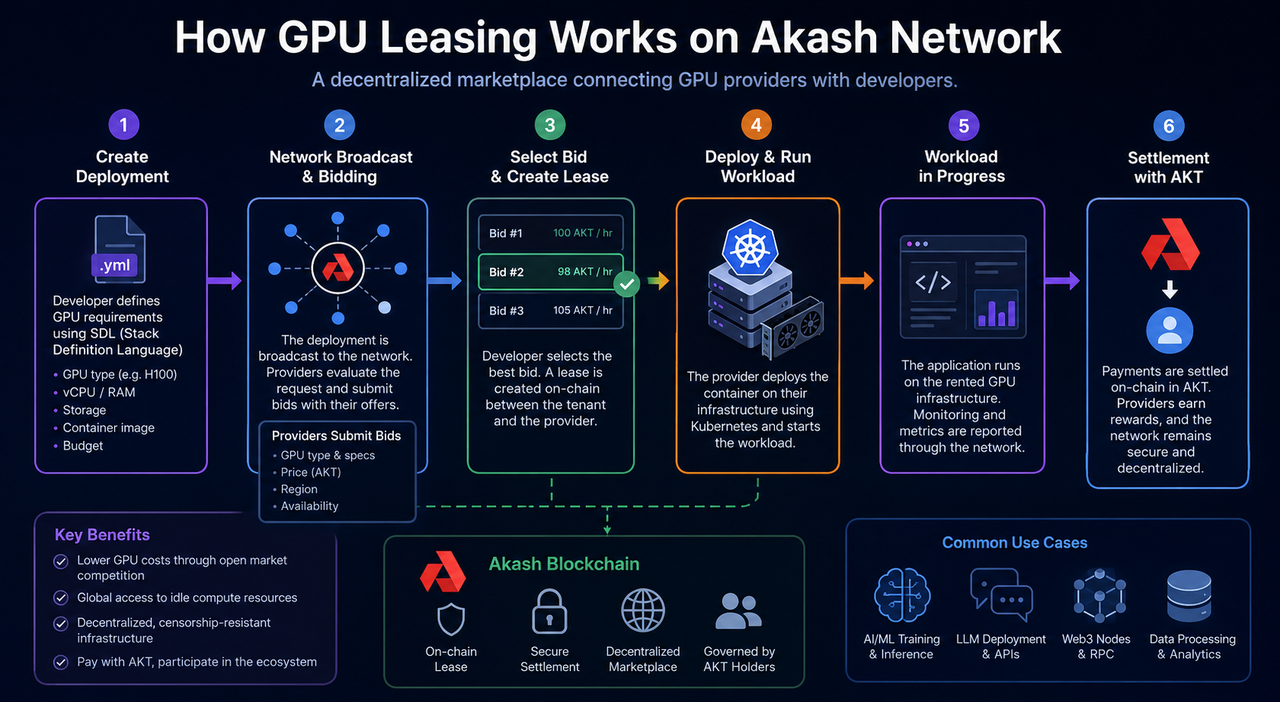
Developers can publish GPU requirements on the network, including configuration needs such as GPU type, CPU, memory, storage, and runtime environment. Providers in the network then submit bids based on their available resources, and developers eventually choose the most suitable resources to complete deployment.
The biggest difference between this model and traditional cloud platforms is that resource prices are determined dynamically by market supply and demand, rather than being set uniformly by a single platform.
What Are the Core Roles in the GPU Leasing Process?
The Akash GPU leasing process mainly involves four core roles:
Tenant
A tenant is a developer or project team that needs GPU resources. Tenants usually deploy AI models, machine learning tasks, inference services, or Web3 applications.
The tenant submits resource requirements and pays the corresponding fees.
Provider
A provider is a node operator that supplies GPU and server resources to the network. In theory, any individual, mining farm, or data center with idle GPUs can become a provider.
Providers submit bids based on market demand and provide actual computing resources after a lease takes effect.
Validator
Validators are responsible for maintaining the security and consensus mechanism of the Akash blockchain network, including transaction validation, order confirmation, and on-chain governance.
AKT Holder
AKT holders can participate in network governance and security maintenance through staking, while also taking part in the resource settlement ecosystem.
How Do Developers Request GPU Resources on Akash?
On the Akash network, developers first need to create a Deployment.
A Deployment file usually includes
Akash uses SDL, or Stack Definition Language, to describe these resource requirements and combines it with Kubernetes to manage container deployment.
After the Deployment is submitted, the system broadcasts the requirements across the network and waits for providers to submit bids.
How Does the Provider Bidding Mechanism Work?
When the network receives a Deployment request, qualified providers submit bids based on their own available resources.
A bid usually includes the GPU rental price, available GPU model, deployment region, network resource configuration, and service stability. The tenant can then choose the most suitable provider from multiple bids.
Because providers compete with one another, GPU prices on Akash are often lower than those on some traditional cloud platforms. This market based mechanism is also one of the defining features of decentralized GPU networks.
What Happens After a Lease Is Created?
When a tenant accepts a provider’s bid, the system creates a Lease.
A Lease is an on-chain resource usage agreement that confirms the two parties, GPU configuration, resource usage period, payment method, and service status. After the lease is created, the provider automatically deploys the corresponding resources and begins running the application submitted by the developer.
The entire process is usually completed through Kubernetes and Docker containers, so developers can deploy AI services and applications much as they would on a traditional cloud platform.
How Do AI Models Run After GPU Deployment Is Completed?
After GPU deployment is completed, developers can run a variety of AI workloads on Akash, including:
Because Akash supports Kubernetes, many existing AI workflows can be migrated directly to the network.
Some developers also use Akash to deploy Hugging Face models, open source AI applications, and GPU API services.
What Role Does AKT Play in GPU Leasing?
AKT is the core settlement asset of Akash Network.
In the GPU leasing process, AKT mainly serves the following functions:
Resource Payment
Tenants can use AKT to pay GPU and server leasing fees.
Network Fees
on-chain Deployment, Lease, and governance operations usually require Gas fees.
Network Security
AKT is used in the PoS staking mechanism to maintain network operation and validation security.
Governance
AKT holders can vote on protocol upgrades and parameter adjustments.
How Is the Akash GPU Marketplace Different From Traditional GPU Cloud Services?
The biggest difference between Akash and traditional GPU cloud platforms lies in how resources are organized.
Traditional platforms usually rely on large data centers to provide GPU resources in a centralized way, while Akash allows idle GPUs around the world to freely enter the market.
This model brings several clear characteristics:
| Comparison Dimension |
Akash Network |
Traditional GPU Cloud Platforms |
| Resource Source |
Decentralized providers |
Official data centers |
| GPU Pricing |
Market bidding |
Platform fixed pricing |
| Cost Structure |
Usually lower |
Usually higher |
| Deployment Method |
Kubernetes + Docker |
Platform ecosystem |
| Censorship Risk |
Relatively lower |
Relatively higher |
| GPU Utilization |
Uses idle resources |
Centralized management |
However, traditional platforms still have advantages in enterprise support, stability, and global service systems.
What Challenges Does the Akash GPU Marketplace Face?
Although decentralized GPU marketplaces offer openness and cost advantages, Akash still faces some practical issues.
First, hardware quality and network stability may vary across different providers. Compared with centrally managed data centers, decentralized resources are less standardized.
Second, demand for high end GPUs in the AI market is growing extremely quickly. How to keep expanding the number of providers and the supply of GPUs is also an important challenge for Akash.
In addition, competition in decentralized AI infrastructure is intensifying, with projects such as io.net, Render, and Gensyn also building in the GPU market.
In the future, developer experience, stability, and ecosystem scale may become important factors that determine Akash’s long term competitiveness.
Summary
Akash Network reorganizes idle computing power around the world through an open GPU marketplace, allowing developers to access AI computing resources in a more flexible and lower cost way.
Its GPU leasing process mainly includes several core stages: Deployment, Bid, Lease, and resource deployment. Kubernetes and blockchain technology are used to automate resource management and settlement.
As demand for AI model training and inference continues to grow, GPUs have gradually become a critical resource in digital infrastructure. The decentralized GPU marketplace represented by Akash is also helping push cloud computing from a centralized platform model toward an open resource marketplace.
FAQs
What Steps Are Included in Akash’s GPU Leasing Process?
The main stages include Deployment, Bid, Lease creation, resource deployment, and AKT settlement.
What Is a Provider?
A provider is a node operator that supplies GPU and server resources to the Akash network. It can be an individual, mining farm, or data center.
Does Akash Support AI Model Deployment?
Yes. Akash is widely used for LLMs, AI inference, Stable Diffusion, machine learning training, and AI agent deployment.
What Role Does AKT Play in GPU Leasing?
AKT is used to pay GPU leasing fees, network fees, PoS staking, and on-chain governance.
Akash organizes GPU resources through an open marketplace and provider bidding mechanism, while traditional cloud platforms usually rely on centralized data centers and fixed pricing models.