The discussion around Holo (HOT): Foundational Definitions and Mechanisms reveals that risks and limitations are not isolated to a single point but are distributed across four key pathways: asset holding, host participation, application usage, and information verification. Each pathway is constrained by different factors—ranging from market and account security, to the availability of custodial infrastructure, and to cognitive biases arising from terminology confusion. Only by deconstructing each participation action can risk assessments remain grounded in the actual mechanisms.
What Activities Typically Constitute Participation in the Holo Ecosystem?
Participation in the Holo ecosystem is often broadly summarized as “being bullish on Holo.” However, from an operational perspective, it encompasses at least three distinct activities: holding or transferring HOT, providing host capacity, and accessing hosted applications via a web portal. Each of these activities faces unique failure points and requires separate analysis.
| Participation Activity |
Typical Actions |
Main Risk Source |
Key Verification Focus |
| Holding HOT |
Deposit, withdrawal, wallet management, on-chain transfer |
Market volatility, private key security, fake contract addresses |
Token contract, wallet permissions, source channels |
| Acting as Host |
Deploying hardware/software hosts, maintaining uptime |
Operational stability, device/network failures, yield expectation deviation |
Host documentation, operational costs, service terms |
| Using Hosted Applications |
Accessing hApp web portals via browser |
Accessibility fluctuations, bridging layer experience, service interruptions |
Authenticity of domain and portal, availability disclosures |
This table makes it clear that “participation” is not a single action. Applying host operational risks directly to token holding, or treating token risks as equivalent to custodial technology risks, leads to misjudgment. Establishing a layered perspective—such as by understanding the boundaries between Holo and Holochain—is essential for effective risk identification.
What Are the Structural Advantages?
Structural advantage narratives in the Holo ecosystem primarily focus on the mechanism layer, not the price layer. One narrative highlights the agent-centric application framework and the separation of responsibilities at the custodial layer, aiming to shift application logic and data control from a single center to a distributed structure. Another narrative emphasizes the Web Bridge, which allows traditional browser users to access distributed applications, lowering the barrier of “having to run your own node.” A third narrative points to the scalable supply from community hosts, ensuring resources aren’t limited to a single cloud provider.
These advantages are only valid if certain prerequisites are met: stable host supply, available bridging links, and clear understanding among participants regarding the roles of HOT and HoloFuel. Ignoring these prerequisites and assuming “inevitable superiority” can misrepresent mechanism descriptions as outcome guarantees. Reviewing the Holo hosting and Web Bridge process shows that the bridging layer is designed to enhance accessibility—not to eliminate all operational constraints.
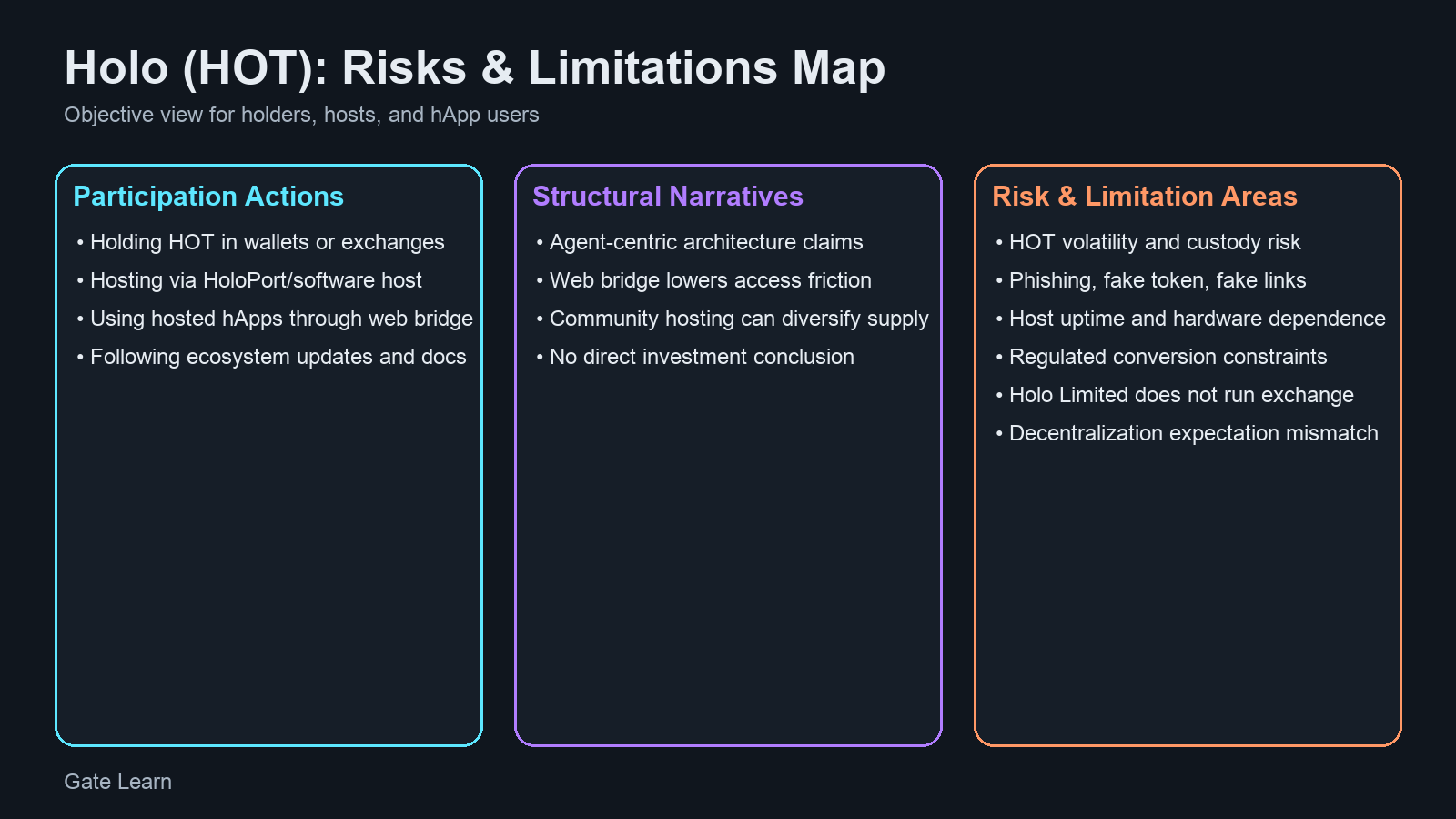 Figure 1. Overview of Holo ecosystem participation activities, structural narratives, and the layered relationship of risks and limitations.
What Are the Technical and Ecosystem Limitations?
Technical and ecosystem limitations are often described as “high design flexibility, but more complex implementation requirements.” For the custodial network to deliver a stable experience, it depends on host uptime, load balancing, and ongoing maintenance of bridging components—any disruption can impact the end-user experience. For typical users, problems usually present as unstable access speeds, temporary service outages, or confusing entry points, rather than pure protocol-level errors.
Ecosystem limitations include cognitive barriers and coordination costs: new users must understand the distinctions between the framework, custodial, and asset layers; application providers need to balance user experience with distributed deployment; and hosts must manage hardware, networking, maintenance cycles, and cost recovery. Unlike traditional centralized hosting, the Holo approach does not automatically resolve all operational challenges—it reallocates some responsibilities and capabilities to network participants.
What Are the Cognitive Risks Regarding Tokens and Accounting?
Misunderstandings about HOT and HoloFuel are among the most common sources of risk in the Holo ecosystem. HOT is an existing, tradable token; HoloFuel is a mutual-credit accounting and settlement design for custodial scenarios. Their relationship must be understood through three lenses: design intent, implementation status, and compliance boundaries—not through a single narrative.
| Key Concept |
Common Misunderstanding |
More Accurate Understanding |
| HOT and HoloFuel Relationship |
Holding HOT automatically provides a HoloFuel balance |
HOT and HoloFuel operate at different layers, with their relationship governed by technical and regulatory factors |
| Exchange Expectations |
Exchange can occur freely in any scenario |
Exchanges are subject to regulatory and licensing requirements; refer to public disclosures and service provider boundaries |
| Role of Operating Entity |
Holo Limited manages trading and matching |
Holo Limited does not operate an exchange; trading and exchange services are handled by separate entities |
| Accounting Nature |
HoloFuel is no different from generic trading tokens |
HoloFuel is designed specifically for custodial valuation and settlement, not for general market trading |
Another frequent risk at the asset level is conflating price volatility with mechanism issues. Price swings, liquidity changes, and custodial security are asset risks; the ability to establish stable settlement paths within the custodial network is a system implementation issue. The two are related but distinct, and conflating them leads to misjudgment.
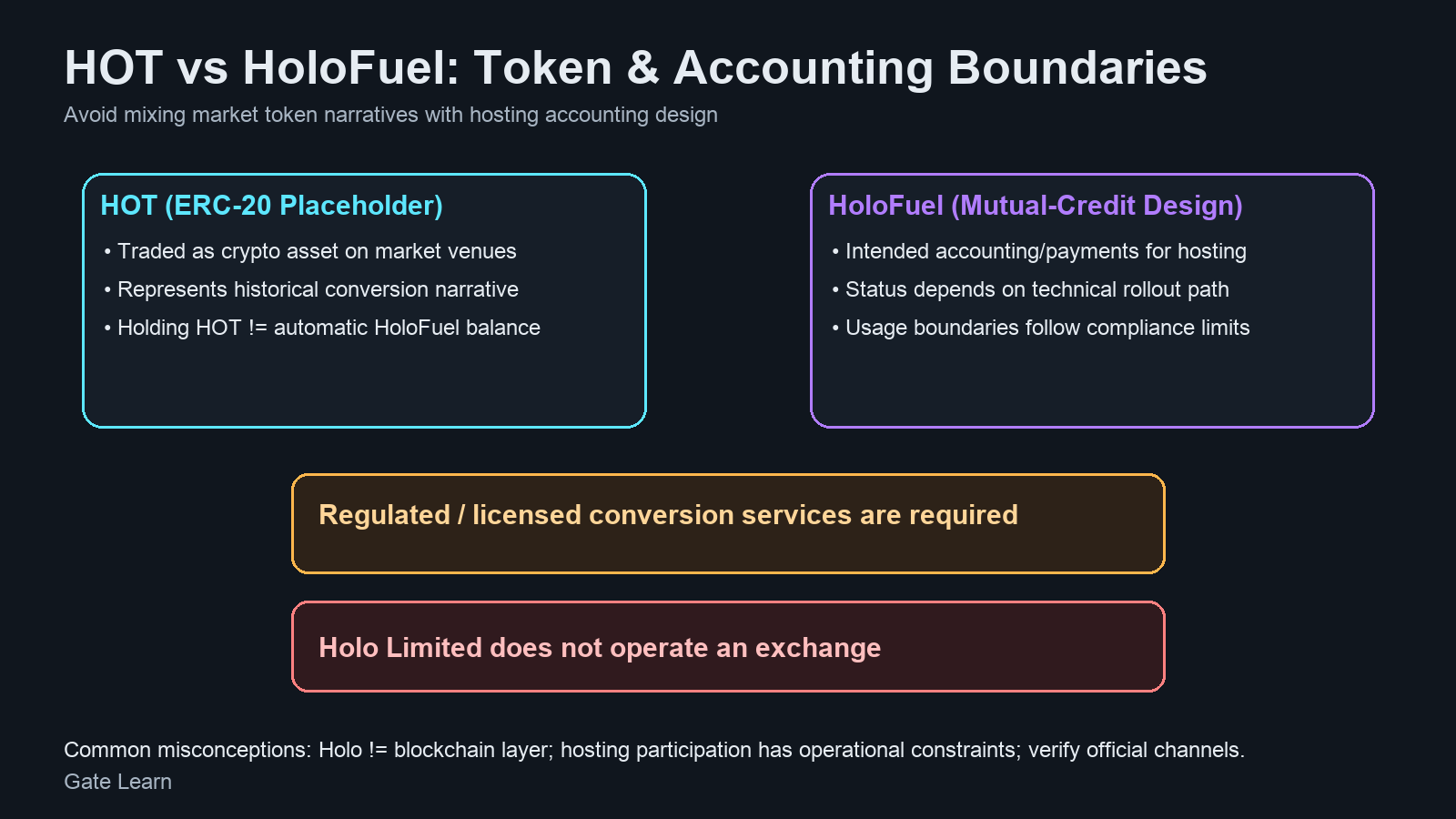
Figure 2. Illustration of HOT and HoloFuel role boundaries, compliance constraints, and common misconceptions.
Counterfeiting risks exist at both the token and portal levels. On the token side, common problems include fake contracts, identically named assets, and forged announcements; on the portal side, issues include counterfeit domains, impersonated social media accounts, and redirect links. For new users, the biggest risk is not “failing to understand technical details,” but mistaking unverified information for official updates.
Effective verification involves four steps: first, identify and cross-check official sources; second, verify the entity before the content; third, be alert to language such as “limited-time exchange” or “private message guidance”; and fourth, always return to the official website and public documentation for critical actions. If a statement involves exchange, custodial rules, or ecosystem role changes, always check for consistency across the official website, official X account, and public statements.
How Should Decentralized Custody Expectations Be Viewed Objectively?
A more precise understanding of “decentralized custody” is the redistribution of responsibilities and capabilities—not the total elimination of intermediaries. In the Holo context, hosts, application providers, bridging services, and end users all play roles. The system’s architecture reduces reliance on a single central entity, but does not eliminate operational costs, service boundaries, or compliance obligations.
Objective assessment requires breaking expectations into three questions: Is the goal to increase availability or achieve complete autonomy? Is the participant an asset holder, host provider, or application user? What ongoing responsibilities are involved? Only by clarifying these points can mechanism direction be distinguished from outcome guarantees.
Summary
Risk identification for holding or using HOT and participating in the Holo ecosystem hinges on layering and role differentiation: the asset layer focuses on price and security, the custodial layer on accessibility and operations, and the cognitive layer on terminology and information authenticity. Structural advantage narratives are valid only when their prerequisites are met. The relationship between HOT and HoloFuel should be assessed within the frameworks of technical progress, regulatory arrangements, and entity responsibilities. The fact that Holo Limited does not operate an exchange is a key baseline for evaluating exchange narratives. Centering on mechanism facts is far more effective than relying on emotional conclusions for reducing misjudgment.
FAQ
What Are the Risks of Using or Holding HOT?
Risks fall into three main categories: price volatility and liquidity changes at the asset level, wallet private key and phishing risks at the account level, and fake announcements and portals at the information level. Holding and host participation are distinct activities with different risk controls. Confirm your participation path and match it with the appropriate verification checklist to significantly reduce misjudgment.
What Is the Use of the HOT Token?
HOT is typically seen as a tradable token within the Holo ecosystem, historically associated with expectations for a future accounting system. It appears mainly in the context of market trading and asset management and should not be equated with the internal accounting and settlement functions of the custodial network. Distinguish between its role as a trading asset and as a settlement mechanism.
What Is HoloFuel? How Does It Relate to HOT?
HoloFuel is a mutual-credit accounting and payment system designed for custodial use cases, with the goal of facilitating resource valuation and settlement. The relationship between HOT and HoloFuel exists at the design and regulatory levels, not as an “automatic single asset.” Understanding requires consideration of technical roadmap, regulatory boundaries, and compliance requirements.
Is Holo a Blockchain?
Holo is positioned as a custodial and web accessibility layer, not as a traditional global consensus blockchain network. Holochain, by contrast, is usually described as an agent-centric distributed application framework, not a typical chain-based global consensus system. Treating Holo as “another public chain” leads to cognitive errors.
What Is the Difference Between Holo and Holochain?
Holochain addresses application framework and data collaboration, while Holo focuses on custodial supply and web access. Their roles are complementary, not interchangeable. Distinguishing between the framework and custodial layers enables accurate understanding of the boundaries for HOT, HoloFuel, host participation, and application access.