In DeFi protocols, protocol tokens typically serve multiple roles, including governance participation, ecosystem incentives, liquidity support, and the coordination of user interests. However, a token having these functions does not mean that all of a protocol's economic activity will directly translate into returns for token holders. Understanding the value of a protocol token requires distinguishing between its practical use cases, economic incentive mechanisms, and market expectations for future development.
HAEDAL is the native token of the Haedal protocol. Built on liquid staking in the Sui ecosystem, Haedal connects underlying staking with DeFi applications through liquid staking assets such as haSUI and haWAL. As the protocol's product architecture expands, HAEDAL has also been incorporated into its governance and ecosystem incentive framework, becoming one of the tools used to coordinate protocol participants and long-term development goals.
Unlike haSUI and haWAL, HAEDAL does not represent a user's ownership interest in SUI or WAL staking pool assets. Its core role is protocol governance and ecosystem incentives. Holding HAEDAL, locking HAEDAL to obtain veHAEDAL, and using Haedal's liquid staking services are three distinct activities that involve different rights and risks.
Therefore, analyzing HAEDAL requires more than looking at its token price or circulating supply. It also requires examining its governance mechanism, locking system, token allocation, sources of incentives, and whether protocol business activity can generate sustained economic demand.
What Is HAEDAL?
HAEDAL is the native governance token of Haedal Protocol, primarily used to support protocol governance, ecosystem participation, and related incentive mechanisms.
Haedal's core business is liquid staking. Users delegate assets such as SUI or WAL to validators through the protocol and receive liquid staking tokens such as haSUI and haWAL. HAEDAL operates at the protocol's governance and incentive layer, helping coordinate ecosystem participants, encourage long-term participation, and support protocol development.
This distinction is important. Holding HAEDAL does not mean that users directly own a proportion of Haedal staking pool assets, nor does it mean they can redeem SUI or WAL at a fixed ratio. Rights to underlying assets are primarily represented by the corresponding liquid staking tokens, while HAEDAL's value is more closely related to governance mechanisms, ecosystem incentives, and market expectations.
From an analytical perspective, Haedal's main tokens can be divided into two categories:
-
Liquid staking tokens: haSUI and haWAL, which represent staking rights to the corresponding underlying assets and accumulate staking rewards according to protocol rules.
-
Protocol token: HAEDAL, which is used for governance participation, ecosystem incentives, and veHAEDAL-related mechanisms.
Both types of tokens may participate in the Haedal ecosystem, but their value formation mechanisms differ.
HAEDAL's Core Functions: Governance and Ecosystem Incentives
Protocol governance is one of HAEDAL's key functions. Through token-related mechanisms, ecosystem participants can take part in protocol proposals and voting, discuss protocol development directions and related parameters, and make decisions.
The purpose of a governance token is to distribute some decision-making participation rights to ecosystem participants, so protocol development does not rely entirely on the internal decisions of a single team. However, the actual scope of governance rights must be assessed based on the protocol's governance rules, proposal permissions, voting mechanisms, and execution methods.
HAEDAL also serves an ecosystem incentive function. The protocol can use token incentives to encourage users to participate in liquid staking, use related products, or support ecosystem expansion. Incentives can reduce the initial cost of participation and promote growth in liquidity and application scale.
However, incentives alone do not constitute real demand. If users participate in a protocol primarily to receive token rewards, some capital may exit quickly when rewards decrease or market prices change. Therefore, evaluating the effectiveness of ecosystem incentives requires assessing whether users remain willing to use the protocol after incentives end and whether the protocol has developed sustainable real business activity.
veHAEDAL: Locking Mechanism and Governance Participation
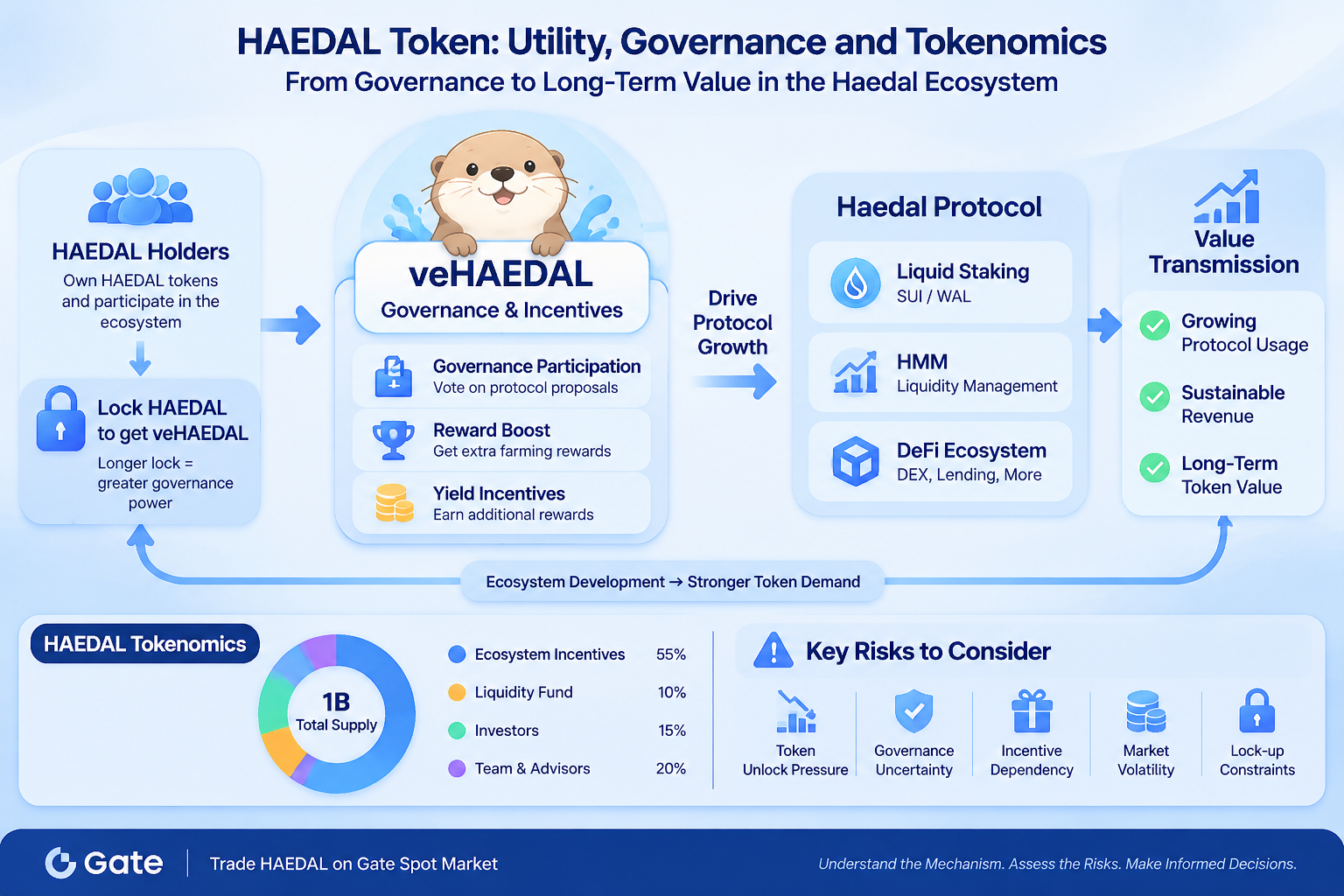
veHAEDAL is Haedal's token-locking and governance mechanism. Users can lock HAEDAL for a specified period to obtain veHAEDAL and participate in related ecosystem benefits based on their veHAEDAL holdings.
According to Haedal's official documentation, veHAEDAL primarily involves three areas:
Governance Participation
veHAEDAL holders can participate in Haedal DAO proposals and voting and take part in protocol governance decisions. The locking mechanism links governance participation with token holders' long-term commitment.
Staking Rewards
Locking HAEDAL allows users to obtain corresponding veHAEDAL and participate in related reward distributions. The official documentation describes an ongoing periodic reward mechanism. Specific reward sources and actual distribution details are subject to current protocol rules.
Ecosystem Reward Boosts
A user's veHAEDAL balance may also affect reward boosts in the Haedal Farm module. Through this design, the protocol seeks to connect long-term token holding, governance participation, and ecosystem use.
The amount of veHAEDAL obtained is related to the lock period. The official documentation describes a maximum lock period of 52 weeks. The longer the lock period, the greater the initial amount of veHAEDAL received, while shorter lock periods are calculated proportionally.
veHAEDAL balances decay linearly as the end of the lock period approaches. Once the lock period ends, the veHAEDAL balance falls to zero, and users can unlock and recover their original HAEDAL.
This design allows users who lock for longer periods to receive greater initial governance weight and incentive eligibility, while governance weight changes over time rather than remaining permanently fixed.
However, locking does not protect token value. During the lock period, users remain exposed to changes in HAEDAL's market price, opportunity costs, and adjustments to the governance mechanism. If users need to exit early, they should first confirm the specific rules and any applicable restrictions.
HAEDAL Tokenomics Structure
Token allocation determines the initial proportion of tokens held by different participants and can also affect future circulating supply and potential market selling pressure.
According to Haedal's official tokenomics documentation, HAEDAL has a total supply of 1 billion tokens, with the following initial allocation:
| Allocation Category |
Share |
Primary Purpose |
| Ecosystem incentives |
55% |
Promote the adoption of Haedal and its liquid staking assets in the Sui ecosystem, including user rewards and partnership incentives |
| Liquidity fund |
10% |
Initial liquidity and ongoing CEX and DEX liquidity support |
| Investors |
15% |
Token allocation for investors |
| Team and advisors |
20% |
Token allocation for the team and advisors |
| Total |
100% |
Total supply of 1 billion tokens |
Based on the allocation structure, ecosystem incentives account for more than half of the supply, indicating that Haedal aims to promote protocol adoption and ecosystem expansion through token rewards. This approach can help attract users and liquidity during the early stages of development, but it also means that incentive efficiency needs to be continuously evaluated.
If ecosystem incentives can generate long-term users, real trading activity, and sustained protocol use, the token allocation may support ecosystem development. Conversely, if users participate mainly for rewards, capital and activity may decline after incentives end, potentially affecting actual demand for the token.
Investor and team tokens also require attention to locking and unlocking schedules. The original arrangements listed in the official documentation are as follows: investor tokens are locked for 6 months and then released linearly over 12 months; team and advisor tokens are locked for 12 months and then released linearly over 24 months.
These arrangements reflect the initial tokenomics design, but users should also review the latest unlocking progress, circulating supply, and changes to relevant addresses when conducting an actual analysis. The original release schedule alone should not be used to infer how many tokens are currently circulating or remain locked.
How Does HAEDAL's Value Connect With Protocol Business Activity?
The long-term value of a protocol token requires analyzing whether protocol business activity can generate sustained economic demand and whether that demand can be transmitted to the token layer.
Haedal's business foundation includes liquid staking, liquidity management, and related DeFi products. As assets such as haSUI and haWAL see increased use in the Sui ecosystem, the protocol may gain more users, assets, and trading activity.
However, growth in protocol business does not automatically mean growth in HAEDAL's value. Further analysis is needed regarding protocol revenue, token incentives, buyback or reward arrangements, and whether governance mechanisms create effective token demand.
For example, official documentation for Haedal Market Maker (HMM) describes its protocol-owned liquidity and fee distribution mechanism: a portion of net revenue is allocated to haSUI-related funding arrangements, a portion of fees is used for HAEDAL buybacks and rewards for veHAEDAL participants, and another portion is retained as protocol revenue.
This mechanism indicates that Haedal seeks to connect the economic activity of related products with protocol token incentives. However, specific proportions, execution status, and actual revenue should be subject to the latest rules and on-chain data. The design described in documentation should not be treated as evidence of an already sustained buyback scale or a guarantee of future returns.
Therefore, evaluating HAEDAL's value transmission requires observing three levels separately:
First, whether the protocol has real and sustained demand for use, including staking scale, the use of liquid staking assets, and the extent of DeFi integrations.
Second, whether related products can generate sustainable revenue rather than relying primarily on token subsidies to maintain user activity.
Third, whether protocol revenue and economic incentives can be transmitted to HAEDAL or veHAEDAL participants through clear and verifiable rules.
Only by considering these three levels together can users assess whether protocol business growth truly provides economic support at the token level.
How Is HAEDAL Different From Other DeFi Protocol Tokens?
Different DeFi protocol tokens have different sources of value. HAEDAL can be compared across three dimensions: governance participation, ecosystem incentives, and its connection to protocol business activity.
Compared With Pure Governance Tokens
Some DeFi tokens are primarily used for proposals and voting, while token holders may have relatively limited economic rights. In addition to its governance function, HAEDAL uses the veHAEDAL locking mechanism to connect staking rewards and Farm reward boosts, seeking to link governance participation with ecosystem use.
However, whether this creates stronger value support still depends on reward sources, protocol revenue, and actual participation demand, rather than the number of functions alone.
Compared With Pure Liquidity Mining Tokens
Some protocol tokens rely mainly on continuously issuing token rewards to liquidity providers. HAEDAL's mechanism incorporates lock periods, governance weight, and reward boost designs in an effort to encourage users to develop longer-term participation.
However, a locking mechanism can only change how users participate and cannot guarantee long-term growth in token demand. If ecosystem activity lacks real use cases, locking incentives may also fail to attract users over time.
Compared With Liquid Staking Tokens
Assets such as haSUI and haWAL represent underlying staking rights, while HAEDAL primarily serves governance and incentive functions. The value formation of the former is related to underlying assets, staking rewards, and redemption mechanisms. The latter is more affected by protocol development, tokenomics, and market supply and demand.
This is also a distinction that must be maintained when analyzing the Haedal ecosystem: the redemption value of liquid staking assets is not equivalent to the market value of the protocol token.
HAEDAL's Key Risks and Evaluation Factors
Token Unlocks and Supply Pressure
HAEDAL's ecosystem incentive, investor, and team allocations have different release schedules. As tokens gradually unlock, the tradable market supply may change. If new supply exceeds market demand, it may put pressure on the price.
Governance Participation and Actual Authority
Holding governance tokens does not mean that holders can directly control all protocol assets or all product parameters. Users should confirm the scope of DAO proposals, voting rules, and execution authority to avoid equating governance participation with full control of the protocol.
Incentive Dependence and Demand Quality
If users participate in staking or Farm activities mainly to receive token rewards, capital outflows may occur after rewards decrease. The protocol needs to demonstrate that its business can generate real demand rather than merely relying on token incentives to maintain activity.
Protocol Revenue and Token Value Transmission
A protocol generating revenue does not mean that all revenue is distributed to token holders. Users should distinguish between protocol revenue, treasury reserves, buybacks, rewards, and other uses of funds, and verify actual execution records.
Market Liquidity and Price Volatility
HAEDAL's market price is affected by trading depth, market sentiment, and the broader crypto asset environment. Even if the protocol's fundamentals change, this does not mean the token price will change at the same time. Market trading prices alone do not represent protocol value.
Locking and Opportunity Costs
veHAEDAL requires users to lock HAEDAL. During the lock period, users may lose some liquidity, while token prices can still fluctuate. Locking rewards should be evaluated alongside the time funds are committed, potential losses, and exit restrictions.
Gate Spot: A Centralized Market Access Point for HAEDAL
HAEDAL's protocol functions primarily occur on the Sui blockchain, while its protocol token can be traded on centralized trading platforms. For users seeking to observe HAEDAL's market price, trading depth, and buying and selling demand, the spot market is an important channel for price discovery.
Gate listed HAEDAL/USDT for spot trading on April 29, 2025. Users can view the corresponding trading pair on the Gate spot market and trade according to real-time market conditions.
It is important to note that HAEDAL spot trading is not the same operation as veHAEDAL locking, Haedal DAO governance, or haSUI staking. Buying HAEDAL on Gate does not automatically provide veHAEDAL, nor does it directly provide staking rewards or governance eligibility in the Haedal protocol. To participate in related on-chain mechanisms, users must complete the relevant steps according to protocol rules and confirm current eligibility requirements.
Therefore, Gate Spot provides market trading access for HAEDAL, while protocol governance and on-chain rights should be understood separately according to Haedal's official mechanisms. Before trading, users should verify the trading pair, asset network, and service status on Gate's real-time trading page.
FAQ
What Type of Token Is HAEDAL?
HAEDAL is the native governance token of Haedal Protocol, primarily used for governance participation, ecosystem incentives, and veHAEDAL-related mechanisms.
What Is the Difference Between HAEDAL and haSUI?
HAEDAL is a protocol governance and incentive token. haSUI is a liquid staking token received by users after staking SUI through Haedal, representing the corresponding SUI staking rights.
What Is veHAEDAL?
veHAEDAL is a governance and incentive rights credential obtained after users lock HAEDAL. It can be used to participate in DAO governance, related rewards, and Farm reward boosts. Its balance gradually decays based on the lock period.
What Is HAEDAL's Total Supply?
Haedal's official tokenomics documentation lists a total supply of 1 billion tokens. The actual circulating supply is affected by token unlocks, allocations, and other supply changes and should be confirmed using the latest data.
Does HAEDAL Represent a Holder's Right to Receive All Protocol Revenue?
No. Protocol revenue and token holder rights are not the same concept. Whether and how revenue is transmitted to token participants must be determined based on specific governance rules, buyback arrangements, and reward distribution mechanisms.
Can I Obtain veHAEDAL by Buying HAEDAL on Gate?
No, not automatically. Gate spot trading is a token buying and selling activity. veHAEDAL must be obtained through on-chain operations according to Haedal Protocol's locking rules.
Can HAEDAL's Price Reflect the True Value of the Haedal Protocol?
Not completely. Token prices are also affected by circulating supply, market liquidity, trading sentiment, and the overall market environment. Evaluating protocol value requires reviewing protocol usage, revenue sources, and tokenomics mechanisms together.