For users comparing meme coin trading platforms, the important difference is not simply whether a trade settles onchain. The practical question is which layer manages the wallet, transaction signing, network selection, and liquidity route. Gate Trenches consolidates those steps inside an exchange interface; a DEX leaves more control with the user.
Key Takeaways
- Gate Trenches reduces wallet setup, private-key handling, and manual bridging for exchange users.
- DEXs provide self-custody, permissionless access, and broader composability across protocols.
- Both routes depend on onchain liquidity and remain exposed to slippage, failed transactions, and token-contract risk.
- The simpler route depends on whether convenience or direct asset control matters more.
What Is Gate Trenches?
Gate Trenches is a Gate onchain trading product that lets users on Gate Web or the Gate App search by token name or paste a contract address, view real-time market data and candlestick charts for supported assets, and complete onchain trades with Gate account assets. The Gate Trenches product entry is the access point; networks, fees, gas treatment, and available assets depend on the launch announcement and help-center description.
Compared with a standalone wallet workflow, this account-based path can reduce extra wallet preparation, fund transfers, and network-selection steps. The exact flow remains dependent on the product interface, while network coverage, fees, and gas treatment may change.
What Is a DEX?
A decentralized exchange is a protocol that lets a user swap tokens through a connected crypto wallet and onchain liquidity pools, order books, or an aggregator route. The user controls the wallet keys and signs transactions directly, while the protocol executes according to its smart-contract rules.
DEX access is more flexible because users can interact with permissionless pools and combine protocols without moving assets into an exchange account. The user must select the chain, fund gas, approve the token, review slippage, and verify the contract and pool.
Gate Trenches vs DEX: Which Is Easier to Set Up and Trade Onchain?
Gate Trenches is usually easier to start for users who already use a Gate account. A DEX requires a wallet, network-specific funds, and native gas, so the user manages more of the transaction workflow.
| Feature |
Gate Trenches |
DEX |
| Account and wallet preparation |
Gate account workflow |
Self-custody wallet |
| Asset and key arrangement |
Gate account assets; platform rules apply |
User-managed private keys |
| Funding path |
Gate account assets |
Wallet funding and network selection |
| Transaction confirmation |
Product interface |
Wallet signature and token approval |
| Trading route |
Supported onchain trading routes |
Direct pools or aggregator routes |
Gate Trenches offers a shorter execution path for users with assets in a Gate account: search a token, review market data and the chart, and submit an onchain trade through the account interface. It can reduce some network switching and extra-wallet steps, but it does not eliminate the need to verify a contract address or assess liquidity.
A DEX gives the user more execution choices. A wallet can connect to an aggregator, choose among pools, set slippage limits, and select transaction priority. That control can improve route selection for experienced users, but it also creates more opportunities for a wrong network, bad approval, failed transaction, or unexpected price impact.
Execution quality should be compared using the amount received, not only the fee displayed before submission. A larger order can consume several price levels in a shallow liquidity pool, creating price impact even when the quoted route looks competitive. Trading volume is useful context, but high volume alone does not prove that a pool is deep or that activity is organic. A careful comparison checks pool depth, recent volume, the quoted output, slippage tolerance, and whether the route uses one pool or several.
The two interfaces also present different failure points. Gate Trenches can reduce the number of manual decisions, but a user still needs to confirm the token contract, supported chain, and final quote. A DEX exposes more transaction details, which helps experienced users inspect the route but makes wrong-network selection, insufficient gas, token approval, and signature errors more likely.
DEXs provide stronger direct control because the user holds the keys and can interact with any compatible protocol. Gate Trenches places supported onchain trading inside a Gate account workflow, which suits users who prefer one account and fewer extra-wallet steps.
The trade-off is not the same as a simple centralized-versus-decentralized label. Gate Trenches is designed for supported onchain token trading, while a DEX can expose a wider range of pools and protocols. The deciding variables are supported-chain coverage, asset and account arrangements, liquidity depth, and how much transaction detail the user wants to control.
Both routes remain exposed to thin liquidity, slippage, fake tokens, malicious contracts, and price impact. A simpler interface does not make an asset legitimate. Contract-address verification, holder concentration, liquidity status, and the ability to complete a small test transaction still matter when checking whether a meme coin is legit.
Gate Trenches adds account rules, product-availability, and platform-workflow considerations. A DEX adds self-custody risks, including lost keys, malicious approvals, wrong-network transfers, and failed transactions. Gas fees and aggregator charges can also make a small trade uneconomic even when the quoted swap looks attractive.
Cost comparisons need the same measurement window and trade size. An exchange-based quote may show a trading fee separately from any applicable network cost, while a DEX swap can combine the pool fee, gas, priority fee, routing charge, and price impact in the final result. A fee that looks lower in isolation can still produce a worse fill if the route has less liquidity. Comparing the final received amount for the same contract, chain, and notional size gives a more useful result than comparing headline percentages.
Choose Gate Trenches when reducing setup complexity matters most, assets are already available in a Gate account, and the supported networks and token routes cover the intended trade. Choose a DEX when self-custody, permissionless access, and granular route control matter more than a shorter workflow.
Neither route is automatically safer or cheaper for every token. A platform comparison should include the complete trade path: custody, network, gas, trading fee, slippage, liquidity depth, contract verification, and the consequences of a failed transaction.
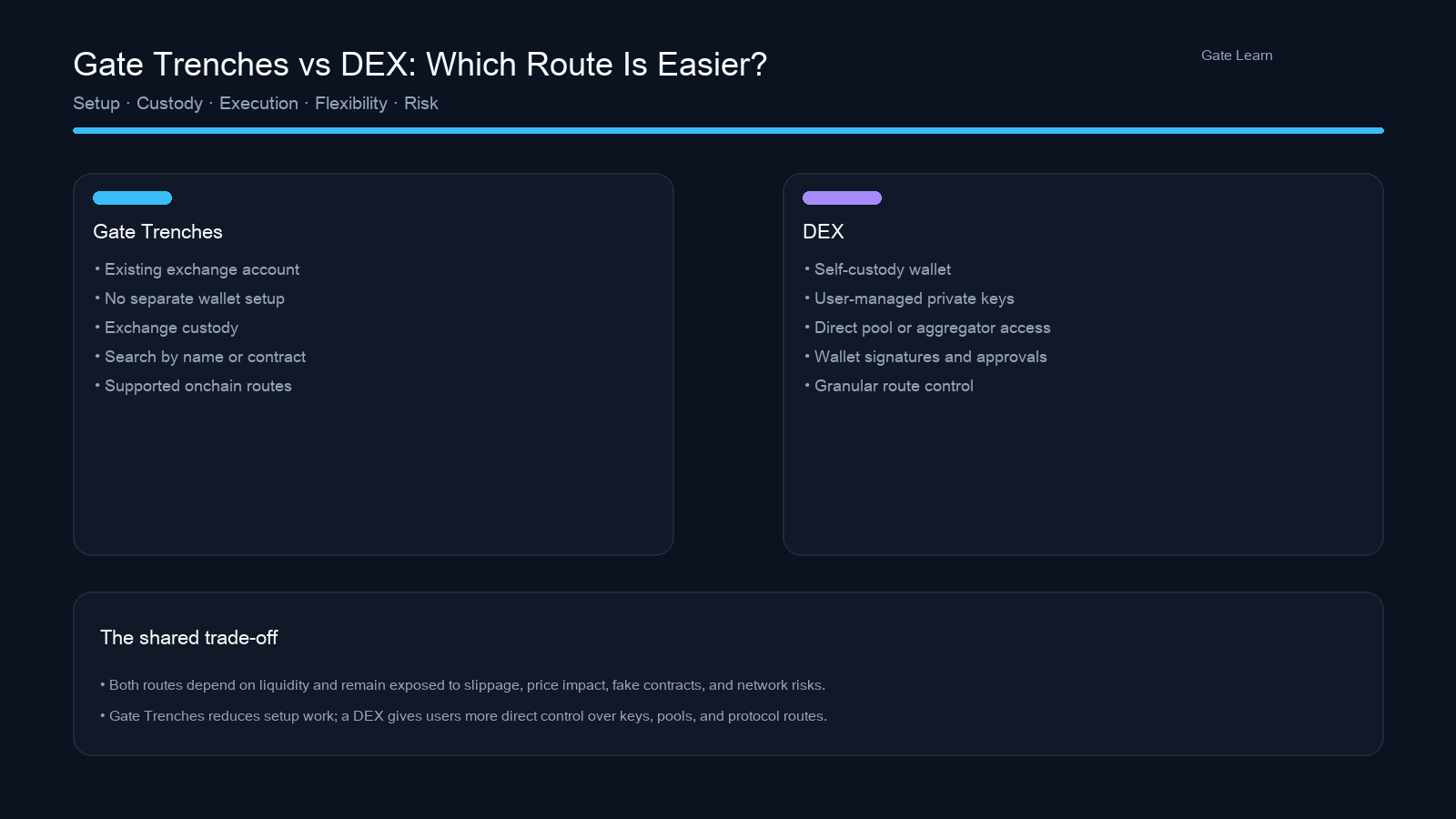
Figure 1. Gate Trenches and DEX compared across setup, custody, execution, flexibility, and risk.
Summary
Gate Trenches is easier for users who prefer to keep supported onchain trading within a Gate account workflow and reduce some extra wallet-preparation and network-selection steps. A DEX is more flexible because it gives users direct control over keys, pools, and protocol routes. Both are onchain execution paths with shared risks, so convenience changes the workflow rather than removing the need for verification.
FAQ
Is Gate Trenches easier than a DEX?
Gate Trenches is generally easier for users who already use an exchange account and want fewer wallet, network, and signing steps. A DEX can be easier for experienced self-custody users who already understand wallet approvals, gas, and liquidity routing.
Do you need a crypto wallet to use Gate Trenches?
Gate Trenches lets users use a Gate account workflow for supported onchain token trades. Users still need to check the supported asset, network, quote, and transaction conditions before submitting an order.
Is Gate Trenches a DEX?
Gate Trenches is a Gate onchain trading product, not a standalone self-custody DEX. It uses a Gate account interface, while the product page determines the available assets and trading route.
Which is cheaper, Gate Trenches or a DEX?
The cheaper route depends on the full cost of a trade, including platform fees, network fees, gas, slippage, routing charges, and price impact. A DEX may offer more route choices, while Gate Trenches may reduce operational work associated with extra wallet preparation and network switching.
What risks remain when trading onchain through Gate Trenches?
Onchain trading through Gate Trenches can still involve fake contracts, thin liquidity, slippage, price impact, supported-network limits, and changing fee rules. Users must also follow Gate account and product rules and confirm available assets and trading conditions in the actual interface.