Gate groups CandyDrop, Launchpool, and HODLer Airdrop under Launch navigation. CandyDrop centers on Task-Driven Participation; Launchpool’s menu tag reads Quick staking, earn potential new tokens; HODLer Airdrop reads Hold GT and get massive airdrops for free.
The sections below compare mechanics and selection paths. Gate CandyDrop task and reward rules are in the CandyDrop FAQ; Launchpool and HODLer Airdrop rules change by round on live product pages and announcements.
Key Takeaways
- CandyDrop: opt-in tasks → Candy → token airdrop share (or fixed rewards), with per-user caps.
- Launchpool: stake designated assets (examples often include BTC, ETH, or project tokens) to earn potential new-token rewards for that pool round.
- HODLer Airdrop: hold GT to receive free airdrop-style rewards under that product line’s rules.
- Pick by mechanic and inventory you already hold—tasks/trading capacity, stakeable assets, or GT holdings—then read the live round page.
How Do the Three Launch Products Differ at a Glance?
| Dimension |
CandyDrop |
Launchpool |
HODLer Airdrop |
| Official framing |
Candy airdrop platform; Task-Driven Participation |
Quick staking, earn potential new tokens |
Hold GT and get massive airdrops for free |
| Core action |
Complete tasks (trade / deposit / invite, per project) |
Stake into the live pool |
Hold GT under product rules |
| Opt-in control |
Must click Join Now on the project page |
Follow the live pool subscribe/stake flow |
Follow the live HODLer campaign rules |
| Reward shape |
Candy- or volume-based share of an airdrop pool, or fixed rewards |
New-token rewards from the pool round |
Airdrop distributions tied to GT holding |
| Account note |
Main accounts only for CandyDrop |
Follow each Launchpool round’s eligibility |
Follow each HODLer round’s eligibility |
CandyDrop task and reward rules are in the CandyDrop FAQ; browse live rounds on the CandyDrop product page. Launchpool and HODLer Airdrop parameters change by round; treat menu blurbs as positioning, not as a substitute for the round page.
When search results ask Launchpad vs Launchpool, map the answer back to Gate’s live Launch product cards rather than copying third-party LaunchHub or PoolX naming matrices.
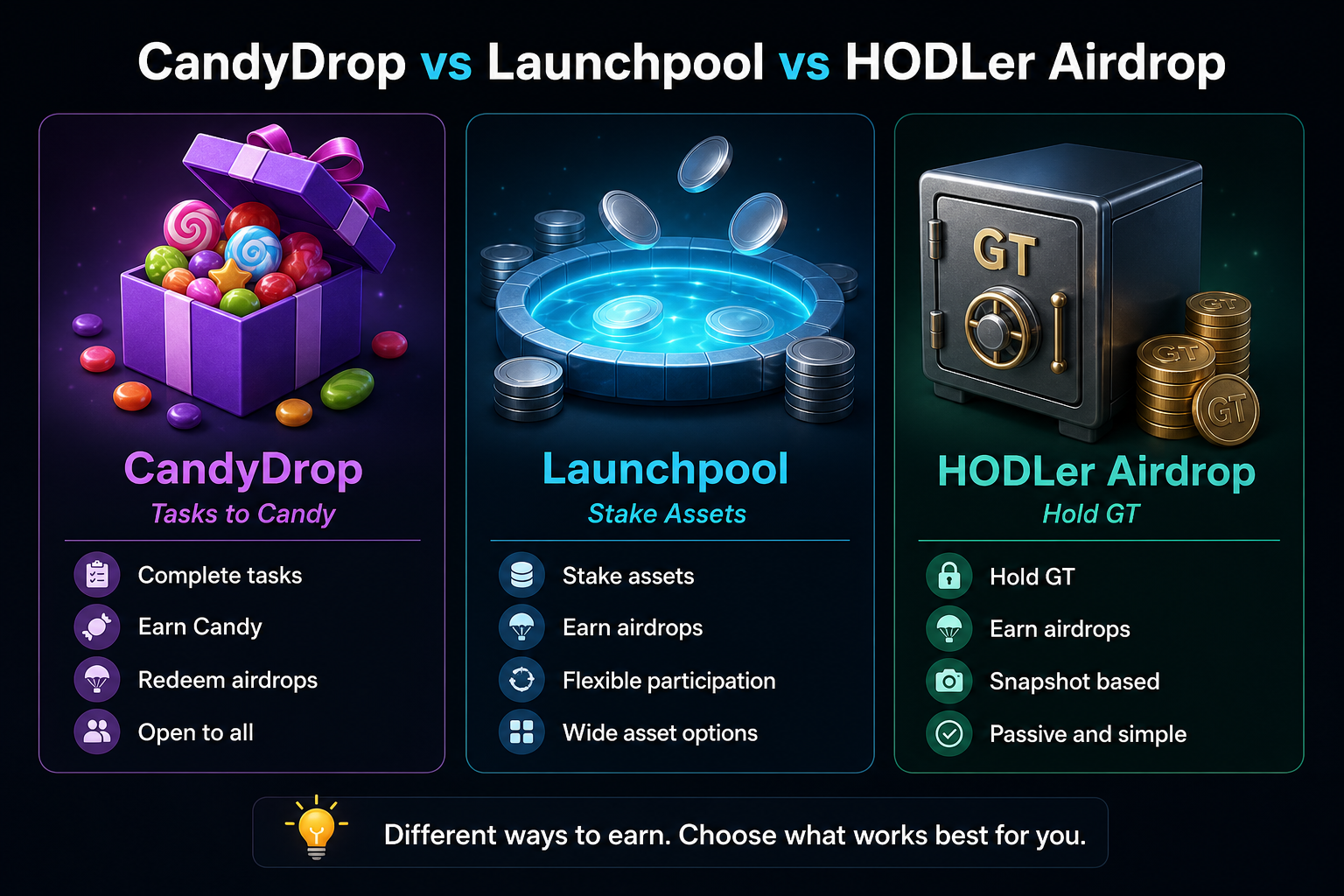
Figure 1. CandyDrop vs Launchpool vs HODLer Airdrop participation mechanics.
What Is CandyDrop’s Participation Model?
CandyDrop uses Task-Driven Participation. Users earn Candy by completing project tasks—designated trading volume, depositing certain tokens, inviting friends—then exchange Candy for token airdrops. Participation is opt-in via Join Now. Rewards may use Candy-pool share, volume-based pool share, or fixed rewards, each with a per-user maximum. Candy expires with the campaign and does not carry over. Sub-accounts are ineligible. Steps follow how to join Gate CandyDrop.
CandyDrop therefore behaves like a measured airdrop contest: more valid Candy can raise your share of a pool, but caps and eligibility still bind outcomes. It does not replace staking inventory into Launchpool, and it does not substitute for GT holding under HODLer Airdrop.
What Is Launchpool’s Participation Model?
Launchpool is Gate’s staking-oriented new-token campaign line. Product navigation describes staking designated assets—announcement examples commonly cite staking BTC, ETH, and the project token—to earn potential new-token airdrop/reward allocations for that pool period. Users choose a live pool, stake eligible assets for the stated window, and receive rewards according to that round’s rules. Unlike CandyDrop, the primary mechanic is staking inventory rather than completing trading or referral tasks for Candy. Always read the live Launchpool round for lockups, eligible assets, and reward schedules.
Launchpool incentives are pool-round specific. A high displayed rate on one round does not transfer to the next, and staking does not automatically mint CandyDrop Candy. When people compare “Launchpad vs Launchpool,” they are often mixing a subscription/sale metaphor with a stake-to-earn pool; on Gate, evaluate Launchpool only through the current pool page rather than through another exchange’s LaunchHub naming.
What Is HODLer Airdrop’s Participation Model?
HODLer Airdrop is Gate’s GT-holder airdrop product line. Navigation copy frames it as holding GT to receive free airdrop-style rewards. Eligibility, snapshot or holding rules, and distribution timing depend on each live HODLer campaign rather than on CandyDrop’s Join Now plus task model. Users evaluating HODLer Airdrop should confirm GT holding requirements on the current campaign page instead of assuming CandyDrop formulas apply.
HODLer Airdrop is inventory-led: if you do not hold GT under the campaign’s rules, task farming on CandyDrop will not create HODLer eligibility by itself. Holding GT does not complete CandyDrop tasks. Keep the three ledgers separate—Candy counts, Launchpool stake shares, and GT holding status.
How Should You Choose Among CandyDrop, Launchpool, and HODLer Airdrop?
Choose CandyDrop when you can complete opt-in campaign tasks and want task-driven airdrop share under Candy or volume rules. Choose Launchpool when you prefer to stake eligible assets into a live pool for potential new-token rewards. Choose HODLer Airdrop when your primary inventory edge is holding GT under that product’s campaign rules. You can use more than one Launch product over time if each campaign’s eligibility allows, but do not assume Candy, stake shares, or GT airdrops are interchangeable.
Practical check: (1) Can you click Join Now and complete listed tasks? → CandyDrop. (2) Do you hold stakeable BTC/ETH/project tokens for a live pool? → Launchpool. (3) Do you hold GT that meets the live HODLer rules? → HODLer Airdrop. Joining multiple campaigns does not raise Candy caps by itself; verify each campaign’s UTC start and end times. Digital asset participation involves market and product risk; not investment advice.
Summary
CandyDrop, Launchpool, and HODLer Airdrop sit in Gate’s Launch area with different mechanics: task-driven Candy airdrops, staking pools for new tokens, and GT-holder airdrops. Use the CandyDrop FAQ for task and reward math; use each Launchpool or HODLer round page for staking and holding rules.
FAQ
CandyDrop vs Launchpool — what’s the difference?
CandyDrop awards Candy through opt-in tasks that convert into token airdrops. Launchpool awards potential new tokens primarily through staking designated assets in a live pool.
Is HODLer Airdrop the same as CandyDrop?
No. HODLer Airdrop is framed around holding GT for free airdrop-style rewards, while CandyDrop is a task-driven candy airdrop platform.
Do I need to click Join Now for Launchpool like CandyDrop?
CandyDrop explicitly requires Join Now for task tracking. Launchpool uses each pool’s own stake/subscribe flow—follow the live Launchpool page rather than CandyDrop FAQ buttons.
Can I join CandyDrop and Launchpool at the same time?
Possibly if each product’s eligibility allows, but rules, caps, and account restrictions are independent. Check both live pages before participating.
Which product is better for beginners?
It depends on what you already hold and can do. Task capacity favors CandyDrop; stakeable assets favor Launchpool; GT holdings favor HODLer Airdrop. Read the live round before acting.