Ethereum is an open-source, decentralized, and programmable blockchain network that enables developers to build decentralized applications through smart contracts; ETH, or Ether, is its native asset and is used to pay Gas fees, transfer value, participate in staking, and help secure the network.
For crypto traders, developers, investors, and blockchain enthusiasts who want a practical understanding of how Ethereum works and where it fits in Web3, this guide explains the network’s architecture, smart contracts, ETH and Gas mechanics, Layer 2 scaling, staking and restaking, DeFi, NFTs, DAOs, Rollup-as-a-Service, major protocol upgrades, and Ethereum’s competitive landscape.
From the ICO boom of 2017 and DeFi Summer in 2020 to the mainstream rise of NFTs in 2021, Ethereum has played a central role in many major developments across Web3. As the ecosystem expanded, Ethereum’s scaling strategy also evolved toward a multi-layer architecture in which Rollups and Layer 2 networks handle more transaction execution while Ethereum Mainnet continues to provide settlement and security.
Ethereum itself continues to evolve. The Merge moved the network from Proof of Work to Proof of Stake in 2022, Dencun introduced blobs in 2024, and Pectra and Fusaka followed in 2025. In 2026, development remains focused on Layer 1 scaling, blob capacity, account experience, security, and protocol efficiency, with Glamsterdam among the next major upgrades on Ethereum’s roadmap.
Key Takeaways
Ethereum is a programmable blockchain network that uses smart contracts to support DeFi, NFTs, DAOs, games, and other decentralized applications.
ETH is Ethereum’s native asset and is primarily used to pay Gas fees, transfer value, participate in Proof-of-Stake validation, and serve as a base asset across the ecosystem.
Ethereum completed The Merge in 2022, replacing Proof-of-Work mining with Proof-of-Stake validators and significantly reducing the network’s energy consumption.
Layer 2 has become a core part of Ethereum’s scaling strategy, while upgrades including Dencun, Pectra, and Fusaka continue to improve Rollup capacity, account functionality, and scalability.
Beyond DeFi and NFTs, Ethereum has developed major ecosystems around DAOs, liquid staking, restaking, data availability, and Rollup-as-a-Service infrastructure.
What Is Ethereum?
Ethereum was proposed by Vitalik Buterin in 2013 as both a blockchain network and a digital platform. Its central idea was that blockchain technology should not be limited to transferring digital currency but could also provide a general-purpose programming environment where developers could deploy and run applications on a decentralized network.
Ethereum held a public crowdsale in 2014 and launched its mainnet in July 2015. Compared with Bitcoin, which uses proof-of-work for transaction validation and was designed primarily around decentralized money and value settlement, the ethereum platform introduced a more general-purpose smart contract environment that allows developers to define rules for asset issuance, trading, lending, governance, and other on-chain activities.
This design later supported the development of ERC-20 tokens, DeFi, NFTs, DAOs, stablecoins, and Layer 2 networks. Ethereum’s significance therefore extends beyond ETH as a crypto asset: it also provides an open and permissionless infrastructure for blockchain computing and applications.
What Is Ether?
ETH
Ether, commonly known as etherethether ethethereth, is the nativecryptocurrencynative cryptocurrencynativecryptocurrency of the Ethereum network—a cryptocurrencycalledethercryptocurrency called ethercryptocurrencycalledether, or ETH. Users can transfer ETH as digitalmoneydigital moneydigitalmoney, while ETH is also required to pay Gas fees when sending transactions, deploying smart contracts, or interacting with decentralized applications.
After Ethereum transitioned to Proof of Stake, ETH also became directly connected to network security. Validators earn ETH rewards when they process transactions correctly. Ethereum’s proof-of-stake mechanism can penalize dishonest validators. Activating an independent Ethereum validator traditionally requires 32 ETH. Users who do not hold 32 ETH or do not want to maintain validator infrastructure can participate through staking pools and other third-party staking solutions.
ETH therefore serves several roles within the ecosystem. It functions as a value-transfer asset, the settlement asset for Gas fees, a staking asset that helps secure Ethereum, and a widely used base asset across DeFi and other Ethereum applications.
ETH as “Digital Oil”
Bitcoin is often described as “digital gold,” while ETH has sometimes been compared to “digital oil.” This analogy comes primarily from ETH’s role in paying for computation on Ethereum, and Ether is the second-largest cryptocurrency by market capitalization.
If Ethereum is viewed as open digital infrastructure, smart contracts and DApps are programs running on that infrastructure. Gas represents the computational resources required to execute those programs, while ETH is used to pay for those resources.
However, ETH now serves a broader role than simply acting as network “fuel.” Proof of Stake gives ETH a direct role in Ethereum’s security model, while DeFi, liquid staking, and Layer 2 ecosystems have expanded its utility across the network.
Unlike Bitcoin, whose fixed supply reflects bitcoin's supply cap of 21 million BTC, ETH does not have a fixed maximum supply. Instead, new ETH is issued as validator rewards, and EIP-1559 burns the base fee associated with eligible transactions, meaning changes in ETH supply are influenced by both protocol issuance and fee burning. During periods of sufficiently high network activity, ETH burned through transaction fees can exceed newly issued ETH.
How Does Ethereum Work?
Ethereum is maintained by a globally distributed network of nodes that collectively track and verify blockchain state. Unlike blockchains designed mainly for value transfer, Ethereum also provides a general-purpose smart contract execution environment, allowing developers to create financial protocols, digital assets, games, and many other types of applications.
When a user submits a transaction, validators participate in block proposal and consensus, while nodes execute transactions and smart contracts according to Ethereum’s protocol rules. The resulting changes are incorporated into the shared network state, allowing participants to reach agreement on account balances and smart contract data.
The Ethereum Blockchain
The Ethereum blockchain is a public blockchain that stores transaction data as well as state changes produced by smart contract execution. The network is maintained by nodes distributed across different regions rather than by a single central server or central authority responsible for controlling transaction records.
Nodes follow the same protocol rules when verifying transactions and blocks, and nodes across the entire network synchronize the shared state. This distributed architecture makes on-chain state publicly verifiable and makes it difficult for any single participant to arbitrarily alter confirmed blockchain history.
This design also helps the network resist malicious activity because no single participant controls the records.
Ethereum can also execute smart contracts rather than merely record asset transfers. This enables the network to process more complex on-chain activities such as decentralized trading, lending, token issuance, governance voting, and other programmable interactions.
Solidity and Smart Contracts
Smart contracts are programs deployed on a blockchain that execute according to predefined code, with the logic first written as source code before deployment. Solidity is one of the most widely used programming languages in the Ethereum ecosystem and is commonly used to build trading protocols, lending platforms, NFTs, DAOs, and other DApps.
As of Q4 2025, Ethereum supports over 8.7 million smart contracts, with 8.7 million smart contracts deployed in Q4 2025.
For example, a decentralized exchange can use smart contracts to determine how assets enter liquidity pools, how exchange rates are calculated, and how assets are transferred after a trade. When the required conditions are met, the contract can execute according to its code without requiring a traditional financial intermediary to manually settle each transaction.
Automatic execution, however, does not mean smart contracts are inherently risk-free. Smart contract functionality is what enables automated execution, but code vulnerabilities, oracle failures, economic design flaws, and permission-management issues can all affect on-chain assets, making audits, access controls, and risk management important considerations.
Decentralized Applications (DApps)
A DApp, or decentralized application, typically provides users with a web or mobile user interface for interacting with blockchain-based logic while smart contracts manage core assets and part of its business logic.
From the user’s perspective, a DApp may look similar to a conventional internet application. The difference lies primarily in its underlying architecture: traditional applications usually rely on company-controlled servers, while key logic and asset states in DApps can be recorded and executed directly on a blockchain.
Ethereum has developed a broad developer and infrastructure ecosystem around Solidity, the EVM, wallets, node services, development frameworks, and ERC token standards, and it remains especially popular among software developers. Today, many Ethereum applications no longer execute every transaction directly on Ethereum Mainnet. Instead, they may operate on Layer 2 networks while continuing to use Ethereum for settlement, data availability, or security.
Gas Fees
Gas is the unit used to measure the computational resources consumed by transactions and smart contract execution on Ethereum. Validators process transactions, and users pay the associated fees in ETH; more complex smart contract interactions generally consume more Gas.
Since The Merge in 2022, Ethereum no longer relies on Proof-of-Work miners. Instead, Proof-of-Stake validators participate in maintaining the network. Under the current fee mechanism, transaction costs generally include a base fee and a priority fee. The base fee is determined by the protocol and burned, while the priority fee provides an incentive for validators to include a transaction in a block.
A simplified representation is:
Transaction Fee = Gas Used × (Base Fee + Priority Fee)
A basic ETH transfer generally consumes 21,000 Gas, while ERC-20 transfers, NFT transactions, and complex DeFi interactions may require considerably more.
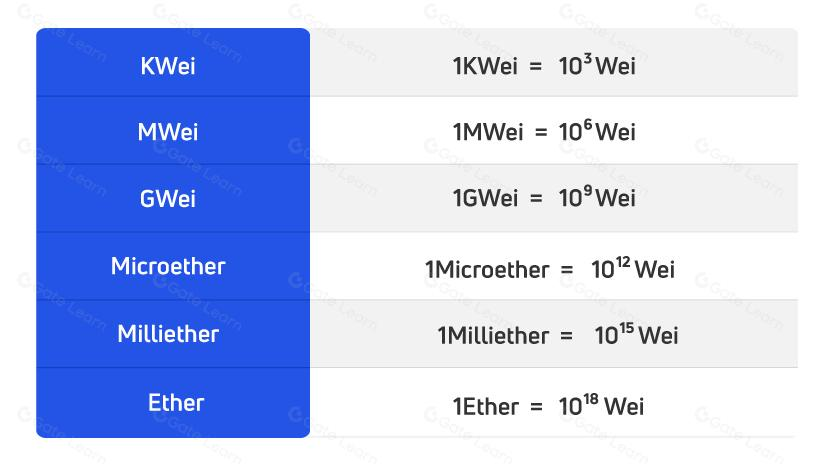
(ETH denominations and Gas fee structure)
EIP-1559 was implemented through the London upgrade in 2021. It redesigned Ethereum’s fee market rather than simply guaranteeing lower Gas fees, and Ethereum’s scaling path for lower transaction fees depends largely on Layer 2 rather than Mainnet itself. Because the base fee is burned, network activity now has a more direct relationship with ETH’s supply dynamics.
Ethereum Virtual Machine (EVM)
The Ethereum Virtual Machine, or EVM, is the execution environment responsible for running smart contract code on Ethereum. Contracts written in higher-level languages such as Solidity are compiled into code that the EVM can execute according to standardized rules.
When users interact with a smart contract, Ethereum nodes perform the corresponding computation under EVM rules and update network state. Because nodes execute the same code under the same protocol rules, they can independently arrive at the same result.
The EVM’s influence extends well beyond Ethereum Mainnet. Many other Layer 1 and Layer 2 networks use EVM-compatible architectures, allowing developers to reuse Solidity contracts, wallets, and development tools. This interoperability has helped strengthen Ethereum’s broader developer network effect.
Major Milestones in Ethereum’s Development
Since Ethereum was proposed in 2013, its development has progressed through several major phases, from establishing a programmable smart contract platform and building an application ecosystem to transitioning to Proof of Stake and adopting a Layer 2-centered scaling strategy; ethereum created its live network in 2015 with the Frontier mainnet launch.
Period
Major Event
Why It Mattered
2013–2014
Ethereum whitepaper and public crowdsale
Vitalik Buterin proposed a general-purpose smart contract blockchain, while the crowdsale helped fund development
2015
Frontier mainnet launch
Ethereum became operational, allowing developers to deploy smart contracts and DApps
2016
The DAO incident and hard fork
A major smart contract exploit triggered a governance dispute and led to the split between Ethereum and Ethereum Classic
2017
ERC-20 and the ICO boom
ERC-20 lowered the barrier to issuing blockchain tokens and demonstrated Ethereum’s network effects
2018–2019
Bear market and infrastructure development
Market activity slowed while protocol development, tooling, and scaling research continued
2020
DeFi Summer and Beacon Chain
Decentralized trading, lending, and liquidity protocols expanded rapidly, while Beacon Chain prepared Ethereum for Proof of Stake
2021
NFT growth and London upgrade
NFTs attracted a wider user base, while EIP-1559 redesigned Ethereum’s transaction fee mechanism
2022
The Merge
Ethereum completed its transition from Proof of Work to Proof of Stake on September 15
2023
Shapella and Layer 2 expansion
Shapella enabled withdrawals of staked ETH while major Layer 2 ecosystems continued to expand
2024
Dencun
EIP-4844 introduced blobs, providing lower-cost data space for Rollups
2025
Pectra and Fusaka
Pectra improved account and validator functionality, while Fusaka further advanced scaling and data availability
2026
Glamsterdam and subsequent development
Ethereum continues to focus on Layer 1 scaling, Gas repricing, block construction, data capacity, and protocol efficiency
The ethereum foundation, a Swiss non-profit, has helped coordinate and fund core development across many of these stages.
The Merge was one of the most important turning points in Ethereum’s history. On September 15, 2022, Ethereum ended Proof-of-Work mining and formally adopted Proof of Stake, making the network far more energy efficient. According to Ethereum.org, the transition reduced Ethereum’s energy consumption by approximately 99.95%.
Shapella followed in 2023 and enabled withdrawals of staked ETH. This completed another important part of Ethereum’s transition to Proof of Stake by allowing validators to exit and withdraw their staked assets according to protocol rules.
Dencun in 2024 strengthened Ethereum’s Rollup-centered scaling strategy. EIP-4844 introduced blobs, giving Layer 2 networks dedicated, lower-cost space for publishing transaction data to Ethereum.
Pectra went live in May 2025 and introduced changes including EIP-7702, improvements to account functionality, increased blob throughput, and validator-related adjustments. Fusaka followed in December 2025 and continued to expand Ethereum’s data availability and Rollup scaling capabilities, including PeerDAS-related improvements.
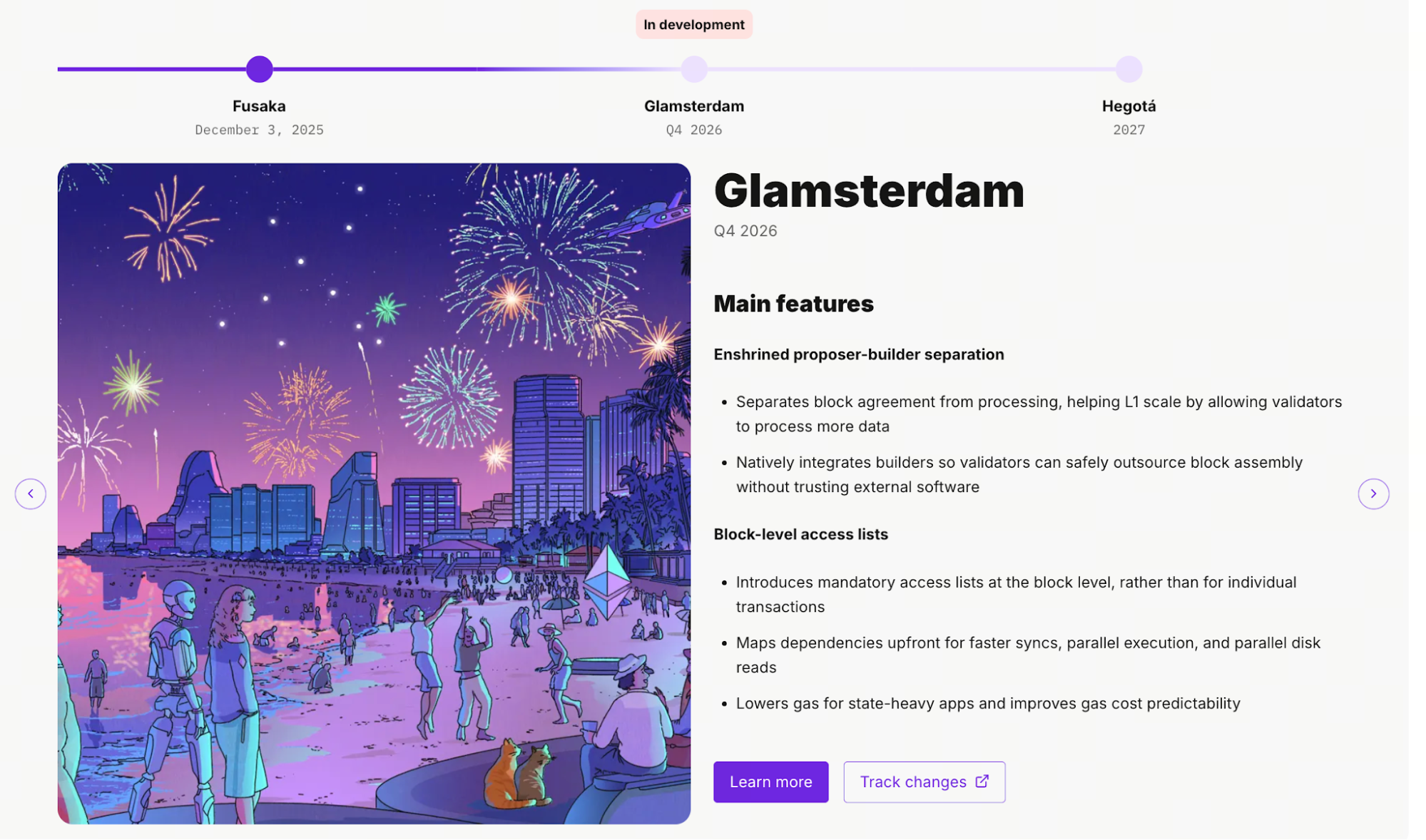
As of August 2026, Glamsterdam is among the next major protocol upgrades on Ethereum’s roadmap and is currently targeted for the fourth quarter of 2026. Its development focuses on areas including Layer 1 scaling, transaction processing, block construction, and management of Ethereum’s growing state, although its final scope and activation timing may still change.
Important Applications of Ethereum
DeFi
DeFi, or decentralized finance, refers to financial services built using blockchain smart contracts. Within the Ethereum ecosystem, users can use wallets to access decentralized exchanges, lending protocols, stablecoins, liquidity pools, derivatives, and other financial applications.
In these applications, part of the transaction logic and asset-management rules is executed by smart contracts. This makes many asset states and transactions publicly verifiable, providing transparency in DeFi transactions and asset states, while also allowing different protocols to interact with one another, creating the composability for which Ethereum DeFi is known.
DeFi still carries significant risks. Smart contract vulnerabilities, oracle failures, asset depegging, liquidations, and liquidity problems can all result in losses, so users need to understand how individual protocols operate before interacting with them. In 2020, Uniswap grew from 20millionto2.9 billion in liquidity.
NFTs
NFT stands for non fungible tokens, or NFTs, and refers to blockchain-based digital assets with unique identifiers. Unlike fungible tokens such as ETH or USDT, which are interchangeable in ways similar to traditional currencies, individual non-fungible assets can have different values based on their attributes, provenance, numbering, or scarcity.
ERC-721 is one of Ethereum’s best-known NFT standards, while ERC-1155 supports multiple types of assets within a single contract. NFT applications have expanded beyond digital art and collectibles to include gaming assets, memberships, digital identity, virtual real estate in metaverse-style environments, and other forms of on-chain ownership.
( Ethereum NFT ecosystem or NFT application example)
The rapid expansion of NFTs in 2021 played an important role in introducing Ethereum to a broader audience. Since then, the technology has increasingly been explored for utility-focused applications beyond speculative collecting and trading. CryptoKitties was the first popular NFT project on Ethereum in 2017.
Layer 2
Layer 2 networks scale Ethereum by processing large numbers of transactions outside Ethereum Mainnet and then submitting necessary data or proofs back to Ethereum. By moving execution off Mainnet, they help achieve lower fees and increase overall transaction capacity while reducing costs for users.
Rollups have become a central part of Ethereum’s scaling architecture, including both Optimistic Rollups and ZK Rollups. Arbitrum, Optimism, Base, zkSync, Starknet, Scroll, and other networks have developed distinct Layer 2 ecosystems.
Arbitrum launched the ARB governance token in March 2023. ARB holders can participate in Arbitrum DAO governance, adding a community-governance layer to the broader network ecosystem.
Layer 2 is no longer simply a temporary response to Ethereum Mainnet congestion. It has become a core component of Ethereum’s long-term scaling strategy. Upgrades such as Dencun, Pectra, and Fusaka have continued to expand the amount of data available to Rollups and improve the economics of Layer 2 execution. Some Layer 2 designs can also reduce certain forms of counterparty risk by relying on Ethereum for settlement or security. Networks such as Optimism and Base are often used where lower fees matter.
DAOs
DAO stands for decentralized autonomous organization. DAOs generally use smart contracts and on-chain governance tools to coordinate community decision-making, treasury management, and protocol development.
Unlike organizations that depend entirely on centralized management, DAOs can allow token holders, delegates, or other participants to submit proposals and vote according to predefined governance rules. In practice, many DAOs also combine on-chain governance with foundations, multisignature wallets, councils, and delegate systems.
Projects such as MakerDAO played an important role in the early development of Ethereum-based DAOs and DeFi. DAO structures have since expanded across DeFi, Layer 2 governance, public-goods funding, and other blockchain communities.
Lido and Liquid Staking
Lido is one of the best-known liquid staking protocols in the Ethereum ecosystem. Users can stake ETH through Lido and receive liquid tokens such as stETH that represent their underlying staking position.
Ethereum has supported validator exits and withdrawals of staked ETH since the Shapella upgrade in 2023. As a result, the main value of liquid staking today is not simply overcoming an inability to withdraw ETH, but improving liquidity, composability, and capital efficiency for staked assets.
Lido has also continued to develop its staking infrastructure. Lido V3 launched on Ethereum Mainnet in 2026 and introduced stVaults, providing more modular staking configurations for node operators and other ecosystem participants, with optional access to stETH liquidity.
EigenLayer and Restaking
EigenLayer introduced restaking as an important concept within the Ethereum ecosystem, allowing assets already contributing to Ethereum’s economic security to be used to secure additional services.
EigenLayer supports different forms of restaking, including native ETH and supported liquid staking assets. Restaked economic security can be used by services commonly referred to as Actively Validated Services, or AVSs, reducing the need for every service to build a completely independent validator and economic-security system.
This approach can extend the utility of staked ETH, but it also introduces additional risks. In addition to Ethereum staking risks, restakers may face smart contract, operational, and slashing risks associated with the additional services they choose to secure.
AltLayer and Rollup-as-a-Service
Modular blockchain architecture separates functions such as execution, settlement, consensus, and data availability, allowing developers to combine different infrastructure components according to the requirements of their applications.
Rollup-as-a-Service, or RaaS, has developed within this framework. RaaS providers allow projects to deploy customized Rollups using existing infrastructure rather than building every underlying component from scratch.
AltLayer is one project operating in this area. Its RaaS infrastructure supports Rollup stacks such as OP Stack, Arbitrum Orbit, and ZK Stack, while also allowing integration with data availability solutions such as Celestia, EigenDA, and Avail.
As Ethereum increasingly relies on Layer 2 scaling, RaaS has become one way for applications to create customized execution environments while remaining connected to the broader Ethereum ecosystem.
Future Upgrades: The Ethereum Roadmap
Ethereum has continually evolved through network upgrades designed to improve scalability, security, efficiency, and user experience. Its roadmap is not a permanently fixed sequence but changes over time as research advances and network priorities evolve.
Ethereum’s roadmap has often been described through long-term development areas such as The Merge, The Surge, The Scourge, The Verge, The Purge, and The Splurge. These names remain useful for understanding broad technical objectives, but the work is not carried out as six strictly sequential phases; many areas are developed in parallel.
Major completed upgrades include The Merge in 2022, Shapella in 2023, Dencun in 2024, and Pectra and Fusaka in 2025. Pectra introduced EIP-7702 and other improvements affecting account functionality, blob throughput, and validators, while Fusaka continued to expand data availability and Rollup scaling.
As of August 2026, Glamsterdam is among the next major upgrades under development and is currently targeted for the fourth quarter of 2026. Its focus includes changes to transaction and block processing, greater Layer 1 scalability, and improvements to the management of Ethereum’s growing state.
Over the longer term, Ethereum’s roadmap continues to revolve around several core goals: increasing the scalability of both Mainnet and Layer 2, lowering the cost of using the network, strengthening security, improving wallets and account experience, and increasing protocol efficiency without sacrificing decentralization, while widespread adoption can expand the use of Ethereum applications even though it does not by itself guarantee asset-price gains.
Ethereum’s Competitors
Bitcoin and Bitcoin Layer 2 Networks
Bitcoin was originally designed primarily around decentralized peer-to-peer money and digital scarcity. Its scripting environment differs substantially from Ethereum’s general-purpose smart contract architecture.
As the Lightning Network, sidechains, and other Bitcoin scaling and execution layers have developed, the Bitcoin ecosystem has also explored more complex payments, asset issuance, and blockchain applications.
Bitcoin and Ethereum therefore cannot be reduced to a simple comparison between a “payments blockchain” and an “application blockchain.” Their monetary policies, development models, and scaling strategies remain different, although some areas of application increasingly overlap.
Solana
Solana is designed for high-performance smart contracts and decentralized applications, with a greater emphasis on increasing execution capacity at the base layer.
Its scaling philosophy differs from Ethereum’s. Ethereum increasingly relies on Rollups and Layer 2 networks for transaction execution, while Solana places greater emphasis on scaling a more unified base layer.
These approaches involve different technical trade-offs and make Solana one of Ethereum’s major competitors in the smart contract platform market.
Cosmos
Cosmos has long pursued an “Internet of Blockchains” vision, focusing on interoperability between independent blockchain networks.
The Cosmos SDK allows developers to create application-specific chains, while IBC enables compatible networks to communicate and transfer assets and data.
Compared with Ethereum’s model of combining a shared settlement and security layer with Layer 2 scaling, Cosmos places greater emphasis on sovereign blockchains and cross-chain interoperability.
NEAR
NEAR Protocol is also designed for smart contracts and decentralized applications, with a focus on scalability, developer experience, and reducing barriers for users.
NEAR uses sharding and related technologies to distribute network processing and increase scalability while exploring different approaches to account design and application usability.
Beyond Bitcoin, Solana, Cosmos, and NEAR, networks such as Avalanche, Polkadot, and Sui also pursue different approaches to smart contracts, application chains, parallel execution, and interoperability. Ethereum’s competitive landscape is therefore better understood as long-term competition between multiple blockchain architectures and scaling models rather than a search for a single “Ethereum killer.”
Summary and Key Considerations
Ethereum has evolved from an early smart contract platform into a broad Web3 ecosystem spanning DeFi, NFTs, DAOs, Layer 2, liquid staking, restaking, and modular blockchain infrastructure—a big deal in the broader digital asset market. Technologies and standards such as Solidity, the EVM, and ERC-20 have also been adopted widely across the blockchain industry.
Compared with Ethereum’s earlier years, when most activity took place directly on Mainnet, its architecture has become increasingly multi-layered. More user transactions can now be executed on Layer 2 networks, while Ethereum Mainnet continues to play an important role in settlement, security, and data availability.
From The Merge in 2022 and Dencun in 2024 to Pectra and Fusaka in 2025, Ethereum’s technical architecture continues to evolve. In 2026, upcoming work including Glamsterdam remains focused on Layer 1 scaling, data capacity, Gas mechanics, account experience, and overall protocol efficiency.
For new users, understanding Ethereum involves more than following the market price of ETH. Smart contracts, Gas, the EVM, Proof of Stake, Layer 2, and the wider application ecosystem all help explain how Ethereum operates today and how it differs from other blockchain networks. ETH and other digital assets are highly volatile, and users can lose money.
FAQ
Are Ethereum and ETH the same thing?
No. Ethereum is the blockchain network that supports smart contracts and decentralized applications, while ETH is its native asset used for Gas, staking, and value transfer.
Can Ethereum still be mined?
No. Ethereum completed The Merge in 2022 and transitioned from Proof of Work to Proof of Stake, so new blocks are no longer produced through traditional PoW mining.
Why do Ethereum Gas fees change?
Ethereum Gas fees vary according to network demand and transaction complexity, with current transaction costs generally consisting of a base fee and a priority fee.
What is the relationship between Layer 2 and Ethereum?
Layer 2 networks process more transactions outside Ethereum Mainnet while using Ethereum for settlement, data, or security, helping the broader ecosystem scale.
What is ETH mainly used for?
ETH is primarily used to pay Ethereum Gas fees, transfer value, participate in Proof-of-Stake validation, and serve as a base asset across DeFi and other Ethereum applications.
Will Ethereum continue to upgrade?
Yes. As of August 2026, Ethereum continues to develop upgrades including Glamsterdam, with ongoing work focused on scalability, data capacity, account experience, security, and protocol efficiency.
* The information is not intended to be and does not constitute financial advice or any other recommendation of any sort offered or endorsed by Gate.
* This article may not be reproduced, transmitted or copied without referencing Gate. Contravention is an infringement of Copyright Act and may be subject to legal action.
Solana faces both opportunities and challenges in its development. Recently, severe network congestion has led to a high transaction failure rate and increased fees. Consequently, some have suggested using Layer 2 and appchain technologies to address this issue. This article explores the feasibility of this strategy.
This article introduces the technical principles, framework, and applications of Zero-Knowledge (ZK) technology, covering aspects from privacy, identity (ID), decentralized exchanges (DEX), to oracles.
Sui is a PoS L1 blockchain with a novel architecture whose object-centric model enables parallelization of transactions through verifier level scaling. In this research paper the unique features of the Sui blockchain will be introduced, the economic prospects of SUI tokens will be presented, and it will be explained how investors can learn about which dApps are driving the use of the chain through the Sui application campaign.
TronScan is the primary blockchain explorer for the TRON network. It allows users to check TRX and TRC-20 transactions, inspect wallet balances, analyze smart contracts, monitor tokens, and view network activity without logging in. By connecting a compatible wallet such as TronLink, users can also transfer assets, stake TRX, vote for Super Representatives, and interact with TRON ecosystem applications.
This article analyzes the tremendous potential for the development of the Layer 2 (L2) market and the accompanying bridging needs among various L2 solutions. It delves into the current status, potential, and risks of the cross-chain protocol Across Protocol in this market.