The on-chain derivatives market is gradually becoming one of the fastest growing areas in the DeFi ecosystem. As the crypto market expands from simple spot trading into leveraged trading, hedging, and volatility strategies, more protocols are trying to bring professional derivatives architecture from traditional finance into the on-chain environment. In this process, order books, margin systems, and risk engines have become important infrastructure for on-chain derivatives platforms.
Among the many on-chain derivatives protocols, Derive and dYdX both aim to provide a trading experience in a decentralized environment that is close to what centralized exchanges offer, and both use an order book trading model. However, dYdX leans more toward highly liquid perpetual contract markets, while Derive extends further into options, portfolio margin, and multi asset risk management systems.
A Brief Overview of Derive and dYdX With Their Core Differences
Derive is a decentralized derivatives protocol focused on on-chain options and perpetual contract markets. Its core features include portfolio margin, multi asset collateral, and an on-chain risk engine.
Compared with traditional AMM based derivatives protocols, Derive places greater emphasis on a professional trading experience. The protocol uses a central limit order book, or CLOB, architecture, and relies on a Layer2 network to reduce trading costs and improve order processing speed. In addition to perpetual contracts, Derive also supports options and structured yield products, which means its risk management system needs to handle risk relationships across multiple types of derivatives at the same time.
As one of the earliest on-chain derivatives protocols to gain large scale users and liquidity, dYdX’s core product is mainly perpetual contract trading.
dYdX also uses order book architecture and has long emphasized a high performance trading experience. As the protocol has evolved, dYdX has also begun building its own chain and a more specialized trading infrastructure.
| Comparison Dimension |
Derive |
dYdX |
| Core Positioning |
Comprehensive derivatives platform |
Perpetual contract trading platform |
| Product Structure |
Options + perpetual contracts |
Perpetual contracts |
| Risk Management |
Portfolio Margin |
Cross / Isolated |
| Multi Asset Collateral |
Supported |
Limited |
| Risk Complexity |
Higher |
Medium |
| Suitable Users |
Professional derivatives traders |
High frequency perpetual contract traders |
| Main Focus |
Risk management and options |
Liquidity and trading performance |
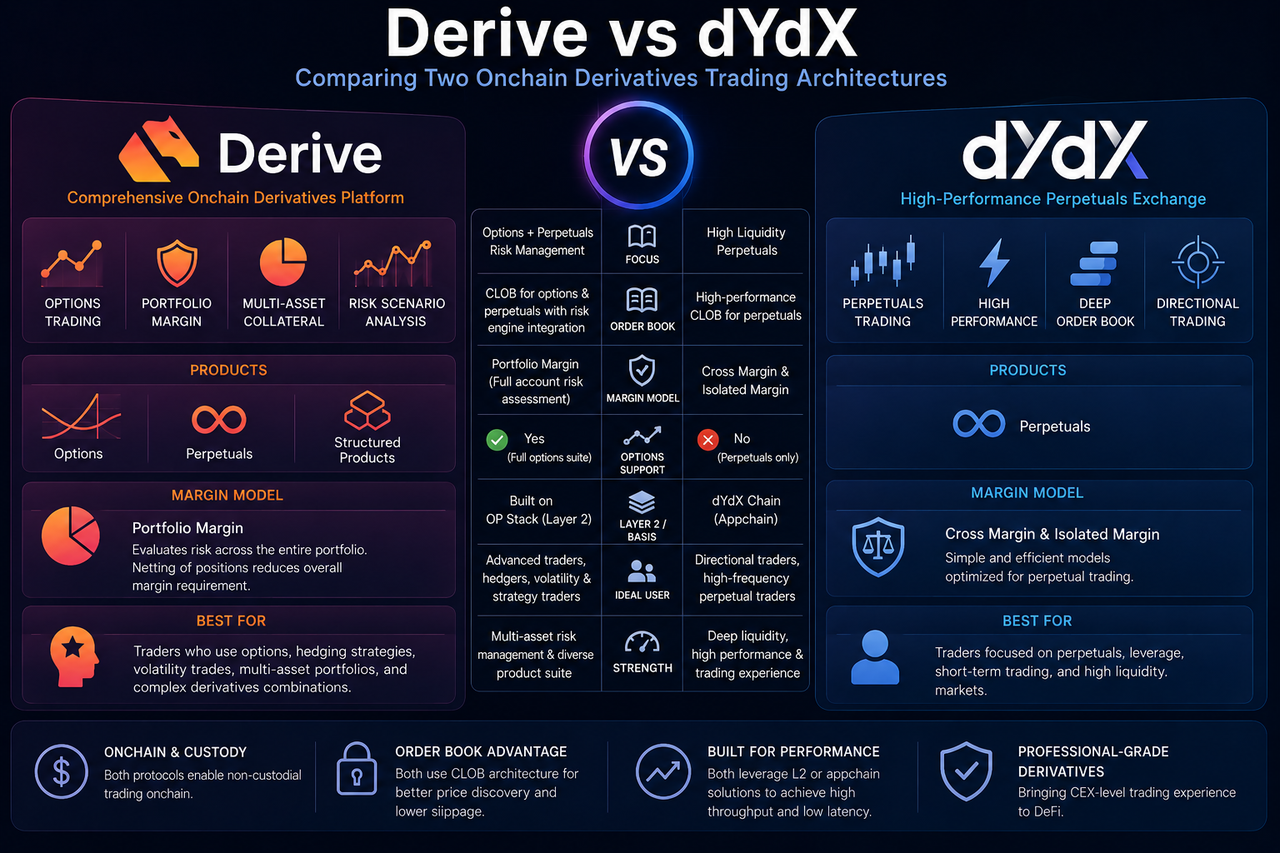
What Is the Core Difference Between Derive and dYdX?
Derive and dYdX both support on-chain leveraged trading, so users often see them as similar products. However, their underlying positioning is clearly different.
dYdX is more like an on-chain perpetual contract exchange, while Derive is closer to a comprehensive on-chain derivatives platform.
Derive’s core focus includes:
-
Options trading
-
Portfolio margin
-
Multi asset collateral
-
Risk scenario analysis
dYdX, by contrast, mainly focuses on:
-
Highly liquid perpetual contracts
-
High frequency trading experience
-
Deep order book markets
-
Professional directional trading
This difference also means that the two platforms do not serve exactly the same user groups.
How Do Derive and dYdX Differ in Their Order Book and Matching Mechanisms?
Both Derive and dYdX use an order book model rather than the AMM model commonly seen in traditional DeFi.
The advantage of an order book is that it can support more precise price discovery and reduce slippage for large trades. For this reason, order books are usually better suited to professional trading scenarios in high frequency derivatives markets.
Still, the two platforms differ in how they position their order book systems.
dYdX places greater emphasis on high liquidity and high throughput in perpetual contract markets, so its architecture is more oriented toward high frequency directional trading.
Derive, meanwhile, needs to handle both options and perpetual contract markets. Because options involve different strike prices, expiration dates, and volatility levels, Derive’s order book and risk systems are usually more complex.
In addition, Derive places more emphasis on the connection between its order book and risk engine so that it can support a portfolio margin system.
How Are the Margin Models of Derive and dYdX Different?
The margin system is one of the most important differences between Derive and dYdX.
dYdX mainly uses Cross Margin and Isolated Margin models. This approach is better suited to perpetual contract markets, where the risk structure is relatively straightforward.
Derive uses a Portfolio Margin model.
Portfolio Margin assesses risk from the perspective of the entire account, rather than calculating margin requirements position by position. For example, when a user holds hedged positions at the same time, the system can reduce the overall margin requirement.
This mechanism is especially suitable for options markets, because options risk usually cannot be measured accurately through simple position based calculations.
| Comparison Dimension |
Derive |
dYdX |
| Margin Model |
Portfolio Margin |
Cross / Isolated Margin |
| Risk Calculation |
Overall account risk |
Single position or full account risk |
| Hedging Recognition |
Stronger |
Limited |
| Suitable Products |
Options + perpetual contracts |
Perpetual contracts |
How Do Derive and dYdX Differ in Options Support?
Options are one of the biggest differences between the two platforms.
dYdX currently focuses mainly on the perpetual contract market, while Derive has inherited the development path of the on-chain options ecosystem and therefore places more importance on volatility markets and options trading infrastructure.
The options market is far more complex than the perpetual contract market because its risk is affected not only by price, but also by time value, implied volatility, and Greeks.
As a result, Derive needs a more complex risk engine and margin model.
This difference also makes Derive better suited to:
dYdX is better suited to high frequency directional trading and leveraged trading.
How Do Derive and dYdX Differ in Layer2 and Underlying Architecture?
Both platforms try to improve trading performance through Layer2 or independent chain architecture.
In its later development, dYdX has gradually moved toward an independent chain model to achieve higher trading throughput and lower latency.
Derive builds its Layer2 network on the OP Stack, aiming to improve trading performance while remaining compatible with the Ethereum ecosystem.
In terms of goals, both are trying to solve the core problems of the on-chain derivatives market:
However, Derive places more emphasis on its risk management system and multi product support, while dYdX focuses more on perpetual contract market performance.
What Type of User Is Better Suited to Derive?
Derive is better suited to users with some derivatives trading experience.
Users who engage in options strategies, hedging, multi position portfolio management, and volatility trading at the same time are especially likely to benefit from Portfolio Margin and multi asset collateral mechanisms.
Because the system structure is relatively complex, Derive usually has a higher learning curve than ordinary perpetual contract platforms.
What Type of User Is Better Suited to dYdX?
dYdX is better suited to users who mainly engage in directional trading, such as high frequency traders, leveraged traders, short term perpetual contract traders, and professional traders who care about market depth.
Because dYdX has built up relatively high liquidity over a long period, its order book depth and trading activity are usually strong.
For users who only care about perpetual contract trading, dYdX offers a more direct product path.
Conclusion
Derive and dYdX both represent the professionalization of the on-chain derivatives market, but their product logic and core goals are not the same.
dYdX places greater emphasis on highly liquid perpetual contract markets and a high frequency trading experience, while Derive expands further into options, portfolio margin, and multi asset risk management systems. In comparison, Derive is closer to a traditional comprehensive derivatives trading platform, while dYdX is more like an on-chain version of a professional perpetual contract exchange.
As on-chain financial markets continue to mature, these two architectures also represent different development paths for the DeFi derivatives market.
FAQs
What Is the Biggest Difference Between Derive and dYdX?
Derive places more emphasis on options and portfolio margin, while dYdX focuses more on the perpetual contract market.
Does Derive Support Options Trading?
Yes. One of Derive’s core features is its on-chain options and risk management system.
Does dYdX Use an AMM?
No. dYdX mainly uses an order book trading model.
Why Does Derive Need Portfolio Margin?
Because options and complex derivatives portfolios require a more complete overall risk assessment mechanism.
For users who only trade perpetual contracts, dYdX’s product structure is usually easier to understand.
Are Both Derive and dYdX Decentralized Protocols?
Both are on-chain derivatives protocols, but they make different design choices in their underlying architecture and degree of decentralization.