As the DeFi derivatives market gradually expands from simple leveraged trading into options, cross asset portfolios, and complex hedging strategies, the traditional isolated margin model has begun to reveal its limitations in capital efficiency. To support more professional trading needs, more on-chain derivatives protocols are adopting portfolio margin models, using overall risk assessment to improve capital efficiency.
In the on-chain derivatives sector, Derive treats Portfolio Margin as one of its core infrastructure components. Because Derive supports options, perpetual contracts, and multi asset collateral, a single position margin model is no longer enough to accurately reflect real risk.
What Is Portfolio Margin?
Portfolio Margin is a risk management mechanism that calculates margin requirements based on the overall risk exposure of an account.
In the traditional isolated margin model, each position requires its own separate margin calculation. This means that even when several positions hedge each other, the system cannot effectively recognize the risk offset, so users often need to lock up more capital.
Portfolio margin assesses risk at the account level. For example, when a user holds both a BTC long perpetual contract and a BTC put option, part of the downside risk can be hedged by the option, so the system can reduce the overall margin requirement.
This mechanism has already been widely used in traditional financial derivatives markets, and Derive brings it into the on-chain derivatives environment.
Why Does Derive Use a Portfolio Margin Mechanism?
Derive’s core products include options and perpetual contracts, both of which naturally involve complex risk structures.
If the protocol continued to use a traditional isolated margin model, users would still need to allocate margin separately for each position when running hedging strategies. This would significantly reduce capital efficiency.
The goal of Portfolio Margin is to reflect real risk more accurately. Instead of simply looking at the profit and loss of a single position, the system evaluates the potential loss of the entire account under different market scenarios.
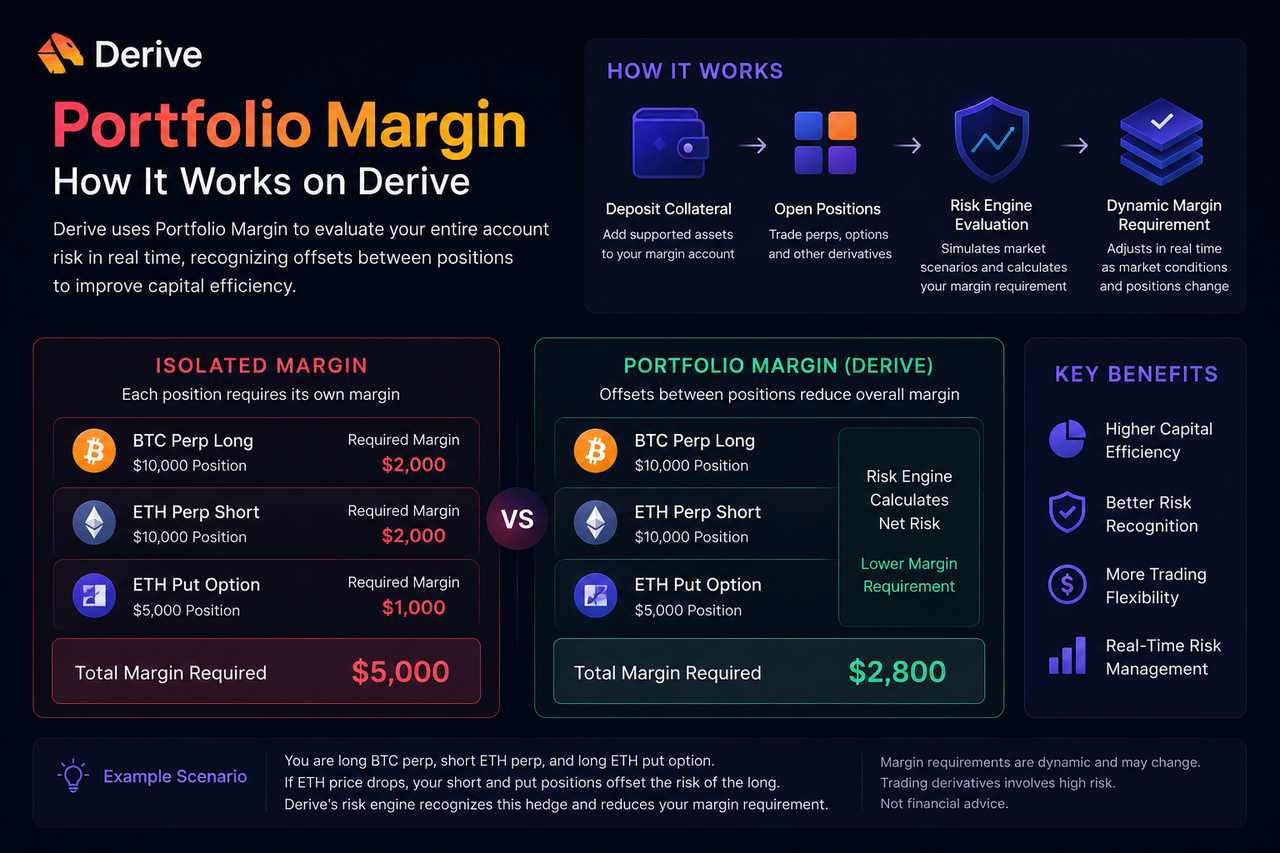
This design is especially important for professional traders, because options portfolios, cross market arbitrage, and volatility strategies often require multiple positions in different directions to be held at the same time.
Compared with the traditional isolated margin model, portfolio margin can offer:
| Model |
Risk Assessment Method |
Capital Efficiency |
| Isolated Margin |
Calculated separately for each position |
Lower |
| Cross Margin |
Account wide shared margin |
Medium |
| Portfolio Margin |
Overall risk scenario analysis |
Higher |
How Does Derive’s Risk Engine Calculate Margin?
Derive’s risk engine analyzes all positions in an account in real time and simulates potential risk under different market movement scenarios.
The system mainly considers the following factors:
| Risk Parameter |
Function |
| Position Direction |
Determines long or short risk |
| Volatility |
Assesses the scale of market price changes |
| Delta Exposure |
Measures price sensitivity |
| Gamma Risk |
Assesses the rate of price change |
| Liquidity Depth |
Assesses market impact risk |
| Asset Correlation |
Evaluates the hedging effect between positions |
In options markets, relying on price movement alone is not enough to fully measure risk, so the risk engine also needs to combine implied volatility and Greeks for a more complete analysis.
For example, when market volatility suddenly rises, the risk of some options positions may expand quickly even if the spot price does not change much. In that case, the system dynamically raises margin requirements.
How Does Multi Asset Collateral Improve Capital Efficiency?
Derive supports multi asset collateral, which means users can use different assets as a unified source of margin.
Traditional trading platforms usually require users to use a single stablecoin as margin, while Derive allows certain major assets to participate in the margin system. The system calculates the actual usable collateral value based on the risk weight of each asset.
For example:
| Collateral Asset |
Example Risk Weight |
Capital Efficiency |
| USDC |
Higher collateral value |
Lower |
| ETH |
Medium risk discount |
Medium |
| BTC |
Medium risk discount |
Higher |
| Highly volatile assets |
Lower collateral value |
|
| Liquidity Depth |
Assesses market impact risk |
|
| Asset Correlation |
Evaluates the hedging effect between positions |
|
This mechanism can reduce the need for frequent asset conversions and improve overall capital efficiency.
However, multi asset collateral also means the protocol must handle more complex risk management pressure. If the collateral asset itself experiences sharp volatility, account risk can increase quickly.
How Do Derive’s Margin Requirements Change Dynamically?
Derive’s margin requirements are not fixed. They change dynamically with market conditions.
When market volatility is low, the system usually lowers margin requirements to improve trading efficiency. When the market enters a high volatility phase, the risk engine may raise margin requirements.
Factors that affect margin changes include:
-
Market volatility
-
Position size
-
Liquidity depth
-
Asset correlation
-
Extreme market risk
For example, during major macro events or periods of intense crypto market volatility, margin ratios for certain assets may be raised temporarily.
This dynamic adjustment mechanism can reduce systemic risk for the protocol, but it also means users need to continuously monitor account health.
How Does Derive’s Liquidation Mechanism Work With Portfolio Margin?
Under the portfolio margin model, liquidation logic is also different from the traditional isolated margin model.
Isolated margin usually liquidates a single position, while Derive first assesses risk from the perspective of the entire account. If some positions hedge each other, the system may not trigger liquidation immediately.
When account equity falls below the maintenance margin requirement, the protocol gradually reduces the riskiest positions to restore the account to a safer level.
This mechanism can reduce the likelihood of unnecessary liquidation, but it also means the risk engine must be more complex.
In extreme market conditions, if market liquidity is insufficient, the following risks may still occur:
-
Wider liquidation slippage
-
Rapid changes in risk parameters
-
Simultaneous decline in collateral assets
-
Liquidation delay risk
Therefore, even with portfolio margin, risk management remains a core issue in on-chain derivatives trading.
What Is the Difference Between Portfolio Margin and Cross Margin?
Portfolio Margin and Cross Margin are both account wide shared margin models, but their risk calculation logic is different.
Cross Margin mainly provides simple risk coverage based on the overall account balance, while Portfolio Margin goes further by analyzing the real risk relationships between different positions.
The core differences are as follows:
| Comparison Dimension |
Cross Margin |
Portfolio Margin |
| Risk Assessment |
Basic account risk |
Scenario based risk simulation |
| Hedge Recognition |
Limited |
Stronger |
| Suitable Products |
Perpetual contracts |
Options + derivatives portfolios |
| Capital Efficiency |
Medium |
Higher |
| System Complexity |
Lower |
Higher |
Because options have a more complex risk structure, Portfolio Margin is better suited to platforms like Derive that support both options and perpetual contracts.
What Are the Potential Risks of Derive’s Portfolio Margin?
Although Portfolio Margin can improve capital efficiency, its complexity also introduces additional risks.
First, the risk model itself depends on assumptions about volatility, liquidity, and correlation. If the market changes dramatically, the model may not fully or accurately reflect real risk.
Second, multi asset collateral means the collateral itself may also fall quickly. When several assets experience sharp volatility at the same time, system risk can rise significantly.
In addition, portfolio margin is generally better suited to professional traders. Ordinary users who lack risk management experience may find it difficult to accurately understand changes in overall account risk.
As a result, higher capital efficiency often comes with more complex risk management requirements.
Conclusion
Portfolio Margin is an important part of Derive’s core risk management system. Its goal is to provide more realistic risk assessment and higher capital efficiency in an on-chain derivatives environment. Compared with the traditional isolated margin model, portfolio margin can recognize hedging relationships between different positions, reducing duplicated margin usage.
Through multi asset collateral, a real time risk engine, and dynamic margin adjustment, Derive is gradually developing into a professional on-chain derivatives trading platform. However, the more complex risk structure also means users need to pay closer attention to position management and market volatility risk.
FAQs
Why Does Derive Use Portfolio Margin?
Because Derive supports both options and perpetual contracts, the traditional isolated margin model cannot accurately reflect real risk.
What Is the Difference Between Portfolio Margin and Cross Margin?
Portfolio Margin analyzes the risk relationships between different positions, while Cross Margin mainly shares the account balance.
Which Assets Does Derive Support as Margin?
Derive supports multi asset collateral, and different assets receive different collateral values based on their risk weights.
Can Portfolio Margin Reduce Liquidation Risk?
If the positions in an account have effective hedging relationships, portfolio margin can usually reduce the likelihood of liquidation.
Is Portfolio Margin Suitable for Beginners?
Portfolio margin has a relatively complex risk structure and is better suited to traders who understand derivatives and risk management mechanisms.