DePIN combines distributed hardware resources with blockchain-based incentives in an effort to build an economic system involving resource providers, service users, and network protocols. However, resource onboarding, service usage, and token value do not necessarily have a linear relationship. AIOZ Network offers a case study for understanding this issue: its infrastructure spans AI computing, storage, and content delivery, while its token mechanisms involve network participation, rewards, and supply management. This article analyzes resource costs, incentive design, token utility, changes in supply and demand, and value capture to discuss how to assess whether a DePIN network is developing a sustainable economic cycle.
Key Takeaways
-
DePIN tokenomics must coordinate resource supply, service demand, and participant costs, rather than simply attract nodes through rewards
-
AIOZ's token design involves network transactions, staking, incentives for resource contributions, and supply management. Consult the current official documentation for specific rules
-
Token rewards can encourage early participation, but continued issuance may create supply pressure if demand for actual services is insufficient
-
Network activity, token utility, market demand, and price performance are related indicators, but they are not directly equivalent
-
Assessing value capture requires examining whether service revenue, resource utilization, token demand, and supply changes form sustainable connections
The Economics of DePIN: Why Resource Contributions Need a Coordination Mechanism
The central challenge for decentralized physical infrastructure networks is turning device resources held by different parties into services that can operate sustainably. Compared with traditional centralized infrastructure, DePIN can seek to open more channels for resource supply, allowing participants to provide computing, storage, bandwidth, and other capabilities using idle or dedicated equipment. However, open participation does not automatically resolve resource scheduling and service delivery issues. The network still needs to determine which nodes can accept tasks, how to verify task completion, how to handle service failures, and what compensation participants should receive.
Economic incentives play a coordinating role in this process. Node operators must cover equipment, electricity, connectivity, and maintenance costs. Returns from resource contributions must cover some of these costs to encourage continued participation. At the same time, the network needs to prevent its reward mechanism from excessively subsidizing low-quality resources or resources with little practical use. If rewards depend only on uptime or device registration and do not effectively reflect service quality and actual workload, they may attract many participants in name only without improving the user experience. A sound incentive mechanism should link compensation to verifiable contributions as closely as possible.
An important distinction between DePIN and conventional digital token projects is that DePIN attempts to connect token mechanisms with real-world resource supply. Participants' resources must become deliverable services, and users must be willing to pay for those services or provide economic support in other ways. If user demand continues to grow, the network can seek to use revenue to compensate resource providers, cover operating expenses, and support system development. If demand is insufficient, the network may rely on token issuance or subsidies to maintain resource supply. Both situations may show active nodes in the short term, but their long-term sustainability differs significantly.
Research into DePIN economic models should therefore examine both supply and demand. The supply side includes resource scale, node reliability, operating costs, and reward mechanisms. The demand side includes actual task volume, user retention, service prices, and willingness to pay. Only as the two sides become aligned can a network potentially move from building a resource pool through incentives to sustaining services through actual usage. For a multiservice network such as AIOZ, researchers also need to distinguish the costs and demand associated with AI computing, storage, and content delivery, rather than conflate the economic performance of different businesses.
The Economic Roles of the AIOZ Token: Network Participation, Payments, and Supply Management
The AIOZ token is more than an asset traded in the market. According to the project's official tokenomics documentation, AIOZ's design includes functions related to network transactions, staking, participant rewards, and ecosystem development. Official materials also describe token burn mechanisms tied to network activity and a schedule for gradually reducing the inflation rate. These mechanisms seek to connect network security, resource incentives, ecosystem development, and token supply. However, official descriptions outline the protocol design and the project's economic rules. Their long-term effects still depend on actual usage levels and implementation.
In economic terms, the token can first serve as a tool for network participation and settlement. If users need AIOZ to pay for certain infrastructure services, and resource providers can earn tokens by completing work, the token may connect service demand with resource supply. Staking can provide economic constraints that support network security or specific participation requirements, while rewards seek to compensate nodes and other network participants for their continued involvement. However, the actual role of each function must be understood in the context of specific protocol rules. A list of functions alone does not establish that all services already generate stable token demand.
Supply management is another key mechanism. Token issuance can fund network security, resource rewards, and ecosystem development, but the issuance rate also affects circulating supply. If newly issued tokens continually enter the market without corresponding demand from service usage, the additional supply may put pressure on market prices. Token burn mechanisms seek to mitigate the effects of continued issuance by removing some supply or linking network activity to changes in net supply. However, the economic effects of burns depend on actual burn volumes, issuance volumes, and the composition of circulating supply. The existence of burn rules does not mean the token will necessarily become net deflationary.
Analyzing AIOZ's tokenomics requires checking the scope, calculation methods, and latest status of its different mechanisms. Official project documents may change with protocol upgrades, and early overviews may not fully reflect current rules. Researchers should therefore prioritize current tokenomics documentation and distinguish between mechanisms already in effect, features under development, and long-term design objectives. This helps avoid applying historical rules directly to the current economic structure and supports a more accurate assessment of the relationship between token utility and actual network activity.
How Resource Incentives Affect the Quality of Network Supply
In a DePIN network, reward mechanisms affect not only participant numbers but also the composition of resource supply. If rewards primarily depend on node uptime, operators may focus more on keeping devices online. If rewards are more closely tied to verified task completion and service quality, operators may have stronger incentives to improve equipment performance, connectivity, and task-processing efficiency. In practice, protocols often need to balance verifiability, computational costs, and fairness. Overly complex verification processes may burden the system, while overly simple rules may allow low-quality participants to exploit them.
AIOZ's service types place different demands on resource quality. AI computing requires suitable hardware, task execution environments, and methods for verifying results. Storage requires data accessibility and durability. Content delivery requires attention to bandwidth, latency, and node distribution. A single reward metric may therefore not suit all services. For different resource types, the network needs to establish appropriate work verification, quality assessments, and reward conditions based on actual tasks to prevent growth in resource supply from becoming disconnected from improvements in service capabilities.
Rewards also affect nodes' participation decisions. When rewards adequately compensate for equipment and operating costs, nodes may be willing to continue providing services. When returns decline, some nodes may leave, particularly those with higher costs or lower task utilization. These departures are not necessarily harmful, since reducing inefficient resources may improve the overall cost structure. However, if departures are concentrated in critical resources or important regions, they may weaken service coverage and reliability. The network therefore needs to monitor more than changes in total node count. It must also examine the relationships among resource distribution, service quality, useful work performed, and operating costs.
For researchers, an important distinction is between effective incentives and sustainable incentives. Effective incentives attract resources and encourage task completion. Sustainable incentives allow the network to maintain those resources over the long term at reasonable economic costs while gradually reducing reliance on subsidies alone. The former can emerge early in a project's development; the latter requires more evidence from actual usage and economic data. AIOZ's long-term performance also needs to be assessed from this perspective, rather than judging whether its economic model has matured solely from node participation or the existence of token rewards.
From Service Demand to Token Demand: The Key Links in Value Capture
Value capture is one of the most frequently oversimplified aspects of tokenomics analysis and requires particular care. Adoption of infrastructure services does not automatically translate into a proportional increase in token demand. First, researchers need to establish how service fees are settled, whether users must use the token, how resource providers handle their rewards, and whether protocol revenue has a direct connection to token supply. If services can be paid for with other assets or fiat currency, token demand may arise mainly from specific parts of the protocol design rather than from all business revenue.
Second, researchers need to assess whether demand is sustained. Short-term campaigns, test tasks, or reward-driven usage may increase network activity, but they do not necessarily mean users will continue using services after subsidies decline. A long-term economic foundation depends on applications running consistently, users purchasing services repeatedly, resource utilization remaining at reasonable levels, and services meeting practical performance and cost requirements. If incentives drive most network activity, resource supply may expand rapidly without a corresponding increase in actual demand.
Third, token supply must be part of the analysis. Even if network service revenue increases, the market may still face selling pressure if supply from token issuance, reward releases, or holder sales grows faster. Likewise, token burns can change supply and demand only when their actual scale is large enough to affect net supply. Researchers need to compare issuance, burns, circulation, holdings distribution, and actual usage rather than assess token scarcity or future prices based on a single mechanism.
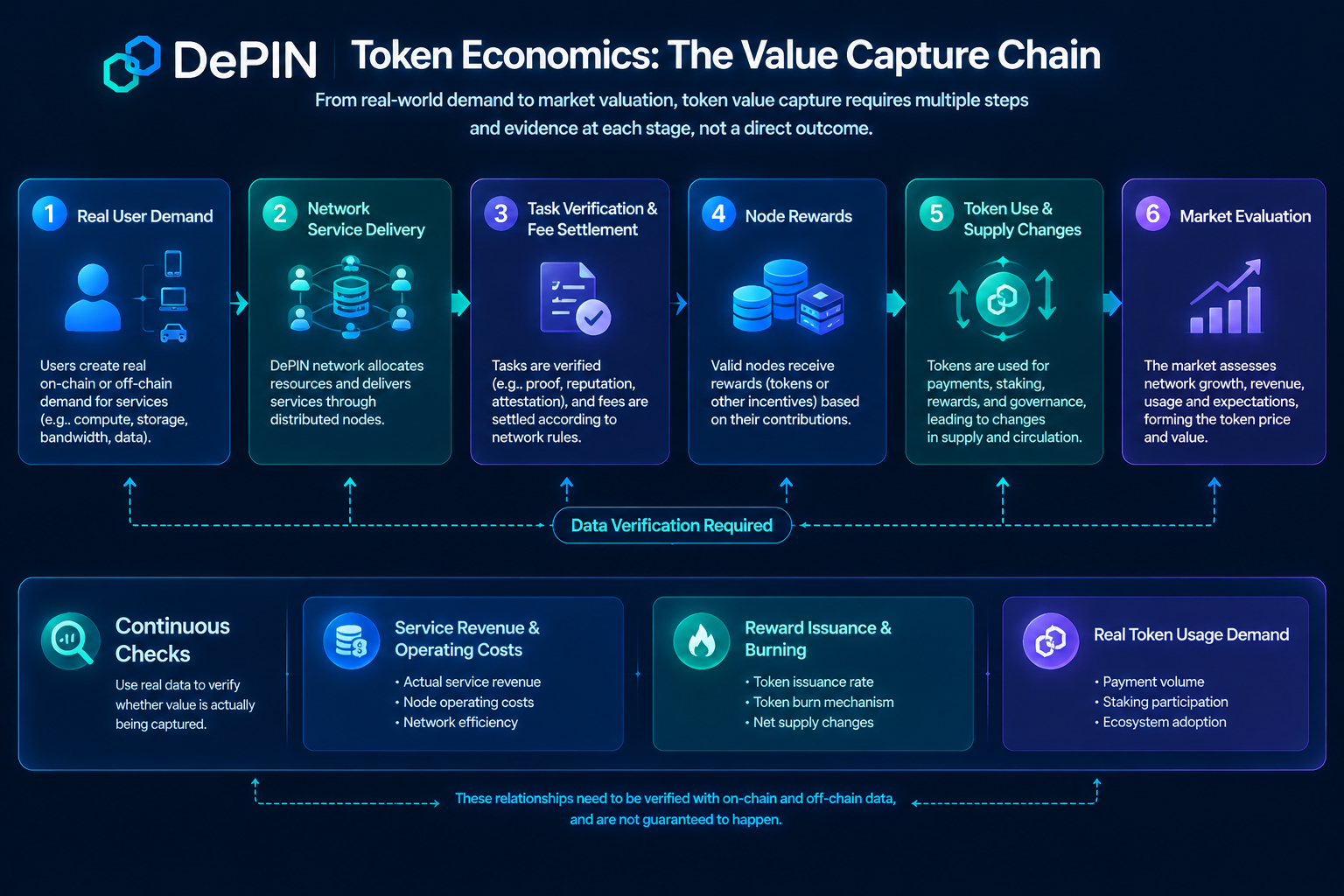
AIOZ's value capture can therefore be understood as a chain of relationships that needs verification: user demand generates service tasks; task completion creates economic activity; related fees and reward mechanisms support resource providers; token rules link some network activity to token usage or supply; and the market ultimately prices sustained demand, supply structure, and risk. This process is not automatic. Only when evidence supports each link can the relationship between network growth and token economics be discussed on a firmer basis.
Inflation, Burns, and Circulation: Token Supply Requires More Than One Metric
Token inflation typically supports network security, participant rewards, and ecosystem development, but it also increases circulating supply. For DePIN networks that need to continually incentivize resource providers, eliminating issuance entirely may not meet early-stage funding needs. However, if the issuance mechanism lacks a long-term way to adjust in line with actual usage, it may create persistent supply pressure. A sound design needs to account for the network's development stage, resource supply costs, service revenue, and participants' long-term expectations.
AIOZ's official tokenomics materials set out a schedule for gradually reducing inflation and describe burn rules related to on-chain transactions, DePIN rewards, infrastructure revenue, and native application revenue. According to its public Tokenomics 2.0 description, the long-term base inflation target is 5%. Related mechanisms also allocate some newly issued tokens to validators, delegators, and the ecosystem treasury. These figures are part of the mechanism design announced by the project. Analysis should still verify the rules currently in effect, actual implementation, and the latest on-chain data rather than infer net supply changes from design parameters alone.
Determining whether a token has deflationary characteristics requires comparing actual new issuance with actual burns over a given period. Even with a burn mechanism, circulating supply may continue to increase if issuance remains significantly higher than burns. Conversely, a declining inflation rate does not mean token supply has stopped growing. Researchers should therefore focus on net supply changes rather than look only at the inflation rate or burn percentage.
Beyond circulating supply, holder distribution and market liquidity are also important. Tokens may be concentrated among a small number of addresses, long-term holders, or specific participants, and different holders' trading behavior affects market supply and demand. Market depth, trading volume, and price volatility also influence the execution costs of large purchases and sales. Tokenomics mechanisms determine some supply conditions, while market structure determines how that supply translates into actual trading. Both need to be analyzed together.
Key Risks and Sustainability Conditions for DePIN Economic Models
DePIN first faces the risk of insufficient demand. A network can attract nodes to supply resources through rewards, but without sustained user demand for services, those resources may sit idle, and rewards may struggle to translate into stable economic returns. The economic costs of idle computing, storage, and bandwidth resources differ, but all can reduce overall efficiency. If a network continually expands subsidies to maintain participation, researchers need to assess whether future service revenue or other sustainable funding sources can cover that spending.
A second category of risk concerns service quality and cost competitiveness. Even with sufficient resource supply, a network may struggle to secure long-term customers if task completion speed, data reliability, or the content delivery experience does not meet user requirements. Traditional cloud providers offer large-scale operations, professional support, and established service guarantees. DePIN projects must demonstrate their value through cost, flexibility, or other advantages in specific use cases. Without clear differentiation, open resource supply alone cannot ensure market adoption.
A third category of risk is a disconnect between tokenomics and actual business activity. Reward mechanisms may encourage participation, but they may also attract short-term behavior focused primarily on acquiring tokens. Burn mechanisms may remove some supply, but their impact remains limited if actual usage is insufficient. Networks need to gradually establish sustainable service demand, shifting economic incentives from a tool primarily used to attract participants toward a mechanism that supports high-quality services and appropriate resource allocation.
For AIOZ, assessing whether its economic model is sustainable requires analyzing each service separately and then examining whether the overall network creates synergies. Relevant factors include actual service usage, task quality, user retention, revenue and costs, token issuance and burns, and the relationship between token utility and real demand. No single metric can fully describe the health of the economic model. Only when resource supply, service adoption, and token mechanisms develop relatively stable relationships can DePIN gradually move from incentive-driven expansion toward a more mature economic system.
AIOZ and Gate: Separate Market Trading From Economic Research
AIOZ's public trading page on Gate lists the AIOZ/USDT spot trading pair, and users can check the relevant page to verify current market information. This gives market participants a way to observe token prices and liquidity, but trading markets cannot replace research into the project's economic model.
An analysis of AIOZ should answer two separate questions: whether its infrastructure services generate real, sustained demand, and whether its token mechanisms can meaningfully connect network activity with token utility. The first requires examining product adoption, service quality, revenue, and operating costs. The second requires analyzing token usage, reward rules, supply changes, and the composition of circulating supply. Even if the first improves, researchers still need to verify how it affects the second. Likewise, short-term price increases or higher trading volume do not directly prove that the network's economics have improved.
Users can consult Gate for market trading information and the project's official documentation for research into token rules and infrastructure design. These information sources serve different purposes and should complement rather than replace each other. A trading platform's provision of access to an asset does not guarantee the project's future performance, and a token's market price should not be the sole measure of infrastructure quality.
FAQ
What is the core of DePIN tokenomics?
The core is coordinating resource supply, service demand, and participant costs while supporting continued network operation through economic mechanisms. Tokens can serve payment, reward, staking, or other functions, but actual sustainability depends on the relationship among real service demand, cost structure, and token supply and demand.
What economic functions does the AIOZ token serve?
AIOZ's official materials describe functions involving network transactions, staking, participant rewards, and ecosystem development, along with inflation adjustments and token burn mechanisms. Consult current official documentation for specific functions and the rules governing their implementation. Design objectives should not be treated as economic effects that have already materialized.
Do token burns necessarily raise prices?
No. Burns affect supply, but prices also depend on new issuance, real demand, the composition of circulating supply, market liquidity, and broader market expectations. If issuance exceeds burns, supply may still increase. Even if net supply declines, insufficient demand may limit price performance.
How can you assess whether a DePIN network is sustainable?
Examine actual service demand, resource utilization, service quality, revenue and operating costs, participant rewards, and changes in token supply and demand together. Sustained user activity and a sound economic cycle provide a better indication of the network's long-term foundation than node count alone or short-term incentive campaigns.