As AI applications, digital content, and on-chain applications continue to develop, computing, storage, and data delivery are becoming important components of Web3 infrastructure. AIOZ Network seeks to use distributed nodes and blockchain coordination mechanisms to integrate AI computing, decentralized storage, content pinning, and media distribution into a single infrastructure framework. This model is significant not only because it expands the ways resources can be supplied, but also because it explores how to coordinate resource contributions, service delivery, and economic incentives. This article analyzes AIOZ's positioning, infrastructure architecture, service collaboration, ecosystem development, and risk boundaries, examining how its potential competitive strengths might translate into sustainable, real-world demand.
Key Takeaways
-
AIOZ Network's core focus is to organize distributed computing, storage, and content delivery resources into infrastructure services that applications can use
-
AI computing, storage, and media distribution offer potential technical synergies, but each service faces different performance, cost, and reliability requirements
-
DePIN's long-term value depends on whether resources are used effectively, not just node counts, token incentives, or the number of ecosystem products
-
AIOZ's tokenomics involve network participation and incentive mechanisms, but network adoption, token demand, and market price require separate assessments
-
The project's long-term development still requires validation of developer adoption, actual service demand, cost efficiency, security capabilities, and economic sustainability
AIOZ Network's Positioning: From Distributed Resources to Digital Infrastructure
The growth of digital services is changing the structure of infrastructure demand. AI applications need computing power and data management capabilities, video and interactive content require storage and efficient distribution, and decentralized applications must handle large volumes of files, media resources, and user requests beyond on-chain rules. Not all of these requirements are suited to being recorded directly on a blockchain, as on-chain execution typically faces constraints related to transaction costs, throughput, and data storage methods. Web3 applications therefore often need to combine blockchains, computing services, storage systems, and content delivery mechanisms into an application architecture that can operate in practice.
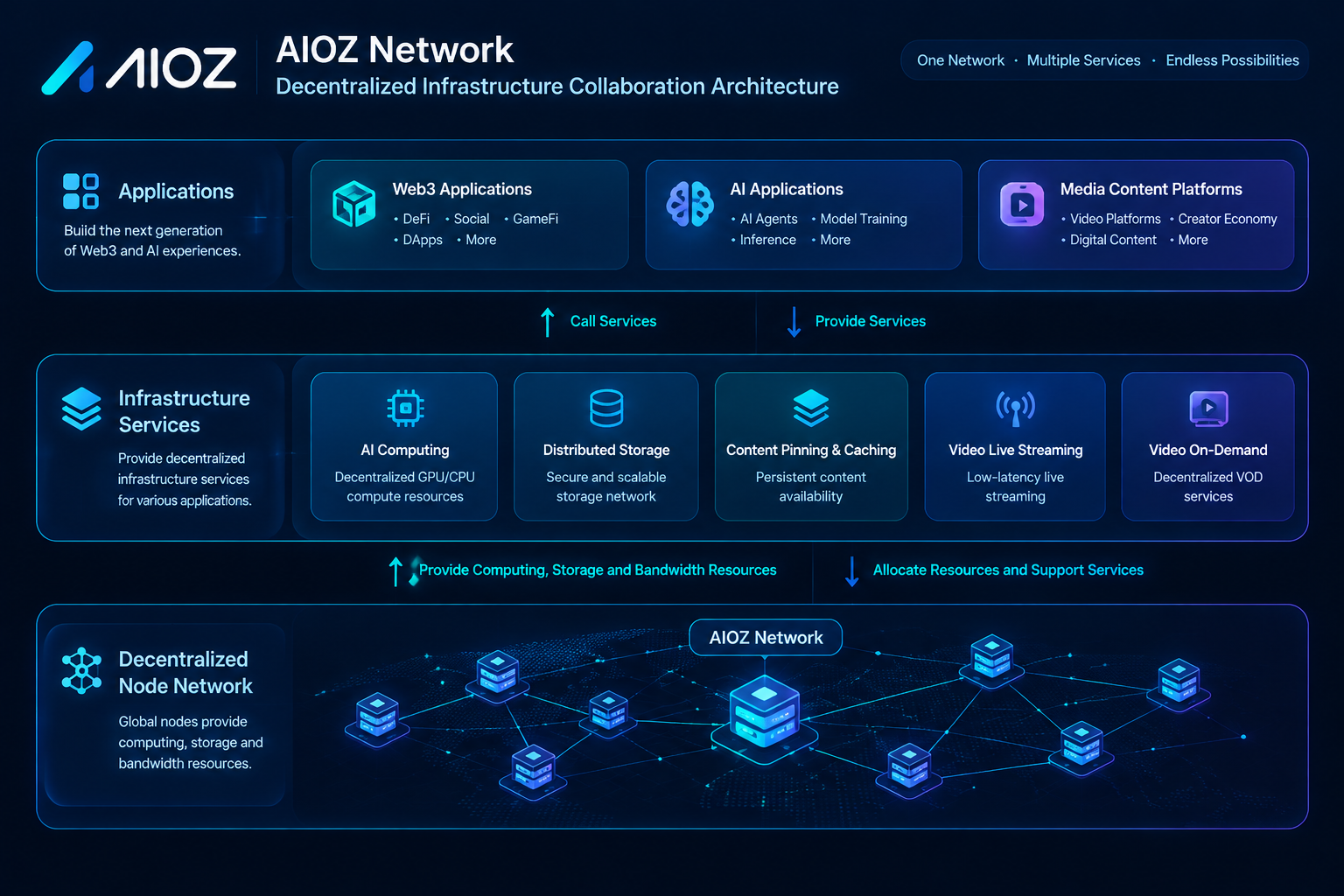
AIOZ Network's positioning centers on these infrastructure needs. Its official materials describe service areas including AIOZ Storage, AIOZ Pin, AIOZ Stream, and AIOZ AI, covering object storage, content pinning and caching, media delivery, and AI computing, respectively. The project aims to coordinate computing, storage, and bandwidth resources through a distributed node network supported by community participation, using blockchain and token mechanisms to support network participation and economic settlement. This means AIOZ is not simply trying to provide a standalone storage service or AI tool. Instead, it aims to organize multiple infrastructure capabilities into an interconnected service framework.
This positioning relates to DePIN's direction of development. Professional operators typically deploy and manage traditional infrastructure centrally, while DePIN seeks to bring devices and resources from different participants into a unified service network through open participation. Its potential advantages include expanding resource supply channels, offering different cost structures, and reducing reliance on a single infrastructure provider in certain scenarios. However, distributed resources do not automatically translate into high-quality services. The network still needs to address node selection, task scheduling, service verification, data security, and failure recovery for resource providers' participation to deliver real value to end users.
Understanding AIOZ therefore requires distinguishing among three layers. The first is the resource layer: which computing, storage, and bandwidth resources the network can coordinate. The second is the service layer: whether these resources can be converted into products that developers can access. The third is the economic layer: whether service demand can support reasonable operating costs and ongoing incentives. Only when these three layers form stable connections can the infrastructure architecture gradually develop into a business framework with long-term competitiveness. The range of services a project covers can reflect its strategic direction, but it cannot independently prove that every service has achieved sufficient adoption.
From a Single Service to an Infrastructure Portfolio: AIOZ's Architectural Logic
AIOZ's infrastructure portfolio can be understood through four types of capabilities. Storage services address how data is stored and accessed; content pinning services seek to improve the availability of specific content on distributed networks; media streaming and content distribution services focus on delivering data to users at an appropriate speed; and AI computing serves applications that require model execution, inference, or other computing workloads. These capabilities have different technical objectives, but they may all appear within the same application, creating some scope for integration.
For example, a generative media application may first need to save materials uploaded by users, then call a computing service to generate or process content, and finally store and distribute the results to users. If the application also involves digital assets, content licensing, or payment rules, smart contracts can record relevant states and execute agreements at appropriate stages. This application architecture illustrates that computing, storage, and content distribution are not necessarily independent of one another. However, whether a specific application can complete the entire workflow using AIOZ's existing services still depends on the actual interfaces, scope of support, performance requirements, and integration methods. The product portfolio alone does not establish that all components are already seamlessly connected.
From a developer's perspective, the main value of infrastructure integration lies in reducing the complexity of system coordination. If developers can access multiple services through relatively consistent interfaces, accounts, and settlement mechanisms, they may be able to reduce the work involved in configuring permissions, managing data flows, and handling billing across different service providers. However, this advantage requires validation through actual development experience. If products still have different interfaces, service restrictions, or inconsistent operational procedures, adding more products will not necessarily reduce integration costs and may even increase the complexity of the application architecture.
Resource requirements also vary significantly across services. Object storage requires attention to data durability, access permissions, and recovery mechanisms; content distribution requires attention to node distribution, bandwidth, and latency; and AI computing depends on hardware performance, model specifications, task scheduling, and output verification. A unified network can attempt to share some infrastructure resources, but it cannot overlook the distinct requirements of each workload. AIOZ's long-term competitiveness therefore depends not only on whether it can offer multiple types of products, but also on whether it can establish appropriate quality standards, resource scheduling mechanisms, and failure-handling procedures for different tasks.
The Value of AIOZ's Services: Resource Scale Must Translate Into Actual Use
In distributed infrastructure, node counts and the scale of available resources are often easy to observe, but they are only supply-side indicators. For users, the more important questions are whether the service is available and stable, whether it meets task requirements, and whether its total cost is competitive. Even a network with many nodes may have limited service capabilities if its resource distribution does not match user demand or if its nodes cannot deliver sufficient performance at critical moments. An analysis of AIOZ therefore needs to go beyond network scale and examine resource utilization and the quality of service delivery.
For storage services, relevant considerations extend beyond how much data has been stored. They also include whether users can access that data consistently, whether read speeds meet expectations, whether permission and recovery mechanisms are reliable, and whether users return to the service. For content distribution services, relevant indicators include actual delivery volume, latency, geographic coverage, stability, and operating costs. For AI computing, task completion rates, execution times, resource matching, result verification, and unit computing costs all provide useful reference points. These metrics cannot fully capture service quality, but they can help researchers distinguish between having resources and being able to provide reliable services.
Actual use also needs to be distinguished from incentive-driven activity. In their early stages, infrastructure projects may attract participants through rewards, subsidies, or developer programs, helping establish an initial network and gather product feedback. However, short-term participation does not necessarily indicate sustained demand. If users run tasks mainly to receive rewards, or developers use services only during testing, network activity may not reflect long-term business adoption. More compelling signs include continuously operating applications, consistent repeat usage, clear service demand, and resource contributions and user retention that persist after incentives change.
AIOZ's multiservice approach makes this issue even more important. Different products may target different user groups, so their adoption needs to be assessed separately. AI computing has its own hardware and task requirements, storage and content pinning services have different data access patterns, and media distribution depends on content types and user distribution. Growth in one service does not automatically demonstrate the same level of adoption in others. Researchers should examine product-level data separately before analyzing whether genuine cross-service usage and economic synergies have emerged.
DePIN's Economic Logic: Resource Contributions, Service Demand, and Token Incentives
One of DePIN's central challenges is how to coordinate resource supply. Distributed node operators may bear costs for equipment purchases, electricity, network connectivity, maintenance, and time. If the network can compensate for these inputs through rewards or service revenue, participants have an incentive to keep providing resources. If returns remain insufficient to cover costs over the long term, resource supply may decline. Conversely, if rewards rely primarily on continued token issuance while actual service demand fails to grow at the same pace, the network may face excessive incentive costs and token supply pressure. The economic mechanisms therefore need to balance resource contributions, service quality, and sustainable costs.
The AIOZ token serves roles such as network participation and incentives within the project's economic framework. Official tokenomics materials describe uses for network transactions, staking, and participant rewards, and propose managing supply by adjusting inflation mechanisms and introducing burn mechanisms linked to network activity. However, understanding these mechanisms requires checking the scope and current status of the specific rules. Designing a token as a payment or reward tool does not mean that all infrastructure products have already generated token payment demand at scale, nor does it mean that token demand will automatically grow as the number of products increases.
An analysis of value capture needs to distinguish network value from token value. Network value comes from the ability to consistently provide useful services, attract developers and users, and establish a stable resource supply. Token value also depends on factors such as token utility, supply changes, liquidity, and market expectations. If growth in network services does not generate corresponding demand for token use, or if new token supply consistently exceeds actual demand, network development may not translate directly into token price performance. Conversely, a short-term increase in the token price does not establish that service revenue, user retention, or resource utilization has improved.
AIOZ's economic model should therefore be analyzed through a verifiable chain: real users generate service demand, the network converts that demand into tasks, nodes complete and verify the work, services generate corresponding economic settlement, participants receive reasonable compensation, and token mechanisms connect with network usage and supply changes. Each link in this chain requires independent evidence. Resource scale, token incentives, on-chain transactions, and market prices can serve as dimensions for observation, but no single metric can replace a complete economic analysis.
Conditions for AIOZ's Development and Its Competitive Boundaries
AIOZ faces competition not only from other DePIN projects, but also from established cloud computing, storage, AI service, and content distribution providers. Traditional providers typically have mature operational procedures, clearly defined service levels, professional support, and the ability to procure resources at scale. Distributed networks, meanwhile, need to demonstrate practical advantages in cost, flexibility, resource coverage, or other specific areas. For some tasks that can tolerate longer execution times, distributed resources may offer different cost and supply options. For businesses with exceptionally high requirements for latency, reliability, and accountability, users may place greater value on the service assurances offered by established providers.
AIOZ's potential competitiveness therefore needs to be tied to specific use cases. For storage and content delivery, the network's ability to meet requirements for data availability, access speed, and continuous operation is critical. For AI computing, hardware compatibility, task execution efficiency, data security, and output quality all require consideration. If the project can establish clear cost or functional advantages in certain scenarios, it has an opportunity to attract developer adoption. If those advantages remain conceptual, or if service quality falls noticeably short of established alternatives, an open network architecture alone may not be enough to drive adoption at scale.
Ecosystem development also requires supporting developer tools, documentation, integration interfaces, and troubleshooting mechanisms. Infrastructure users need more than products that work: they also need to predict costs, identify problems, manage permissions, and migrate data. If developers encounter excessive complexity during integration or operation, they may reduce their reliance on the services involved. A unified experience is particularly important for a multiservice platform. If different products develop independently without clear interfaces and methods of collaboration, the infrastructure portfolio's value will be difficult to realize fully.
Over the long term, AIOZ's development should rest on technical viability, user adoption, and economic sustainability together. Technical capabilities determine whether services can complete tasks, user adoption determines whether services genuinely solve problems, and economic mechanisms influence whether resource providers can continue participating. These three factors are interconnected, but none can substitute for another. An assessment of AIOZ should consider its infrastructure integration strategy while continually examining whether each service establishes stable competitiveness through actual use.
AIOZ and Gate: A Trading Channel Is Not a Project Endorsement
The relationship between AIOZ and Gate can be understood in terms of access to crypto asset markets. Gate's public trading pages currently list the AIOZ/USDT spot trading pair, and users can check the relevant page for real-time trading status, prices, and market information. For researchers, trading markets offer a way to observe asset liquidity and market behavior, but these are separate assessment dimensions from an infrastructure project's technical quality, business adoption, and long-term economic sustainability.
AIOZ's technical approach requires assessment across service architecture, resource scheduling, data security, developer experience, and actual usage demand. The token market also depends on liquidity, supply and demand dynamics, market sentiment, and macroeconomic conditions. Even if the project's infrastructure capabilities gradually improve, this does not mean the token price will necessarily rise. Likewise, significant token price fluctuations do not independently establish a substantive change in service adoption. Project analysis and trading asset analysis should therefore use separate technical and market assessment frameworks.
For users interested in AIOZ, Gate can serve as one channel for checking asset market information, while the project's official documentation is suitable for understanding product positioning, technical design, and token rules. Research should rely on currently valid materials, distinguish between live services, features under development, and long-term plans, and account for market liquidity and price volatility risks. An asset's availability for trading does not mean the platform guarantees the project's future development, and a trading channel cannot replace independent research.
Within the broader development of DePIN, AIOZ offers a case worth observing: it seeks to organize distributed resources into an infrastructure framework covering computing, storage, and content delivery. Whether it can establish a stable competitive advantage will still depend on whether its services consistently meet user needs, whether developers are willing to adopt them over the long term, and whether the network's economic mechanisms can support a reliable resource supply. These conditions reveal more about the foundations of the project's long-term development than market attention alone.
FAQ
What is AIOZ Network?
AIOZ Network is a project that builds digital infrastructure around distributed resources. Its official materials describe service areas including AI computing, decentralized storage, content pinning, and media streaming. Its goal is to provide related infrastructure capabilities to developers and applications through distributed nodes and network coordination mechanisms.
How does AIOZ Network relate to DePIN?
AIOZ adopts DePIN's approach to organizing resources, seeking to convert computing, storage, and bandwidth resources supplied by different participants into network services and coordinate participants through incentive mechanisms. Its actual value still depends on resource utilization, service quality, and sustained demand, rather than node counts or token rewards alone.
Does AIOZ's token value automatically increase as the network develops?
No. Network development may have a more direct impact on token demand only when it creates sustained service demand and connects that demand to token utility through clear economic mechanisms. Supply changes, market liquidity, and investment expectations also affect token performance.
What is the relationship between AIOZ and Gate?
Gate's public trading pages currently list the AIOZ/USDT spot trading pair. Users should check Gate's current pages for real-time trading status and applicable rules. The availability of a trading channel does not mean the platform guarantees the project's fundamentals or token price.