For retail traders with a small account, that makes account type, broker implementation and risk control more important than simply counting day trades. The following 10 rules focus on what a trader actually needs to check before actively day trading with less than $25,000.
Key Takeaways
-
FINRA's new intraday margin standard removes the fixed $25,000 minimum equity requirement and the old pattern day trader trade-count test once a broker transitions to the new system.
-
During the transition period, a broker may still apply the old PDT rule, so traders should confirm which margin system governs their account.
-
A cash account doesn't rely on margin, but trading is still constrained by settled funds and Regulation T.
-
Small-account traders generally need tighter position sizing, daily loss limits and liquidity controls because several losing trades can reduce account equity quickly.
-
Futures, crypto and other markets operate under different margin and regulatory frameworks; avoiding the PDT label doesn't remove leverage or market risk.
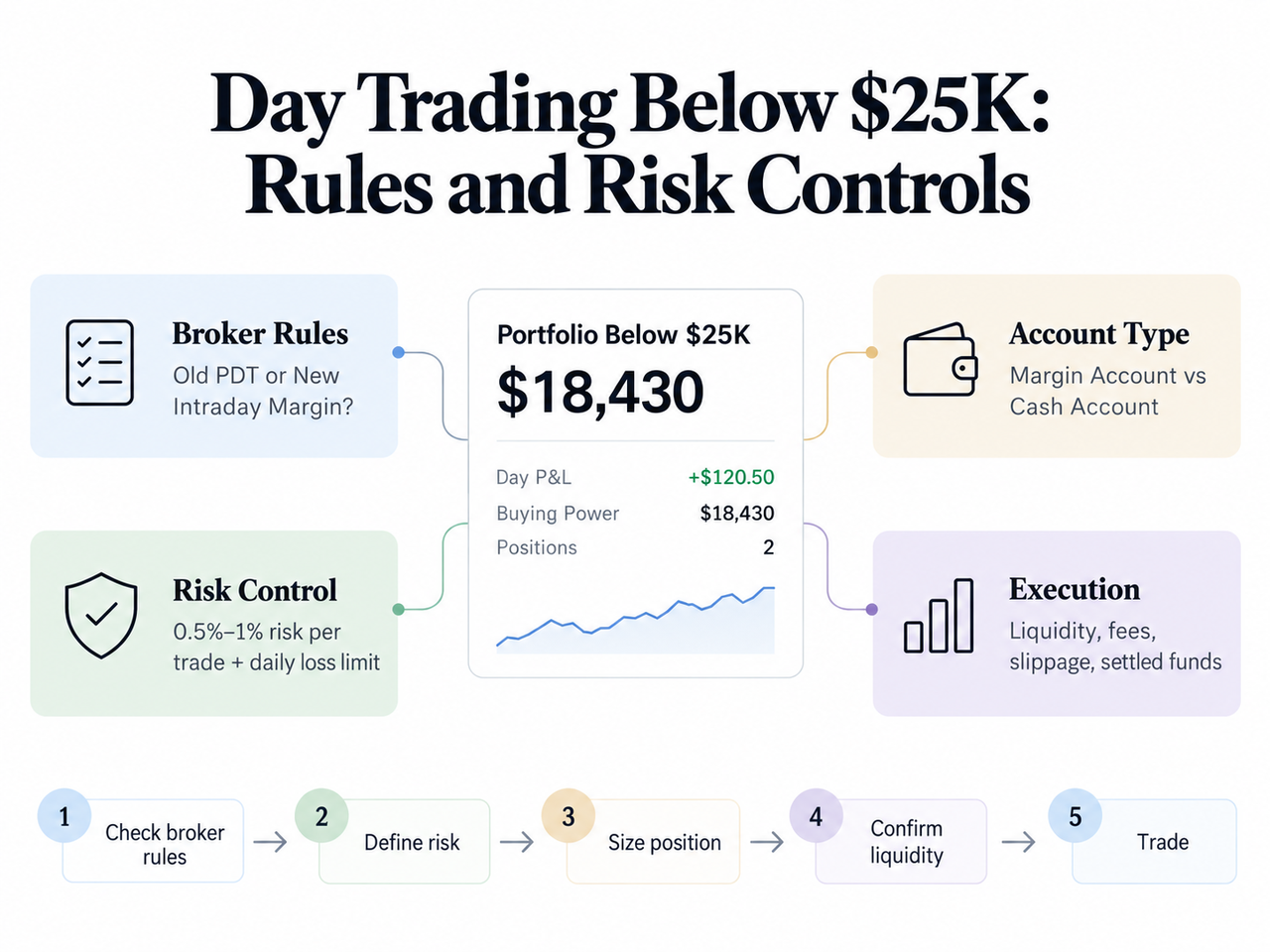
1. Check Which Day Trading Rule Your Broker Uses
Don't assume the $25,000 minimum disappeared from every account on April 14, 2026.
That date was when the SEC approved FINRA's rule change. The new rules became effective June 4, 2026, but firms may phase them in through October 20, 2027. A broker can therefore still apply the previous Pattern Day Trader rules during this transition.
Under the old rule, a pattern day trader generally meant someone making four or more day trades within five business days in a margin account, subject to the rule's 6% test. The account then needed at least $25,000 in equity.
Before planning how many trades to make, check the margin policy shown by your broker.
2. Understand the New Intraday Margin Standard
The new system shifts the focus from how many trades you make to how much intraday exposure the account carries.
Once a firm moves to the new standard, there is no FINRA $25,000 PDT minimum and no pattern day trader designation based on counting trades. Instead, the broker monitors whether account equity is sufficient for positions held during the trading day.
An intraday margin deficit can occur when account equity isn't sufficient for that exposure. Repeated failure to satisfy such deficits promptly can lead to restrictions lasting up to 90 days. That's different from saying every small deficit automatically creates a 90-day freeze.
3. Know How a Cash Account Changes Day Trading
A cash account can remove margin-related PDT concerns because the trader isn't borrowing from the broker. But it doesn't create unlimited usable buying power.
A cash account requires securities to be paid for in full. Selling securities purchased with available cash is permitted, but reusing proceeds before settlement can create problems such as freeriding if the transactions don't comply with Regulation T.
So the practical rule for a small account is simple: track settled funds, not just the cash balance displayed on the screen.
4. Keep Risk Per Trade Small
Removing a fixed minimum balance doesn't make a $5,000 or $15,000 account behave like a $100,000 account.
A useful risk-management framework is to predetermine how much account equity can be lost on a single trade. For example, a trader using a 0.5% risk limit on a $10,000 account would cap planned loss near $50; at 1%, it would be $100.
Those percentages aren't FINRA rules or guarantees. They're position-sizing examples. What matters is connecting the stop distance to the amount of capital actually at risk.
That discipline fits naturally with day trading strategies that combine entries with defined exits instead of choosing position size first and worrying about the stop afterward.
5. Set a Hard Daily Loss Limit
Single-trade risk isn't enough. Several normal losing trades can become a large drawdown when a trader keeps attempting to recover losses on the same trading day.
Suppose each planned loss is 0.75% of account equity. Four full losses could cost roughly 3% before fees and slippage. A preset daily loss threshold can stop that sequence before frustration turns into oversized positions or increasing short positions simply to recover money.
The exact threshold depends on the strategy, account size and risk tolerance. The important part is setting it before trading begins.
6. Don't Treat Buying Power as a Target
Margin buying power describes what an account may be permitted to control. It isn't a recommended position size.
Under FINRA's new framework, firms must consider intraday exposure and require equity proportional to the margin risk being created. Brokers can also impose requirements above regulatory minimums.
That matters especially for active traders using short positions, options or leveraged instruments, where market movement can change required margin quickly.
The same principle applies in crypto derivatives. For example, a trader studying open interest versus volume for order-flow analysis still needs to separate a useful market signal from the amount of leverage placed behind it.
7. Prefer Markets With Enough Liquidity
A strategy can look profitable on paper and still perform poorly when execution is added.
Thin order books create larger spreads and slippage, particularly when entering or closing positions quickly. For small accounts, a few extra basis points on every entry and exit can materially change the result after dozens of trades.
Volume is one way to judge participation, while net volume can help separate buying and selling pressure.
For a crypto example, a trader using the BTC/USDT market on Gate.com can compare the live order book, trading activity and price movement before deciding whether the available liquidity fits an intraday setup. Crypto trading rules and availability vary by jurisdiction and aren't governed by the U.S. securities PDT framework.
8. Count Fees and Slippage Before Counting Profits
Frequent trading magnifies small costs.
Imagine a strategy that produces an average gross gain of 0.30% per successful trade. Spread, slippage and trading fees may take a meaningful portion of that edge. A system can therefore have more winning trades than losing trades while producing disappointing net results.
This is why risk-to-reward should be measured using realistic execution costs rather than chart prices alone.
Indicators can improve timing, but they don't remove those costs. A trader combining signals from buy and sell indicators on TradingView should still record actual entry, exit, fees and slippage.
9. Define the Stop Before Opening the Trade
The stop-loss determines the monetary risk of a trade. Position size should follow from it.
For example, suppose a trader is willing to risk $75 and the planned entry is $50 with a stop at $49.50. The risk is $0.50 per share, implying a theoretical maximum of 150 shares before considering slippage and other costs:
$75 ÷ $0.50 = 150 shares
Technical tools can help identify where invalidation makes sense. VWAP versus EMA for day trading shows why price relative to intraday value and trend can matter, while daily highs and lows can provide visible structural levels.
The trade should fit the risk limit, not the other way around.
10. Don't Choose Another Market Only to Escape the $25k Rule
Futures, forex, crypto and proprietary trading arrangements may not use the same FINRA Pattern Day Trader framework that historically applied to U.S. securities margin accounts. Their risks and margin systems are different.
Commodity futures, for example, use performance-bond margin rather than stock-margin rules, and leverage can make losses large relative to deposited capital. The CFTC warns that futures are volatile, complex and risky, and losses can exceed the amount initially deposited.
Micro contracts can reduce contract size, while prop firms may use funded-account models, but neither removes the need to understand fees, drawdown limits, leverage and contractual rules.
What Changed From the Old PDT Rule?
| Area |
Previous PDT Framework |
New Intraday Margin Framework |
| Main trigger |
Four or more qualifying day trades within five business days, subject to the 6% test |
Intraday exposure and margin |
| $25,000 minimum |
Required for designated pattern day traders |
Removed under new framework |
| Trade-count designation |
Pattern day trader |
Removed |
| Margin focus |
Day-trading buying power |
Equity relative to intraday exposure |
| Implementation |
Legacy system |
Effective June 4, 2026; firms may transition through Oct. 20, 2027 |
FINRA's old PDT framework developed around rules approved in 2000 and 2001, during a period when online retail trading had expanded rapidly. The 2026 change doesn't mean margin risk disappeared. It changes how FINRA member broker-dealers measure that risk.
Conclusion
For a portfolio below $25K, the most important day trading rule in 2026 is no longer simply “stay under three day trades.” Traders first need to know whether their broker has transitioned from the old Pattern Day Trader rules to FINRA's new intraday margin standard.
After that, account survival comes down to less dramatic things: use settled funds correctly, keep individual positions small, cap daily losses, avoid treating maximum buying power as a target, trade liquid markets and include costs in every setup.
The removal of the fixed $25,000 minimum gives some small accounts more freedom. It also places more responsibility on the trader to manage intraday exposure rather than treating a regulatory threshold as a substitute for risk management.
FAQ
Can you day trade with less than $25,000?
Yes. Under FINRA's new intraday margin framework, the fixed $25,000 Pattern Day Trader minimum is being replaced for firms that have transitioned to the new system. During the implementation period, however, some brokers may still apply the older PDT requirements, so the account's broker policy matters.
Does the Pattern Day Trader rule still apply in 2026?
It depends on the broker. FINRA's new intraday margin standard became effective in 2026, but broker-dealers have a transition period to implement it. Until a firm switches systems, its customers may still encounter the previous PDT framework.
Can I day trade freely with a cash account?
A cash account isn't subject to the margin-based PDT framework, but trading is still limited by available and settled funds. Traders must also avoid settlement violations such as freeriding, so a cash account shouldn't be treated as unlimited intraday buying power.
What happens if I have an intraday margin deficit?
An intraday margin deficit occurs when the equity in a margin account is insufficient for its intraday exposure under the applicable margin rules. Brokers may require additional funds or restrict activity, and unresolved deficits can lead to longer trading restrictions depending on the firm's implementation of FINRA requirements.
Are futures subject to the $25,000 day trading rule?
No. U.S. futures aren't governed by FINRA's stock-market Pattern Day Trader rule. They use a different margin framework, and leverage can still produce losses that are large relative to the capital deposited.
How much should a small day-trading account risk per trade?
There is no regulatory percentage that every trader must use. Some traders use limits such as 0.5%–1% of account equity per trade as a risk-management framework, but the appropriate level depends on volatility, stop distance, strategy and personal risk tolerance.
Disclaimer: This content is for educational purposes only and does not constitute investment, legal or tax advice. Margin rules, account restrictions and product availability vary by broker and jurisdiction. Trading securities, crypto, futures and other leveraged products can result in substantial losses.