For example, someone might transfer EUR from a bank account to a crypto platform and use it to buy USDC. That is an on-ramp. Months later, they might sell the USDC for EUR and withdraw the funds back to their bank account. That is an off-ramp. The same basic flow can also happen through cards, P2P marketplaces, payment processors, OTC desks, or crypto-linked payment cards.
For active retail traders, investors, businesses, and institutions needing compliant global crypto-fiat payment services, differences between ramp providers impact cost, speed, access, and operational risk. Available fiat currencies, payment methods, KYC requirements, fees, withdrawal limits, settlement times, and provider types vary. This guide compares how on-ramps and off-ramps work, fee sources, delays, and how Gate supports both through Gate Connect, bank transfers, direct fiat deposit/withdrawal via Gate Europe, P2P trading, and products like Gate Card and Gate Pay.
Key Takeaways
-
A crypto on-ramp converts fiat currency into cryptocurrency, while an off-ramp converts or routes crypto back into traditional money or payment systems.
-
Common on-ramp methods include bank transfers, debit or credit cards, local payment methods, P2P trading, and third-party payment providers.
-
Common off-ramp methods include selling crypto for fiat and withdrawing to a bank account, P2P settlement, OTC transactions, and crypto-linked payment cards.
-
Gate Europe currently supports direct fiat deposits and withdrawals, while Gate Connect provides additional card and bank-transfer routes in supported regions.
-
Gate US launched a Visa-based Gate Card in July 2026 for eligible users, allowing supported stablecoins such as USDC to be converted for everyday payments.
What Is a Crypto On-Ramp?
A crypto on-ramp is a service that lets someone use traditional currency to acquire cryptocurrency.
Suppose you have 1,000 EUR in your bank account and want to buy Bitcoin. For new users, the on-ramp is the service that helps them move from fiat to crypto by connecting that EUR payment with the purchase of BTC. Depending on the platform, you might first deposit EUR and then place a BTC/EUR trade, or you might use a “Buy Crypto” service that completes the payment and conversion in one flow.
Common funding methods for Fiat to Crypto include bank transfers, debit or credit cards, instant-payment systems, mobile wallets, and local payment methods, with some providers also supporting google pay. In some cases, apple pay is available too. The exact options depend heavily on where the user lives and which provider they use.
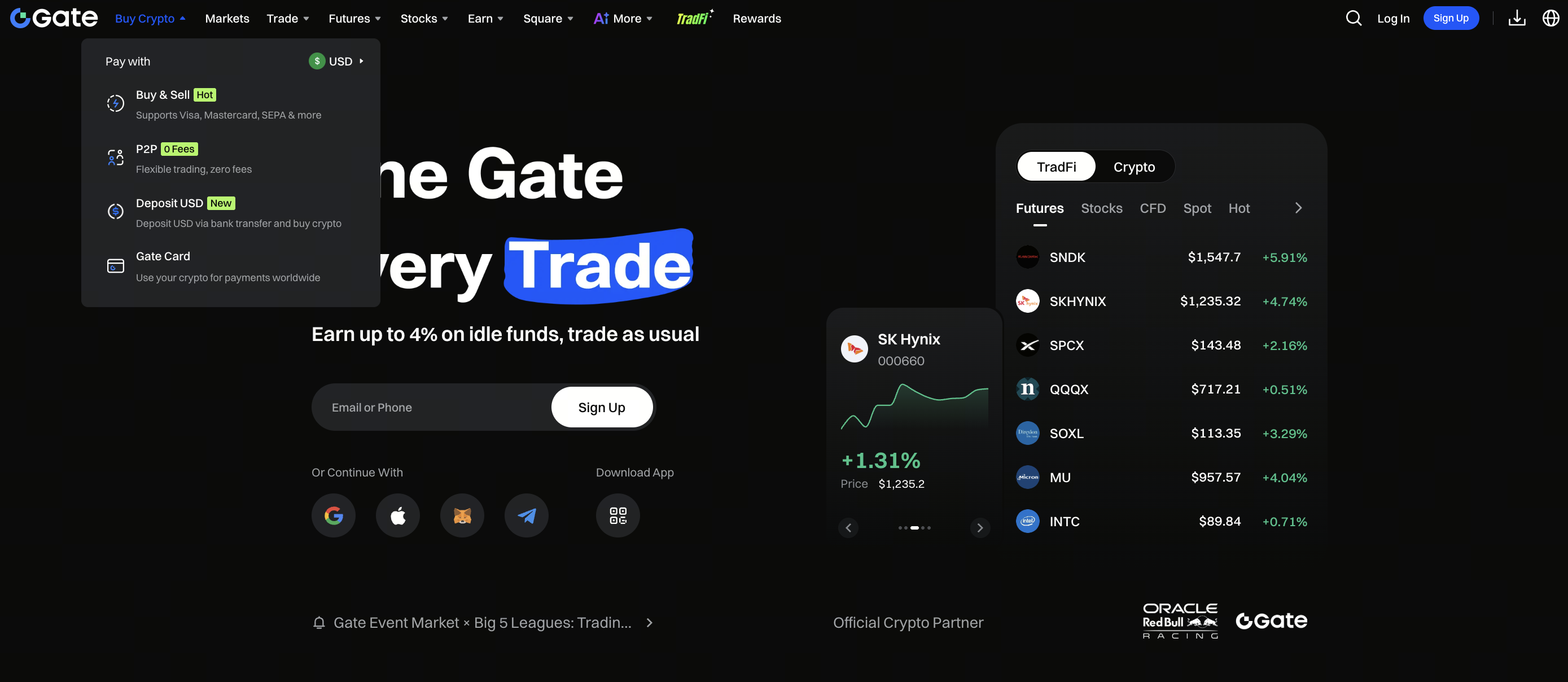
Gate, for example, currently offers card-based crypto purchases through Gate Connect aka "Gate Buy & Sell" in supported regions, giving users a user-friendly way to buy crypto with card payments. Users choose a fiat amount and cryptocurrency, select an available card channel, complete the payment process, and receive the purchased crypto in their Gate Spot Account.
https://images.surferseo.art/60951f87-1cf2-4164-bfa7-66db4e58bd49.png
Gate states that certain Gate Buy and Sell card services are provided through third-party partner like Alchemy Pay and shows an estimated arrival time of around 5–10 minutes for the documented flow, although actual processing can vary. Gate also supports bank-transfer purchase routes through Gate Connect where available.
What Is a Crypto Off-Ramp?
A crypto off-ramp moves value in the opposite direction by converting cryptocurrency into a government issued currency or letting users access traditional financial infrastructure.
The most straightforward example is selling BTC for US Dollars and withdrawing the proceeds into a bank account. In that case, the exchange and banking connection together form the off-ramp and let users transfer funds through regulated payment rails.
An off-ramp does not always require a traditional bank withdrawal. Users may first send crypto to the service for conversion and withdrawal. A P2P trade can allow one user to sell crypto to another user in exchange for a local bank payment. A crypto-linked card can also function as a practical spending off-ramp because supported crypto is converted into fiat as the purchase is processed.
Gate Europe currently provides a direct conventional off-ramp service. Eligible users can select a supported fiat withdrawal currency and payment method, bind a bank IBAN matching their verified identity, and submit the fiat withdrawal through the platform. Depending on the payment rail and bank, payouts can take 1–3 business days. Gate notes that arrival times depend on the payment method, initiation time, and receiving bank rather than promising one universal settlement window.
Crypto On-Ramp vs Off-Ramp: The Main Difference
The simplest distinction is direction:
|
Crypto On-Ramp |
Crypto Off-Ramp |
| Direction |
Fiat → Crypto |
Crypto → Fiat |
| Typical purpose |
Buy or fund crypto |
Cash out or spend crypto |
| Common methods |
Bank transfer, cards, P2P, payment providers |
Bank withdrawal, P2P, cards, OTC |
| Main concern |
Purchase price and funding fees |
Conversion price and payout fees |
| Settlement destination |
Exchange or self-custody wallet |
Bank, card, payment account |
| Compliance checks |
Common |
Common, particularly for unusual or large transactions |
The distinction is important because the user experience and costs can be very different in each direction. A platform may provide a convenient card-based on-ramp while offering only bank-transfer withdrawals for off-ramping, or it may support fiat deposits in one jurisdiction but not another.
That means users should verify both directions before choosing a platform, particularly if they know they will eventually need to withdraw funds into a specific bank or currency.
How Crypto On-Ramps Work
A typical on-ramp begins when the user selects a fiat currency, cryptocurrency, and amount, which enables users to convert fiat into digital currencies. The platform then shows the available payment methods and provides either a conversion quote or instructions for depositing fiat.
For a card transaction, a credit or debit card is a common purchase method, and payment authorization normally happens through the card issuer or payment processor. Fraud prevention and identity checks may also be performed before the transaction is approved. Once payment is accepted, the platform or payment partner executes the conversion and credits crypto to the user’s exchange account, digital wallets, or external wallet.
Bank-transfer flows work differently. Instead of charging a card, the user sends money through a supported banking rail. Once the fiat arrives and is credited, the user may either receive cryptocurrency directly or use the fiat balance to trade.
Gate Europe currently supports direct fiat deposits where users select their fiat currency and available payment method, send funds according to the receiving bank instructions, and wait for the deposit to be credited.
This distinction matters because “buying crypto with a bank transfer” can mean either transferring fiat into an exchange balance first or using a third-party service that handles the transfer and conversion as one transaction.
How Crypto Off-Ramps Work
Off-ramping normally starts with the crypto already held on an exchange or sent to the provider from an external wallet, and users may need to exchange digital assets before withdrawal.
The user first converts the cryptocurrency into the fiat currency supported by the withdrawal method. Depending on the service, this might happen through a spot trade, an instant conversion feature, or automatically during withdrawal.
After the fiat balance is created, the payout is sent through the selected banking or payment rail, and off ramp support matters because not every provider offers the same fiat withdrawal options. Compliance checks can occur before the payout is released, especially when transaction size, source of funds, destination account, or account activity requires additional review.
Gate Europe’s withdrawal process demonstrates the direct model: users select a fiat currency and payment method, enter the amount, and bind an IBAN belonging to an account whose identity information matches their Gate verification. The final arrival time depends on the receiving bank.
This is why an off-ramp should not be described as a guaranteed “instant cash-out.” Crypto conversion may happen immediately, while actual fiat settlement can still depend on banks and payment processors.
Main Types of Crypto On-Ramps and Off-Ramps
Different ramp models solve different problems. Some prioritize convenience, while others prioritize local payment support, lower trading costs, self-custody, or large transaction capacity.
Centralized Exchanges
Centralized exchanges are one of the most complete ramp models because they can combine fiat funding, crypto trading, custody, and fiat withdrawal.
A user may deposit EUR by card or bank wire, trade EUR or a stablecoin into BTC, hold or trade the cryptocurrency, later sell it, and withdraw fiat again. Centralized exchanges often become both the entry and exit point within the cryptocurrency ecosystem.
Gate Europe currently has both a MiCA Crypto-Asset Service Provider authorization and a PSD2 Payment Institution authorization from the Malta Financial Services Authority. The MiCA authorization covers services including crypto-to-fiat exchange, crypto-to-crypto exchange, trading-platform operation, custody, execution, and transfers, while its payment authorization supports the development of regulated payment infrastructure in Europe.
Third-Party Payment Providers
Payment providers can embed an on-ramp directly inside an exchange or wallet, and third-party providers are often used by crypto businesses embedding ramp tools into apps or wallets. The user remains inside a familiar interface while another company handles card processing, payment risk, and conversion infrastructure.
Take Gate Buy and Sell as an example. Gate supports card purchases routed through partner services such as Alchemy Pay, depending on region and payment channel. Some providers, such as Ramp Network, offer widgets or APIs for similar embedded ramp flows.
The convenience is high, but users should compare the final crypto amount received because processor fees and exchange-rate spreads can differ between channels, and some services check aggregator routes across multiple providers before presenting an offer.
P2P Trading
P2P marketplaces connect buyers and sellers directly. A buyer may send local fiat to another user through a bank transfer or supported payment service, while the marketplace uses escrow to manage the corresponding crypto transaction.
This can provide access to payment methods that are not available through traditional banking integrations. Gate P2P marketplace operates with supported merchant, payment-method, dispute, and AML processes.
P2P introduces additional considerations, including counterparty behavior, payment disputes, bank-account risk, and the need to follow marketplace rules carefully.
OTC Desks
OTC, or over-the-counter, services are generally aimed at larger transactions. Rather than executing a large trade through a public order book, an OTC desk can quote the transaction directly and arrange settlement, often relying on market makers to source liquidity and reduce market impact for larger trades.
This can help institutions or high-volume clients manage market impact, although available fiat rails, minimum transaction sizes, onboarding requirements, and banking partners vary by provider.
Crypto Cards as a Different Type of Off-Ramp
A crypto-linked payment card does not necessarily send fiat into your bank account, but it can function as an off-ramp for spending by connecting blockchain technology to everyday purchases in the traditional financial system.
Gate US launched Gate Card in July 2026 in partnership with Visa, Stripe, and Bridge for eligible users in supported U.S. states. The card is issued by Lead Bank and currently supports stablecoin-based payment flows, with Gate specifically stating that assets such as USDC can be converted to USD during payment, while Visa helps handle authorization and settlement across card networks.
Mastercard has also collaborated with stablecoin issuers on on-ramping services, showing how card-based crypto access is expanding.
This means the user does not necessarily need to sell USDC manually, withdraw dollars to a bank, and then use a separate debit card. Conversion can occur as part of the payment process.
Gate Card availability remains jurisdiction-dependent, and supported assets, fees, and eligibility should always be checked against the current card terms.
Gate Pay and Merchant Crypto Payments
Gate Pay serves a different purpose from a conventional retail bank off-ramp. It provides payment infrastructure that supports other services beyond simple buy-and-withdraw use cases, letting merchants accept supported crypto payments and integrate checkout experiences into their businesses.
Its current documentation supports payment orders denominated in either cryptocurrency or fiat value. If a merchant specifies a fiat order currency, Gate Pay can calculate the corresponding cryptocurrency amount using the real-time exchange rate when the order is created.
Gate Pay also provides merchant APIs, checkout functionality, payment tracking, asset management, and fiat-deposit functionality for verified merchant accounts.
For businesses, this illustrates how ramp infrastructure extends beyond simply “buy crypto” and “withdraw cash.” The same connections can be used to connect the crypto world with everyday business payments by bridging customer payments, merchant balances, crypto settlement, and fiat treasury operations.
How Much Do Crypto On-Ramps and Off-Ramps Cost?
There is no reliable universal percentage for ramp fees.
The original idea that card purchases generally cost exactly 3.5–5% or bank transfers always cost 0.5–1.5% is too broad. Costs vary based on provider, country, currency, transaction size, payment network, exchange rate, promotion, and banking partner; in practice, fees vary by payment method, country, and provider.
Instead, ramp costs should be divided into several components:
Payment fee: Charged for the card, bank transfer, or other payment method, including card payments routed through card networks or bank rails.
Conversion spread: The difference between the market price and the rate quoted to the user.
Trading fee: Applicable when fiat is deposited first and the user later executes a spot trade.
Withdrawal fee: May apply when fiat is sent back to a bank account or payment method.
Blockchain network fee: Relevant when crypto needs to move between an external wallet and the ramp provider.
The most useful metric is therefore:
How much crypto or fiat do I receive after every cost?
A service advertising “zero processing fees” can still provide a less competitive conversion rate. Another service may show an explicit fee but offer a tighter spread and produce a better final result.
Gate’s card-purchase interface, for example, displays the estimated amount to be credited before completing supported Gate Connect's including Buy & Sell service, allowing users to review the final expected crypto amount.
How Long Do On-Ramps and Off-Ramps Take?
Settlement time also cannot be reduced to one universal rule.
Card-based purchases may be approved and credited within a few minutes for some flows. Gate’s current Gate Connect card guide, for example, indicates an estimated 5–10 minute crediting period for the documented flow.
Bank transfers depend on the payment network, sending bank, receiving bank, weekends, holidays, compliance checks, and cut-off times. Instant-payment rails may settle quickly, while traditional transfers can take longer, and blockchain confirmation times can also affect when crypto is credited or released in ramp flows.
Off-ramp timing is similarly variable. Gate Europe explicitly tells users that fiat withdrawal arrival depends on the selected payment method, the initiation time, and the receiving bank.
Large or unusual transactions can also require additional review, but that does not apply to every case; most transactions still depend on normal banking and compliance timelines, so it is unwise to rely on a fixed one-day payout assumption when money is needed for a time-sensitive expense.
KYC, AML, and Compliance
Fiat ramps often sit at the intersection of crypto regulation, banking regulation, payments rules, sanctions compliance, and anti-money-laundering obligations. As a result, regulated providers commonly require identity verification before allowing users to access fiat purchase or withdrawal services, and enterprise-facing providers typically build fiat-linked crypto transactions around formal compliance frameworks.
The exact information requested depends on the jurisdiction and risk level. A retail user may be asked for personal information and government-issued documents, while larger or unusual transactions can lead to additional source-of-funds or source-of-wealth checks.
Providers also screen customers against sanctions lists.
In the USA, the Travel Rule applies to certain transfers over $1,000.
Most of Gate's services currently requires users to complete identity verification before using its documented debit and credit card purchase flow.
In Europe, Gate Technology Ltd now operates under a full MiCA authorization and a separate PSD2 Payment Institution authorization from the MFSA, though oversight structures differ by jurisdiction, including cases where licensing is handled by a central bank.
Gate US has also continued expanding its money-transmitter licensing. Following its Gate Florida approval in July 2026, Gate US stated that it held 36 state Money Transmitter Licenses and operated across 47 U.S. jurisdictions, although product availability remains subject to state-specific rules.
Are Crypto Off-Ramps Taxable?
Off-ramping itself should not automatically be described as taxable in every jurisdiction. Tax rules depend on where the user lives and what happened before or during the transaction.
In many jurisdictions, selling cryptocurrency for fiat can be a taxable disposal, but taxation can also arise when crypto is exchanged for another cryptocurrency, used to purchase goods, or otherwise disposed of. The bank withdrawal that happens afterward is not necessarily the event that creates the tax liability.
Users should therefore distinguish between:
selling the crypto
and:
withdrawing the resulting fiat
The relevant tax treatment depends on local law, cost basis, holding period, transaction type, and whether the user is acting personally or through a business.
How to Choose a Crypto On-Ramp or Off-Ramp
The first question should be whether the service actually supports your country, fiat currency, preferred bank or payment method, and your crypto wallet. A provider with attractive headline pricing is not useful if your local bank cannot receive the withdrawal.
Next, compare the complete transaction rather than one fee. Look at the quoted exchange rate, amount received, deposit or withdrawal charges, blockchain costs, and settlement time, and check whether the provider can convert fiat efficiently in both directions. For large transactions, liquidity and withdrawal limits become increasingly important.
Security and regulatory status should also be evaluated. A ramp necessarily connects crypto assets with banks or payment infrastructure, so users are trusting both the crypto platform and the stablecoin infrastructure or payment infrastructure behind it to process funds correctly.
Finally, decide whether you need only an on-ramp or an entire financial loop. Someone who simply wants BTC in a self-custody wallet has different requirements from someone who expects to trade actively, convert into stablecoins, spend through a crypto card, and later withdraw EUR to a bank through reliable exit points or into local currency.
Gate’s broader ecosystem can support several stages of that flow depending on jurisdiction: Gate Connect for supported card and bank purchases, spot markets for crypto conversion, Gate Europe fiat deposit and withdrawal, P2P for alternative fiat settlement, Gate Card for supported payment use cases, and Gate Pay for merchant crypto payments.
Conclusion
Crypto on-ramps and off-ramps are the infrastructure that connects government issued currency and digital assets within the broader crypto economy. On-ramps move fiat into crypto through methods such as bank transfers, cards, and P2P, while off-ramps convert crypto back into fiat or make it spendable through traditional financial networks, creating a bridge that supports mainstream adoption by helping users and businesses move between traditional finance and crypto. The most important variables are not simply speed or headline fees, but the final exchange rate, total cost, supported currencies, settlement method, liquidity, and regulatory availability.
Gate connects to this process in several ways rather than through one universal ramp product. Depending on region, users can access Gate Connect, direct fiat deposit and withdrawal, P2P, Gate Card, and Gate Pay alongside Gate’s spot markets. Because fiat access differs substantially by jurisdiction, the best approach is to check which rails are available for your specific account before moving funds and compare the full cost of getting fiat into crypto—and back out again.
FAQ
Is a crypto exchange an on-ramp and an off-ramp?
It can be both. If an exchange supports fiat deposits or purchases as well as fiat withdrawals, users can enter and exit crypto through the same platform. Availability depends on the exchange entity and region.
Does Gate support fiat on-ramps?
Yes. Depending on the user’s jurisdiction, Gate supports options including Gate Connect card purchases, supported bank-transfer purchases, direct fiat deposit services, and P2P.
Can I withdraw fiat from Gate to a bank account?
Direct fiat withdrawal is available through certain Gate entities and regions. Gate Europe, for example, currently supports fiat withdrawal to a verified bank IBAN through supported payment methods.
Is Gate Card an off-ramp?
It can function as a spending off-ramp. Gate US Card allows eligible users to spend supported stablecoins through Visa, with assets such as USDC converted during payment rather than requiring a separate manual fiat withdrawal.
Are bank transfers cheaper than buying crypto by card?
Often, but not always. Fees and spreads vary by provider, country, transaction amount, and banking rail. Users should compare the final crypto amount received rather than assume one payment method is universally cheaper.
Do crypto on-ramps require KYC?
Regulated fiat ramp services commonly require identity verification, but exact requirements vary by provider, transaction type, and jurisdiction.
How fast is a crypto off-ramp?
It depends on the payment method and receiving institution. Some payment rails can settle quickly, while other bank transfers and compliance reviews can take longer. Providers should be checked for current estimated settlement times.