As the GameFi industry gradually evolves from the early Play-to-Earn model toward open gaming economies, more projects are trying to build infrastructure specifically designed for blockchain gaming scenarios. Compared with general-purpose Layer 1 networks, gaming blockchains tend to focus more on transaction speed, NFT asset circulation, and player experience. Ronin was one of the earlier representatives in this field, while CROSS belongs to a newer generation of Web3 gaming infrastructure that emphasizes open economies and cross-game ecosystems.
In today’s Web3 gaming industry, gaming blockchains are no longer just “transaction processing networks.” They also serve as platforms for asset ownership, on-chain economies, wallet systems, and developer tools.
Overview of CROSS and Ronin
As an EVM compatible blockchain network built for the Web3 gaming ecosystem, CROSS uses NFTs, on-chain assets, and developer SDKs to create an open gaming economy. Its core goal is to establish “player-owned” gaming infrastructure, allowing players to truly hold digital assets and move them across different games.
Ronin is a dedicated gaming blockchain launched by Sky Mavis. It was originally built mainly around the Axie Infinity game ecosystem. Its goal was to address the high Gas fees and low efficiency of the Ethereum mainnet in blockchain gaming scenarios.
During the early GameFi boom, Ronin gained a large number of users and significant transaction volume thanks to the rapid growth of Axie Infinity, becoming one of the most representative blockchain gaming infrastructures in the Web3 gaming industry.
Differences Between the Underlying Architectures of CROSS and Ronin
Although both are gaming blockchains, their underlying architecture logic is not the same.
Ronin initially used a sidechain structure to reduce transaction costs on the Ethereum mainnet and improve transaction efficiency through a validator node system. This model can support a large volume of blockchain gaming transactions, but in its early stage it leaned toward a relatively closed ecosystem.
By contrast, CROSS places greater emphasis on an open EVM compatible architecture. EVM compatibility means developers can more easily migrate Solidity contracts, wallets, and Web3 tools, thereby lowering the development barrier.
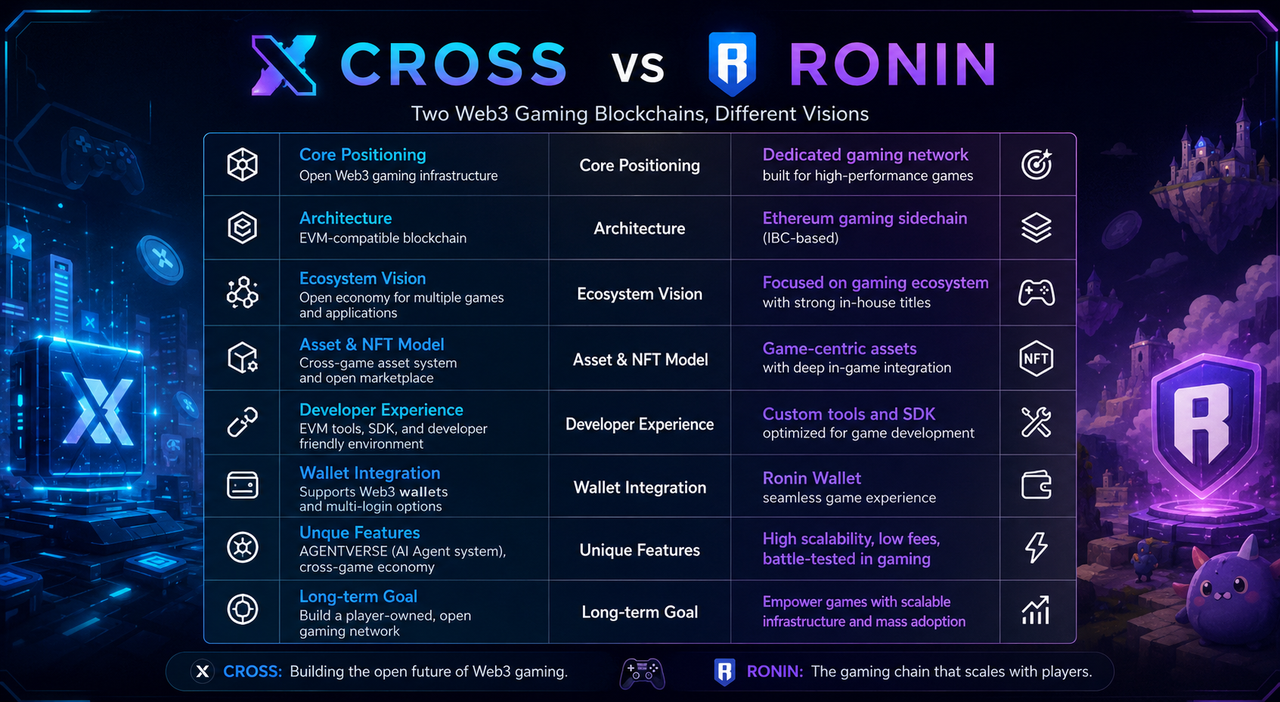
The table below shows the main differences between the two in technical structure:
| Comparison Dimension |
CROSS |
Ronin |
| Core positioning |
Open Web3 gaming infrastructure |
Dedicated blockchain gaming network |
| Architecture type |
EVM compatible public blockchain |
Ethereum gaming sidechain |
| Ecosystem direction |
Multi-game open economy |
Blockchain gaming ecosystem centered |
| NFT system |
Emphasizes cross-game asset circulation |
Mainly focused on game asset trading |
| Developer tools |
SDK + EVM tool compatibility |
Gaming ecosystem tools |
| Wallet system |
Web3 wallet and blockchain game login |
Ronin Wallet |
| AI Agent layout |
Supports AGENTVERSE |
Still mainly focused on the blockchain gaming ecosystem |
| Long-term direction |
Open gaming network |
Game assets and user growth |
This difference means that although both belong to GameFi infrastructure, their development paths are not the same.
How Do the Game Asset and NFT Systems of CROSS and Ronin Differ?
CROSS and Ronin both support NFTs and on-chain game assets, but their asset logic is different.
Ronin’s NFT system was initially built mainly around Axie Infinity, and its asset structure leaned more toward circulation within a single ecosystem. Character NFTs, land NFTs, in-game items, and other assets mostly served the Axie game system.
CROSS, on the other hand, places greater emphasis on an “open game asset system.” Its goal is not only to support assets from a single game, but also to build on-chain economic infrastructure shared by multiple games.
This means CROSS pays more attention to:
-
Cross-game asset circulation
-
Open marketplaces
-
Economic compatibility across multiple projects
-
On-chain identity systems
By comparison, Ronin’s advantage lies in its more mature gaming user ecosystem and NFT trading system.
As the Web3 gaming industry develops, questions such as “how blockchain game NFTs differ from traditional game items” and “whether cross-game assets are truly feasible” are also becoming central topics in GameFi.
Comparing the Developer Ecosystems and Entry Barriers of CROSS and Ronin
For the Web3 gaming industry, the developer ecosystem often determines a blockchain’s long-term competitiveness.
Ronin’s advantage lies in its mature user base and proven blockchain game operating experience. Because Axie Infinity once brought in a large number of users and transaction activity, Ronin has strong recognition in the GameFi industry.
However, Ronin’s ecosystem was relatively concentrated around its internal gaming system in the early stages, so third-party developer expansion was comparatively limited.
By contrast, CROSS places more emphasis on an open development ecosystem. Because it uses an EVM compatible structure, Ethereum developers can more easily migrate existing tools and smart contracts.
In addition, CROSS provides SDKs, wallets, and blockchain gaming infrastructure interfaces, aiming to reduce the complexity for traditional game studios entering Web3.
This distinction means that:
Differences in Decentralization and Governance Models Between CROSS and Ronin
In terms of governance structure, the two are also at different stages of development.
To improve efficiency in its early stage, Ronin used a structure with fewer validator nodes. This model helped reduce transaction latency, but it also meant the network leaned more toward a limited validator system.
As the industry has developed, Ronin has gradually expanded its validators and governance participation, aiming to improve network security and decentralization.
CROSS places greater emphasis on an open community and on-chain governance structure. One of its goals is to build a gaming ecosystem network jointly participated in by players, developers, and the community.
However, whether it is CROSS or Ronin, gaming blockchains usually need to balance:
-
Performance
-
User experience
-
Decentralization
This is a challenge that all GameFi infrastructure must face.
Differences in Use Cases Between CROSS and Ronin
Ronin is better suited for:
-
Mature large-scale blockchain games
-
High-frequency NFT trading
-
Game payments and marketplaces
-
Ecosystems driven by a single core game
CROSS is better suited for:
-
Multi-game open economic systems
-
Web3 native game development
-
AI Agent entertainment systems
-
Cross-game asset exploration
-
Open blockchain gaming infrastructure
As AI and Web3 entertainment become increasingly integrated, CROSS has also begun moving into AI Agent gaming through ecosystem modules such as AGENTVERSE. By contrast, Ronin is currently still more focused on blockchain gaming and NFT economies themselves.
Conclusion
CROSS and Ronin both belong to Web3 gaming infrastructure, but their development paths are clearly different.
Ronin is closer to a mature blockchain gaming network, serving large game ecosystems through high performance and NFT trading systems. CROSS, by contrast, places greater emphasis on open gaming economies, EVM compatibility, and cross-game asset systems, aiming to establish more open Web3 gaming infrastructure.
From the perspective of industry trends, GameFi blockchains are no longer just transaction processing tools. They are gradually evolving into integrated ecosystem platforms that combine asset systems, developer tools, player economies, and digital identity.
FAQs
Are CROSS and Ronin Both Gaming Blockchains?
Yes. Both are blockchain networks built specifically for Web3 gaming scenarios.
What Is the Biggest Difference Between CROSS and Ronin?
Ronin leans more toward a mature blockchain gaming ecosystem, while CROSS places greater emphasis on open gaming economies and cross-game asset systems.
Why Is Ronin Well Known in the GameFi Industry?
Ronin gained a large number of users and significant transaction volume thanks to the rapid growth of Axie Infinity, making it one of the representative networks of early GameFi.
Is CROSS Compatible with Ethereum?
Yes. CROSS uses an EVM compatible architecture, so it can support Ethereum development tools and Solidity smart contracts.
What Types of Games Are More Suitable for CROSS?
Projects that emphasize open economies, cross-game assets, and Web3 native interaction are usually more suitable for the CROSS ecosystem.
Does Ronin Only Support Axie Infinity?
No. Ronin has gradually expanded to support other Web3 games and third-party developer ecosystems.







