As the core risk module of Arrow Finance (ARROW) on Robinhood Chain, the collateral list—together with LTV (Loan-to-Value) and liquidation thresholds—jointly governs the capital efficiency and safety margins of single-asset debt positions.
Robinhood Chain unifies crypto assets, tokenized stocks, ETFs, and RWAs within a single execution environment, where liquidity depth, volatility, and oracle reliability can vary significantly across asset types. Arrow Finance sets parameters by asset class: stablecoins enjoy the highest capital efficiency, while tokenized stocks are subject to more conservative limits due to trading hours and NAV update frequency.
Understanding collateral parameters is essential for assessing Vault health factors, estimating liquidation risk, and selecting optimal collateral strategies.
What Types of Collateral Does Arrow Finance Support?
Arrow Finance categorizes approved collateral into six types: fiat-backed stablecoins, yield-bearing stablecoins, liquid staking tokens (LST), major cryptocurrencies, primary and secondary tokenized stocks, and on-chain ETFs and RWAs. Each asset class must be listed via governance vote and assigned its own maximum LTV, liquidation threshold, and debt ceiling.
Stablecoins and major cryptocurrencies rely on general oracles like Chainlink; tokenized stocks, ETFs, and RWAs utilize dedicated NAV oracles, synchronized with the net asset value of stock trading venues on Robinhood Chain. Each Vault is structured for a single user, single collateral, and single debt position—each collateral type corresponds to one independent position, and parameters are not shared across assets. This layered parameter approach is designed to balance capital efficiency and system solvency.
What Are the LTV and Liquidation Thresholds for Stablecoin Collateral?
Stablecoin collateral offers high liquidity and relatively low price volatility, resulting in the highest capital efficiency. USDC's maximum LTV is approximately 90%, with a liquidation threshold around 95%. sUSDe has a maximum LTV of about 85%, with its liquidation threshold set by governance. sUSDe carries underlying yield strategy exposure, so its parameters are slightly lower than USDC. The maximum LTV sets the upper limit for minting aUSD; the liquidation threshold is the minimum safe collateral-to-debt ratio—if breached, the health factor drops below 1.
How Are Parameters Set for Liquid Staking and Major Crypto Assets?
Liquid staking tokens wstETH and weETH have a maximum LTV of about 72%, with liquidation thresholds set by governance. In addition to ETH price volatility, these assets carry staking depeg risk. WETH's maximum LTV is about 75%, with a liquidation threshold of around 82%. WBTC's maximum LTV is about 70%, with a liquidation threshold of about 78%—slightly lower than WETH. When selecting between major crypto or LST collateral, users must balance capital efficiency against volatility tolerance.
How Do LTVs Differ Between Primary and Secondary Tokenized Stocks?
Tokenized stocks on Robinhood Chain are Arrow Finance’s core collateral, distinguishing it from traditional Ethereum CDPs. Primary tokenized stocks have a maximum LTV of about 55%; secondary tokenized stocks, about 40%. For stocks, liquidation thresholds are widened during market closures and new borrowing is suspended. NAV updates pause during closures, increasing price gap risk compared to 24/7 crypto trading. Collateralizing tokenized stocks allows users to retain upside exposure while minting aUSD. The Vault Opening and aUSD Minting Guide details the steps from selecting collateral to confirming the health factor.
How Are ETF and RWA Collateral Incorporated?
On-chain ETFs and RWAs (Real World Assets) are integrated into Arrow Finance’s unified Vault framework, with maximum LTV, liquidation thresholds, and debt ceilings set individually by ARROW governance. ETFs share the NAV oracle logic of tokenized stocks, following the same freezing and buffer rules during market closures. RWAs may involve issuer credit and settlement cycles, so their initial parameters are typically more conservative. Always verify the on-chain contract address and current governance parameters before participating.
How Is Collateral Managed During Market Closures?
During US stock market closures, NAV oracles for tokenized stocks and some ETFs freeze the last traded price or switch to a widened buffer mode, preventing stale prices from being used for new debt minting. New borrowing against stock collateral is typically suspended during closures; existing Vaults continue to accrue stability fees, and the liquidation buffer is temporarily widened. Parameters revert to normal when trading resumes; crypto assets and stablecoins are unaffected by stock market hours.
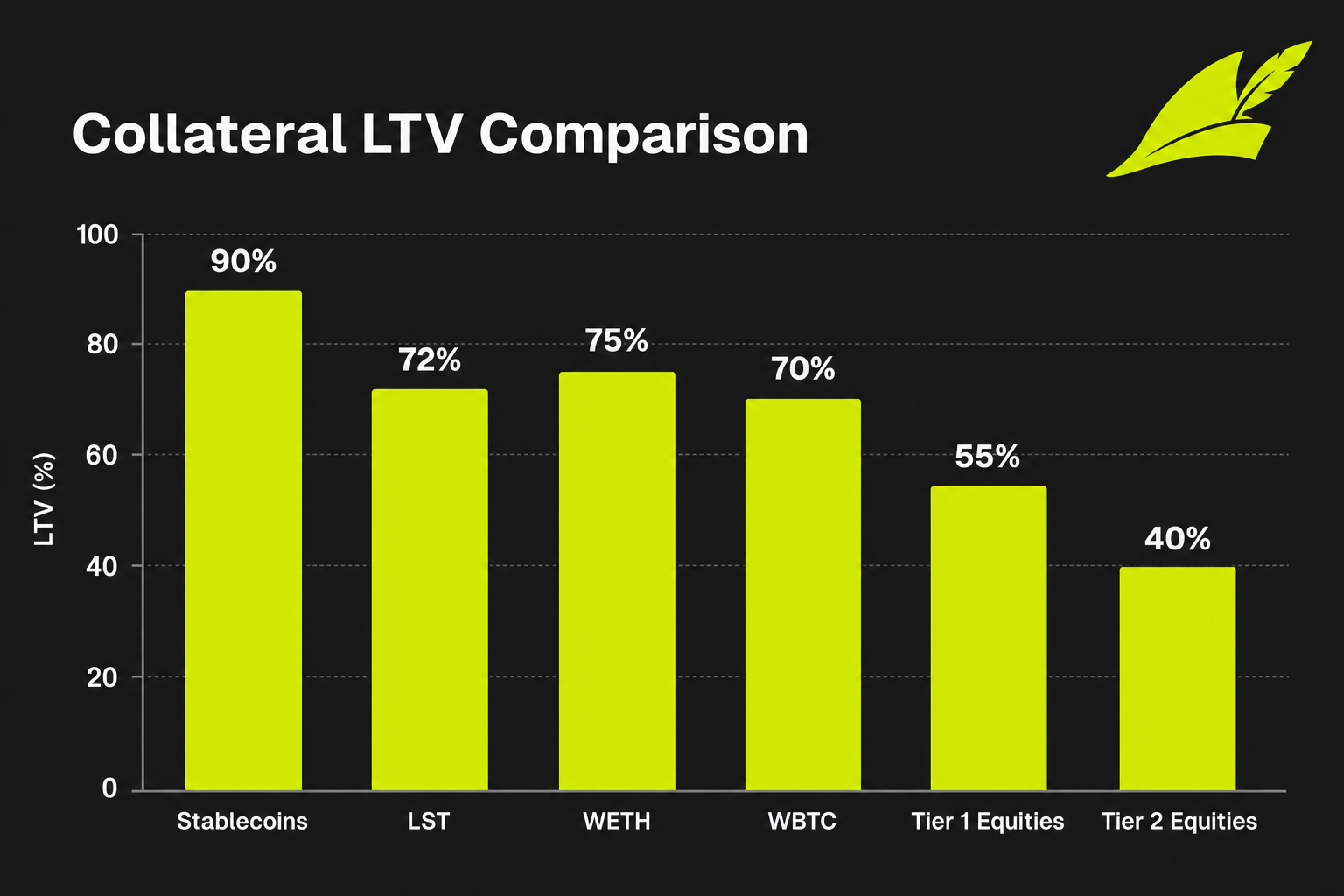 Figure 1. Comparison of maximum LTV and liquidation thresholds among Arrow Finance collateral types. Stablecoins offer the highest capital efficiency, while tokenized stocks have the most conservative parameters.
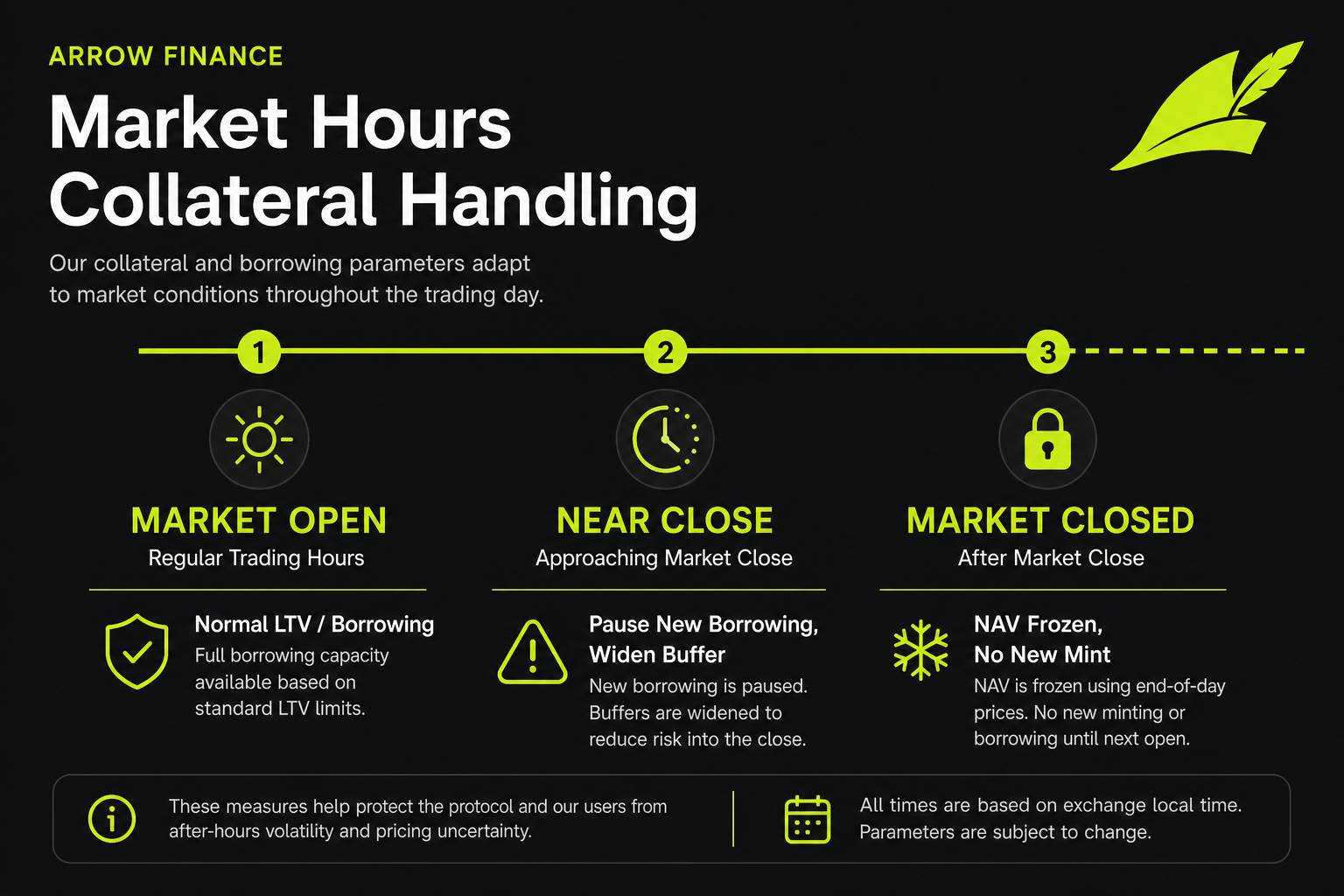 Figure 2. Special handling for tokenized stocks during market closures: oracles freeze or widen buffers, new borrowing is suspended, and normal pricing resumes after trading hours.
Collateral Parameter Summary Table: LTV and Liquidation Thresholds
The table below summarizes the core risk parameters for Arrow Finance’s main collateral categories, enabling easy comparison of capital efficiency and safety margins. Exact values are determined by on-chain governance, and ARROW holders can vote to adjust listed assets and parameter curves.
| Collateral |
Category |
Maximum LTV |
Liquidation Threshold |
Remarks |
| USDC |
Stablecoin |
90% |
95% |
Highest capital efficiency |
| sUSDe |
Yield-bearing stablecoin |
85% |
Governance-set |
Yield strategy exposure |
| wstETH |
LST |
72% |
Governance-set |
Staking depeg risk |
| weETH |
LST |
72% |
Governance-set |
Staking depeg risk |
| WETH |
Major crypto |
75% |
82% |
24/7 pricing |
| WBTC |
Major crypto |
70% |
78% |
Slightly higher volatility than ETH |
| Primary tokenized stock |
Stock |
55% |
Widened during market closure |
Trading session constraints |
| Secondary tokenized stock |
Stock |
40% |
Widened during market closure |
Higher volatility constraints |
| ETF / RWA |
Extended asset |
Governance-set |
Governance-set |
Asset-by-asset governance listing |
The difference between maximum LTV and liquidation threshold is the liquidation buffer. A health factor above 1 indicates a safe range; dropping below 1 triggers liquidation. The Stability Pool burns aUSD and acquires collateral at a discount, with a liquidation penalty of approximately 10%–13%. The aUSD Peg and Redemption Router details how redemption pressure and liquidation paths together maintain system solvency.
Summary
Arrow Finance sets collateral LTV and liquidation thresholds by asset class: USDC leads with a maximum LTV of about 90%, primary tokenized stocks at about 55%, and secondary at about 40%, reflecting differences in liquidity and volatility. Tokenized stocks and ETFs are subject to special arrangements during market closures, including oracle freezing, widened liquidation buffers, and suspension of new borrowing. Understanding these parameter differences helps users assess liquidation risk and capital efficiency before minting aUSD and make informed decisions about risk tolerance.
FAQ
Which Collateral Types Does Arrow Finance Support?
Arrow Finance supports USDC, sUSDe, wstETH, weETH, WETH, WBTC, primary and secondary tokenized stocks, and on-chain ETFs and RWAs. USDC’s maximum LTV is about 90%, primary tokenized stocks about 55%, and secondary about 40%. ETF and RWA parameters are set individually by governance. All collateral must be on the governance-approved list, and Vaults are single-asset structures.
How Can I Borrow Stablecoins Using Tokenized Stocks?
On Robinhood Chain, deposit primary or secondary tokenized stocks into an Arrow Finance Vault and mint aUSD based on the maximum LTV for that asset type. aUSD is a USD-denominated debt token that can circulate on-chain until repayment. After repaying the debt and stability fee, you can withdraw your stock collateral. Before opening a position, confirm the trading session, target LTV, and health factor. New borrowing is generally paused during market closures.
What Happens If the Vault Health Factor Falls Below 1?
If the health factor drops below 1, the Vault becomes eligible for liquidation. The Stability Pool burns the corresponding aUSD debt and acquires the collateral at a discount of about 10%–13%. If the Stability Pool lacks capacity, redistribution reallocates debt and collateral to other Vaults in the system. Price declines, accumulated stability fees, or excessively high LTV settings can all cause the health factor to fall below 1.
What’s the Difference Between LTV and Liquidation Threshold?
Maximum LTV is the upper limit for aUSD minting at position opening as a percentage of collateral value, determining capital efficiency. The liquidation threshold is the minimum collateralization ratio that triggers liquidation; when the collateral-to-debt ratio drops below this threshold, the health factor falls below 1. The difference between the two is the liquidation buffer, which absorbs short-term price volatility and fee accrual.
How Does Arrow Finance Manage Stock Collateral During Market Closures?
During US stock market closures, the NAV oracle for tokenized stocks typically freezes the last traded price or switches to a widened buffer mode to prevent stale prices from being used for debt minting. New borrowing for stock collateral is generally suspended during closures, existing Vaults continue to accrue interest, and the liquidation buffer is temporarily widened. After trading resumes and the oracle resynchronizes, parameters revert to normal logic.







