Bitcoin’s entry into traditional capital markets is no longer limited to spot trading on exchanges and direct BTC ownership. As public companies begin incorporating Bitcoin into their corporate asset management and business strategies, a category of companies centered on Bitcoin mining, reserve accumulation, and infrastructure operations has gradually attracted market attention. These companies both participate in the production and maintenance of the Bitcoin network and establish a connection between their corporate balance sheets and the price of Bitcoin.
American Bitcoin Corp. (NASDAQ: ABTC) is one representative example of this development. The company combines Bitcoin mining with a corporate Bitcoin reserve, seeking to establish a long-term business model through mining efficiency, capital allocation, and reserve expansion. Understanding ABTC requires more than looking at how much Bitcoin it holds, and it should not simply be viewed as a traditional mining company. More importantly, investors should analyze how its mining operations generate BTC, how its reserve strategy affects the company’s assets, and how the two work together to influence shareholder value.
For investors, ABTC also provides a case study of the intersection between the crypto industry and traditional stock markets. Buying ABTC through the stock market and purchasing BTC directly are two different investment methods: the former provides equity exposure to a public company, while the latter involves direct ownership of Bitcoin. Their return drivers, sources of risk, and nature of the ownership rights are not the same.
Key Takeaways
-
Dual business model: American Bitcoin combines Bitcoin mining with BTC reserve accumulation. Its corporate value is affected both by mining performance and by changes in its digital asset reserves
-
Mining capacity determines the production base: The scale of ASIC miners, network hashrate, equipment efficiency, and power costs collectively affect BTC production efficiency and operating costs
-
Reserve growth does not come solely from mining: The company may also increase its BTC holdings through market purchases and other methods, so mining proceeds must be distinguished from external purchases
-
ABTC represents equity in the company, not ownership of BTC: Holding ABTC stock means holding an interest in a public company. It does not mean directly owning or being able to withdraw a proportionate share of the company’s BTC reserves
-
Corporate value is influenced by multiple factors: The price of BTC, mining profitability, financing conditions, operating expenses, and changes in the share count can all affect the company’s long-term performance
American Bitcoin’s Corporate Positioning and Business Structure
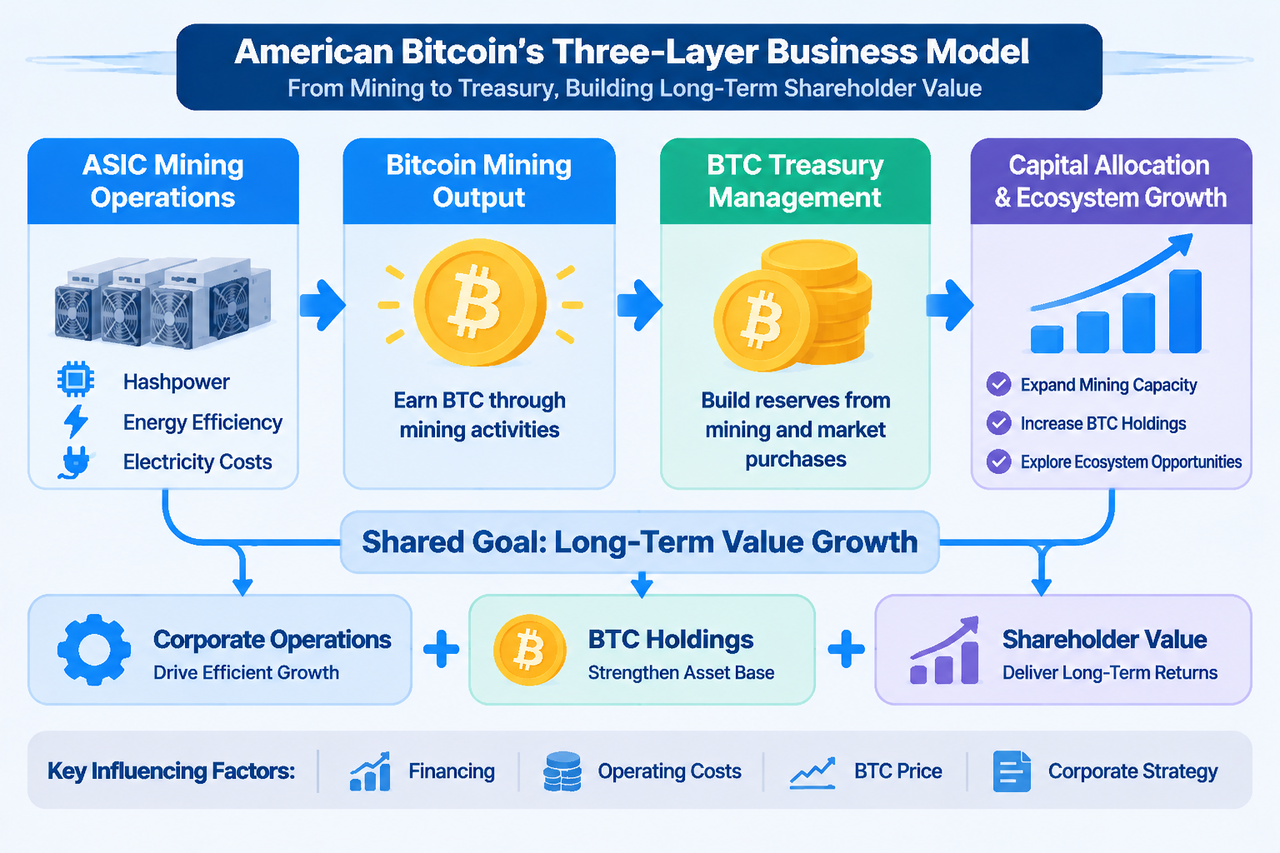
American Bitcoin’s core positioning is to combine Bitcoin mining capabilities with corporate BTC reserves, creating a business model focused on Bitcoin accumulation. Unlike companies that build reserves solely by purchasing BTC, ABTC treats mining as an important part of its business structure. It seeks to obtain Bitcoin by operating mining machines and then expand its reserves through market purchases, capital allocation, and other methods. The company describes its strategy in three layers: mining, reserves, and ecosystem development.
Mining is the foundation of this model. The company deploys specialized ASIC miners to participate in Bitcoin’s proof-of-work mechanism, provide computing power to the network, and receive corresponding block rewards and transaction fee distributions according to the mining pool’s rules. Mining is not simply a matter of converting electricity into Bitcoin. Its operating results also depend on factors such as miner efficiency, power costs, network difficulty, equipment utilization, mining pool fees, and the price of Bitcoin. Even if the market price of BTC remains unchanged, changes in power costs or the network’s total hashrate may affect the company’s mining profits.
The reserve layer links mined BTC with corporate asset management. The company may retain a portion of its mining proceeds on its balance sheet or increase its holdings through market purchases and other methods. As a result, the company’s Bitcoin reserves reflect not only its accumulated holdings over a given period but also an important source of future changes in asset value. However, the size of the reserves does not equal the amount of BTC that shareholders can directly control, because the company also has operating expenses, financing arrangements, debt, pledged assets, and other capital requirements.
The ecosystem layer primarily reflects the company’s strategic goal of establishing long-term influence across the Bitcoin industry. Mining infrastructure, technology partnerships, capital market financing, and industry participation may collectively support its business expansion. Strategic objectives should be distinguished from operating results that have already been achieved. When evaluating the company, investors should prioritize actual operating data, financial statements, and regulatory disclosures rather than judging its future growth potential solely on the basis of its corporate vision.
How Bitcoin Mining Is Converted Into Corporate Reserves
Bitcoin mining uses computing power to participate in competition across the network. Mining machines continuously perform hash calculations, while miners or mining pools compete for the right to record blocks according to network rules. When a mining pool successfully receives a block reward, it distributes the corresponding proceeds to miners based on their contributed computing power and the mining pool’s allocation rules. For a company such as ABTC, mining output is one source of growth for its BTC reserves.
However, mining revenue is not the same as mining profit. The company must cover miner depreciation, equipment purchases, hosting and maintenance fees, power costs, mining pool fees, and operating and administrative expenses. A miner’s energy efficiency determines the amount of energy required for each unit of computing power, while the scale of its deployment and equipment efficiency affect the company’s position in the competition for network hashrate. Therefore, when analyzing mining operations, investors should not compare only the amount of BTC mined per day. They should also consider the production cost per BTC, equipment efficiency, and capital investment.
The company may also increase its BTC reserves through market purchases. This means reserve growth may come from both mining output and external purchases, and these two sources have different economic implications. Mining output is related to operating efficiency, power costs, and network difficulty, while market purchases depend more on the source of funds, purchase price, and capital allocation decisions. If investors look only at total reserves without distinguishing the source of the BTC, they may overlook differences in operating efficiency and financing costs.
How Is ABTC Different From Direct Bitcoin Ownership?
Directly holding BTC means that investors own a corresponding amount of Bitcoin. Its value primarily changes with the market price of BTC and is also affected by factors such as wallet management, custody methods, transaction costs, and asset security. Investors may choose an exchange account, a self-custody wallet, or another holding method based on their needs. However, BTC itself does not automatically incur additional corporate operating risks because its holder chooses to invest in a particular public company.
Purchasing ABTC stock is different. Investors obtain equity in American Bitcoin, rather than directly acquiring the company’s BTC according to a fixed proportion. The stock price is influenced not only by Bitcoin market conditions but also by mining performance, operating costs, capital expenditures, corporate financing, changes in the number of shares, market liquidity, and investor expectations. Therefore, even if the company’s BTC holdings increase, ABTC’s stock price may not rise accordingly.
The two investment methods also have different risk profiles. Directly holding BTC primarily involves crypto asset price volatility, custody risk, and trading risk. Holding ABTC also involves corporate operating risk, management risk, financing risk, equity dilution risk, and stock market trading risk. The company may support business expansion through additional stock issuance, debt financing, or other capital instruments. These arrangements may change existing shareholders’ ownership percentages and the per-share economic value of their holdings.
Therefore, ABTC is better understood as a public company with exposure to the Bitcoin industry, rather than an equity-market substitute for BTC. Investors seeking price exposure to Bitcoin itself should understand the difference between directly holding BTC and holding stock in a related company. Investors seeking to participate in Bitcoin mining and corporate reserve operations should further examine the company’s operating efficiency, asset and liability structure, and capital allocation capabilities.
Key Factors Affecting American Bitcoin’s Operating Performance
The price of Bitcoin is an important variable affecting ABTC’s business performance, but it is not the only one. An increase in BTC’s price may raise the market value of the company’s reserve assets and improve the dollar-denominated value of its mining revenue. However, miner purchases, power expenditures, equipment depreciation, and operating costs do not automatically change in line with the price of BTC. If network difficulty increases and revenue per unit of computing power declines, the company may still face shrinking mining profit margins.
Mining efficiency is another important factor. Miner energy efficiency, equipment uptime, power procurement conditions, and the stability of hosting facilities determine whether the company can produce BTC at a competitive cost. ABTC’s partnership with Hut 8 enables it to use related infrastructure and hosting and operating capabilities. However, this partnership also means that investors need to consider the service agreement, related-party arrangements, operating responsibilities, and cost structure. Ownership of mining machines is not the same as ownership of data center facilities. Owning mining machines should not be interpreted as owning all of the mining infrastructure.
Capital allocation also deserves attention. The company may allocate funds among purchasing miners, expanding its hashrate, increasing its BTC reserves, repaying debt, and maintaining liquidity. Different choices will affect its future operating capacity and financial risk. For example, expanding the miner fleet may increase future production capacity but also raise capital investment and operating costs. Increasing BTC reserves may increase the company’s sensitivity to the price of Bitcoin, but it may also make the balance sheet more concentrated in a single highly volatile asset.
Finally, investors should also monitor the equity structure and financing arrangements. A public company may raise funds through stock offerings, ATM (at-the-market) programs, debt, or other financial instruments. Financing can support business expansion, but it may also create interest expenses, repayment pressure, or equity dilution. Determining whether the company has truly achieved per-share value growth requires analyzing total BTC reserves, shares outstanding, financing costs, and operating performance together.
Trading ABTC Stock on Gate
American Bitcoin is a company listed on Nasdaq under the ticker symbol ABTC. Gate’s stock section provides an ABTC stock trading page where users can view market information and the stock trading interface. For users seeking to participate in Bitcoin-related companies through traditional stock markets, this provides an alternative to directly purchasing BTC.
It is important to distinguish that ABTC stock trading on Gate involves company stock, not Bitcoin spot trading or a derivative contract settled in BTC. Purchasing stock means investing in the equity of a public company. Its price may be affected by the company’s operations, capital structure, market expectations, and the overall stock market environment. Before trading, users should review the product type, trading rules, trading hours, fees, available regions, and relevant risk disclosures displayed on the Gate page, and confirm the type of asset they are actually trading.
From a broader perspective, Gate TradFi and the stock section reflect the platform’s product strategy of providing users with access to traditional financial asset trading. ABTC is a listed stock with characteristics of the crypto industry: its business activities are closely related to the Bitcoin network and BTC reserves, but the stock itself remains an equity interest in a company. Understanding this distinction can help users avoid confusing company stock, Bitcoin spot holdings, and other derivatives.
FAQ
What Type of Company Is American Bitcoin (ABTC)?
American Bitcoin is a public company whose core business focuses on Bitcoin mining and BTC reserve accumulation. Its business model combines ASIC miner operations, Bitcoin reserve management, and capital allocation.
Is ABTC Stock Equivalent to Bitcoin?
No. ABTC is the stock ticker for American Bitcoin Corp. Purchasing ABTC provides exposure to the company’s stock, not direct ownership of BTC. In addition to Bitcoin market conditions, its stock price depends on the company’s operations, financing, equity structure, and supply and demand in the stock market.
Does American Bitcoin Obtain Bitcoin Solely Through Mining?
No. The company’s strategy includes both mining output and Bitcoin reserve accumulation. Changes in its reserves may be affected by mining proceeds, market purchases, asset disposals, and other capital arrangements. Different sources should be distinguished when analyzing reserve data.
What Is the Relationship Between ABTC and Hut 8?
American Bitcoin’s mining business has a partnership with Hut 8’s infrastructure and service system. This partnership involves miner hosting, operations management, and infrastructure support. Investors should review the service agreements and related-party arrangements disclosed by the company to understand the rights, responsibilities, and cost relationship between the two parties.
Does Trading ABTC on Gate Mean That I Directly Own BTC?
No. Gate’s ABTC page is a stock trading portal, and the trading instrument is American Bitcoin stock. It belongs to a different asset class from holding BTC spot. The nature of the rights and the sources of risk are also different.