RollerCoin is a free-to-play Bitcoin mining simulator and play-to-earn (P2E) game. Players build virtual mining rigs, play mini-games, and complete tasks to earn real cryptocurrencies such as Bitcoin (BTC), Ethereum (ETH), and Dogecoin (DOGE), plus the platform’s native RollerCoin token (RLT) used for in-game upgrades. No hardware mining farm or upfront crypto deposit is required to start.
RollerCoin launched in 2019 and sits in the GameFi niche: casual gameplay with an open in-game economy. Over time RollerCoin has added tournament modes, team mining, broader coin options including Ethereum and Dogecoin, mobile improvements, and NFT-style collectibles on its marketplace. Educational overview only—reward rates, supported coins, withdrawal minima, and item prices change on the live RollerCoin product. Collectible-miner narratives sit alongside NFTs as digital collectibles in the wider crypto toolkit.
One practical way to approach RollerCoin is as a learning sandbox: starting on web or Android, reading the dashboard carefully, then choosing the earn path that fits your time. Note that customer service, in-game help, and account recovery service quality can matter as much as raw hash power when payouts stall.
Key Takeaways
RollerCoin is a Bitcoin mining simulator game: you earn crypto through gameplay power, not by running ASIC hardware at home.
Core earn paths include mini-games, tasks/quests, referrals, events, and keeping your virtual rig powered by logging in regularly.
RLT is the platform’s native utility token for buying miners, racks, and upgrades; treat listing and withdrawability claims carefully and verify in-wallet on the official site.
Withdrawals of earned coins (for example BTC) are subject to platform minimums such as 10,000 satoshis (0.0001 BTC)—always confirm current thresholds before you plan cash-outs. Free-to-play still carries time cost, optional spends, and crypto price volatility; daily play streaks usually sustain power better than one-off sessions.
Latest Updates on RollerCoin
RollerCoin continues to expand beyond early BTC/ETH/DOGE/RLT mining simulation. Product pages and community updates have highlighted more competitive and social modes, a wider set of mineable tickers, mobile UX work, and marketplace/NFT-style items. Treat user-count and partnership claims as marketing figures and confirm on official channels before relying on them.
Enhanced gaming experience
Advanced mining simulation with upgraded visuals and rig progression
Tournament mode for weekly/monthly competitive reward pools
Team mining so groups can combine power and share rewards
Expanded cryptocurrency options
Beyond the original set (BTC, ETH, DOGE, and RLT), the platform has marketed additional mineable options such as Solana (SOL), Cardano (ADA), Polygon (MATIC), Avalanche (AVAX), and BNB. Availability and withdrawability differ by asset—check the in-game wallet before allocating power.
Technical improvements
Mobile optimization for smoother play on phones
Energy-style systems that reward consistent login and play cadence
Smart allocation helpers that steer power toward higher-yield coins (rules can change)
Account security features such as stronger encryption practices and two-factor authentication options
NFT and marketplace direction
RollerCoin has framed collectible miners, virtual land-style assets, achievement badges, and cross-platform experiments as NFT-adjacent features, alongside a player marketplace for miners, racks, parts, and RLT.
Community and partnerships
Public materials have cited multi-million user scale, regional events, ambassador programs, education content, and partnerships with exchanges, studios, and analytics firms. Verify current programs on rollercoin.com rather than treating any single article snapshot as permanent.
What is RollerCoin?
RollerCoin is the first widely known Bitcoin mining simulator game, a crypto game and mining game that lets people earn cryptocurrency through gameplay without buying mining hardware. A simulation game copies real-world activities—in this case crypto mining—into an interactive environment, a concept that makes mining easier to understand through gameplay. In the P2E layer, players also compete and complete tasks for rewards.
You can play on the RollerCoin website or mobile app. Instead of ASICs and electricity bills, progress is measured in in-game mining power. That power determines how quickly your account accumulates supported cryptocurrencies, including BTC, ETH, DOGE, and RLT. RLT is typically spent on items that raise power further.
History of RollerCoin
RollerCoin debuted in 2019, built by crypto enthusiasts who wanted a low-barrier entry into earning digital assets. Early growth centered on free accounts, mini-games, and virtual rigs. Later milestones in public posts include large user milestones and giveaways, BNB mining integration, and the marketplace launch for peer trading of game items and RLT.
How does RollerCoin Work?
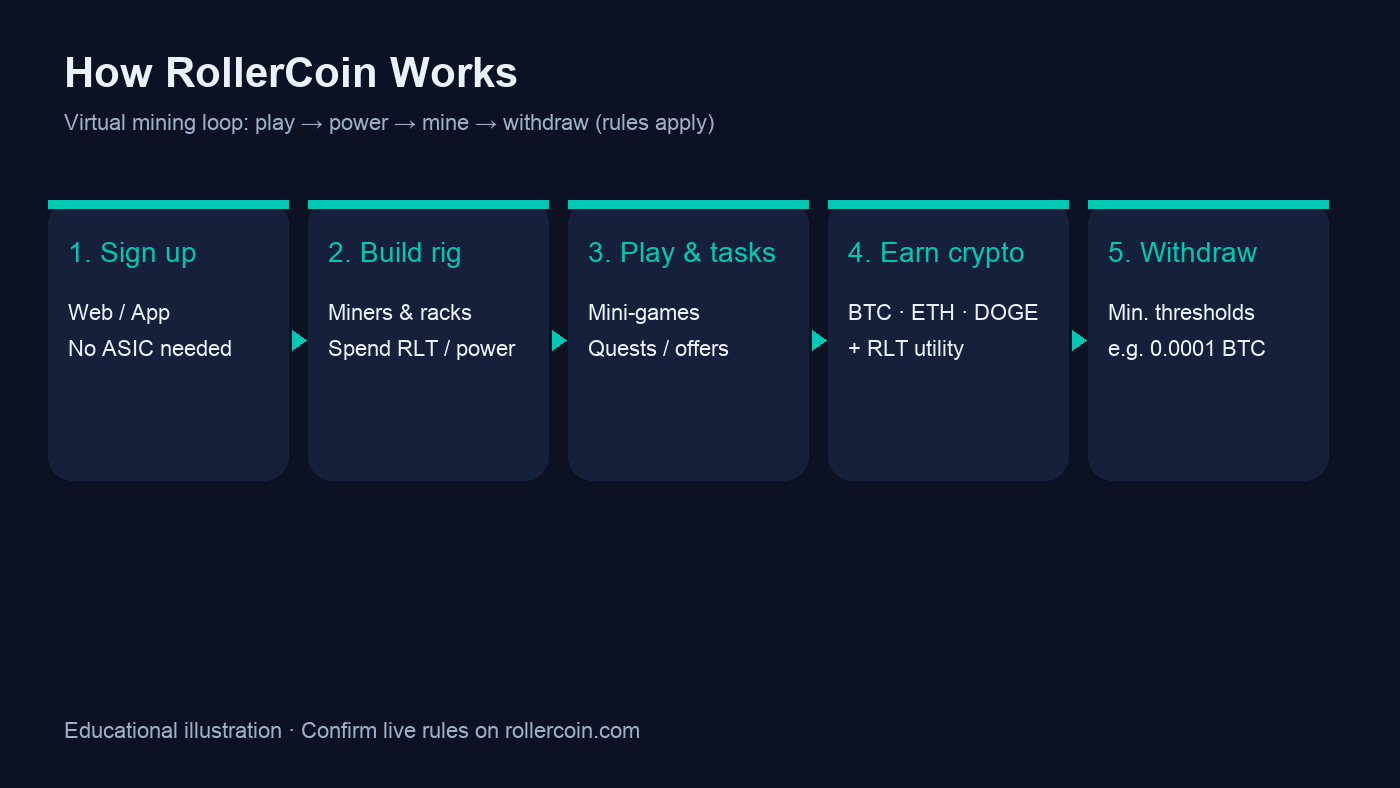
RollerCoin is a game with mining-like mechanics, not a securities offering and not a guaranteed yield product. You cannot “buy RollerCoin stock.” The core loop is simple: the game consists of creating an account, building and upgrading a virtual mining rig, growing power through mini-games and tasks, mining supported coins, and withdrawing eligible balances when you meet platform rules—the basic process of getting started and earning.
Other earn paths include daily quests, special events, competitions, and referrals. To keep earning, players usually need regular activity; historical help copy has noted logging in at least once every five days—so be sure to log in to your rollercoin account to keep the rig active and manage progress—so electricity on the virtual rig does not stop. Always re-check live rules—idle penalties and timers can change.
Figure 1. RollerCoin earn loop from account setup to withdrawal (educational; live rules apply).
What Makes RollerCoin Unique in Crypto Mining?
Compared with many P2E titles that push NFT mints or token buys first, RollerCoin’s differentiators are usually described as:
Free-to-play entry — start earning without an upfront crypto deposit (optional paid upgrades may still exist).
User-friendly UI — beginners can navigate without deep mining or blockchain technology expertise.
Web + mobile access — play wherever you have connectivity, including the Android APK / app service channel when listed.
Security focus — encryption and transfer protections for account and payout flows (no system is hack-proof; enable 2FA).
Support channels — dedicated customer service for account and payout issues, with help-desk style service tickets when withdrawals need review.
Note the trade-off: free entry is convenient, but paced earning means patience. Players who read patch notes and use customer service early when balances look wrong usually resolve issues faster than those who wait.
How to Play RollerCoin
The design goal is simple looped play: build power, keep the rig online, and accumulate coin balances over time. In other words, the game takes the idea of crypto mining and turns it into a simple play loop. Public materials have described players receiving a portion of a Bitcoin block reward every ten minutes as a game framing device—confirm current reward cadence in-product.
How can I play? The short guide is: create an account, keep electricity online, then mix mini-games with task offers. Starting on desktop is common; starting on Android is another supported way when the mobile client is available.
Getting started — Visit rollercoin.com, sign up with email/password or linked social login, then follow onboarding to the dashboard and customize your avatar. You can also personalize your character during setup.
Dashboard — Track balances (for example BTC), power, and experience. Power is the processing capacity that drives earn rate. Read the power meter before you spend RLT.
Games — Mini-games such as Flappy Rocket, Coin Flip, and Crypto Hamster award power and XP; the platform has marketed a larger set of retro arcade-style mini-games (often cited as a dozen-plus—confirm the live catalog), and higher scores generally mean faster progression. Aim to win streaks rather than one lucky run.
Tasks — Offers like watching videos, surveys, or site visits can add rewards; quality and availability vary by region. Some offers pay RLT; others pay temporary power.
Mining farm upgrades — Spend power/BTC/RLT-style resources to upgrade the farm, buy miners, and manage mining equipment so mining accelerates toward higher output.
Withdrawals — Move eligible crypto to an external wallet once you clear the minimum. A commonly cited BTC floor is 10,000 satoshis (0.0001 BTC)—verify live. If a payout stalls, contact customer service and keep ticket IDs from the support service panel.
Referral bonuses can stack on top of play rewards when friends join through your link. Note: learning the dashboard first reduces wasted RLT on low-ROI miners.
Benefits of RollerCoin: How to Earn Crypto
RollerCoin combines idle-style mining simulation with active mini-games and task walls in a way that is designed to be educational and fun. Benefits beginners often look for include:
Learning the crypto mining process without hardware risk
Multiple earn paths, with playing games being one of the main ways users stay active and earn, alongside tasks, events, and referrals
Competition formats for larger prize pools where you can win boosted rewards
A marketplace for trading in-game items
Optional path to withdraw real BTC/ETH/DOGE (subject to rules)
Accessible customer service when account or payout questions appear
Pros and cons in plain language: the pro side is free starting cost and a clear learning curve; the con side is slower free-to-play pacing, optional spend pressure, and regional task limits. Earnings are not guaranteed. Time investment, optional purchases, task eligibility, and market prices all affect outcomes. Is the mining simulator “worth it”? Only if you treat it as a hobby-style way to learn—not as a wage replacement.
RollerCoin Gameplay and Mini Games
Besides the main rig loop, mini-games boost hash/extraction power, and higher difficulty usually leads to better rewards if you can score consistently. Common examples include:
Coin Click — clear falling coins before they hit the ground; short sessions can still win incremental power.
Coin Match — match-3 style puzzles with crypto theming; play to earn power.
Token Surfer — platformer-style runs, with options like token blaster; historical reward tiers include extended power for 20 / 50 / 100 daily wins (3 / 5 / 7 days). Confirm current tables in-game.
Each mini-game win may grant a time-limited power boost (some materials cite about 24 hours—confirm in-game).
Playing strategy note: prioritize playing mini games you can win consistently, then dump earned power into miners with higher durability or higher output per RLT. Read seasonal event banners before starting a long grind so you do not miss limited offers. A simple service habit—export screenshots when an offer fails to credit—helps customer service resolve disputes.
What is RLT?
RollerCoin token (RLT) is one of the native utility tokens in the RollerCoin ecosystem. Players earn RLT through play and spend these tokens on miners, racks, accessories, and other upgrades that raise mining power rather than using them as general-purpose crypto. Public educational copy has described RLT using ERC-20 language and a 21 million max supply with ~10-minute block distribution tropes analogous to Bitcoin—treat those figures as platform-stated tokenomics and verify against current official docs, because in-game currencies can diverge from freely withdrawable on-chain assets.
RollerCoin tokenomics (high level)
Stated max supply framing: 21 million RLT at launch (Bitcoin-like narrative)
Distribution between mining pool and in-game economy
Periodic “block” rewards to active miners
Utility for referrals, upgrades, and marketplace trades
Burn or sink mechanics may be used to support long-term economy balance
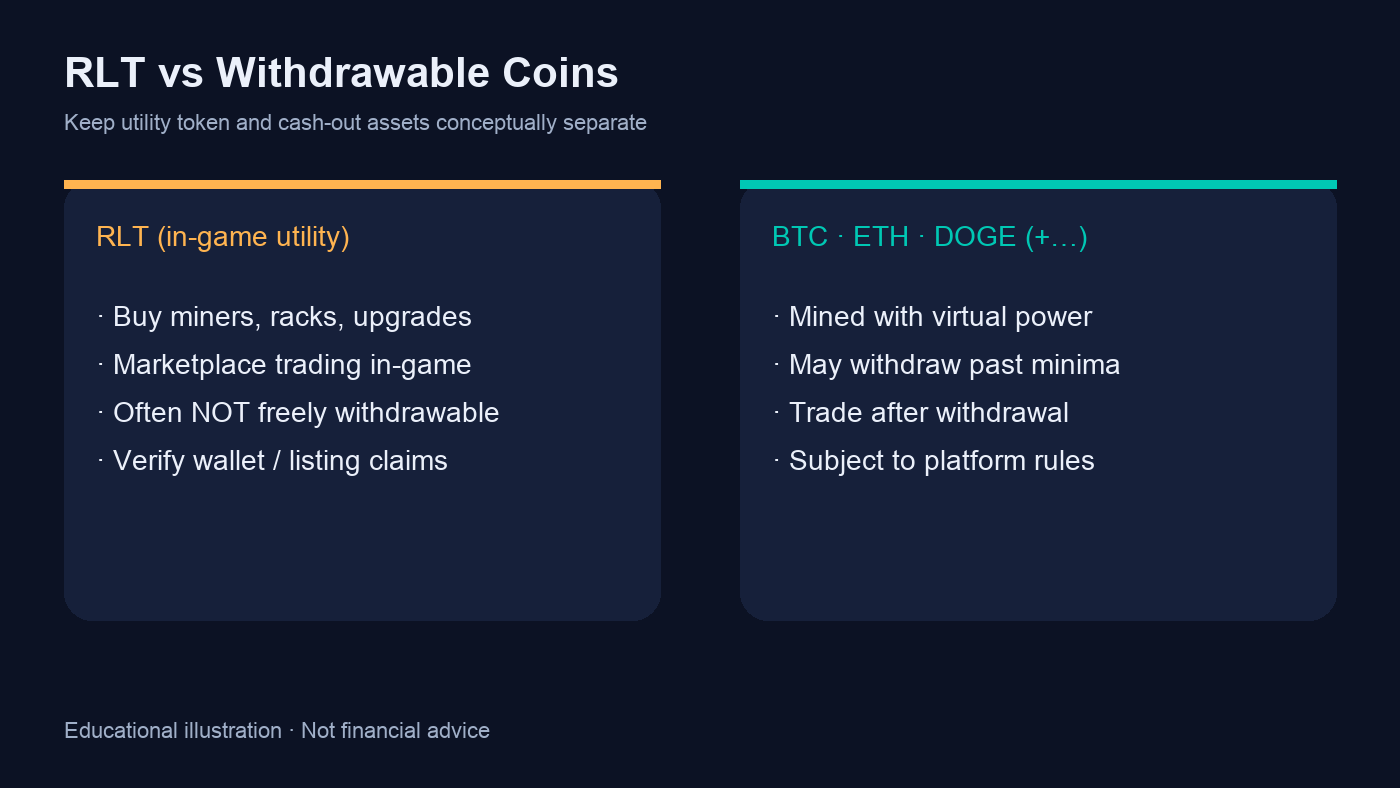
Practical note: Many independent reviews describe RLT primarily as an in-game currency that is not freely withdrawable to external wallets or listed on major CEXs. If a guide claims you can “buy RLT on an exchange,” double-check the live RollerCoin wallet and market pages first.
Figure 2. Keep RLT utility separate from coins that may be withdrawable under platform rules.
How to Get RLT (and Trade Earned Crypto)
The two main ways to earn cryptocurrencies on RollerCoin are (1) mining with virtual power and (2) completing games/tasks that boost that power. Ways to obtain RLT typically include:
Mining / earning it inside RollerCoin gameplay
Buying RLT with supported payment rails inside the game’s buy flow, including in game purchases for added balance or progress (card/crypto—see live checkout)
For cryptocurrencies you successfully withdraw from RollerCoin (such as BTC, ETH, or DOGE), you can hold, spend, or trade them on platforms that list those assets—including creating a Gate account, completing required verification, depositing, and trading the corresponding pairs. That path applies to withdrawn coins, not automatically to RLT itself.
How to withdraw crypto from RollerCoin in practice: if you are not already signed in, log in first, then open Wallet → select an eligible coin → confirm the minimum → paste your address carefully → submit. If the transfer sits pending, open a customer service request rather than re-submitting blindly. Note that network fees and service windows can delay credits.
News and Milestones on RollerCoin
Notable public milestones covered in older Learn copy and project blogs include:
A large giveaway around the 2 million Rollers celebration (tens of thousands of participants; special miner prizes for winners)—see the winners post
BNB mining integration so users can aim power at BNB
Marketplace launch enabling peer-to-peer trading of miners, racks, parts, and RLT
While RollerCoin is a P2E Bitcoin mining platform, the marketplace enables player-to-player trading of in-game inventory. Item catalogs and fees change over time—use the live marketplace UI as source of truth.
Summary
RollerCoin is a beginner-friendly Bitcoin mining simulator and play-to-earn game: build a virtual rig, play mini-games, complete tasks, grow power, and earn supported cryptocurrencies plus RLT for upgrades. It lowers the hardware barrier to “trying mining,” but rewards remain variable, withdrawals have minima, and RLT utility is centered on the in-game economy. Always confirm coin list, power decay, and cash-out rules on the official site before spending time or money. Read this as a learning guide—not a promise that free play will win market-beating returns. When in doubt, use official docs and customer service rather than third-party “get rich” posts.
FAQ
What is RollerCoin in simple terms?
RollerCoin is a free browser/mobile game that simulates crypto mining. You earn in-game mining power by playing and completing tasks using virtual mining equipment instead of physical hardware, and that power accumulates real cryptocurrencies the platform supports. Think of it as an online Bitcoin mining video game with a virtual farm service loop.
Is RollerCoin free to play?
Yes, you can register and start without buying hardware or depositing crypto. Optional purchases for equipment, upgrades, and task offers may still appear; free play usually earns more slowly. Starting costs are mainly your time.
What is RLT used for?
RLT is RollerCoin’s native utility token for buying miners, upgrades, and extra capacity in the in-game room. Some materials describe rack/slot limits for mining equipment (for example up to about twelve racks)—confirm live capacity rules. Each piece of equipment takes space in the room, so confirm whether your RLT balance is withdrawable before treating it like an exchange-listed asset. Note that higher-tier miners usually need more RLT.
How do withdrawals work?
When an eligible coin balance clears the platform minimum (for BTC, materials often cite 10,000 satoshis / 0.0001 BTC), you can withdraw to an external wallet. Exact minima and fees are set in the live wallet. If anything looks wrong, contact customer service and keep a written note of timestamps.
Can I lose money on RollerCoin?
You can lose time, and any optional spend is at risk. Crypto you earn can fall in market value after withdrawal. It is not a risk-free income product—do your own research, and treat “worth it” as a personal learning trade-off rather than a guaranteed win.
Author: Tamilore
Translator: cedar
Reviewer(s): Matheus、Edward、Jayne
Disclaimer
* The information is not intended to be and does not constitute financial advice or any other recommendation of any sort offered or endorsed by Gate.
* This article may not be reproduced, transmitted or copied without referencing Gate. Contravention is an infringement of Copyright Act and may be subject to legal action.
Yala is a modular Bitcoin DeFi infrastructure that connects BTC liquidity with multi-chain ecosystems through its YU stablecoin and MetaMint protocol. It enables Bitcoin holders to earn native DeFi yields across EVM and non-EVM networks securely and seamlessly.
The Altcoin Season Index is a market indicator that measures how many leading altcoins have outperformed Bitcoin over a rolling 90-day period, showing whether market momentum is concentrated in Bitcoin or spreading across a broader group of cryptocurrencies. For sophisticated retail crypto traders and investors, as well as institutions and businesses tracking digital-asset trends, it is a practical way to judge market breadth, relative performance, and whether capital is rotating beyond Bitcoin.
In the field of blockchain investment, the profitability of PoW (Proof of Work) and PoS (Proof of Stake) blockchains has always been a topic of significant interest. Crypto influencer Donovan has written an article exploring the profitability models of these blockchains, particularly focusing on the differences between Ethereum and Solana, and analyzing whether blockchain profitability should be a key concern for investors.
In this article, Portal Ventures introduces Bitcoin's history of innovation and controversy, the latest initiatives, and Portal's argument for making Bitcoin more "capital efficient" rather than "programmable."