When a public company's core business activities are closely tied to Bitcoin, traditional stock investors must address a valuation question that differs from that of a typical company: The company may own operating assets and generate business revenue while also holding a significant amount of highly volatile digital assets. Its stock value is therefore affected by both traditional business fundamentals and changes in the crypto asset market.
American Bitcoin (NASDAQ: ABTC) is a company with this dual nature. Its business combines Bitcoin mining with BTC reserve accumulation, while its stock trades on traditional securities markets. When investors buy ABTC, they acquire equity in the company—not direct ownership of the BTC held by the company. The value of the company's assets, operating cash flow, financing capacity, and share structure all affect the economic exposure that shareholders ultimately receive.
From a traditional finance perspective, analyzing ABTC is not simply a matter of deciding whether it is a "mining stock" or a "Bitcoin-related stock." The key is to understand what its assets consist of, how its profitability is generated, how its financing methods affect shareholder equity, and how the market prices these factors. Only by considering BTC reserves together with business operations and capital structure can investors gain a more complete understanding of the investment characteristics of this type of stock.
Key Takeaways
-
ABTC should be analyzed as a public company equity: Investors hold a residual interest in the company and must assess its assets, liabilities, operating performance, and capital structure rather than treating it simply as a substitute for BTC
-
Corporate assets require separate valuation: BTC reserves, mining machines and operating assets, cash, and other business assets each have different value foundations and risk characteristics
-
Reserve market value does not equal equity value: The company must also bear debt, operating liabilities, and ongoing operating costs, so the market value of its BTC reserves cannot be equated directly with its market capitalization
-
Financing and share dilution affect per-share value: Issuing new shares or introducing other financing instruments may support business expansion, but may also change existing shareholders' ownership percentages and per-share asset exposure
-
Valuation requires multiple scenarios: In addition to the BTC price, investors should consider mining profitability, asset depreciation, financing costs, debt levels, and future capital needs to avoid judging the stock's value based on a single asset metric
ABTC's Stock Characteristics and Shareholder Equity
ABTC is the stock symbol of American Bitcoin Corp., traded on Nasdaq. Common stock investors hold equity in the company, and their related rights are subject to the company's charter, securities regulations, and applicable laws. Shareholders may have rights such as voting and dividend distributions as provided under corporate law and the relevant securities documents. These rights, however, are not the same as directly holding the company's BTC reserves.
The BTC held by the company is a corporate asset, not a personal digital asset registered directly in each shareholder's name based on their ownership percentage. Holding ABTC alone does not entitle a shareholder to require the company to deliver a corresponding amount of BTC, nor can the company's reserves simply be treated as cash equivalents that can be distributed to shareholders at any time. The company may need to use its BTC for operations, financing collateral, or other asset management purposes.
Stock investments also involve corporate governance and capital structure. Different classes of shares may have different voting rights or other rights arrangements. Warrants, convertible securities, and employee equity incentives may also affect the number of shares outstanding in the future. Investors should review the company disclosures regarding share classes, voting rights, potential dilution instruments, and related agreements. They should not judge the full scope of shareholder rights solely based on the stock symbol or common stock trading price.
ABTC's Asset Structure: BTC Reserves and Mining Operations Assets
When analyzing ABTC's balance sheet, the first step is to distinguish between BTC reserves and mining operations assets. BTC reserves are highly sensitive to market prices, and their carrying and economic value is affected by changes in the Bitcoin price and accounting treatment. Mining operations assets include mining machines and related equipment, prepayments, right-of-use assets, and other operating assets. Their value is also affected by equipment depreciation, technological upgrades, and actual utilization.
BTC reserves do not equal the company's net assets. The company must also account for debt, accounts payable, equipment purchase obligations, lease liabilities, and other operating liabilities. If some BTC is pledged as collateral for mining machine purchases or financing arrangements, its liquidity and availability for discretionary use may also differ from those of unrestricted BTC. Therefore, when assessing asset quality, investors should examine BTC holdings, restricted assets, cash balances, and the liability structure together.
Mining operations, meanwhile, require ongoing capital investment. Mining machines need to be upgraded periodically, and equipment efficiency may decline relative to newer-generation ASICs. Hosting facilities and electricity arrangements also affect long-term operating costs. If the company wants to expand its hashrate, it must balance equipment purchases, increases in BTC reserves, and the maintenance of cash flow. An increase in asset size does not automatically mean a higher return on assets. Capital efficiency remains an important evaluation factor.
ABTC's Valuation Framework: BTC Holdings Are Not the Only Consideration
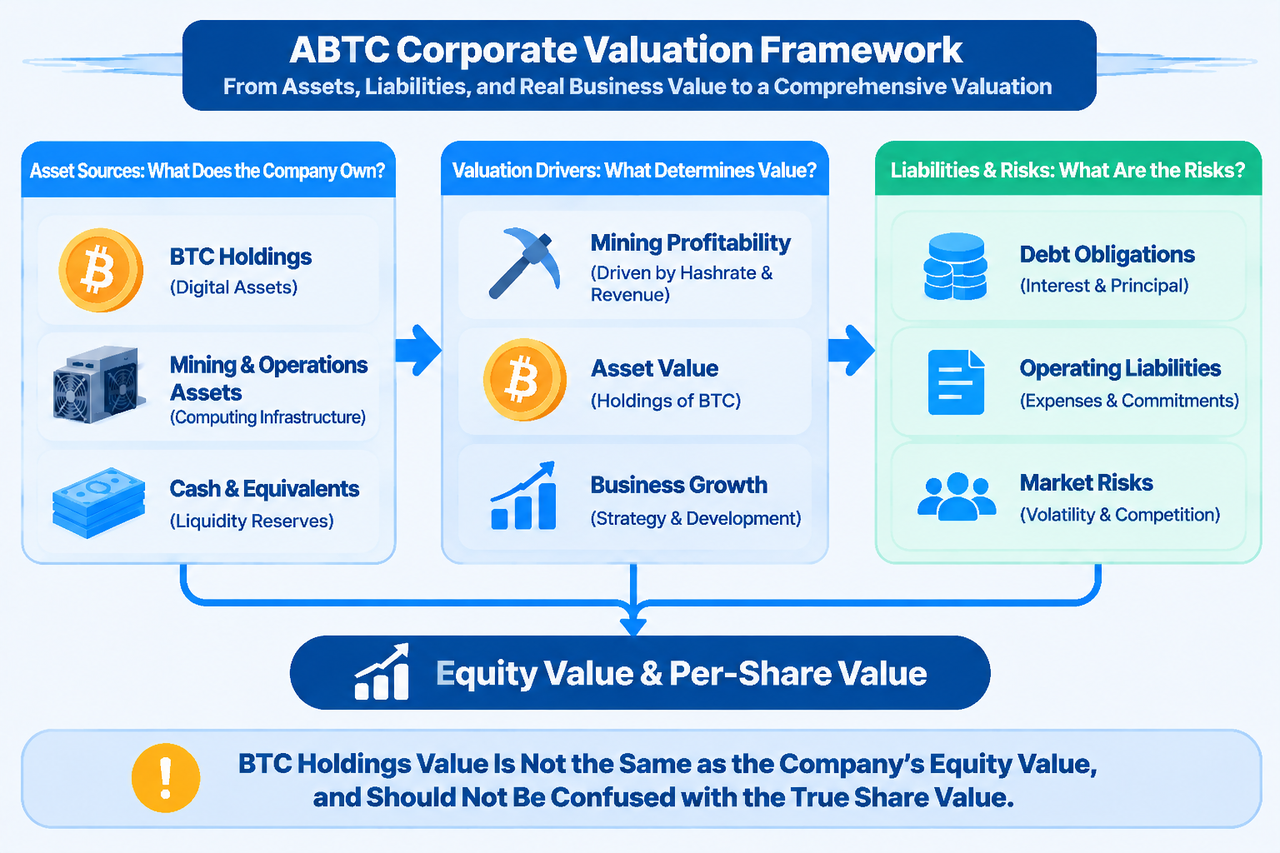
A common approach to valuing ABTC is to reference the market value of its BTC reserves. However, simply multiplying the amount of BTC by the spot price does not directly produce the company's fair equity value. The company also owns mining equipment and operating businesses while bearing debt, operating costs, capital expenditures, and other obligations. Focusing only on the total market value of BTC may overlook other important items on the balance sheet.
A more complete approach is to break the company down into different sources of value. The first is the value of its BTC reserves, which requires consideration of the amount held, market price, asset restrictions, and related liabilities. The second is the value of its mining business, which requires an assessment of hashrate, energy efficiency, electricity costs, equipment depreciation, and future capital expenditures. The third consists of corporate-level cash, debt, management expenses, and other assets and liabilities. Combining these factors creates a valuation framework that more closely reflects the company's overall economic condition.
The market may also use the ratio between market capitalization and net asset value attributable to BTC to assess whether the stock trades at a premium or discount relative to the company's BTC asset exposure. This metric must be used carefully. If the company has substantial mining operations, equipment assets, debt, and potential share dilution, calculating net asset value based only on BTC reserves may not fully reflect the company as a whole. A market premium may also reflect expectations for future reserve growth, mining efficiency, or capital allocation capabilities, while a discount may reflect uncertainty surrounding operating risks, financing costs, and governance structure.
How Do Financing and Equity Dilution Affect Existing Shareholders?
Public companies can support business development through share issuance, debt financing, and other capital instruments. For ABTC, financing proceeds may be used to purchase mining machines, expand hashrate, increase BTC reserves, or maintain operating liquidity. Financing is not necessarily negative. The key questions are whether the use of funds can generate long-term returns above the cost of capital and whether the company's financial risks remain manageable after financing.
Equity financing increases the number of shares outstanding. If new funds generate sufficient operating income or per-share asset growth, the financing may have a positive effect on long-term shareholder value. However, if the number of shares grows faster than the company's assets and earnings capacity, existing shareholders' ownership percentages may be diluted. For companies centered on a BTC reserve strategy, investors should compare per-share BTC exposure before and after financing rather than looking only at whether the company's total BTC holdings have increased.
Debt financing requires attention to interest costs, repayment terms, collateral, and covenant conditions. If the company uses BTC or other assets as financing collateral, a decline in market prices may reduce the value of the collateral and increase refinancing or liquidity pressure. Debt can provide funding without immediately increasing the number of common shares, but it also raises fixed payment obligations and may place greater pressure on the company during a market downturn.
Investors should therefore analyze financing size, financing costs, use of funds, and future changes in the number of shares together. Growth in the company's reserves that depends on substantial new capital does not necessarily mean that per-share value will increase at the same pace. What matters is whether financing improves long-term returns on capital and whether management can balance the pace of expansion, financial flexibility, and shareholder equity.
Risk Comparison: ABTC, Traditional Stocks, and Spot Bitcoin
Compared with a typical traditional stock, ABTC's operations and asset value are more sensitive to the Bitcoin market. A conventional company's revenue may come primarily from product sales or services, while ABTC's operating performance is also affected by the BTC price, network difficulty, mining revenue, and changes in the value of reserve assets. As a result, its stock may reflect both business operating risk and crypto asset price risk.
Compared with directly holding BTC, ABTC stock adds company-level risks. Spot BTC investors primarily bear Bitcoin price volatility, trading, and custody risks. ABTC shareholders must also consider mining costs, equipment depreciation, management decisions, financing arrangements, corporate governance, and stock market liquidity. Even if the BTC price rises, the company may fail to achieve a corresponding increase in per-share value because of higher operating costs, financing pressure, or share dilution.
In addition, stock markets and crypto markets operate under different trading systems. Stocks may be affected by trading hours, market closures, company announcements, financial reporting, and securities regulations, while spot BTC markets generally trade around the clock. The two markets may also differ in the speed of price reactions, liquidity structures, and investor composition. Therefore, ABTC's stock price and the BTC price will not necessarily maintain a fixed correlation at all times.
How Should Traditional Finance Investors Research ABTC?
The first step is to understand the company's business composition. Investors should determine whether the company's BTC reserves come from mining or market purchases, assess the actual operating hashrate and equipment efficiency of its mining business, and understand its relationships with infrastructure service providers. For companies that rely on third-party hosting or management services, investors should also review the terms, fees, related-party relationships, and operating responsibilities under the relevant agreements.
The second step is to analyze the financial statements. On the asset side, investors should examine BTC, cash, mining machines, and other operating assets. On the liability side, they should focus on debt, leases, equipment purchase obligations, and other liabilities. The cash flow statement can help determine whether the company can support daily expenses and capital expenditures through operating activities. Because BTC market prices may cause changes in asset values, investors should also understand the relevant accounting policies and fair value measurement methods.
The third step is to study the share structure and capital allocation. In addition to currently issued shares, investors should review warrants, convertible instruments, equity incentives, and potential new issuances. For metrics such as per-share BTC exposure, investors must understand the calculation methodology and share count used, avoiding an overestimation of per-share asset value caused by overlooking potential dilution.
Finally, investors should conduct scenario analysis rather than relying on a single price forecast. For example, they can separately consider a decline in the BTC price, an increase in mining difficulty, higher electricity costs, tighter financing channels, and the issuance of additional shares, then assess the potential effects on the company's balance sheet, cash flow, and per-share value. This type of analysis helps distinguish the company's operating resilience under different market conditions rather than judging the stock's value solely on market sentiment.
ABTC Stock Trading and the TradFi Gateway on Gate
Gate's stock section provides an ABTC stock trading page, giving users an entry point to access American Bitcoin stock through the platform. For traditional finance investors, ABTC's distinctive characteristic is that it is a public company whose operations are closely tied to the Bitcoin industry. Trading the stock provides exposure to the company's equity, not direct ownership of the BTC on its balance sheet.
Gate TradFi represents the platform's broader offering of trading services for traditional financial assets. When reviewing Gate's related products, users should distinguish among stock trading, stock derivatives, and other traditional asset products based on their specific structures. The ABTC stock page is a stock trading gateway and should not be confused with stock perpetual contracts, CFDs, or tokenized stocks. These products may differ significantly in asset characteristics, trading methods, settlement rules, and risk arrangements.
For users researching ABTC, the Gate page can serve as an entry point for viewing its stock trading information and market performance. Information about the company's operations, financial data, and material events should primarily be obtained from American Bitcoin's investor relations page and regulatory disclosures. Combining trading platform information with the company's original disclosures can help users avoid judging the company's fundamentals solely based on short-term stock price movements.
FAQ
Is ABTC a Traditional Stock or a Crypto Asset?
ABTC is the stock symbol of American Bitcoin Corp. It is a public company stock, not BTC or another crypto token. Its business is related to Bitcoin mining and reserve accumulation, but the stock itself represents equity in the company.
Should ABTC's Valuation Equal the Market Value of the BTC Held by the Company?
It should not be equated directly. The company also owns mining equipment and operating businesses while bearing debt, operating costs, and capital expenditures. The market value of its BTC reserves is only one part of an analysis of the company's value.
Why Could ABTC's Per-Share Value Decline Even If Its BTC Reserves Increase?
If the number of shares grows quickly or debt, financing costs, and operating expenses increase, the economic value attributable to each share may not grow in line with the company's total BTC reserves. Investors must analyze the fully diluted share count together with the company's net assets.
What Are ABTC's Main Traditional Finance Risks?
Key risks include equity dilution, debt repayment, corporate governance, operating costs, stock market liquidity, and securities market volatility. In addition, the company's BTC reserves and mining business create exposure to crypto asset market risks.
What Is the Difference Between Trading ABTC on Gate and Trading Stock Perpetual Contracts?
Gate's ABTC page is a stock trading gateway, and the trading instrument is the company's stock. Stock perpetual contracts are derivatives that generally provide contract exposure based on the price of an underlying asset. The two differ in asset rights, margin requirements, trading rules, and risk structures.