Bitcoin Corporate Treasury Strategies Differ Significantly from Traditional Crypto Asset Investments: Companies do not simply buy and hold BTC. They may also participate in the Bitcoin ecosystem through mining, infrastructure operations, and capital markets financing. These companies are affected not only by changes in the price of Bitcoin but also by competition for network hash rate and operating cost constraints. American Bitcoin (ABTC) is an example that combines mining with treasury accumulation.
From a crypto market perspective, the key question for ABTC is not simply "How much BTC does the company hold?" but also "How did the company acquire that BTC, and how is that BTC converted into economic value per share?" Mining output, market purchases, treasury management, and changes in the number of shares can all affect how investors assess the company's Bitcoin exposure.
Therefore, analyzing American Bitcoin requires a framework that connects the Bitcoin network with the company's balance sheet: first, understand how mining generates BTC; next, analyze how the company manages its treasury; and finally, determine whether treasury growth is genuinely improving per-share value and what costs and risks this process entails.
Key Takeaways
-
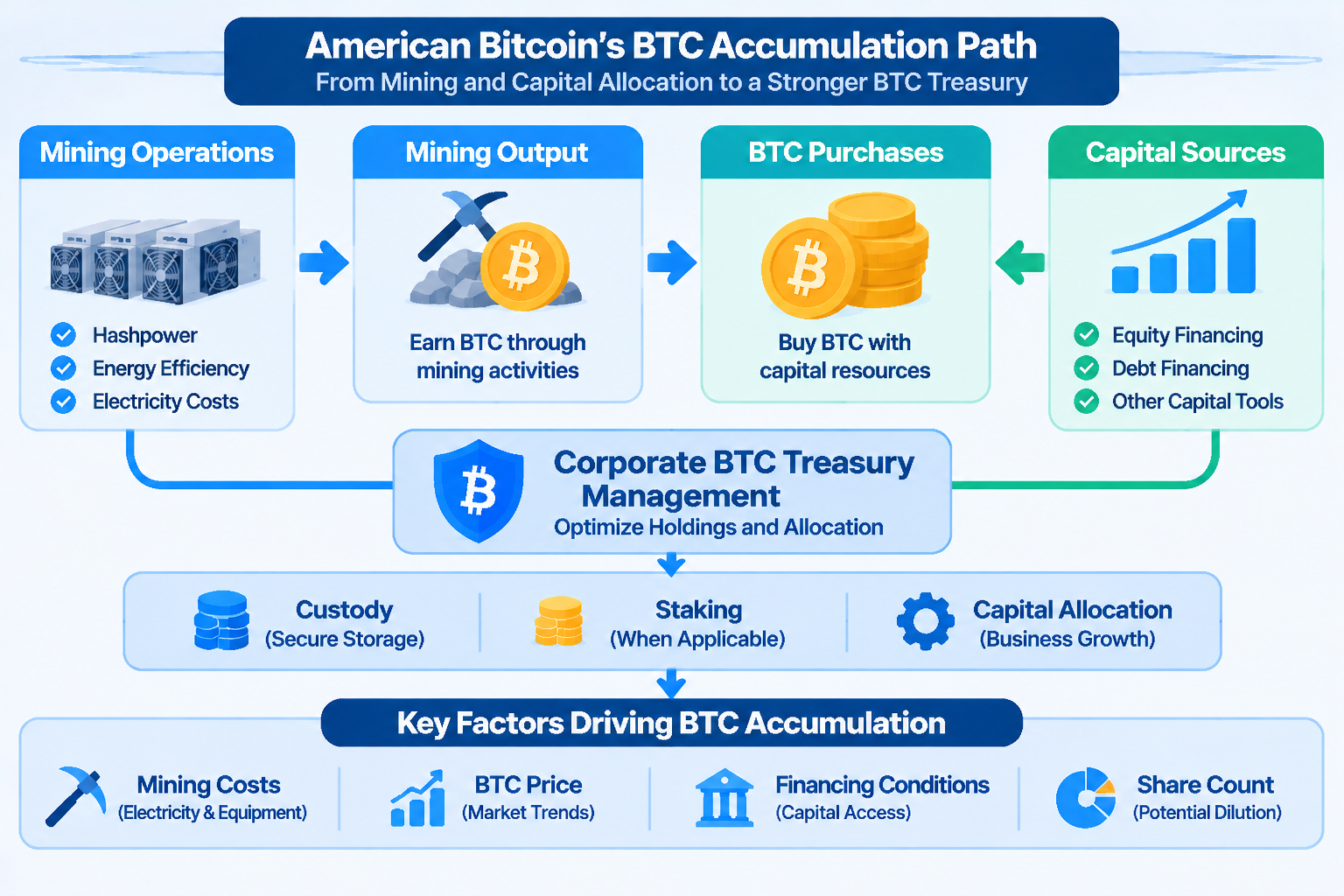
BTC accumulation follows two paths: one comes from operating mining machines and generating mining output, while the other comes from market purchases supported by capital. Together, they affect the company's BTC treasury size.
-
Mining output does not equal net treasury growth: electricity, equipment, maintenance, and other operating expenses, as well as BTC sales, can affect the final amount of Bitcoin retained.
-
BTC treasury size must be considered alongside the share count: simply focusing on how much BTC a company holds is insufficient. Investors should also examine the BTC exposure represented by each share and how it changes.
-
Bitcoin per Share is an important metric: it helps explain the relationship between BTC reserves and the number of shares, but it cannot independently represent a stock's fair valuation or actual return.
-
Treasury growth depends on operating and capital conditions: the BTC price, mining costs, financing capacity, and share dilution all affect the efficiency of BTC accumulation and its significance to shareholders.
Bitcoin Mining: The Basic Mechanism for Companies to Acquire BTC
Bitcoin uses a proof-of-work mechanism. Miners use specialized ASIC equipment to perform hash calculations and compete to produce blocks. When a miner or mining pool successfully produces a new block, it can receive the protocol-defined block subsidy and transaction fees included in the block. For a large-scale mining company, mining is a business that requires ongoing investment in capital, electricity, and operating resources—not a cost-free way to obtain Bitcoin.
American Bitcoin uses mining machine operations as the foundation of its business, contributing hash rate to the Bitcoin network and receiving corresponding BTC rewards according to the mining pool's distribution rules. The mining pool model aggregates the hash rate of multiple miners, reducing the income volatility associated with mining a block independently. However, mining pools distribute rewards based on participants' contributed hash rate and their own rules, and may charge corresponding fees. Therefore, the actual amount of BTC a company receives must be understood in the context of its hash rate contribution, the pool's settlement method, and network conditions.
Mining economics are influenced by multiple variables. Machine efficiency determines how much electricity is required per unit of hash rate, electricity prices affect the energy cost of each unit of BTC, and total network hash rate and difficulty affect the expected return per unit of hash rate. Even if a company adds more mining machines, its mining profits may come under pressure if total network hash rate grows faster or electricity costs increase. Therefore, evaluating a company's mining capabilities requires looking beyond total hash rate to also consider efficiency per unit of hash rate, equipment uptime, and production costs.
From Mining Output to BTC Reserves: How the Accumulation Strategy Works
American Bitcoin's business model relies not only on BTC generated by mining machines but also on company-level treasury accumulation. Mining output provides the company with an internal source of Bitcoin, while market purchases allow it to adjust the size of its treasury beyond operating output. The two approaches can work together, but their sources of funding and economic costs differ.
Acquiring BTC through mining requires the company to bear operating costs such as mining machine purchases, hosting, electricity, maintenance, and equipment depreciation. Market purchases require the use of the company's existing cash, financing proceeds, or other available funds, and directly expose the company to the BTC market price at the time of purchase. If the market price rises, the dollar-denominated value of the treasury may increase. If the price falls, the asset value may decline accordingly. The company must balance treasury expansion with the need to maintain operating liquidity.
The treasury strategy also involves the custody, staking, and availability of BTC. The Bitcoin holdings disclosed by a company may not all be freely available for unrestricted use. Some BTC may be used in mining machine purchase arrangements or other financing transactions. Investors should distinguish between the company's total BTC holdings, the amount actually held in custody, the amount that has been pledged, and the assets that can be freely allocated. Relying only on the total holdings figure may lead to an inaccurate assessment of the company's liquidity.
Bitcoin per Share: How Should Per-Share Bitcoin Exposure Be Understood?
For publicly traded companies whose core strategy centers on BTC reserves, investors often pay attention to the amount of Bitcoin represented by each share, or Bitcoin per Share. This metric attempts to connect a company's BTC reserves with its share count, helping investors assess the theoretical BTC exposure represented by each share. The basic approach is to divide the amount of BTC held by the company by the number of shares under a specified calculation basis.
However, this metric does not mean that shareholders own the corresponding amount of BTC, nor does it mean that the company will distribute Bitcoin to shareholders based on the amount of BTC per share. It is simply an analytical metric that measures the relationship between the company's reserves and its share count. Shareholders actually own equity in the company. The company's BTC assets remain part of its corporate assets and are subject to factors including creditor claims, operating obligations, pledging arrangements, and corporate governance structures.
When analyzing the amount of Bitcoin represented by each share, the choice of denominator is particularly important. Using only the number of issued common shares at a particular point in time may not fully reflect changes resulting from convertible securities, warrants, restricted stock, and potential future financing. If a company raises funds by issuing additional shares, its total BTC reserves may increase without a corresponding increase in BTC exposure per share. Investors should therefore consider both the basic share count and the share count after potential dilution.
More importantly, the amount of Bitcoin represented by each share cannot independently represent the company's value. It does not directly reflect mining costs, debt, cash, equipment assets, management expenses, or other liabilities, and it cannot replace an analysis of net asset value per share or enterprise value. To determine whether treasury growth genuinely benefits shareholders, investors should comprehensively assess BTC exposure per share, the company's net assets, financing costs, and long-term operating returns.
Bitcoin Mining Companies vs. BTC Treasury Companies
Traditional Bitcoin mining companies primarily earn block rewards and transaction fees through hash rate operations. Their operating value is generally closely tied to mining costs, equipment efficiency, hash rate scale, and the BTC market price. A mining company may sell some of its mining proceeds to pay for electricity, equipment purchases, and operating expenses, or it may choose to retain some BTC and build a corporate treasury.
BTC treasury companies may place greater emphasis on increasing their Bitcoin holdings through capital markets financing and asset allocation. Their key value drivers may include changes in the BTC price, financing costs, capital allocation efficiency, and changes in BTC exposure per share. If a company does not operate a mining business, its BTC treasury growth may depend primarily on market purchases and financing arrangements.
American Bitcoin combines these two models: it generates BTC through mining while making treasury accumulation an important part of its corporate strategy. This structure may allow the company to create synergies between mining operations and BTC asset allocation, but it also requires investors to analyze both mining operational risks and treasury asset risks. Inefficient mining may weaken the company's ability to generate BTC internally, while excessive reliance on external financing may increase capital costs and share dilution pressure.
Therefore, a company should not be classified as a pure Bitcoin treasury company solely based on the amount of BTC it holds. Likewise, it should not be viewed as a traditional mining company solely based on the size of its mining fleet. A more appropriate approach is to analyze the mining business, treasury strategy, and financing structure separately, then assess how they jointly affect the company's long-term performance.
What Metrics Should Crypto Market Investors Monitor?
The first is mining efficiency and unit production costs. Hash rate reflects a company's ability to compete on the network, but energy consumption per unit of hash rate, equipment uptime, and electricity costs have a more direct impact on mining economics. Investors should monitor the pace of mining machine upgrades, equipment efficiency, and actual operating hash rate rather than relying solely on the planned deployment scale announced by the company.
The second is the quality of the BTC treasury and the sources of its changes. Total reserves can show the scale of the company's asset accumulation, but investors should also distinguish between mining output, market purchases, pledged assets, and other changes. Treasury growth driven primarily by high-cost financing to purchase BTC has different economic implications from BTC generated internally through efficient mining.
The third is BTC exposure per share and share dilution. A company may raise funds by issuing shares to expand its BTC treasury, but the additional shares also change the asset exposure represented by each share. Investors should consider total BTC alongside the fully diluted share count to avoid equating growth in the company's overall treasury directly with growth in per-share value for existing shareholders.
The final consideration is the company's balance sheet and liquidity. When the BTC price falls, the value of treasury assets may decline, while the company still needs to pay for electricity, hosting, employees, equipment, and financing-related expenses. If some BTC has been pledged or used in financing arrangements, the company's flexibility in responding to market volatility may also be affected. For crypto market investors, the key question is whether the company can maintain sustainable mining economics and a sustainable capital structure across different market cycles.
ABTC on Gate: Observing a Bitcoin Company Through the Stock Market
Gate's Stocks section provides a stock trading page for American Bitcoin (ABTC), allowing users to observe, from a stock market perspective, a publicly traded company whose core business centers on Bitcoin mining and treasury accumulation. For crypto market participants, this is one way to gain exposure to the Bitcoin industry through equity in a publicly traded company. However, it is fundamentally different from directly purchasing BTC.
The price of ABTC stock is not determined solely by BTC market performance. Mining business performance, mining machine efficiency, treasury changes, company financing, share dilution, and supply and demand in the stock market can all affect the stock price. When researching ABTC, users can use the BTC price and network data as industry context while also reviewing the company's financial disclosures to assess its operations.
Gate TradFi and the Stocks section provide different product access points for trading traditional assets, while ABTC is a specific example connecting the crypto industry with the traditional stock market. Before trading, confirm the actual product type and trading rules. Do not interpret the stock trading page as a BTC spot account or a Bitcoin derivatives position.
FAQ
Where Does American Bitcoin Get Most of Its BTC?
The company obtains BTC by participating in Bitcoin mining with ASIC mining machines and can also increase its reserves through market purchases and other methods. When analyzing changes in its reserves, investors need to distinguish between mining output and external purchases.
What Is Bitcoin per Share?
Bitcoin per Share is an analytical metric that connects a company's BTC reserves with its share count and is used to assess the theoretical BTC exposure represented by each share. It does not mean that shareholders directly own the corresponding amount of Bitcoin.
Does a Larger BTC Treasury Mean a Higher Value for ABTC Stock?
Not necessarily. Stock value is also affected by the number of shares, debt, financing costs, mining efficiency, pledged assets, and market expectations. Treasury growth does not necessarily result in a corresponding increase in per-share value.
How Does American Bitcoin Differ from Traditional Bitcoin Mining Companies?
ABTC combines mining operations with corporate BTC treasury accumulation. Traditional mining companies may focus more on hash rate operations and mining revenue, while ABTC also treats treasury expansion and BTC exposure per share as strategic priorities.
Does Holding ABTC Provide Bitcoin Exposure?
Holding ABTC means holding stock in American Bitcoin. It does not mean directly receiving BTC. The Bitcoin held by the company is a corporate asset, while shareholders receive equity exposure to the company through the stock.