Akash Network and AWS are both widely used for cloud computing and GPU resource deployment. Although both can provide developers with servers, storage, and AI GPU resources, they differ significantly in how underlying resources are organized, how their markets are structured, and how they operate. AWS is a typical centralized cloud platform, while Akash is a blockchain based decentralized cloud computing network.
As demand grows rapidly for AI model training, large language models, and GPU inference, the cloud computing industry is seeing new trends in resource allocation. Traditional cloud platforms rely on large data centers to provide standardized services, while decentralized cloud markets aim to use idle computing power around the world to build open GPU networks.
AWS and Akash Network Overview and Core Differences
AWS, or Amazon Web Services, is a centralized cloud computing platform launched by Amazon and is one of the largest cloud service ecosystems in the world today. Its core model is based on Amazon building and operating its own data centers, then offering on demand computing resources to developers and enterprises.
At present, many internet platforms, AI companies, and traditional enterprises rely on AWS for infrastructure services. Beyond servers and storage, AWS has also built a complete AI service ecosystem, including GPU cloud instances, machine learning platforms, database systems, and networking services.
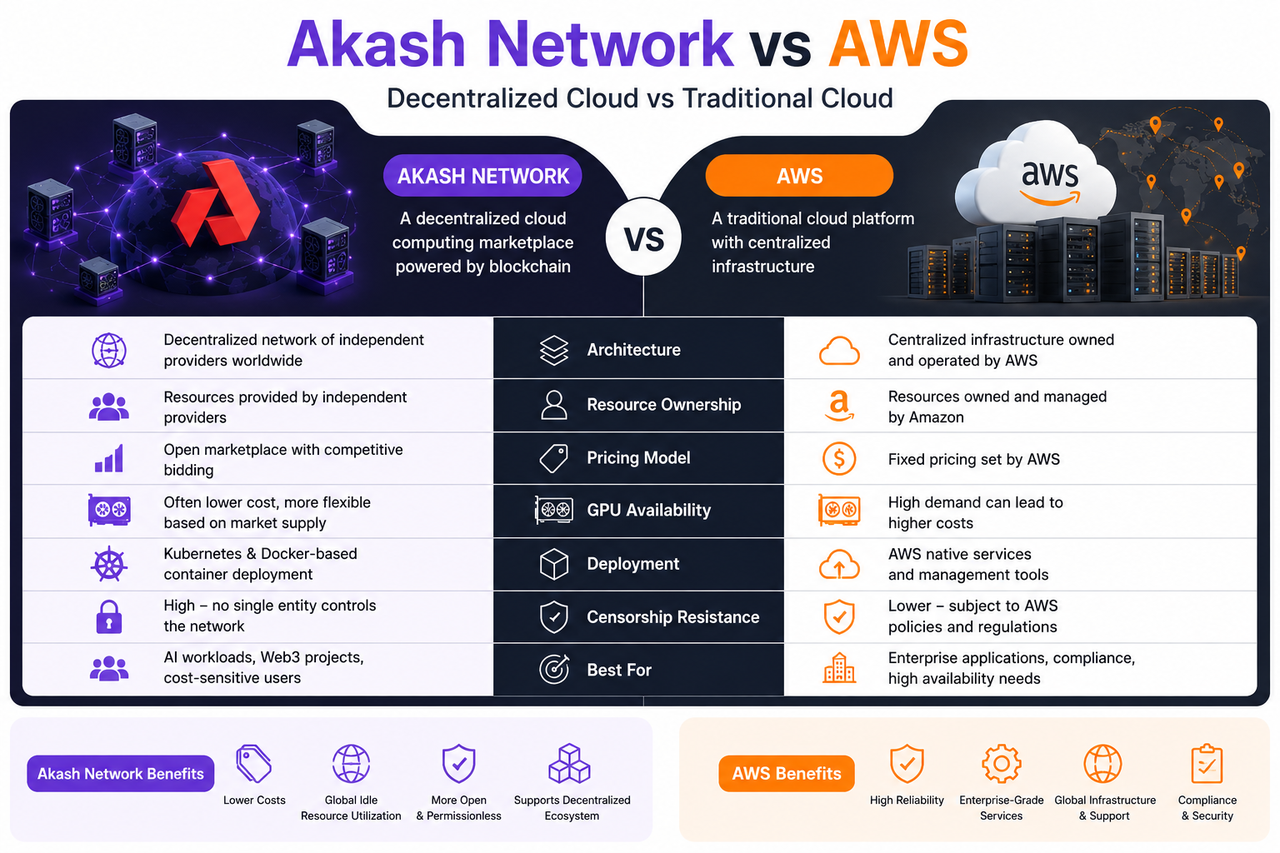
As a decentralized cloud computing network, Akash Network’s main goal is to build an open marketplace for GPUs and computing power. Unlike AWS, Akash does not own large data centers itself. Instead, it uses a blockchain network to connect developers with different computing providers around the world.
| Comparison Dimension |
Akash Network |
AWS |
| Infrastructure |
Decentralized provider network |
Centralized data centers |
| GPU Pricing |
Market bidding |
Official fixed pricing |
| Resource Source |
Global idle computing power |
Amazon official resources |
| Deployment Model |
Kubernetes + Docker |
AWS cloud service ecosystem |
| Censorship Control |
Relatively lower |
Unified platform control |
| Enterprise Support |
Relatively limited |
Mature enterprise grade services |
| AI Service Ecosystem |
Open deployment |
Complete AI tool ecosystem |
| Web3 Compatibility |
Stronger |
Relatively limited |
How Do Akash and AWS Differ in Resource Organization?
AWS organizes its resources around centralized data centers. The GPU, CPU, and storage resources rented by developers all ultimately come from server clusters operated directly by Amazon.
Akash uses a completely different model. Its resources come from different providers around the world, including data centers, mining farms, enterprise servers, and individual GPU nodes. Akash does not directly control these resources. Instead, it coordinates resource allocation and settlement through a blockchain based marketplace mechanism.
This difference also means the two systems scale their resources in very different ways. Traditional cloud platforms usually expand computing power by continuously building large data centers, while decentralized cloud markets depend more on the dynamic participation of idle global resources.
For the AI industry, this open marketplace model can help improve GPU utilization and reduce waste from underused computing resources.
How Do Akash and AWS Differ in GPU Pricing?
GPU pricing is one of the most important differences between the two.
AWS uses a unified platform pricing system, with GPU rental prices set by the platform. Because supply and demand for high end GPUs have remained tight for a long time, popular GPUs such as the H100 and A100 often come with relatively high usage costs.
Akash, by contrast, uses an open bidding mechanism. After developers publish their GPU requirements, providers in the network submit bids based on their available resources. Developers then choose a suitable provider from multiple bids and complete the deployment.
This market based model can create a more flexible GPU pricing structure. When GPU supply is sufficient, developers can often obtain computing power at a lower cost than on traditional cloud platforms.
However, prices in a decentralized market are also affected by changes in supply and demand, so price stability is usually weaker than on centralized platforms.
How Do Akash and AWS Differ in AI Workload Deployment?
AWS is more oriented toward a complete enterprise grade AI service platform.
Developers can not only rent GPUs, but also use official AI services such as SageMaker and Bedrock directly for model training, inference, and deployment. AWS provides mature APIs, databases, and security systems, making it more suitable for traditional enterprises and large AI teams.
Akash, by comparison, places greater emphasis on open infrastructure.
Developers usually need to deploy AI models and inference services themselves using Kubernetes and Docker. Akash is more like an open GPU marketplace than a packaged AI platform.
This model gives developers greater flexibility, but it also means they need some experience with containerization and cloud native operations.
For Web3 native teams, open source AI developers, and decentralized applications, Akash’s open deployment model is often more attractive.
How Do Decentralized Cloud and Traditional Cloud Differ in Openness?
Traditional cloud platforms are centralized service systems, so the platform has strong control over resources, including account permission management, regional restrictions, and service review mechanisms.
This model supports enterprise compliance and risk control, but it also means developers must rely on a single platform.
Akash places more emphasis on open markets and censorship resistance. Because resources come from different providers around the world, developers can deploy AI models, Web3 nodes, and containerized applications with more freedom.
This openness is also one of the key reasons Web3 and DePIN projects pay close attention to decentralized cloud.
Even so, for large enterprises, centralized platforms still have clear advantages in security audits, data compliance, and service stability.
How Does the Developer Experience Differ Between Akash and AWS?
AWS has a highly mature developer ecosystem and toolset. Developers can usually create GPU instances, configure networks, and call AI services quickly through the console.
A large body of official documentation, SDKs, and enterprise support also reduces the learning curve for traditional development teams.
Akash is more aligned with Web3 and Kubernetes native development.
Developers need to understand concepts such as Deployment, Bid, Lease, and SDL configuration, and they must manage container deployment workflows themselves. Compared with AWS, Akash is therefore better suited to developers who are familiar with cloud native technologies and decentralized infrastructure.
That said, this model also provides greater freedom, allowing developers to customize AI workloads and GPU usage strategies more flexibly.
Will Decentralized Cloud Replace Traditional Cloud?
At this stage, decentralized cloud is more likely to become an important supplement to the traditional cloud market rather than a complete replacement.
AWS still has clear advantages in enterprise services, global networking, and stability. For large enterprises and financial institutions, mature data security systems and SLAs remain very important.
Decentralized GPU markets such as Akash are better suited to open AI infrastructure, Web3 node deployment, and GPU cost optimization.
Summary
Akash Network and AWS can both provide GPU and cloud computing resources, but they represent entirely different paths for the development of cloud computing.
AWS is a traditional centralized cloud platform that builds global cloud computing infrastructure through large data centers and enterprise grade service systems. Akash, by contrast, integrates idle computing power around the world through an open GPU marketplace, giving AI and Web3 applications a more flexible way to access resources.
FAQs
Why Are Akash GPUs Usually Cheaper?
Akash uses a provider bidding mechanism, so GPU prices are determined dynamically by market supply and demand. As a result, some GPU resources usually cost less than those on traditional cloud platforms.
Does AWS Support AI Model Deployment?
Yes. AWS provides SageMaker, EC2 GPU instances, and various AI services that can be used to train and deploy AI models.
What Use Cases Is Akash Better Suited For?
Akash is better suited to AI inference, Web3 node operation, GPU cost optimization, and open AI infrastructure.
Is Decentralized Cloud More Secure Than Traditional Cloud?
The two have different security models. Traditional cloud places greater emphasis on enterprise grade security and compliance, while decentralized cloud places more emphasis on openness and censorship resistance.
Will Decentralized Cloud Replace AWS?
At present, the two are more likely to form a complementary relationship. Traditional cloud still dominates the enterprise market, while decentralized GPU markets are gradually becoming an important supplement to AI and Web3 infrastructure.