What Problem Does Yield.xyz Aim to Solve?
In the current DeFi ecosystem, most functionalities remain highly fragmented. Users who wish to simultaneously engage in staking, lending, yield management, and derivatives trading often need to switch back and forth between different protocols. This not only makes the process cumbersome but also increases asset management and security risks.
For example, a user might need to stake assets on one protocol, then move to another platform for lending, and finally execute perpetual contract operations through a different wallet and trading interface. This multi-platform switching model has long been a key barrier to lowering the entry threshold for DeFi.
Yield.xyz’s core value proposition is to consolidate these scattered functions into a single infrastructure layer through an API aggregation layer, allowing wallets, trading platforms, or asset management tools to rapidly access DeFi capabilities at lower cost. In other words, Yield.xyz is not merely a protocol aimed at end users; it functions more as an integration middleware for on-chain financial capabilities.
The Core Architecture of Yield.xyz: The API Aggregation Layer
Yield.xyz’s core concept is not to build an entirely new DeFi protocol from scratch but rather to serve as an integrator of on-chain financial infrastructure. Through its API, the platform connects with multiple existing protocols, integrating features such as Staking, Liquid Staking, Restaking, lending, Yield Vaults, and RWA yield products into a single interface.
The advantage of this architecture lies in significantly lowering the barrier to Web3 development. Previously, if an application wanted to support functions like staking, yield aggregation, lending, and even perpetual contracts simultaneously, it would typically need to interface with multiple protocols and smart contracts separately. This made the development process tedious and increased maintenance and security management costs.
Yield.xyz aims to abstract these previously scattered DeFi capabilities through a unified API design. For developers, this means they no longer need to handle the underlying protocol details one by one but can instead quickly access a variety of on-chain yield and financial tools, creating a more comprehensive Web3 financial product experience. To some extent, Yield.xyz seeks to offer not just yield services but an infrastructure layer that more closely resembles a financial operating system.
Why Did Yield.xyz Enter the Trading Market?
In its early stages, Yield.xyz’s product focus was primarily on yield-oriented applications, with core functions centered around Earn, Staking, Yield Vaults, and passive yield management. Its positioning was more akin to an asset growth and yield aggregation platform.
However, as the DeFi ecosystem matured, market demand began to shift. Users’ expectations for on-chain finance evolved beyond simply depositing assets to earn yields; they now want to simultaneously perform trading, leverage operations, asset management, and risk control within a single platform environment—a more complete set of financial activities.
This indicates that on-chain finance is transitioning from a single-function tool to an integrated financial platform. Consequently, Yield.xyz began extending its capabilities into the trading infrastructure domain, aiming to expand its role within the DeFi ecosystem.
This also forms the important backdrop to Yield.xyz’s partnership with Ledger. By combining yield products with trading capabilities, Yield.xyz seeks to build a more complete on-chain financial gateway, enabling users to manage yields and trade assets all within one system.
How Does the Yield.xyz and Ledger Integration Work?
 (Source: Ledger)
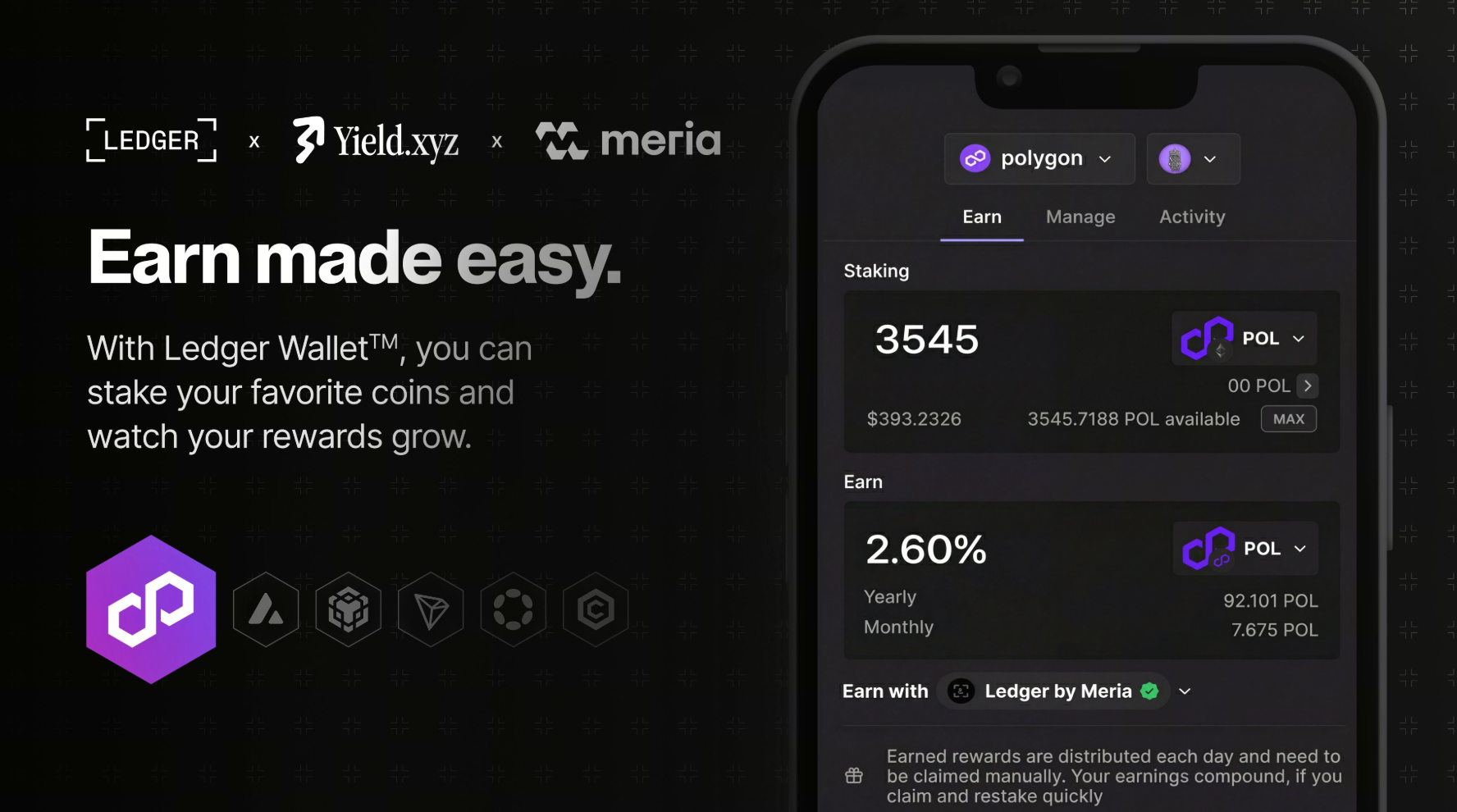
One of Yield.xyz’s recent key development directions is its partnership with Ledger, integrating perpetual contract trading capabilities into the hardware wallet environment. The core objective of this collaboration is to allow users to directly participate in on-chain derivatives trading under a self-custody framework, balancing security with operational convenience.
In the past, most perpetual contract trading was concentrated on centralized exchanges. Users typically had to deposit assets onto the platform, ceding a degree of direct control over their assets and assuming the exchange’s own risks. While some on-chain trading platforms offered self-custody models, the overall operational process was often more complex and could introduce security concerns due to the browser wallet environment.
The Yield.xyz and Ledger integration aims to strike a balance between these issues. When users trade, all critical operations and transaction signatures must still be confirmed via the Ledger hardware device. As a result, private keys always remain with the user, preventing the transfer of asset control. At the same time, the platform hopes that a more streamlined trading process will lower the barrier for average users to enter the on-chain derivatives market, making the self-custody trading experience more akin to how mainstream financial products operate.
What Role Does Hyperliquid Play?
Within this collaborative framework, it is actually Hyperliquid that handles market matching, trade execution, and liquidity provision. In other words, Yield.xyz does not build its own complete derivatives trading market; instead, it provides trading capabilities by integrating existing infrastructure.
The division of roles can be understood as follows: Yield.xyz manages API and trading interface integration, Ledger provides hardware-level security, and Hyperliquid handles the on-chain derivatives market and liquidity support. Together, they form an on-chain trading architecture that combines trading efficiency, self-custody features, and security.
This model also reflects the current trend in Web3 infrastructure development. Increasingly, protocols are focusing on their specific strengths—such as security, liquidity, yield, or trading engines—and then connecting with each other through APIs and modular architectures to gradually build a more complete on-chain financial ecosystem. Yield.xyz’s role within this setup leans more toward that of an on-chain financial capability integrator rather than a single-function protocol.
Why Is Clear Signing Important?
 (Source: Ledger)
Another core design element in Yield.xyz’s partnership with Ledger is the introduction of the Clear Signing mechanism. This feature was developed primarily to address the long-standing Blind Signing problem in DeFi.
In the past, when confirming many on-chain operations, users would often see only a long string of incomprehensible smart contract data and code. They could not clearly identify what they were actually authorizing, nor could they easily determine if there were potential risks behind the transaction. This lack of transparency has been a major pain point for Web3 user experience and security.
Clear Signing aims to present the originally complex and hard-to-read on-chain information in a more intuitive way. Details such as transaction type, asset changes, contract interaction content, and permission scope are clearly displayed directly on the hardware device, allowing users to fully understand what they are authorizing before confirming a transaction.
The importance of this design goes beyond enhancing asset security—it is also crucial to the user experience required for mass Web3 adoption. When users can more intuitively understand on-chain operations, it means the overall barrier to using DeFi is gradually lowering, allowing more non-technical users to enter the world of on-chain finance.
Yield.xyz’s True Goal: Building an On-Chain Financial Gateway
From the current product development direction, Yield.xyz is no longer simply a yield aggregation platform. Rather than providing just a single DeFi function, it is building an on-chain financial API infrastructure, aiming to become a key entry point for future Web3 financial applications.
In the past, cryptocurrency wallets were primarily used for asset storage and token transfers. But as DeFi, ecosystem applications, and on-chain trading demands continue to expand, the role of wallets is also evolving. Future Web3 wallets may no longer be merely asset tools; they could gradually transform into yield management centers, trading gateways, DeFi operation platforms, and even execution environments for AI agents.
Yield.xyz’s development direction is aligning with this more complete on-chain financial architecture. Especially as AI agents begin to enter the on-chain finance space, the importance of an API aggregation layer may increase further. AI systems rely on standardized interfaces, composable financial capabilities, and a foundational environment capable of automated execution—precisely the core capabilities Yield.xyz aims to build.
Therefore, Yield.xyz’s positioning has already moved beyond traditional DeFi aggregation tools, leaning more toward being an on-chain financial infrastructure provider, with the goal of playing a role closer to the underlying entry point and a capability integration platform in the future Web3 financial ecosystem.
Summary
Yield.xyz’s core value lies in integrating previously fragmented DeFi functions into a unified interface, making yield generation, lending, and trading capabilities more accessible to wallets and platforms. Through its partnerships with Ledger and Hyperliquid, Yield.xyz has also evolved from a simple yield aggregator into an on-chain trading infrastructure layer. This model reflects a shift in the direction of DeFi development: the market is moving from competition among individual protocols to competition among integrated financial gateways. As a result, future Web3 wallets may no longer be mere asset management tools but rather become the central entry point for on-chain financial activities.







