




#ZECSurges23%LeadingPayFiSector
ZEC AT $1,355: WHY ZCASH IS TURNING INTO ONE OF THE MOST IMPORTANT PRIVACY AND PAYFI STORIES OF 2026
Zcash is no longer moving like a quiet legacy privacy asset.
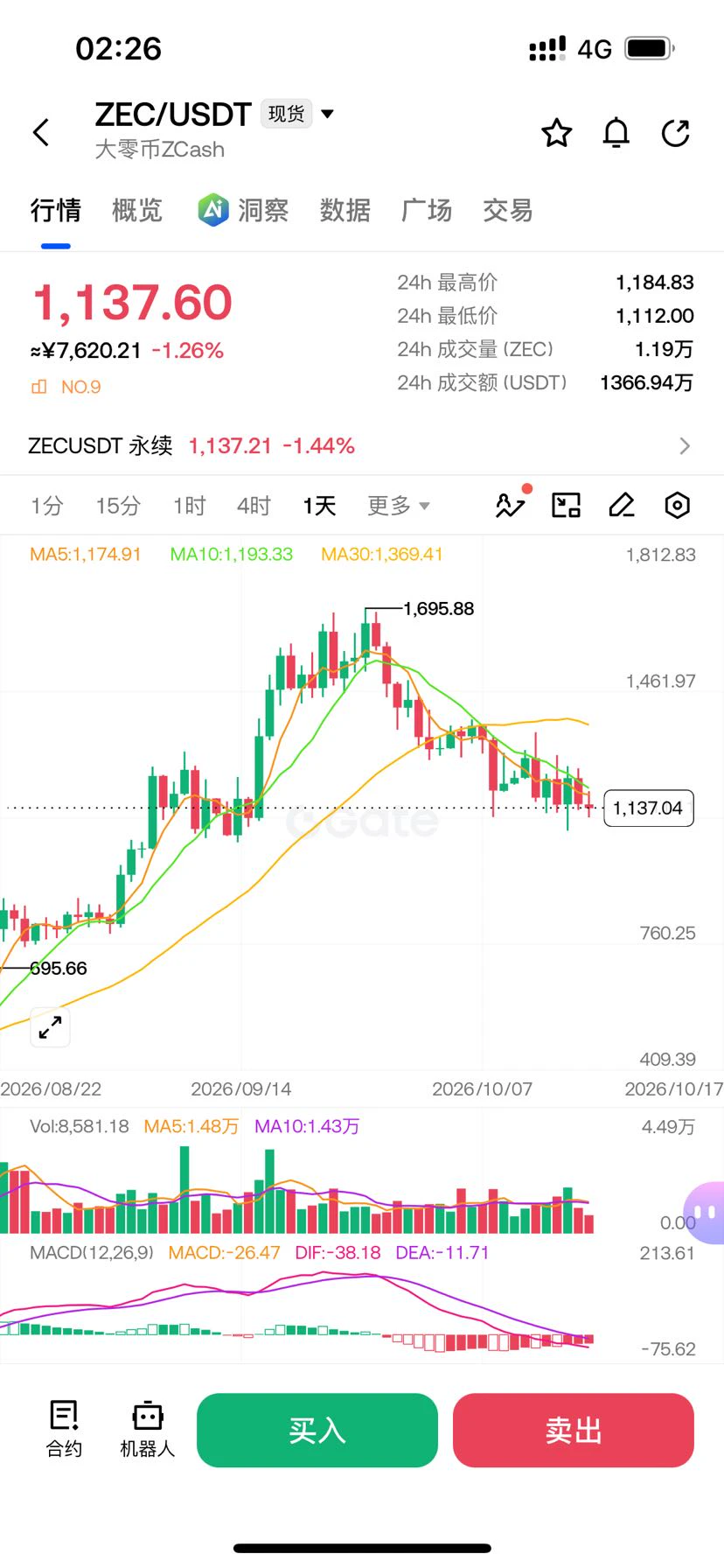
At the latest snapshot, ZEC is trading around $1,355, after reaching a 24-hour high of $1,398 and a 24-hour low of $1,206. That gives the market an extremely wide intraday range and shows just how aggressively capital is moving through ZEC right now.
The important part is not simply that ZEC is up.
The bigger story is the combination of privacy demand, institutional access, protocol development, limited liquid supply, and increasingly strong market momentum.
This is why ZEC has become one of the most closely watched assets in the privacy and PayFi narrative.
ZEC'S PRICE ACTION IS NOW A MARKET STORY
The current price structure is remarkable.
Zcash was trading below $50 roughly a year ago. It then went through a massive repricing cycle, reaching hundreds of dollars before breaking through the psychologically important $1,000 level.
The latest move pushed ZEC toward the $1,400 area, with the 24-hour range now showing $1,206–$1,398.
That means traders are dealing with extremely high volatility.
CoinGecko's historical data also shows how quickly the market has expanded around ZEC: its reported market capitalization reached more than $22.6 billion on September 17, while daily trading volume was above $2.3 billion.
This is no longer a small-cap privacy trade.
ZEC has become a major market asset, and its price action can now attract both speculative capital and longer-term investors interested in financial privacy.
WHY PRIVACY IS BECOMING A BIGGER NARRATIVE
The most important fundamental argument behind Zcash is simple:
Blockchain transparency is powerful, but complete transparency is not always desirable.
Individuals, businesses and institutions may want decentralized settlement while still protecting sensitive financial information.
Zcash was built around this problem.
Its shielded transaction technology allows users to transact while protecting important transaction information through cryptographic privacy.
That makes ZEC different from ordinary payment-focused cryptocurrencies.
Instead of competing only on speed or transaction fees, Zcash is competing around financial privacy.
And this narrative is becoming more relevant as stablecoins, digital payments, tokenized assets and AI-driven financial analysis continue expanding.
The Zcash ETF itself now markets the broader idea as “financial privacy for the age of AI,” showing how the privacy narrative is being positioned for a much larger financial market.
THE ETF CHANGED THE ACCESS STORY
One of the biggest developments for ZEC is institutional accessibility.
The Zcash ETF began trading on NYSE Arca on August 25, 2026, providing spot exposure to ZEC through a traditional exchange-traded product. Grayscale described it as the first exchange-traded product offering spot exposure to ZEC.
That matters because investors who do not want to directly hold or secure ZEC can now obtain exposure through a traditional market structure.
The ETF has also already reached significant scale.
Grayscale reported that ZCSH had grown to more than $500 million in assets under management shortly after launch.
A September 8 SEC filing also showed that DCG acquired approximately $100 million of ETF shares in exchange for 85,705.32563297 ZEC.
This does not guarantee that ZEC will continue rising.
But it does show that institutional infrastructure around ZEC is becoming much more developed.
NU7 ADDS ANOTHER FUNDAMENTAL CATALYST
The next major part of the story is Zcash's protocol development.
The NU7 governance vote closed on September 14, 2026. Zcash Labs' official voting information confirms that the voting period ran through September 14 and that the upgrade process is now an important part of the network's development roadmap.
The market is watching NU7 because protocol upgrades can influence long-term network economics, security and usability.
For ZEC, this is especially important because the asset's valuation increasingly depends on whether privacy technology can move from a niche concept toward a widely used financial infrastructure.
IRONWOOD AND ZAKURA SHOW THE TECHNOLOGY SIDE
The Zcash story is not only about price.
The Ironwood upgrade and subsequent development work have focused attention on the network's shielded ecosystem.
Zcash has also been working toward making shielded transactions easier and faster to use.
This matters because privacy technology has historically faced a difficult trade-off:
More privacy can mean more computational complexity.
If Zcash can continue reducing that friction while preserving strong privacy guarantees, the addressable market becomes larger.
The more practical the technology becomes, the easier it is to build a long-term investment narrative around it.
THE PAYFI CONNECTION
Calling ZEC a “PayFi leader” requires some precision.
PayFi generally refers to payment-focused financial infrastructure involving programmable payments, stablecoins, tokenized assets and on-chain settlement.
ZEC is not a traditional PayFi platform in the same way as a general-purpose financial network.
Its role is more specific.
Zcash can be viewed as a privacy-focused settlement asset.
That distinction is important.
The real story is not that ZEC has officially been crowned the PayFi leader.
The measurable story is that privacy-focused assets are attracting significant capital, and ZEC has become one of the strongest performers within that narrative.
That makes ZEC a major asset to watch whenever the market rotates toward privacy, censorship resistance and private settlement.
THE SUPPLY STRUCTURE ALSO MATTERS
One of the most interesting characteristics of ZEC is its shielded supply.
A meaningful portion of ZEC is held in shielded addresses, reducing the amount of supply that can be easily observed through conventional transparent blockchain analysis.
When available liquidity is limited, aggressive demand can create larger price movements.
That can work in both directions.
When buyers become aggressive, price can accelerate quickly.
But when leveraged traders begin closing positions, the same liquidity structure can produce sharp downside moves.
That is exactly why today's $1,206–$1,398 range should not be ignored.
TECHNICAL STRUCTURE: $1,400 IS THE BIG TEST
At $1,355, ZEC is now sitting close to the psychological $1,400 level.
The immediate resistance area is therefore around:
$1,398–$1,400
A convincing break above this region with strong volume could shift market attention toward:
$1,500
$1,600
$1,800
and eventually the $2,000 psychological zone.
But resistance is only half the story.
The first important downside area is around $1,200–$1,206.
Below that, the market could start testing:
$1,132–$1,121
$1,076
$1,001
$975
and $919.
The $1,000 region is particularly important because it represents both a psychological level and a major structural area from the recent breakout.
RISK IS NOW JUST AS IMPORTANT AS MOMENTUM
The biggest mistake traders can make after seeing an explosive move is assuming that strong momentum means unlimited upside.
It does not.
ZEC has already experienced an extraordinary repricing cycle.
The 24-hour high of $1,398 compared with the $1,206 low demonstrates how quickly price can move in both directions.
Momentum traders also need to watch funding rates, open interest and liquidation levels.
If too many traders become positioned in the same direction, even a fundamentally strong asset can experience a violent correction.
ETF flows, NU7 implementation, Bitcoin's broader trend and macro liquidity conditions should therefore remain part of the analysis.
MY FOUR-WEEK ZEC CHECKLIST
For the next several weeks, I would watch five things closely:
1. Can ZEC hold the $1,200 area after volatility?
2. Can price establish a clean breakout above $1,398–$1,400?
3. Do ETF assets and institutional participation continue expanding?
4. Does NU7 progress according to the expected development timeline?
5. Does Bitcoin remain supportive of high-beta crypto assets?
These factors will tell us much more than a single green candle.
THE BIGGER PICTURE
ZEC's current move is interesting because several independent narratives are converging at the same time.
Privacy technology is becoming more relevant.
Institutional access has improved through the Zcash ETF.
Protocol development is continuing.
Shielded supply can create a tighter liquid market.
And price momentum has brought ZEC back into the center of crypto market attention.
But the same strength that creates opportunity also creates risk.
At $1,355, ZEC is no longer an unnoticed privacy coin.
It is a major market story.
For me, the most important levels are now $1,200 on the downside and $1,400 on the upside.
A sustained move above $1,400 would keep the breakout narrative alive, while losing the $1,200 region would increase the probability of a deeper consolidation toward the lower support zones.
The key lesson is simple:
Do not chase the candle.
Study the structure.
Watch the liquidity.
Follow the fundamentals.
And respect the volatility.
Zcash may be entering a new chapter where privacy, institutional access and decentralized settlement become much bigger parts of the crypto conversation.
But whether ZEC continues toward $1,500, $1,600, $1,800 or eventually $2,000 will depend on actual demand, liquidity, protocol execution and market conditions—not headlines alone.
For now, $1,400 is the number everyone is watching.
Not financial advice. Always do your own research.
#Gate广场中秋团圆局 #weeklyshare #ZEC #ShareWeekly @Gate_Square
ZEC AT $1,355: WHY ZCASH IS TURNING INTO ONE OF THE MOST IMPORTANT PRIVACY AND PAYFI STORIES OF 2026
Zcash is no longer moving like a quiet legacy privacy asset.
At the latest snapshot, ZEC is trading around $1,355, after reaching a 24-hour high of $1,398 and a 24-hour low of $1,206. That gives the market an extremely wide intraday range and shows just how aggressively capital is moving through ZEC right now.
The important part is not simply that ZEC is up.
The bigger story is the combination of privacy demand, institutional access, protocol development, limited liquid supply, and increasingly strong market momentum.
This is why ZEC has become one of the most closely watched assets in the privacy and PayFi narrative.
ZEC'S PRICE ACTION IS NOW A MARKET STORY
The current price structure is remarkable.
Zcash was trading below $50 roughly a year ago. It then went through a massive repricing cycle, reaching hundreds of dollars before breaking through the psychologically important $1,000 level.
The latest move pushed ZEC toward the $1,400 area, with the 24-hour range now showing $1,206–$1,398.
That means traders are dealing with extremely high volatility.
CoinGecko's historical data also shows how quickly the market has expanded around ZEC: its reported market capitalization reached more than $22.6 billion on September 17, while daily trading volume was above $2.3 billion.
This is no longer a small-cap privacy trade.
ZEC has become a major market asset, and its price action can now attract both speculative capital and longer-term investors interested in financial privacy.
WHY PRIVACY IS BECOMING A BIGGER NARRATIVE
The most important fundamental argument behind Zcash is simple:
Blockchain transparency is powerful, but complete transparency is not always desirable.
Individuals, businesses and institutions may want decentralized settlement while still protecting sensitive financial information.
Zcash was built around this problem.
Its shielded transaction technology allows users to transact while protecting important transaction information through cryptographic privacy.
That makes ZEC different from ordinary payment-focused cryptocurrencies.
Instead of competing only on speed or transaction fees, Zcash is competing around financial privacy.
And this narrative is becoming more relevant as stablecoins, digital payments, tokenized assets and AI-driven financial analysis continue expanding.
The Zcash ETF itself now markets the broader idea as “financial privacy for the age of AI,” showing how the privacy narrative is being positioned for a much larger financial market.
THE ETF CHANGED THE ACCESS STORY
One of the biggest developments for ZEC is institutional accessibility.
The Zcash ETF began trading on NYSE Arca on August 25, 2026, providing spot exposure to ZEC through a traditional exchange-traded product. Grayscale described it as the first exchange-traded product offering spot exposure to ZEC.
That matters because investors who do not want to directly hold or secure ZEC can now obtain exposure through a traditional market structure.
The ETF has also already reached significant scale.
Grayscale reported that ZCSH had grown to more than $500 million in assets under management shortly after launch.
A September 8 SEC filing also showed that DCG acquired approximately $100 million of ETF shares in exchange for 85,705.32563297 ZEC.
This does not guarantee that ZEC will continue rising.
But it does show that institutional infrastructure around ZEC is becoming much more developed.
NU7 ADDS ANOTHER FUNDAMENTAL CATALYST
The next major part of the story is Zcash's protocol development.
The NU7 governance vote closed on September 14, 2026. Zcash Labs' official voting information confirms that the voting period ran through September 14 and that the upgrade process is now an important part of the network's development roadmap.
The market is watching NU7 because protocol upgrades can influence long-term network economics, security and usability.
For ZEC, this is especially important because the asset's valuation increasingly depends on whether privacy technology can move from a niche concept toward a widely used financial infrastructure.
IRONWOOD AND ZAKURA SHOW THE TECHNOLOGY SIDE
The Zcash story is not only about price.
The Ironwood upgrade and subsequent development work have focused attention on the network's shielded ecosystem.
Zcash has also been working toward making shielded transactions easier and faster to use.
This matters because privacy technology has historically faced a difficult trade-off:
More privacy can mean more computational complexity.
If Zcash can continue reducing that friction while preserving strong privacy guarantees, the addressable market becomes larger.
The more practical the technology becomes, the easier it is to build a long-term investment narrative around it.
THE PAYFI CONNECTION
Calling ZEC a “PayFi leader” requires some precision.
PayFi generally refers to payment-focused financial infrastructure involving programmable payments, stablecoins, tokenized assets and on-chain settlement.
ZEC is not a traditional PayFi platform in the same way as a general-purpose financial network.
Its role is more specific.
Zcash can be viewed as a privacy-focused settlement asset.
That distinction is important.
The real story is not that ZEC has officially been crowned the PayFi leader.
The measurable story is that privacy-focused assets are attracting significant capital, and ZEC has become one of the strongest performers within that narrative.
That makes ZEC a major asset to watch whenever the market rotates toward privacy, censorship resistance and private settlement.
THE SUPPLY STRUCTURE ALSO MATTERS
One of the most interesting characteristics of ZEC is its shielded supply.
A meaningful portion of ZEC is held in shielded addresses, reducing the amount of supply that can be easily observed through conventional transparent blockchain analysis.
When available liquidity is limited, aggressive demand can create larger price movements.
That can work in both directions.
When buyers become aggressive, price can accelerate quickly.
But when leveraged traders begin closing positions, the same liquidity structure can produce sharp downside moves.
That is exactly why today's $1,206–$1,398 range should not be ignored.
TECHNICAL STRUCTURE: $1,400 IS THE BIG TEST
At $1,355, ZEC is now sitting close to the psychological $1,400 level.
The immediate resistance area is therefore around:
$1,398–$1,400
A convincing break above this region with strong volume could shift market attention toward:
$1,500
$1,600
$1,800
and eventually the $2,000 psychological zone.
But resistance is only half the story.
The first important downside area is around $1,200–$1,206.
Below that, the market could start testing:
$1,132–$1,121
$1,076
$1,001
$975
and $919.
The $1,000 region is particularly important because it represents both a psychological level and a major structural area from the recent breakout.
RISK IS NOW JUST AS IMPORTANT AS MOMENTUM
The biggest mistake traders can make after seeing an explosive move is assuming that strong momentum means unlimited upside.
It does not.
ZEC has already experienced an extraordinary repricing cycle.
The 24-hour high of $1,398 compared with the $1,206 low demonstrates how quickly price can move in both directions.
Momentum traders also need to watch funding rates, open interest and liquidation levels.
If too many traders become positioned in the same direction, even a fundamentally strong asset can experience a violent correction.
ETF flows, NU7 implementation, Bitcoin's broader trend and macro liquidity conditions should therefore remain part of the analysis.
MY FOUR-WEEK ZEC CHECKLIST
For the next several weeks, I would watch five things closely:
1. Can ZEC hold the $1,200 area after volatility?
2. Can price establish a clean breakout above $1,398–$1,400?
3. Do ETF assets and institutional participation continue expanding?
4. Does NU7 progress according to the expected development timeline?
5. Does Bitcoin remain supportive of high-beta crypto assets?
These factors will tell us much more than a single green candle.
THE BIGGER PICTURE
ZEC's current move is interesting because several independent narratives are converging at the same time.
Privacy technology is becoming more relevant.
Institutional access has improved through the Zcash ETF.
Protocol development is continuing.
Shielded supply can create a tighter liquid market.
And price momentum has brought ZEC back into the center of crypto market attention.
But the same strength that creates opportunity also creates risk.
At $1,355, ZEC is no longer an unnoticed privacy coin.
It is a major market story.
For me, the most important levels are now $1,200 on the downside and $1,400 on the upside.
A sustained move above $1,400 would keep the breakout narrative alive, while losing the $1,200 region would increase the probability of a deeper consolidation toward the lower support zones.
The key lesson is simple:
Do not chase the candle.
Study the structure.
Watch the liquidity.
Follow the fundamentals.
And respect the volatility.
Zcash may be entering a new chapter where privacy, institutional access and decentralized settlement become much bigger parts of the crypto conversation.
But whether ZEC continues toward $1,500, $1,600, $1,800 or eventually $2,000 will depend on actual demand, liquidity, protocol execution and market conditions—not headlines alone.
For now, $1,400 is the number everyone is watching.
Not financial advice. Always do your own research.
#Gate广场中秋团圆局 #weeklyshare #ZEC #ShareWeekly @Gate_Square