#夏日创作营 Is the opportunity to short crude oil again here? Three-way logic—geopolitics, macro, and capital flows—converges to validate the turning point
Recently, tensions in the Strait of Hormuz have heated up. WTI crude rallied to the 84–85 USD range, and the market briefly priced in continued upside for oil driven by geopolitical conflict. However, after breaking down this move from three angles—official diplomatic signals, the U.S. economic fundamentals, and the global capital pricing logic—it becomes clear: this round of crude oil gains is only a short-term geopolitical pulse. The underlying long-term upward momentum is basically exhausted, and the window to set up a short position has already appeared.
I. There is no foundation for the geopolitical conflict to keep escalating; the war premium has already been fully priced in by the bulls
The only supporting narrative this time is that tensions between the U.S. and Iran are intensifying, and the risk of a shipping lane disruption is pushing up oil prices. But multiple official signals from both sides have already broken this logic.
1. Top-level talks channels remain open on both sides; no intention for all-out war
After the U.S. carried out targeted strikes on sites of the Iranian Revolutionary Guards across several nights, U.S. Secretary of State Rubio stated publicly that the U.S. remains open to restarting negotiations with Iran and is willing to give diplomacy full room for mediation. At the same time, Iran’s official stance also frames attacks on merchant ships as only a portion of the Revolutionary Guards’ personnel losing control, not a national-level confrontation; senior-level actors still lean toward diplomatic de-escalation. Limited punishment on one side, goodwill toward talks on the other—clearly indicating that the core demands on both sides are to draw red lines and deter friction, not to destroy Iranian oil fields or implement a long-term blockade of the Strait of Hormuz.
2. Iran lacks the capability and economic backing for a permanent blockade of the strait
Iran can only intermittently harass merchant vessels using speedboats, drones, and shore-based missiles. It cannot cut off the entire shipping route around the clock. If Iran were to impose a full blockade, the country’s crude oil export channels would be severed in parallel; fiscal revenue would collapse directly—amounting to self-inflicted damage. The Houthis’ attacks on the Strait of Mandeb are similar: they can only create short-term shipping panic, not permanently block crude oil transportation.
3. Current oil prices have already exhausted the risk premium for localized friction
In today’s 84–85 USD range, the market has already fully priced in all known negative factors: “isolated attacks on merchant ships, oil tankers voluntarily rerouting, and higher shipping insurance prices.” Without a very low-probability black swan event—such as the Strait of Hormuz being completely shut down or large-scale bombing of energy infrastructure—there is no incremental panic-buying demand to keep pushing oil prices higher.
II. High oil prices turn from a “U.S. strategic tool” into a burden that rebounds on itself; pushing oil higher is not worth the cost
Previously, the market believed oil price increases would mainly pressure net oil-import economies in Europe, Japan, and South Korea, widening the U.S.’ relative economic advantage versus the rest of the world. But the macro environment has flipped completely, and the negative impact of high oil prices on the U.S. has already become visible.
1. Squeezing household consumption and dragging down the core of U.S. domestic demand
The U.S. is a car-wheel consumption society; gasoline spending directly crowds out discretionary household consumption. The June U.S. CPI data already confirmed this: the earlier fall in oil prices directly drove a sharp decline in overall CPI. If crude oil stays above 85 USD for a sustained period, the energy component will again push up prices, weaken purchasing power, and soften sentiment in retail and services simultaneously. More than half of U.S. households say fuel prices are significantly eroding their finances, and consumption contraction would directly pull down U.S. GDP growth.
2. Constraining the Fed’s room to cut rates and suppressing domestic asset valuations
Expectations for a rebound in inflation are warming up, which will delay market pricing of a Fed easing cycle. Long-duration core U.S. assets such as AI and semiconductors are highly sensitive to interest rates; passive increases in Treasury yields would keep compressing valuations. The economic advantages that were built on reshoring and AI capital expenditures would be greatly diluted by high oil prices causing weaker domestic demand, while the growth differential between the U.S./Europe and China/U.S. keeps narrowing.
3. The election-cycle constraint: with endogenous motivation to restrain oil prices
The U.S. is in a critical election window. Gasoline prices are the most sensitive民生 indicator for voters; sustained high oil prices would directly hurt approval ratings for the incumbent party. For the U.S., achieving a measured strike against Iran to deter it is enough. Allowing conflict escalation and a spike in oil prices—classic “shooting oneself in the foot”—means there are motivations on the policy side to release reserves and cool diplomacy to stabilize oil prices.
III. Global capital pricing logic has reversed completely; the core trading chain for crude longs breaks
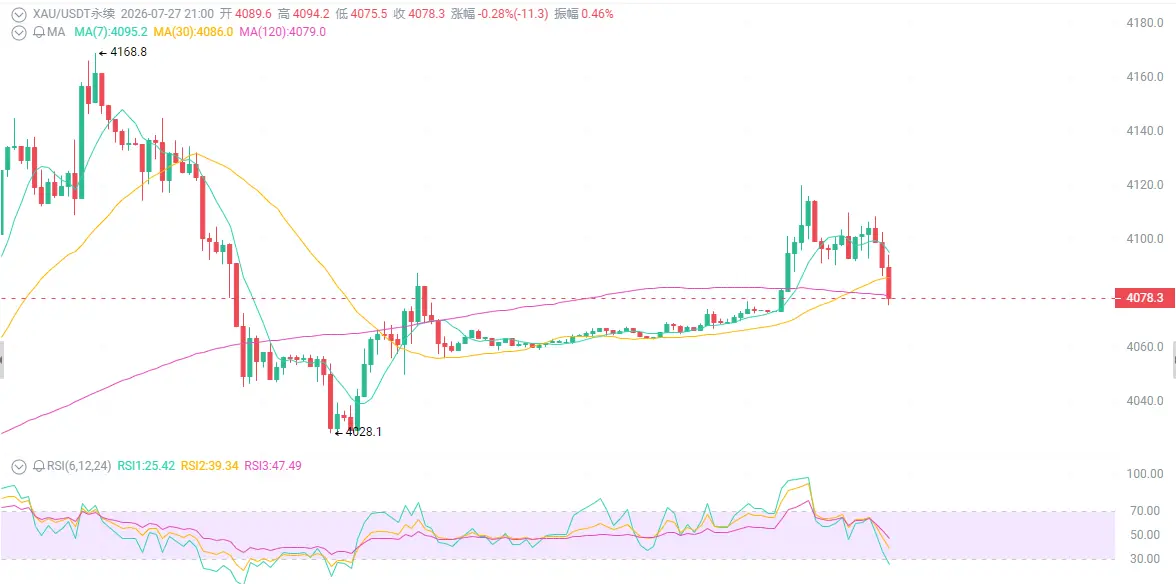
A marked divergence shows up on today’s market: crude oil surged on geopolitical news, but the Korean stock market (the world’s core AI chip arena) fell one-sidedly. Gold rose in parallel, fully overturning the old cycle logic of “conflict intensifies → capital pours into the dollar and AI assets.”
1. The old narrative fails: fighting is no longer good for U.S. stock growth tracks
The market’s fixed chain used to be: Middle East conflict → global safe-haven flows into the dollar → adding to AI and chip leaders. Now this transmission has completely broken. The pressure of higher interest rates caused by high oil prices hurts high-valuation tech stocks far more than any support from dollar inflows. The AI sector had already run up too much earlier and is crowded with leverage, so there is significant potential for a pullback by itself; geopolitical tailwinds can no longer offset valuation downside.
2. The new trading main line: oil and gold rise together, and the market trades weaker risk-asset growth expectations
The market has formed a new pattern of “crude oil and gold both rising, while risk assets broadly fall.” At the underlying logic level, the switch is already made: oil rising → household consumption is squeezed → the market bets on slower U.S. growth → rate-cut expectations rise and U.S. Treasury real yields fall → money flees tech stocks and flows into gold for safe-haven.
A simple comparison of the two cycles:
Old cycle: oil rises = inflation runs too hot → rates rise → gold pressured;
New cycle: oil rises = domestic demand damaged and growth weakens → rates fall → gold strengthens.
Capital no longer treats the Middle East conflict as a positive for U.S. assets. Instead, it prices both stagflation and recession risks. Crude oil loses the underlying narrative support that continuously attracts incremental speculative capital. After money exits high-level growth stocks, it prioritizes defensive assets like gold rather than crude oil, and long positioning loses strong momentum.
IV. Comprehensive conclusion: the short-term pulse doesn’t change the mid-term downward trend; the window to short is open
1. Forecast of market timing
In the short term, crude will likely maintain a wide range of 82–90 USD due to noise from scattered attacks on merchant ships and U.S.-Iran friction headlines. But the geopolitical premium has peaked, with no sustained trend-like upward momentum. As the market gradually absorbs the negative impact of high oil prices on U.S. consumption and inflation, combined with rising expectations for diplomatic de-escalation, the crude oil mid-term base of consolidation and decline is the more likely path.
2. Summary of the core logic to short
First, both the U.S. and Iran still leave room for negotiations, with no willingness or capability for a full blockade of shipping lanes or a large-scale war; geopolitical tailwinds are already fully priced.
Second, high oil prices rebound on U.S. consumption and lift inflation, weakening the U.S.’ relative economic advantage versus the world—contrary to the U.S.’ core interests.
Third, the market’s capital-flow logic has reversed completely: conflict no longer benefits AI and dollar assets; recession trading becomes the main line, and the long narrative for crude oil collapses.
For reference only and does not constitute investment advice.
Recently, tensions in the Strait of Hormuz have heated up. WTI crude rallied to the 84–85 USD range, and the market briefly priced in continued upside for oil driven by geopolitical conflict. However, after breaking down this move from three angles—official diplomatic signals, the U.S. economic fundamentals, and the global capital pricing logic—it becomes clear: this round of crude oil gains is only a short-term geopolitical pulse. The underlying long-term upward momentum is basically exhausted, and the window to set up a short position has already appeared.
I. There is no foundation for the geopolitical conflict to keep escalating; the war premium has already been fully priced in by the bulls
The only supporting narrative this time is that tensions between the U.S. and Iran are intensifying, and the risk of a shipping lane disruption is pushing up oil prices. But multiple official signals from both sides have already broken this logic.
1. Top-level talks channels remain open on both sides; no intention for all-out war
After the U.S. carried out targeted strikes on sites of the Iranian Revolutionary Guards across several nights, U.S. Secretary of State Rubio stated publicly that the U.S. remains open to restarting negotiations with Iran and is willing to give diplomacy full room for mediation. At the same time, Iran’s official stance also frames attacks on merchant ships as only a portion of the Revolutionary Guards’ personnel losing control, not a national-level confrontation; senior-level actors still lean toward diplomatic de-escalation. Limited punishment on one side, goodwill toward talks on the other—clearly indicating that the core demands on both sides are to draw red lines and deter friction, not to destroy Iranian oil fields or implement a long-term blockade of the Strait of Hormuz.
2. Iran lacks the capability and economic backing for a permanent blockade of the strait
Iran can only intermittently harass merchant vessels using speedboats, drones, and shore-based missiles. It cannot cut off the entire shipping route around the clock. If Iran were to impose a full blockade, the country’s crude oil export channels would be severed in parallel; fiscal revenue would collapse directly—amounting to self-inflicted damage. The Houthis’ attacks on the Strait of Mandeb are similar: they can only create short-term shipping panic, not permanently block crude oil transportation.
3. Current oil prices have already exhausted the risk premium for localized friction
In today’s 84–85 USD range, the market has already fully priced in all known negative factors: “isolated attacks on merchant ships, oil tankers voluntarily rerouting, and higher shipping insurance prices.” Without a very low-probability black swan event—such as the Strait of Hormuz being completely shut down or large-scale bombing of energy infrastructure—there is no incremental panic-buying demand to keep pushing oil prices higher.
II. High oil prices turn from a “U.S. strategic tool” into a burden that rebounds on itself; pushing oil higher is not worth the cost
Previously, the market believed oil price increases would mainly pressure net oil-import economies in Europe, Japan, and South Korea, widening the U.S.’ relative economic advantage versus the rest of the world. But the macro environment has flipped completely, and the negative impact of high oil prices on the U.S. has already become visible.
1. Squeezing household consumption and dragging down the core of U.S. domestic demand
The U.S. is a car-wheel consumption society; gasoline spending directly crowds out discretionary household consumption. The June U.S. CPI data already confirmed this: the earlier fall in oil prices directly drove a sharp decline in overall CPI. If crude oil stays above 85 USD for a sustained period, the energy component will again push up prices, weaken purchasing power, and soften sentiment in retail and services simultaneously. More than half of U.S. households say fuel prices are significantly eroding their finances, and consumption contraction would directly pull down U.S. GDP growth.
2. Constraining the Fed’s room to cut rates and suppressing domestic asset valuations
Expectations for a rebound in inflation are warming up, which will delay market pricing of a Fed easing cycle. Long-duration core U.S. assets such as AI and semiconductors are highly sensitive to interest rates; passive increases in Treasury yields would keep compressing valuations. The economic advantages that were built on reshoring and AI capital expenditures would be greatly diluted by high oil prices causing weaker domestic demand, while the growth differential between the U.S./Europe and China/U.S. keeps narrowing.
3. The election-cycle constraint: with endogenous motivation to restrain oil prices
The U.S. is in a critical election window. Gasoline prices are the most sensitive民生 indicator for voters; sustained high oil prices would directly hurt approval ratings for the incumbent party. For the U.S., achieving a measured strike against Iran to deter it is enough. Allowing conflict escalation and a spike in oil prices—classic “shooting oneself in the foot”—means there are motivations on the policy side to release reserves and cool diplomacy to stabilize oil prices.
III. Global capital pricing logic has reversed completely; the core trading chain for crude longs breaks
A marked divergence shows up on today’s market: crude oil surged on geopolitical news, but the Korean stock market (the world’s core AI chip arena) fell one-sidedly. Gold rose in parallel, fully overturning the old cycle logic of “conflict intensifies → capital pours into the dollar and AI assets.”
1. The old narrative fails: fighting is no longer good for U.S. stock growth tracks
The market’s fixed chain used to be: Middle East conflict → global safe-haven flows into the dollar → adding to AI and chip leaders. Now this transmission has completely broken. The pressure of higher interest rates caused by high oil prices hurts high-valuation tech stocks far more than any support from dollar inflows. The AI sector had already run up too much earlier and is crowded with leverage, so there is significant potential for a pullback by itself; geopolitical tailwinds can no longer offset valuation downside.
2. The new trading main line: oil and gold rise together, and the market trades weaker risk-asset growth expectations
The market has formed a new pattern of “crude oil and gold both rising, while risk assets broadly fall.” At the underlying logic level, the switch is already made: oil rising → household consumption is squeezed → the market bets on slower U.S. growth → rate-cut expectations rise and U.S. Treasury real yields fall → money flees tech stocks and flows into gold for safe-haven.
A simple comparison of the two cycles:
Old cycle: oil rises = inflation runs too hot → rates rise → gold pressured;
New cycle: oil rises = domestic demand damaged and growth weakens → rates fall → gold strengthens.
Capital no longer treats the Middle East conflict as a positive for U.S. assets. Instead, it prices both stagflation and recession risks. Crude oil loses the underlying narrative support that continuously attracts incremental speculative capital. After money exits high-level growth stocks, it prioritizes defensive assets like gold rather than crude oil, and long positioning loses strong momentum.
IV. Comprehensive conclusion: the short-term pulse doesn’t change the mid-term downward trend; the window to short is open
1. Forecast of market timing
In the short term, crude will likely maintain a wide range of 82–90 USD due to noise from scattered attacks on merchant ships and U.S.-Iran friction headlines. But the geopolitical premium has peaked, with no sustained trend-like upward momentum. As the market gradually absorbs the negative impact of high oil prices on U.S. consumption and inflation, combined with rising expectations for diplomatic de-escalation, the crude oil mid-term base of consolidation and decline is the more likely path.
2. Summary of the core logic to short
First, both the U.S. and Iran still leave room for negotiations, with no willingness or capability for a full blockade of shipping lanes or a large-scale war; geopolitical tailwinds are already fully priced.
Second, high oil prices rebound on U.S. consumption and lift inflation, weakening the U.S.’ relative economic advantage versus the world—contrary to the U.S.’ core interests.
Third, the market’s capital-flow logic has reversed completely: conflict no longer benefits AI and dollar assets; recession trading becomes the main line, and the long narrative for crude oil collapses.
For reference only and does not constitute investment advice.