






Square
Following
Hot
News
Profile
Share your thoughts
placeholder
Article
🔥 $ENSO
is facing strong bearish pressure after breaking below a key support level! The price has fallen more than 7% in the past 24 hours, and consecutive red candles indicate strong selling momentum. If sellers continue to dominate and the current support level gives way, ENSO may continue to fall toward lower targets. 📉Take profit: 0.2181Stop loss: 0.8137Short $ENSO 👇
post-image
ENSO-6.71%
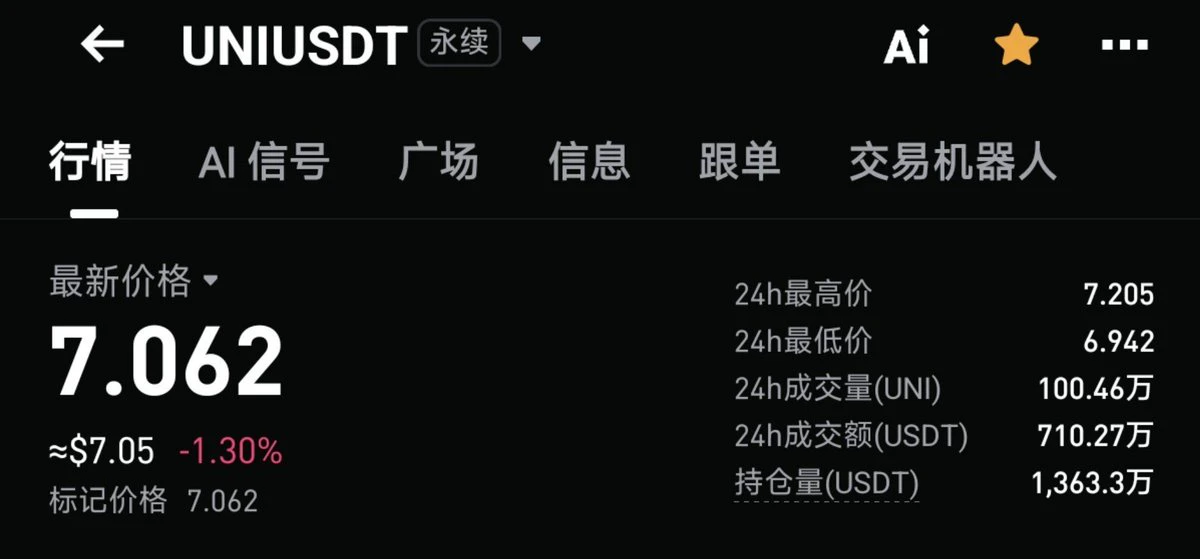
$UNI has reached 7.185 USDT, but one-hour trading participation is only 0.66x, showing some weakness. The price is approaching the one-hour resistance at 7.36, but whether it can truly break through and hold remains to be seen. This looks more like a tentative breakout than a genuine hold.
The price has reached the threshold, but touching, breaking through, and holding are three different things. If $UNI can decisively break above 7.36 and stay above that level, it would be a positive signal. But if the price fluctuates repeatedly around 7.36, or even falls back to the one-hour support at 6.99
post-image
UNI-1.15%
Trenches
AGT
A
bade
b
AGT
0x5d...e274
Market Cap
$.
Change
.
24h Vol
$.
Holders
.
CNPY
C
bade
b
CNPY
0xc6...ddd2
Market Cap
$.
Change
.
24h Vol
$.
Holders
.
Q
Q
bade
b
Q
0xc0...0589
Market Cap
$.
Change
.
24h Vol
$.
Holders
.
Gato
G
bade
b
Gato
55A3...pump
Market Cap
$.
Change
.
24h Vol
$.
Holders
.
DOPE
D
bade
b
DOPE
0xf9...8899
Market Cap
$.
Change
.
24h Vol
$.
Holders
.
What Warsh Said—and Didn’t Say: Reading Between the Lines of His IMF Fireside Chat
At 11:30 this morning, Fed Chair Warsh had a fireside chat with IMF Managing Director Georgieva at the IMF annual meeting in Bangkok. I watched the livestream from start to finish, looking for clues in his wording about an October rate hike. In the end, he said almost nothing.
Warsh’s exact words were: “I don’t prejudge the decision at any meeting. I don’t think it’s appropriate to preview what actions I might take at the remaining meetings this year.” He only made one remark while looking back at September’s ra
AAPL+0.43%
$BTC Tonight’s market action is interesting. I’m still watching. What’s really worth keeping an eye on isn’t these minute-by-minute moves in BTC, but the Altcoin Season Index climbing from 50 to 60—a frustrating middle ground, neither here nor there. It shows that capital is starting to venture out from BTC, but we’re not yet at a full-on risk-on phase: 60 looks more like the “early stages of rotation,” still a long way from the 80–90 range where everything has historically taken off. In other words, altcoins have potential, but it’s not time to sit back and expect easy gains just yet.
celesti
post-image
BTC+0.03%
TIA-5.59%
Sunday, October 18 [Macro]
✅The US postpones imposing a new round of large-scale sanctions on Russia
✅The ECB warns that geopolitical conflicts are driving up inflation risks
📅Sunday, October 18 [Geopolitics]
✅Strait of Hormuz: Iran opens fire to intercept vessels in violation, and an oil tanker hits a mine and catches fire
✅Ukraine: Ukraine and the US may begin a new round of talks as early as next week
✅Egypt says it can provide security protection at Saudi Arabia's request
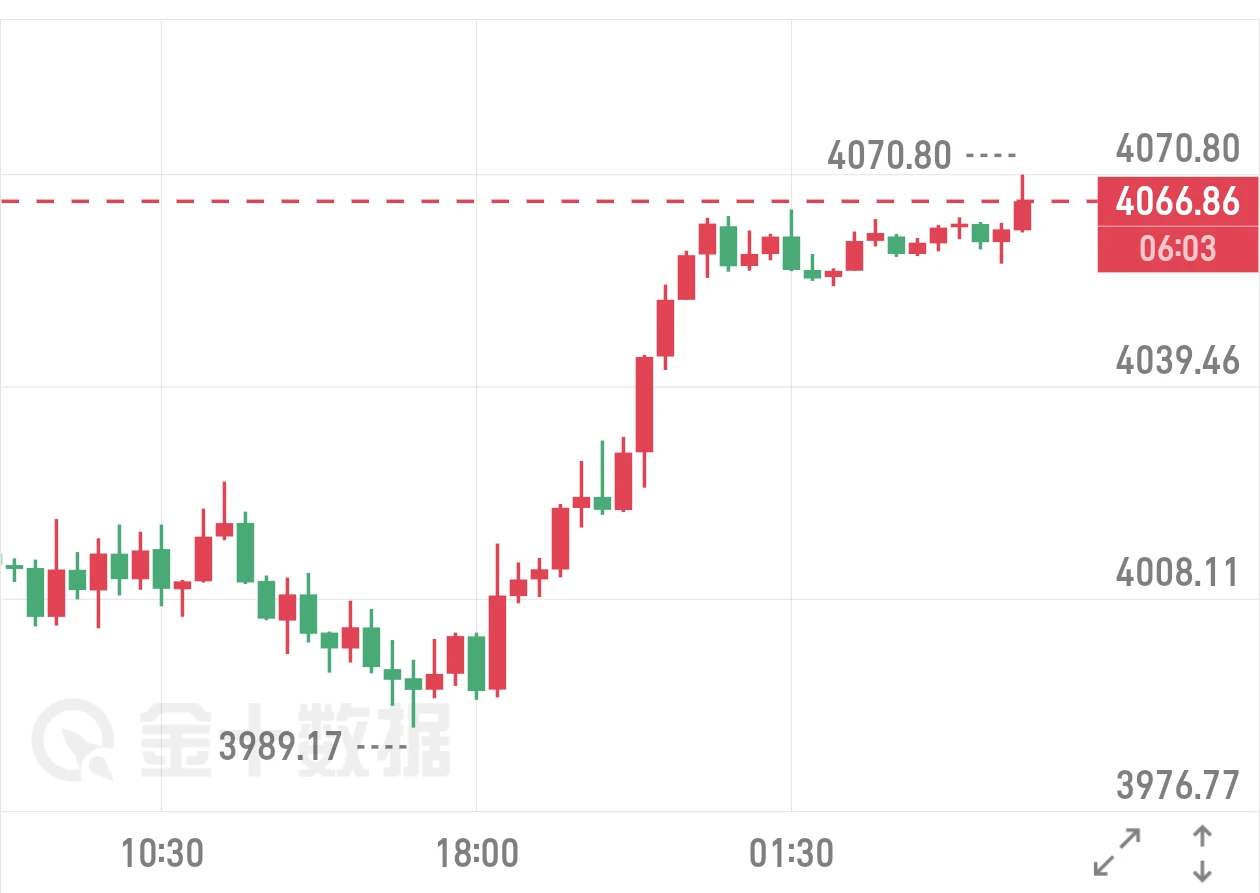
Let’s start with a term: weekend gold prices.
The $XAU on screen isn’t gold moving now; it’s quotes with no takers shifting around.
Only 5.97 million traded in the last hour, compared with 150 million in a single hour a few days ago.
“Breaking above 4205 means a new rally.”
I’ve heard that twice in the past three days. Here are the numbers:
1. 4205.65 was touched only once, at 10-16 22:00, and it hasn’t gone higher since.
2. Since then, over the past 34 hours, it has steadily ground back to 4164.07.
3. The 24-hour range is 4157.36 to 4173.66, a spread of 0.39%.
With a range this narrow, it’s
post-image
XAU-0.17%
After going through forty-eight candles, there’s one I’m not comfortable fast-forwarding through.
A wick spike.
The 05:00 candle plunged to 1214.16, while the previous one was still above 1297.
Volume picked up: 1.17 million in a single hour, compared with just 35,000 in the previous one.
It rebounded to 1269.44 over the next three hours, but has now slid back to 1257.97.
The peak at 1408.95 was reached at 13:00 on 10-16; after that, each high kept moving lower.
$SNDK In forty hours, it went from 1408.95 to 1214.16, a drop of 13.8%.
As usual: a low formed on heavy volume only counts if it hold
post-image
SNDK-2.76%
#每周来晒 #美国9月PPI大超预期 #沃什IMF讲话 Brent crude has surged past $110. U.S. stocks and Bitcoin should be on alert ahead of November 3
What happens if oil prices keep rising, AI stocks begin to correct, and U.S. inflation refuses to come down?
Any one of these factors on its own may not trigger a major sell-off. But if they converge around the November 3 U.S. midterm elections, the market could face a difficult stress test.
01 The real trouble is oil pushing inflation higher again
Brent crude has broken above $110 per barrel. This price warrants caution because crude oil is no ordinary commodity: its
post-image
ThisIsTranslateContent:
#美国9月PPI大超预期 #沃什IMF讲话 Brent crude breaks above $110; U.S. stocks and Bitcoin should be cautious before November 3
What happens if oil prices keep rising, AI stocks start correcting, and U.S. inflation remains stubbornly high?
Each of these factors alone may not necessarily trigger a major sell-off. But if they converge around the November 3 U.S. midterm elections, the market could face a challenging stress test.
01 The real problem is oil pushing inflation higher again
Brent crude has broken above $110 per barrel. This price warrants caution because crude oil is not an ordinary commodity: its effects ripple throughout the economy through transportation, production, chemicals and consumer spending.
More importantly, U.S. CPI rose 3.7% year over year in September, while gasoline prices jumped 9.1% month over month. The simultaneous rebound in inflation and rise in energy prices have prompted markets to reconsider whether the Federal Reserve needs to maintain its restrictive policy. Here lies a key tension. If oil prices spike briefly and then fall, markets may quickly absorb the negative impact; but if geopolitical conflicts persist and oil prices remain elevated, inflation could prove more persistent than expected.
This would make the Fed's choices more difficult: cutting rates could prolong inflationary pressures, while keeping rates high could weigh on the economy and asset valuations. So what concerns us more than oil rising 3.6% on any given day is whether high oil prices will change market expectations for interest rates over the coming months.
02 AI valuations and high interest rates could reinforce each other
AI has been one of the most important drivers of the latest U.S. stock market rally. The market has been willing to assign high valuations to companies involved in chips, cloud computing and data centers because investors believe their revenue and profits will continue to grow.
But two questions need answering now: How much return will AI investment actually generate? If financing costs keep rising, are those returns still worth today's stock prices?
Reuters reported on October 15 that confidence in further gains for U.S. stocks depends heavily on strong earnings from large technology companies. Meanwhile, rising oil prices and Treasury yields are also putting pressure on high-valuation assets. This means that even if the AI industry's long-term direction remains unchanged, stock prices could first go through a valuation contraction. If technology companies report better-than-expected results, the market could still recover; if earnings disappoint while interest rates rise, the correction may be more than a short-term swing in sentiment.
03 Could the November 3 midterm elections become a black swan?
The election itself is not necessarily a black swan; the real risk to watch for is a gap between the election outcome and market expectations.
The U.S. midterm elections will determine control of Congress. Different outcomes could affect fiscal policy, tariffs, AI regulation and the progress of cryptocurrency legislation. For the crypto industry in particular, the pace of digital asset regulatory policy is worth watching.
But changes in congressional seats do not mean all U.S. policies will change immediately. The executive branch still has considerable policy tools at its disposal, and the specific impact will also depend on subsequent legislation and implementation.
What could truly catch markets off guard is a scenario in which investors expect the election to bring policy moderation, but the result instead creates greater policy uncertainty; or in which energy prices keep rising, increasing pressure on the government over inflation and the cost of living. If markets have already bet on a particular election outcome and the result fails to meet expectations, crowded positions could be unwound all at once.
04 What could happen to Bitcoin?
In the short term, Bitcoin should not simply be treated as a safe-haven asset. If oil prices continue to rise, inflation rebounds and the Fed sends a more hawkish signal, both technology stocks and crypto markets could come under pressure.
Bitcoin also faces an additional risk: liquidations of leveraged positions could amplify a decline. Conversely, if geopolitical tensions ease, oil prices fall and markets confirm that the Fed will not tighten policy further, risk assets could rebound quickly.
So, over the coming weeks, focus on four indicators: Brent crude prices, U.S. two-year Treasury yields, U.S. technology companies' earnings performance, and Bitcoin ETF flows and changes in futures-market leverage. These are more useful than simply guessing the outcome of a particular election.
05 How should you respond?
Volatility risks in U.S. stocks and crypto markets may rise for a while, but that does not mean a bear market is inevitable. If oil prices fall, yields stabilize and companies deliver on earnings, the market could still recover; if oil prices stay high, rate expectations continue to rise and AI earnings fall short of expectations, the market could face a deeper correction.
For investors, keep some cash on hand, manage leverage, and don't rush to buy the dip after a single decline or easily dismiss the value of long-term assets when markets panic.
The real risk to watch for is not any single negative factor, but several risks that could otherwise be absorbed separately happening at the same time. Treat the period before November 3 as an event window that warrants close attention, not as a predetermined market turning point. Going forward, watch oil prices, interest rates and earnings. The data will show where the market ultimately goes.
repost-content-media
BZ-0.48%
BTC-0.96%
GAS-2.86%
Find opportunities in $DOGE using price-volume confirmation; key levels and exit lines are here
What stands out most in this $DOGE chart is not the 2.33% 24-hour decline itself, but that the 1-hour and 4-hour charts are both weak yet haven’t delivered the same answer.
My view is that direction is taking shape for now, but low participation has reduced the credibility of this move.
$DOGE The current price is 0.07917, with a 24-hour range of 0.07702–0.08107. The 1-hour support is at 0.07702, with resistance at 0.08096; the two more distant 4-hour boundaries are 0.07702 and 0.08566. These numbers
post-image
DOGE-0.92%
⚠️ CAN P2P CAUSE A BANK ACCOUNT TO BE LOCKED?
A user shared the following experience after visiting their bank to ask about an account being flagged by the system for unusual transactions.
• Some transactions were only 10,000 - 50,000 VND but were still scanned because the transfer descriptions contained characters matching the system's warning patterns.
• The bank required them to sign a commitment confirming that they would not lend out their account to receive or transfer money.
• After that, the bank notified them that the account needed to remain locked for another 2 - 3 days for review.
post-image
BTC’s battle to defend 80,000 goes into overtime after Warsh’s remarks

Before Warsh’s remarks, BTC seesawed between 80,443 and 82,000. After he began speaking, the price saw no sharp moves—because there were no unexpectedly hawkish or dovish signals. As I write this post, BTC is hovering around 80,800.

Why is the 80,000 level so important? I looked at a few data points.

The first is the ETF cost basis. The average cost basis for U.S. spot Bitcoin ETFs is around $81,500. BTC has fallen below this level, meaning most investors who bought through ETFs are now at a loss. If the price stays b
NVDA-1.42%
#美股存储板块跌幅扩大
The core question is whether this represents a healthy correction following a rally driven by artificial intelligence (AI), or the beginning of a deeper repricing process within the storage sector. Rather than buying simply because prices have fallen, it would be more prudent to focus on earnings expectations, memory pricing, and whether each company can maintain its profit margins.
My perspectives on storage sector stocks:
* Micron (MU): Monitor demand for DRAM and HBM, memory growth linked to AI, and gross profit margin forecasts. Strong AI demand could bolster earnings, though
post-image
ybaser
#美股存储板块跌幅扩大
The core question is whether this represents a healthy correction following a rally driven by artificial intelligence (AI), or the beginning of a deeper repricing process within the storage sector. Rather than buying simply because prices have fallen, it would be more prudent to focus on earnings expectations, memory pricing, and whether each company can maintain its profit margins.
My perspectives on storage sector stocks:
* Micron (MU): Monitor demand for DRAM and HBM, memory growth linked to AI, and gross profit margin forecasts. Strong AI demand could bolster earnings, though these expectations may already be priced into the stock.
* SanDisk (SNDK): Focus on NAND flash pricing, demand for enterprise SSDs, and the sustainability of any earnings recovery. NAND supply and price cycles can make this stock particularly volatile.
* Western Digital (WDC): Evaluate "nearline" (high-capacity/accessible) HDD demand from AI data centers, cloud computing expenditures, and free cash flow. The factors influencing HDD demand differ from those affecting NAND and DRAM.
* Seagate (STX): As data center storage requirements grow, keep an eye on demand for high-capacity drives, pricing power, and profit margins.
* Track NAND market conditions, enterprise SSD adoption rates, and the company's valuation relative to earnings expectations.
What signs might justify rebuilding a position? I would look at the following three points:
* Stabilization of fundamental indicators: A halt in the deterioration of memory and NAND prices, company forecasts, and earnings estimates.
* Confirmation through price action: Stocks forming higher lows and reclaiming key moving averages, accompanied by stronger trading volume.
* Attractive valuation: Expected earnings growth that justifies the current price, even under less optimistic scenarios.
A decline in a stock price is not, by itself, a buy signal. If earnings estimates are falling faster than the stock price, the valuation may not have actually become cheaper.
Rather than buying the entire storage sector indiscriminately, I prefer to differentiate between individual companies. While AI demand serves as a long-term tailwind, memory, NAND flash, and hard disk drives each have their own unique supply cycles, competitive pressures, and profit margins.
An important distinction: A pullback driven by profit-taking is fundamentally different from one caused by weak forward guidance or falling memory prices. The latter scenario warrants a much more cautious approach. Which of these stocks—MU, SNDK, WDC, or STX—are you following most closely? I can help you compare their valuations, earnings outlooks, technical levels, and the potential factors that could support a recovery.
$MU ‌$SNDK ‌$WDC ‌$STX ‌
repost-content-media
MU-5.66%
SNDK-6.90%
  • 5
#KOSPIJumps3.3% #ShareWeekly
KOSPI Rebounds After a 7.6% Crash: Is the Semiconductor Sell-Off Over, or Is More Volatility Ahead?
The Asian stock market experienced a dramatic shift on October 15–16, 2026, as semiconductor stocks came under heavy selling pressure before staging a partial recovery. South Korea’s KOSPI index suffered a sharp 7.6% decline on October 15, dropping to 5,554 points and triggering a circuit breaker. The index touched its lowest level since April, highlighting how quickly market sentiment can change when inflation concerns, interest-rate expectations, and uncertainty s
SK Hynix+0.79%
JPN225+0.29%
NAS100-0.48%
CXMT-1.27%
EIA data determines the short-term direction of crude oil
live-cover
LIVE13
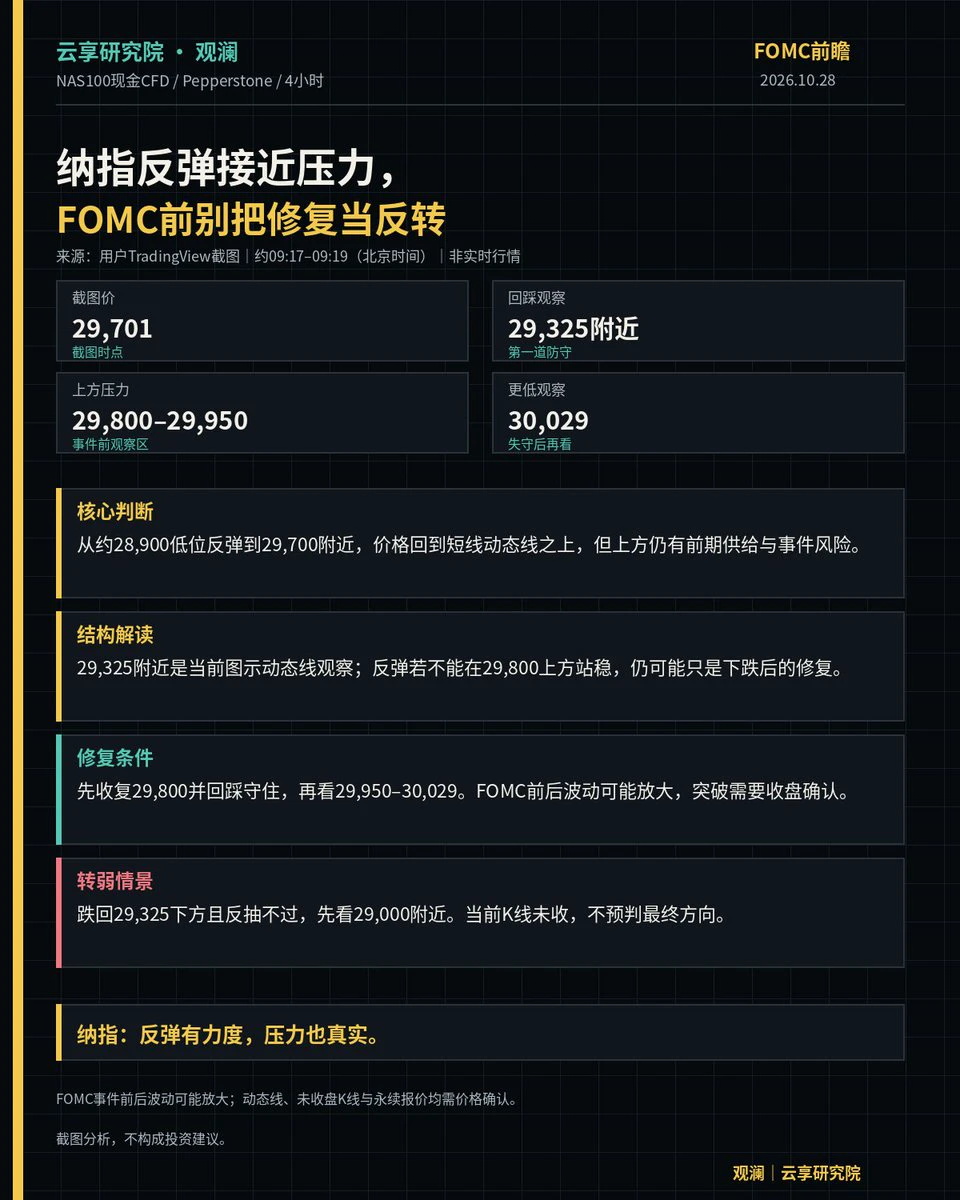
The Nasdaq has started a correction. A weekly bearish divergence is a correction signal, and this correction could be somewhat stronger. It is a multi-timeframe confluence signal, with support at 25,600-24,300-23,800
The question to consider here is: will a U.S. stock market correction spill over to other assets? ❓️
U.S. Treasury yields: The 10-year yield is around 5.09–5.10%, near its highest levels in recent years, putting sustained pressure on high-valuation, long-duration risk assets (tech stocks and crypto)
U.S. Dollar Index: Around 101.8, neutral to firm, with no extreme appreciation
S&P
post-image
SPYX-0.22%
BTC+0.03%
Fees paid to apps on Filecoin rose 68.34% in the past 30 days to $111,353. GLIF, the network's largest app by fees, took in $91,398 of it, up 47.76% over the same window.
@Filecoin
FIL-6.61%
BTC UPDATE
live-cover
LIVE72
Next week: October 19 (Monday) — October 25 (Sunday) Daily Macro + Geopolitical Preview

Sources: CCTV, Cailian Press, Federal Reserve website, public schedules

✅October 19 Monday
📊Macro: The Financial Street Forum Annual Conference opens, with senior officials from the PBOC, SAFE, and CSRC delivering policy speeches; the Federal Reserve holds a closed-door discount rate meeting
🌍Geopolitics: Ukraine-U.S. talks may begin; the European Parliament opens discussions on Black Sea shipping security

✅October 20 Tuesday
📊Macro: China announces its LPR loan prime rate; closed-door meeting of F
A few days ago, I strongly urged a friend
to bet on AVA, and it has doubled now
You ask me why my bets are so accurate
It’s all insider information🤓
Some people pick coins by looking at altcoin holdings/market cap
and trading volume
Actually, this is not much different from guessing high or low
These are all metrics that market makers can easily inflate, at a very low cost
AVA+33.23%
Load More

Join 40 M users in our growing community

⚡️ Join 40 M users in the crypto craze discussion

💬 Engage with your favorite top creators

👍 See what interests you

Trending Topics

USSeptemberPPIBeatsExpectations

91.35k Views1.93k Discussing

US September PPI came in at 6.3% YoY, well above the 5.3% market expectation, pointing to renewed producer-side inflation pressure. Weekly jobless claims were 199K, broadly in line with forecasts. Could hotter inflation further reduce room for rate cuts, and what does it mean for $BTC, US stocks, and gold?

GateWCTCS9GlobalTradingCompetition

37.87k Views6.68k Discussing

GateBTCAndETHFuturesVolumeRanksTop3

53.8k Views1.82k Discussing

View More