Square
Following
Hot
News
Profile
Share your thoughts
placeholder
Article
Why is everyone suddenly bearish on XRP when the daily trend is just ranging?

$XRP /USDT - SHORT

Trade Plan:
Entry: 1.39 – 1.39
SL: 1.43
TP1: 1.36
TP2: 1.34
TP3: 1.31

Why this setup?
Why now? The 1h price is sitting at 1.39, which is the exact entry_ref, and the 15m RSI at 62.16 shows the asset is approaching overbought territory even within a range. The 1h ATR of 0.01578 means the average hourly move is small, so a squeeze toward 1.48 invalidation would be violent. The daily trend is range-bound, meaning this short setup is a mean reversion play toward TP1 at 1.36 and TP2 at 1.34. The i
XRP-2.33%
#FedSeptemberMinutesLeanHawkish
The Federal Reserve’s September meeting minutes have delivered a significant signal to global financial markets. Policymakers remain concerned about persistent inflation, higher energy costs and the possibility that additional monetary tightening may be required.
On September 15–16, the FOMC unanimously approved a 25-basis-point rate increase, taking the federal funds target range to 3.75%–4.00%. The minutes, released October 7, revealed differing views about the reasons for tightening, but most participants considered another increase likely to be appropriate
  • 4
  • 1
Yang Guang bit | October 9 $SOL Precision Strategy: Master the Trend from Start to Finish — Deep Drop After Breakdown, Low-Level Recovery, Short at Rebound Highs to Profit with the Trend
【Today’s Plan】
Entry timing: Set up short positions in the 110.0—111.0 rebound range
Stop-loss: Above 112.5
Staggered take-profit:
First target: 108.0—108.5
Second target: 106.5—107.0
【Key Conclusion】
SOL plunged sharply yesterday, hitting a low of 105.61 before rebounding to around 109.35. Moving averages on both the 1-hour and 4-hour charts are under comprehensive bearish pressure, making rebounds points of
post-image
SOL-5.48%
Alert bells are ringing! The Fed is sharpening its blade—will a major crypto market disaster arrive in 6–9 months?
Before the tide recedes, the Fed’s scythe has already been quietly raised. The end of the liquidity feast often begins with a casual remark about “further tightening.”
On October 9, Fed official Musalem dropped a hawkish bombshell: to bring inflation back down to 2%, further rate hikes may be needed over the next 6 to 9 months. He stressed that inflation remains the core challenge, while the surge in Treasury yields is by no means a sign that the market has lost confidence in the
post-image
  • 5
$ETH maybe from here to Valhalla
Or maybe I’m just shit out of luck
post-image
ETH-3.60%
10.9$BTC Silk Road
Market Analysis
After falling to a low of 80393.56, the market stabilized and rebounded, forming a bottom-recovery structure. The current price is above the middle Bollinger Band, while the Bollinger Bands are gradually narrowing; the MACD DIF has crossed above DEA, forming a golden cross, and the red bars continue to expand, with bullish momentum gradually being released. The short-term trend is showing a strong bias amid volatility, with resistance at 82776.01 and support at 80393.
Strategy (Long)
✅Long rationale: The price has completed a bottoming process, with suppor
post-image
BTC-1.18%
🌈 Gate Live Streaming Inspiration - October 9
Trending topic recommendations:
🔹 Friday “Black Opening”: BTC’s rebound is running out of steam, AI earnings concerns have resurfaced—how much longer will U.S. stocks and Crypto keep falling?
🔹 Is the AI storage myth about to burst? SK Hynix ADR fell over 4%—are the once-hottest chip stocks now starting to retreat across the board?
🔹 Altcoins plunge across the board! Even previously strong coins can’t hold up—is capital rotation over, or is a new round of shakeout underway?
🔹 KOL view: Arthur Hayes firmly believes the super bull market has onl
GateLiveChinese
🌈 Gate Live Streaming Inspiration - October 9
Trending topic recommendations:
🔹 Friday “Black Opening”: BTC’s rebound is running out of steam, AI earnings concerns have resurfaced—how much longer will U.S. stocks and Crypto keep falling?
🔹 Is the AI storage myth about to burst? SK Hynix ADR fell over 4%—are the once-hottest chip stocks now starting to retreat across the board?
🔹 Altcoins plunge across the board! Even previously strong coins can’t hold up—is capital rotation over, or is a new round of shakeout underway?
🔹 KOL view: Arthur Hayes firmly believes the super bull market has only just begun! A global “money-printing wave” is coming—how far away is BTC’s next surge?
🔹 Jump Crypto stakes nearly $50 million in SOL! Institutional capital is entering the market—how much upside does Solana still have?
🔹 Top Pump.fun players rake in $128 million! Who is actually making money in the Meme market?
🔹 Funding rates on CEXs and DEXs turn bearish across the board! The market is betting on another decline—will BTC continue to seek a bottom, or trigger a short squeeze?
🔹 Trump suddenly calls for AI to be renamed SI! From artificial intelligence to “superintelligence,” is a new narrative emerging?
🔹 The Federal Reserve turns hawkish again! Musalem hints at another rate hike in the next 6 to 9 months—can U.S. stocks and Crypto withstand it?
Choose any topic to go live for a chance to be featured on the official website homepage!
🔥 More topic inspiration and tips: https://www.gate.com/help/community-center/live_chat/49345.
repost-content-media
BTC-1.18%
SOL-5.45%
SKHY-4.26%
PUMP-11.22%
BTC Falls Below 82,000: $2.5 Billion in Shorts Waiting Above, $1.5 Billion in Longs Lurking Below
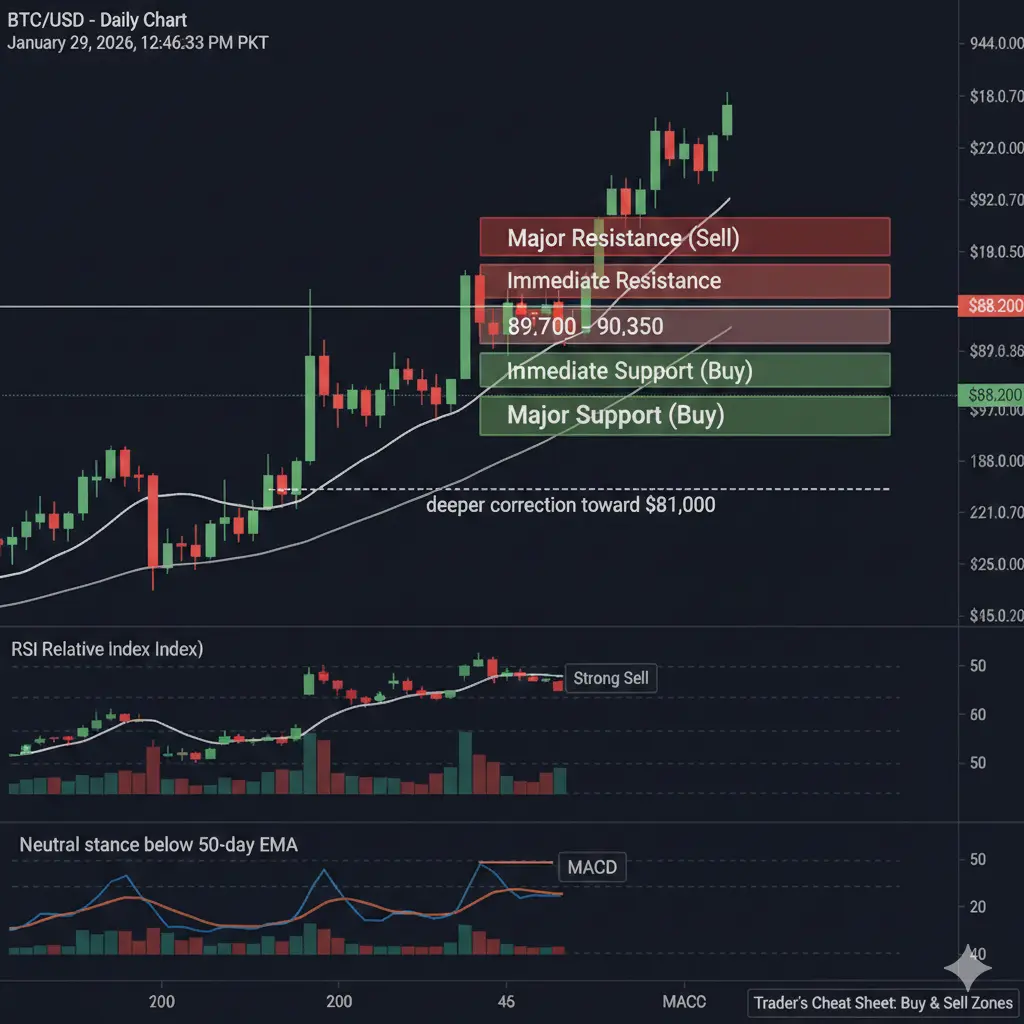
$BTC liquidation map update, BTC current price: 81,600. Two lines are battling on this chart:
Red line: Cumulative long liquidation intensity. Starting from 81,600, it climbs all the way to the left, where cumulative liquidations have exceeded $1.5 billion. This means that if the price continues to fall, a large wave of longs below is still waiting to be liquidated.
Green line: Cumulative short liquidation intensity. Starting from 81,600, it climbs all the way upward, reaching more than $2.5 bill
post-image
BTC-1.15%
Bitcoin Dips Below $83K as Oil Shock Rattles Markets
Bitcoin is under pressure, trading near $83,178.54, down 2.76% on the day after falling as low as $82,776.30. The sharp move came as oil climbed above $101 a barrel and bond yields spiked, prompting roughly $969 million in crypto liquidations over the past 24 hours, with $644.47 million of those from long positions, according to CoinGlass.
Bitcoin opened the session at $85,543.66, slid sharply, and briefly threatened key support before bouncing off the lows. The 3.2% drop left leveraged traders holding the bag.
⚠️ Personal market analysis on
post-image
BTC-1.15%
Securitize is not sticking to Ethereum as its sole chain and has instead moved to Solana to launch Securitize Stocks, clearly because it has fully understood the clearing ledger requirements of institutional fractional-share trading.
Previously, they used Ethereum for U.S. Treasuries and funds, dealing with large institutions whose transactions started at several million dollars. Ethereum’s tens of dollars in gas per transaction was negligible for large players. U.S. stock trading is different, however, involving high-frequency rebalancing, fractional-share allocation, and daily liquidity maki
post-image
ETH-3.60%
SOL-5.45%
#GateMoney正式上线
Gate Money transforms the underlying liquidity model:
Asset Diversity and Instant Liquidity: Gate Money enables users to hold over 5,300 crypto assets, more than 12,800 stocks and ETFs, tokenized gold, and over 60 fiat currencies within a single account system, allowing them to spend directly from these multi-asset balances via the Gate Visa Card.
Dedicated Personal IBANs: Unlike traditional crypto cards that require manual pre-loading with fiat currency, Gate Money offers dedicated personal bank accounts assigned to your name. This allows you to receive primary income (such as
GT-1.82%
AMD-3.88%
MU-4.83%
LPT3L+9.66%
  • 8
I didn’t do anything—I just went to the bathroom, and when I came back, the K-line had already done the work for me. 😎

A few days ago in the afternoon, I was still debating whether to reduce my position. $AGENCY pulled back to the previous big bullish candle, then immediately held after touching it, with buyers stepping in decisively. When I was bullish, I said that as long as this level held, there was still room to the upside. I entered at 0.004378, but honestly wasn’t confident, since the market had been grinding for too long.

When I came back from washing up, the price had already su
post-image
SNDK-4.65%
BNB-4.56%
$STRK The price is moving, but trading volume has yet to respond in kind—this is more worth watching than the 24-hour +18.16% gain.
This time, I’m not looking at the gainers and losers table, only the levels. The current price is 0.05823, about 17.62% above the 1-hour support at 0.04797 and about 7.33% below the resistance at 0.0625.
My criteria are simple: only a breakout above 0.0625 followed by continued upward movement would count as follow-through higher; a break below 0.04797 invalidates the previous view. The 1-hour and 4-hour trends are both relatively strong, with RSI at 46 and 6
post-image
STRK+24.55%
$BTC $BTC $BTC are warning that the market continues to make that mistake, , and the chart proves it three times.
Bitcoin just broke $87k. retracement
Most people see green and assume that good things are coming.
Since the $126K high, the price has fallen from the same descending channel three times?
post-image
BTC-1.15%
  • 1
market updates on today $BTC & $XAU
live-cover
LIVE1,417
$ICP September trading volume ranked second globally, yet the token price fell 8.9%: bullish above 2.791
The September global public-chain trading volume rankings are out, with Solana and $ICP leading the way. Both processed over 3.8 billion transactions in a single month, with $ICP ranking second globally. Yet the market is cold: after the event, it moved from 2.927 to 2.926, barely budging. Second place paired with a cold market setup—I’m bullish here.
Currently at 2.933, down 8.9% over 24h, with an intraday range of 2.86–3.242; daily RSI is weak at 44.2, while the MACD bearish cross above
ICP-7.19%
Good morning, fam 🌞
Have a wonderful day
Starting it with a burger 🍔
Not sure what to have for breakfast,
I passed by KFC and got a burger with coffee,
Fam, what did you all have for breakfast?
post-image
Friday Morning Market Updates
live-cover
LIVE1,992
Small-position long on $INJ . Entry range: 6.726 - 6.829
Take-profit 1: 7.069
Take-profit 2: 7.302
Defense level: 6.524
The price has rebounded strongly from the low, while open interest continues to rise—ride this momentum with the trend and charge straight toward the moving average resistance! If you like this trading strategy, you can enter here. $BTC and $Q are on my watchlist.
post-image
INJ-7.33%
#加密市场观察 Decentralized Exchange Platform Tokens: UNI, HYPE, and ASTER—Who Can Truly Capture Value?
In the crypto market, decentralized exchanges (DEXs) are no longer a fringe concept but core infrastructure for on-chain finance. Spot liquidity, perpetual contracts, and cross-chain trading are all virtually inseparable from these protocols. The protocols’ native tokens often directly reflect their competitiveness and value-capture capabilities. The three currently attracting the most market attention are UNI, HYPE, and ASTER. They have different positions and diverging paths, yet together they o
post-image
ThisIsTranslateContent:
#加密市场观察 Decentralized Exchange Tokens: UNI, HYPE, ASTER—Who Can Truly Capture Value?
In the crypto market, decentralized exchanges (DEXs) are no longer a niche concept but core infrastructure for on-chain finance. Spot liquidity, perpetual contracts, and cross-chain trading are almost impossible to avoid. The protocols’ native tokens often directly reflect their competitiveness and value-capture capabilities. The three currently attracting the most market attention are UNI, HYPE, and ASTER. They have different positioning and divergent paths, but together they outline the competitive landscape of the DEX sector.
UNI: The Undisputed King of Spot Liquidity, Stable but Unlikely to Surge Again
Uniswap is unquestionably the leading spot DEX. From its early AMM model to its current multichain presence, it has become the default standard for on-chain asset issuance and liquidity access. Whether for new token listings, RWA mapping, or institutional capital flows, Uniswap’s deep pools are often the first choice.
UNI’s fee switch continues to advance, while its previous large-scale burn strengthened the deflationary narrative. Combined with narratives such as tokenized stocks and anticipated CME futures, its medium- and long-term value-capture path is clear.
The market views it as infrastructure on the level of an “on-chain Nasdaq.” Its large scale, stable ecosystem, and high level of institutional recognition are its biggest advantages. But precisely because it is already mature enough, the probability of doubling or even rising tenfold again is no longer high. It is more like a portfolio asset—those seeking stability can hold it long term, while those pursuing high elasticity may find it too slow.
At this stage, it is enough to continue waiting patiently for clearer positive catalysts or a directional breakout.
HYPE: The Traffic and Fee Machine for Perpetual Contracts
If UNI is the king of spot trading, Hyperliquid (HYPE) is the undisputed leader in perpetual contracts. Through its own L1 and order-book model, it delivers an on-chain derivatives trading experience close to that of centralized exchanges while retaining its non-custodial nature. What makes HYPE most impressive is the directness of its value capture. The platform uses most of its fees to buy back and hold or burn HYPE, creating sustained deflationary pressure. Its trading volume has led the market over the long term, while open interest and fee revenue also clearly surpass those of its peers.
For investors, HYPE is more like a “high-elasticity fee-dividend asset”—as long as trading volume does not collapse, the buyback mechanism can continuously support demand for the token. Of course, it also faces risks from unlock pressure and intensifying competition, but its leading position in the perpetuals sector remains quite solid for now.
ASTER: A High-Leverage Challenger Using Aggressive Tokenomics to Capture Market Share
ASTER is a relatively new player formed through the merger of Astherus and APX Finance. It is backed by YZi Labs and others and has previously attracted significant market attention. It focuses on multichain support, a self-built privacy-oriented L1, extremely high leverage, and features such as hidden orders, seeking to better meet the needs of professional traders in terms of user experience.
ASTER’s token mechanism is also quite aggressive: the platform uses the vast majority of its fees for buybacks and distribution to stakers, combined with burns, with the goal of gradually reducing its supply to a lower level. This “high fee redistribution + deflation” design has attracted significant attention and trading volume in its early stages.
However, compared with Hyperliquid, it still lags in scale, open interest, and sustainability. The market is also watching to see whether it can turn short-term enthusiasm into long-term users and revenue.
How to Choose Among the Three? Consider Positioning and Timing
Looking at UNI, HYPE, and ASTER together, the logic is quite clear: UNI seeks stability and is suitable as a core DeFi holding, with high certainty and relatively controllable drawdowns but limited upside elasticity. Its current unrealized profit is nearly 80%, its structure remains healthy, and it is enough to continue waiting for catalysts. HYPE’s fees and leadership advantage make it suitable for investors who can accept volatility and are bullish on continued growth in the perpetuals sector. Its direct buyback mechanism and leading trading volume make it one of the strongest “fee machines” at present. ASTER offers elasticity and differentiation; its high leverage, privacy features, and aggressive buybacks are highlights, but competition is intense, requiring continued verification of user retention and revenue conversion. It is suitable for those with a higher risk tolerance who are willing to track emerging challengers.
Short-term prices will be affected by market sentiment, unlocks, and competition, but long-term differentiation will ultimately be determined by fundamentals: whoever can consistently generate trading volume and real revenue and effectively return that revenue to token holders will go further.
Competition among decentralized exchanges has moved from “whether there is trading volume” to “whether trading volume can be converted into sustainable token value.”
UNI represents maturity and stability, HYPE represents efficiency and fee capture, while ASTER is attempting to seize market share through more aggressive products and Tokenomics.
For investors, there is no absolute “best” choice—only the one most suited to their risk tolerance and holding period. In the short term, trading volume, open interest, and buyback data can be tracked; over the medium and long term, the focus should be on who can truly become the default gateway for on-chain trading.
repost-content-media
UNI-8.08%
HYPE-3.76%
ASTER-1.03%
  • 1
Load More

Join 40 M users in our growing community

⚡️ Join 40 M users in the crypto craze discussion

💬 Engage with your favorite top creators

👍 See what interests you

Trending Topics

Gate Money Officially Launches

3.46k Views12.9k Discussing

Gate officially launches Gate Money, a global integrated financial services app that brings digital assets, fiat, stocks, ETFs, gold, bank accounts, and payments into one Gate App. Users can manage assets, invest, send and receive funds, convert currencies, and make payments — all from a single account. Which use case are you most excited about? [👉 Learn more](https://www.gate.com/announcements/article/102094)

Fed September Minutes Lean Hawkish

64.18k Views2.75k Discussing

Samsung Q3 Operating Profit Surges 782.5%

36.98k Views1.94k Discussing

View More