HeavyStakingOnASnowyNight

vip
Active for: 0.5y
Peak Tier 0
Focuses on restaking and security models, likes to list out risks. Favorite saying: "Survive first, then talk about returns."
The Blackwell cycle isn’t over, data center demand remains strong, and NVDA’s fundamentals haven’t broken down. A pullback is the window to get in—not a time to chase higher prices and give your money away.
Anaya
NVIDIA still looks like the core AI infrastructure name. Data-center demand and the Blackwell cycle remain the main drivers. Short-term swings can be sharp, but the longer-term compute thesis is intact. Watching pullbacks instead of chasing strength blindly.
$NVDA
NVDA-0.09%
A drop doesn’t necessarily mean it’s an opportunity; it depends on whether NVIDIA’s AI business is worth that price.
Nayeem003
When NVIDIA’s stock price goes down, many investors start thinking, is this a buying opportunity or could there be another correction?
For me, the important thing is not only that the price is lower. We also need to look at how strong NVIDIA’s AI business is, its revenue growth, future AI demand and whether the current valuation makes sense compared with that growth.
NVIDIA is still seeing strong growth, so the bigger question is whether that growth can continue and how much of it is already reflected in the stock price.
I don’t think “the price is down, so I should buy” is enough. I would rather look at the business growth, future demand, valuation and market expectations before making a decision.
#GateStockInsightsChallenge #GateSquare #NVIDIA #NVDA #StockMarket
NVDA-0.09%
Looking back at that failed trade just now, the problem wasn’t my directional call—it was that I botched my order execution. I thought the pool was deep enough and went straight in with the full size, but slippage ate a huge chunk of my costs. That really hurt. After reviewing it, I realized slippage isn’t just about the percentage; it depends on the relationship between pool depth and your order size. Liquidity is layered, and its depth at the exact moment you trade is what matters. It’s still best to split your orders and enter in batches—don’t fantasize about filling the entire position at
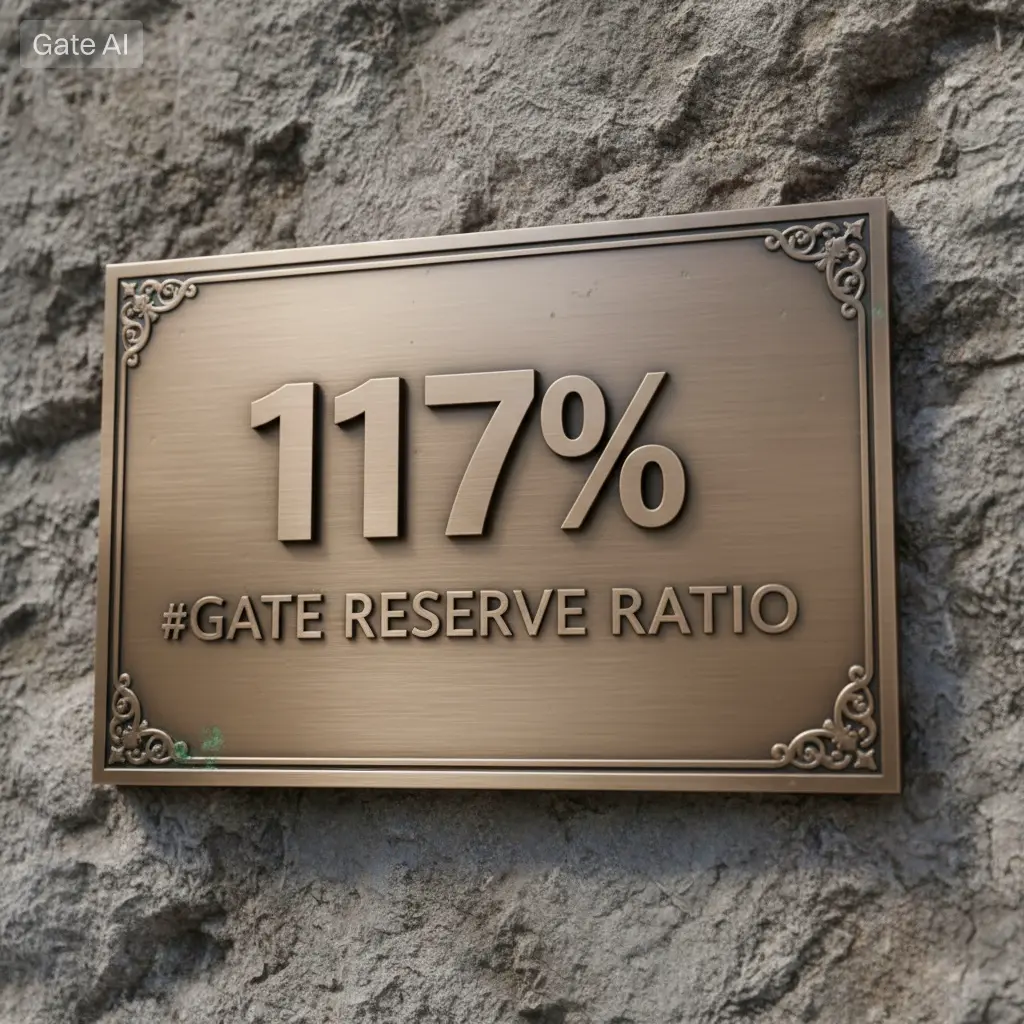
A 117% reserve ratio—this level of transparency is genuinely reassuring.
ForestCrypto
#GateReserveRatio117%
Gate Reserve Ratio 117% Highlights Strong Transparency and User Confidence
Trust and transparency are essential foundations of the digital asset industry. A strong reserve ratio demonstrates the importance of responsible asset management and building confidence among users.
Gate’s Reserve Ratio reaching 117% reflects a commitment toward transparency and providing users with greater visibility into platform stability.
In the rapidly changing crypto environment, proof of reserves and responsible practices play a crucial role in strengthening relationships between platforms and their communities.
Users today are looking for platforms that prioritize security, reliability, and long-term sustainability. Transparent reserve information helps create a more confident trading environment.
Gate continues working toward improving user experience through innovation, security measures, and a commitment to greater transparency.
A stronger foundation of trust supports the future growth of the crypto ecosystem and encourages more people to explore digital finance.
@Gate_Square
repost-content-media
In the past few days, the latest hotspot has shifted back to the NFT royalty slap fight. With insufficient secondary liquidity, creators are arguing that they should get a share—really, it’s still a battle over attention. I’ve always felt that when a hotspot is rotating, it’s easiest to get carried away: charge at this today, chase that tomorrow. When you look back, the fees are already higher than the profits. What I fear most isn’t losing money, but jumping into the trap even when I know it’s a trap. Anyway, my approach is to first focus on the staking models on the few chains I’m watching;
To be honest, every time I see the group spam “That whale bought XX again,” I get a little scared.
Before you copy-trade, please first make sure whether they’re building a position or hedging—I watched an address a few days ago, thinking they were just trying to buy the dip, but when I checked on-chain, it turned out they were running delta-neutral: buying spot while shorting futures… This isn’t copy-trading at all; it’s clearly setting people up for losses.
Lately, discussions about stablecoin regulation have been popping up more and more, and the “de-peg” rumor about USDC has been making t
USDC0.00%
Bitcoin ETFs saw inflows of $727 million over five days—this uptick in the fund flow is a bit intense, so short-term price action is worth watching.
CoinNetwork
CoinDesk news: According to market data, yesterday Bitcoin ETF fund inflows reached $227 million. Over the past five days, the cumulative total inflows amounted to $727 million. This is the longest consecutive period of sustained inflows since May, with continuous growth.
BTC and ETH are moving in different directions; short-term sentiment is bearish, but there is still hope by year-end—watch the risks.
CoinNetwork
Bitcoin and Ethereum prices are mixed, and the outlook for the second half of 2026 is unclear
7/20, BTC opened at $64,680, down 0.2% in early trading, and rose to $64,694 at 9:34; ETH opened at $1,871.21, up 0.5%, and was $1,875.30 at 9:35. Both coins still show an upward trend over the past month, but there is a divergence in sentiment in the second half. Darkfost said that top buyers who bought at $75,000–$126,000 are currently at a loss, and the near-term outlook is not optimistic; Standard Chartered reiterated its year-end target of $100k. Polymarket predicts BTC will end the year at $70,000–$75,000 and ETH at $2,000–$2,250.
BTC+1.54%
ETH+1.58%
Lately, I’ve seen quite a few people discussing royalties in the secondary market. Honestly, I find it kind of interesting. Many creators think that if royalties disappear, the sky will fall, but if you look at it calmly, the royalty mechanism itself is actually pretty fragile—it depends entirely on on-chain execution. If the project team says “change it,” they can; and if users want to get around it, they can too.
I’ve been doing re-staking for a long time, and I’ve gotten into the habit of first mapping any revenue stream into a risk checklist. A model that relies on “moral consensus” to mai
Galaxy has played this brilliantly—turning on-chain protocols into enterprise-grade services, while putting up a $100 million backstop. This cuts the entry barrier for traditional capital in half.
CoinNetwork
According to Bijie.com news, Wu said he learned that Galaxy has launched an on-chain financing plan GOFR for institutions, high-net-worth individuals, and qualified investors, with a minimum loan size of $1 million. Galaxy will integrate the variable interest rates from on-chain lending protocols such as AAVE, Morpho, Spark, and Kamino into a single composite interest rate. Customers can transact directly with Galaxy as the counterparty, without having to manage their own wallets, private keys, or smart contracts. In addition, Galaxy will contribute up to $100 million of its own funds as first-loss protection, and will support customers in using native BTC directly as collateral.
Yet another listed company added more BTC—11 coins doesn’t sound like much, but the signal is dialed up to the max.
CoinNetwork
Gate.io News: A publicly listed company, Farmhouse ($FMHS), recently increased its holdings by 2 BTC, bringing its total holdings to 11.209 BTC.
BTC+1.54%
$EVAA This price surge is too strong, 77% straight to the moon.
Tm_Crypto
$EVAA is showing strong momentum with a +77.66% daily gain, hitting a high of 1.6969. Volume is surging, buyers are in control, and the trend remains bullish. Keep an eye on key resistance if momentum continues.
$EVAA #GUSDYieldRisesto3.8% #PredictWorldCup🇦🇷vs🇪🇬 #StrategySells3588BTC
EVAA-7.73%
This swing trader uses 0.8x leverage on a $25 million semiconductor position—the game of making tens of millions per month is indeed steady, but the MU trade is still being held with a floating loss of $26k. The liquidation line at 3645 looks far away, but the actual pressure is not small.
Original content no longer visible
MU-0.51%
First survive, then talk about making money. This one is worth printing and sticking in front of the screen.
Ai_Power
#RiskManagementFirst 🛡️📊.
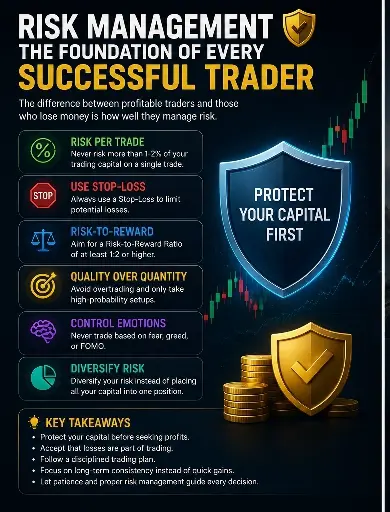
Risk Management: The Foundation of Every Successful Trader
In the world of financial markets, the difference between profitable traders and those who consistently lose money is rarely determined by finding the perfect entry. Instead, it is determined by how well they manage risk. Markets are unpredictable, and no strategy can guarantee a 100% win rate. Professional traders understand this reality and focus first on protecting their capital before pursuing profits.
Many beginners enter the market expecting every trade to be a winner. However, experienced traders know that losses are a natural part of trading. What truly matters is keeping those losses small while allowing winning trades to grow. This disciplined approach is what creates long-term consistency and sustainable profitability.
Risk management is not about avoiding losses—it is about ensuring that no single trade can significantly damage your trading account. By limiting risk, traders give themselves enough opportunities to benefit from future market setups without being forced out of the market by one emotional decision.
📊 Why Risk Management Matters
Successful trading is a marathon, not a sprint. Protecting your capital allows you to stay in the market long enough to take advantage of future opportunities. Without proper risk management, even a series of profitable trades can be wiped out by one poorly managed position.
Professional traders focus on consistency rather than chasing unrealistic returns. They understand that preserving capital is the first step toward building long-term wealth.
🔑 Essential Risk Management Rules
✅ Never risk more than 1–2% of your trading capital on a single trade.
✅ Always use a Stop-Loss to limit potential losses.
✅ Aim for a Risk-to-Reward Ratio of at least 1:2 or higher.
✅ Avoid overtrading and only take high-probability setups.
✅ Never trade based on fear, greed, or FOMO.
✅ Diversify your risk instead of placing all your capital into one position.
📈 Psychology Is the Real Edge
Technical analysis helps identify opportunities, but psychology determines whether traders can execute their strategy successfully. Emotional decisions often lead to buying at market tops, panic selling during corrections, or revenge trading after losses.
Disciplined traders follow their trading plan regardless of short-term market noise. They understand that consistency comes from controlling emotions, not predicting every market move.
💡 Key Takeaways
Protect your capital before seeking profits.
Accept that losses are part of trading.
Follow a disciplined trading plan.
Focus on long-term consistency instead of quick gains.
Let patience and proper risk management guide every decision.
🚀 Final Analysis
The most successful traders are not those who win every trade—they are those who manage losses effectively and remain disciplined through every market cycle. A strong trading strategy without proper risk management is incomplete. Capital preservation, emotional control, and consistent execution are the true foundations of long-term success in cryptocurrency and traditional financial markets.
Remember, your first goal is not to make money—it's to stay in the game long enough to make money consistently.
⚠️ Disclaimer: This content is for educational and informational purposes only and should not be considered financial advice. Always conduct your own research (DYOR) and implement proper risk management before making any investment decisions.
Ai_Power 🛡️📈
repost-content-media
Japan's stock market sees largest inflow in seven weeks, with capital shifting from Silicon Valley to Tokyo Bay—this rotation is faster than expected.
CoinNetwork
Coins World News, Bank of America said investors are selling U.S. stocks at the fastest pace since March. A team led by Michael Hartnett cited EPFR Global data in a report, noting that U.S. stock funds saw outflows of up to $17.2 billion in the week ending July 1. Investors are turning to some international stocks, with Japanese stocks seeing the largest inflow in seven weeks, reaching $1.9 billion. Early this year, U.S. stock market inflows were strong, but market sentiment is shifting. Last week, U.S. stock funds saw their first redemptions in three months. This week, doubts about the high valuations of artificial intelligence continue to hit chip stocks, with the Philadelphia Semiconductor Index falling 11% over the past two days.
Recently, the mainnet gas has gone wild again, while L2 is smooth, but I still feel a bit uneasy. In short, it's cheap, but what if some protocols suddenly upgrade and move along with the mainnet, or migrate? Who would I turn to for the things I staked there...
Right now, I keep my core positions on the mainnet and do small interactions on L2. Betting on both sides means both are up in the air, but there's no choice—survival first. Anyway, when the upgrade comes, I'll withdraw whatever I can first and wait until the dust settles. If I can't predict it, I won't bother guessing.
What about you g
The world’s first publicly listed company focused on video models is coming—see you on the Hong Kong stock market in 2027, and we’ll be watching for the opening performance.
CoinNetwork
According to Coin World News, Kuaishou’s video generation business, Kuaishou AI, is undergoing its first round of financing since the spin-off (Pre-IPO round). The pre-investment valuation is $18B. The related listing filing work is being advanced according to the timeline for submitting materials to the Hong Kong Stock Exchange in early 2027. Based on Kuaishou’s market cap at the close on June 2 (approximately $27.4B), Kuaishou AI’s valuation is already equivalent to 66% of the parent company’s market cap. Kuaishou AI is expected to become the world’s first listed company dedicated to video models. It is expected to complete the restructuring and share reform in 2026, and formally submit its listing application in early 2027.
Gate is making a lot of noise with this event, but orders still need to be placed. The ADA daily chart structure is bullish. Set your stop loss well and see if it can hit 0.23.
DanniéX
$ADA looks clean and bullish for the short term with a bullish divergence printing on the daily timeframe.
If this set up should play out I will be targeting the $0.23 level with a stop at the lowest low $0.138
#GateStocksTransferLive
ADA+3.05%
Doubao Seed 2.1's pricing strategy is quite aggressive, directly targeting GPT-5.5 and even cheaper. The performance surpassing nl2repo in benchmarks is pretty interesting, but is the weekly upgrade cycle for Volcano Engine too aggressive? Would they dare to deploy it in production?
CoinNetwork
ByteDance officially launches the Doubao Seed 2.1 large model API: the Pro version delivers top performance over GPT in multiple evaluation results
CoinWorld reports that ByteDance has opened the Doubao Seed 2.1 large-model API. The Pro and Turbo versions enhance deeper thinking, focusing on complex programming delivery, long-chain agent execution, and multimodal vision. The flagship version, doubao-seed-2.1-pro, performs close to or exceeds GPT-5.5 in code and development evaluations, achieving 59.8% and 47.0% respectively in the sc scientific computing and nl2repo-bench code generation tests, higher than GPT-5.5’s 58.4% and 45.1%. In software engineering evaluations, it scores 57.5%, leading Gemini-3.1-Pro. API pricing: Pro is 6 yuan per million tokens for input and 30 yuan per million tokens for output, while Turbo is priced at half. Volcano Engine has launched seed-evolving weekly rolling upgrades, allowing developers to access the latest model capabilities every week.
Target 1776 is the first to see, set the stop-loss properly, go for it
Original content no longer visible