Square
Following
Hot
News
Profile

contact

vip
Market Analyst
Hello friends I'm new .
70
Following
46
Followers
12
Liked
US economic data delivered a clear message: inflation is running hotter than expected, yet consumer demand and parts of the manufacturing sector remain surprisingly resilient.
🔹 This combination creates a difficult position for the Federal Reserve. After Wednesday's above-forecast CPI, today's producer-level data reinforced the case for rates staying higher for longer.
📊 The data on the table:
🔹 Core PPI: +0.7% MoM (forecast: +0.3%). The largest monthly increase since March 2022.
▪️ Headline PPI: +1.3% MoM (forecast: +0.6%), +6.3% YoY (forecast: +5.3%). The highest annual reading since Dece
User_any
US economic data delivered a clear message: inflation is running hotter than expected, yet consumer demand and parts of the manufacturing sector remain surprisingly resilient.
🔹 This combination creates a difficult position for the Federal Reserve. After Wednesday's above-forecast CPI, today's producer-level data reinforced the case for rates staying higher for longer.
📊 The data on the table:
🔹 Core PPI: +0.7% MoM (forecast: +0.3%). The largest monthly increase since March 2022.
▪️ Headline PPI: +1.3% MoM (forecast: +0.6%), +6.3% YoY (forecast: +5.3%). The highest annual reading since December 2022.
▪️ Core Retail Sales: +0.9% MoM (forecast: +0.6%).
▪️ Retail Sales: +0.8% MoM (forecast: +0.3%). Gasoline stations accounted for roughly 70% of the gain.
▪️ Initial Jobless Claims: 199K (forecast: 199K). Labor market remains historically tight.
▪️ Empire State Manufacturing: 25.5 (forecast: 12.1). The strongest reading since December 2021.
▪️ Philly Fed Manufacturing: 20.9 (forecast: 28.2). Still in expansion territory, but decelerating.
Market response so far:
🔹 Treasuries: The 10-year yield dropped over 13 basis points to around 5.05%, as safe-haven demand for bonds offset the inflation surprise.
▪️ Dollar Index (DXY): Pulled back to approximately 102.03, erasing post-CPI gains as rate-hike odds were reassessed.
▪️ Gold: Rebounded above $4,150, up over 1.3%, as falling yields and a softer dollar supported the metal despite the hot inflation print.
▪️ Bitcoin: Briefly dropped below $80,000 to $80,168 before stabilizing near $80,500. Total crypto market capitalization fell about 3.6% to $2.7 trillion.
▪️ Crypto Liquidations:Approximately $977 million in futures positions were liquidated over 24 hours, with long positions accounting for the vast majority — $203.83 million from Bitcoin longs alone and $286.11 million from Ethereum longs.
▪️ WTI Crude: Slipped about 1% to $94.07 per barrel, reversing prior-session gains as investors weighed supply risks against demand signals.
Structural perspective:
🔹 From a long-term structural perspective, today's data confirms that cost pressures are broadening beyond energy. Core PPI at +0.7% MoM — more than double expectations — shows that producer-level inflation is not isolated to volatile components. Combined with resilient retail sales and a labor market that refuses to crack, the Fed has limited room for dovish signaling.
▪️ The key variable now is the Treasury market. If yields resume climbing despite today's drop, expect renewed support for the dollar and pressure across gold, equities, and crypto. If yields remain subdued even with hot inflation data, it would suggest the market is pricing a more structural shift in the rate path.
▪️ For risk assets like Bitcoin, the macro environment remains challenging for aggressive positioning. The $80,000 level is a critical support zone; a sustained break below could open deeper downside.
▪️ Treasury buybacks may help market liquidity and ease stress in some parts of the bond market, but they do not resolve the underlying inflation problem.
🔹 I'm staying in watch mode here, monitoring BTC, Gold, Silver, and XRP as the market digests this dense data set. The next move won't be determined by a single headline — watching Treasury yields, the DXY, and how gold and BTC react to them will be the key.
💬 How are you interpreting today's data mix for the rate path and risk assets? 👇
#PPI #CPI
#USSeptemberPPIBeatsExpectations #USSeptemberCPITopsEstimates #BTCBreaksBelow82K
Not financial advice.

repost-content-media
XAU-0.05%
XAG-0.14%
BTC+0.69%
ETH-0.40%
XRP-0.38%
US Dollar Index (DXY) climbs to its highest level in 18 months.
The dollar index held around 102.2 on Monday, close to the peak of 102.54 reached last week — its strongest since April 2025. The move extends a fourth consecutive weekly gain, the longest streak since 2025.
The drivers behind the move:
• Middle East tensions: Escalation around the Strait of Hormuz and shipping routes is supporting safe-haven demand for the dollar.
• Elevated oil prices: With the US now a net energy exporter, higher crude prices are acting as a dollar-supportive factor rather than a drag.
• Rate expectations: Ris
cryptoLog
US Dollar Index (DXY) climbs to its highest level in 18 months.
The dollar index held around 102.2 on Monday, close to the peak of 102.54 reached last week — its strongest since April 2025. The move extends a fourth consecutive weekly gain, the longest streak since 2025.
The drivers behind the move:
• Middle East tensions: Escalation around the Strait of Hormuz and shipping routes is supporting safe-haven demand for the dollar.
• Elevated oil prices: With the US now a net energy exporter, higher crude prices are acting as a dollar-supportive factor rather than a drag.
• Rate expectations: Rising Treasury yields and fading bets on near-term Fed easing are fueling interest in the dollar.
• Relative growth: Strong earnings, resilient consumer spending, and AI-related investment continue to support the US growth narrative.
The index climbed from roughly 98.8 in early September to above 102, breaking through the July high of 101.6. A stronger dollar typically pressures risk assets, and the correlation is visible: Bitcoin has pulled back toward $83,000 as the DXY pushed higher.
Where do you see the dollar heading next: consolidation near 102, or a further push higher? 👇
#DXY #GateSquare #Macro #Forex
#BTCUp1.17%
Not financial advice.
USIDX-0.18%
BTC+0.69%
Thrilled to witness Max win the Singapore Grand Prix for the first time in person!
Dr.Han
Thrilled to witness Max win the Singapore Grand Prix for the first time in person!
#GateXRedBullWinsSingaporeGP
🏆 Finally conquers Singapore, Max unlocks a new career achievement
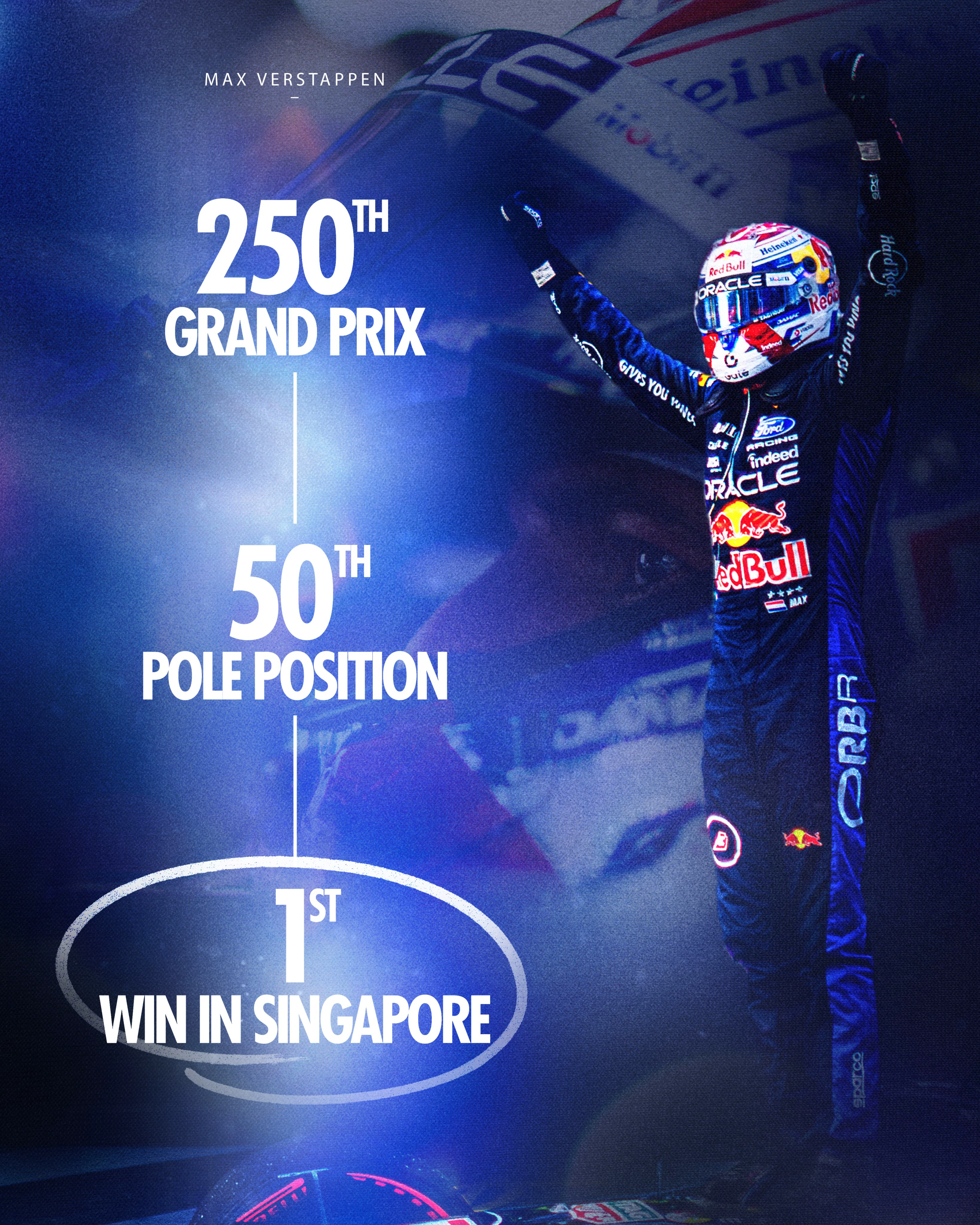
Starting from pole and leading from start to finish, Max Verstappen delivered a spectacular Pole to Win at the F1 Singapore Grand Prix, claiming his first Singapore GP victory 🏎️
Gate founder Dr. Han was also on-site with the Red Bull team, celebrating this historic moment with Max. Isack Hadjar’s performance also deserves applause.
From the TOKEN2049 driver meet-and-greet to winning the F1 Singapore GP, Gate, as Red Bull Racing’s official sponsor and long-term partner, has been along for the jou
User_any
#GateXRedBullWinsSingaporeGP
🏆 Finally conquers Singapore, Max unlocks a new career achievement
Starting from pole and leading from start to finish, Max Verstappen delivered a spectacular Pole to Win at the F1 Singapore Grand Prix, claiming his first Singapore GP victory 🏎️
Gate founder Dr. Han was also on-site with the Red Bull team, celebrating this historic moment with Max. Isack Hadjar’s performance also deserves applause.
From the TOKEN2049 driver meet-and-greet to winning the F1 Singapore GP, Gate, as Red Bull Racing’s official sponsor and long-term partner, has been along for the journey, witnessing speed and breakthroughs together.
💙 First victory secured, the legend continues.
Bring #Max首夺F1新加坡站冠军 to Gate Square to chat:
Which moment from the race left the deepest impression on you?
#GateXRedBullWinsSingaporeGP
🏁 Red Bull’s 2026 season has been a story of two halves.
A difficult start, with power unit gremlins and a car that struggled for consistency. Then a steady, deliberate climb back.
The turning point came mid-season, with a significant upgrade package that allowed the team to consistently fight at the front. Since the summer break, the RB22 has shown genuine pace across different circuits, and Verstappen has converted that into podiums and now two consecutive wins.
The Singapore result was the clearest confirmation. Pole, fastest lap, and a win from lights to flag
User_any
#GateXRedBullWinsSingaporeGP
🏁 Red Bull’s 2026 season has been a story of two halves.
A difficult start, with power unit gremlins and a car that struggled for consistency. Then a steady, deliberate climb back.
The turning point came mid-season, with a significant upgrade package that allowed the team to consistently fight at the front. Since the summer break, the RB22 has shown genuine pace across different circuits, and Verstappen has converted that into podiums and now two consecutive wins.
The Singapore result was the clearest confirmation. Pole, fastest lap, and a win from lights to flag. His first at Marina Bay. Hadjar’s drive from pit lane to P10 added a valuable point in the constructors’ fight.
📊 The standings reflect the progress:
• Verstappen is now fourth in the drivers’ championship, closing in on the top three.
• Red Bull sits seven points behind McLaren for third in the constructors’ battle.
Team principal Laurent Mekies has been measured about expectations. He sees Mercedes as the benchmark and targets podiums rather than wins for the remaining races.
That realism matters. The gap to the leaders is still significant. But the trajectory is clear, and with several races left, there is room to keep building.
What do you think has been the key to Red Bull’s turnaround? 👇
#GateSquare #RedBullRacing #F1
repost-content-media
All eyes were on Gate at TOKEN2049 Singapore 2026. As the global crypto industry’s pulse quickened at Marina Bay Sands—drawing 25,000 attendees from 160 countries, 250 speakers, and over 500 exhibitors—the atmosphere intensified further when Gate took the main stage. This was no ordinary speech; it marked the announcement of a new chapter in a thirteen-year journey.
Gate Founder and CEO Dr. Han delivered a keynote titled "One Gate, Everything Money" and officially unveiled Gate Money. Gate Money is a financial super-app that integrates digital assets, fiat currencies, stocks, ETFs, gold, bank
User_any
All eyes were on Gate at TOKEN2049 Singapore 2026. As the global crypto industry’s pulse quickened at Marina Bay Sands—drawing 25,000 attendees from 160 countries, 250 speakers, and over 500 exhibitors—the atmosphere intensified further when Gate took the main stage. This was no ordinary speech; it marked the announcement of a new chapter in a thirteen-year journey.
Gate Founder and CEO Dr. Han delivered a keynote titled "One Gate, Everything Money" and officially unveiled Gate Money. Gate Money is a financial super-app that integrates digital assets, fiat currencies, stocks, ETFs, gold, bank accounts, and payment services under one roof. The message—"Let your assets grow, let your value move freely"—encapsulated the product's essence in a single sentence.
This announcement demonstrates that Gate is not merely an exchange but aims to touch every aspect of its users' financial lives. Throughout the event, the Gate ecosystem was showcased in various ways. The Gate Lounge offered attendees the opportunity to explore products and meet the team. As part of the collaboration with F1’s Red Bull Racing, four-time world champion Max Verstappen joined Gate CMO Kyle Chiu on the main stage to discuss performance, innovation, and maintaining a competitive edge. Following the event, Verstappen visited the Gate booth and left a special handprint. Meanwhile, the Gate Gala brought together global industry leaders and business partners for an exclusive event at the Raffles Hotel. Gate's presence at this event was a reflection of the infrastructure it has built over the past 13 years. All announcements and activities throughout the event marked the first tangible steps toward the "One Gate, Everything Money" vision. At TOKEN2049 this year, Gate stood out not merely as a participant, but as a key player shaping the financial architecture of the future.
This article does not constitute investment advice. The analysis is based on publicly available information and does not guarantee future results.
#GateAtTOKEN2049
#Gate亮相TOKEN2049
repost-content-media
$SAMSUNG #SamsungQ3OperatingProfitSurges782.5%
Samsung Electronics reported a preliminary third-quarter operating profit of 107.4 trillion won, or roughly $80.1 billion, an increase of 782.5% from the same period a year earlier. It is the first time a South Korean company has surpassed 100 trillion won in quarterly operating profit, and the fourth consecutive record quarter for the world's largest memory chipmaker. Revenue for the July-to-September period came in at approximately 195 trillion won, up 126.59% year over year.
The driver behind the surge is memory. Demand for high-bandwidth mem
ToTheYUE
$SAMSUNG #SamsungQ3OperatingProfitSurges782.5%
Samsung Electronics reported a preliminary third-quarter operating profit of 107.4 trillion won, or roughly $80.1 billion, an increase of 782.5% from the same period a year earlier. It is the first time a South Korean company has surpassed 100 trillion won in quarterly operating profit, and the fourth consecutive record quarter for the world's largest memory chipmaker. Revenue for the July-to-September period came in at approximately 195 trillion won, up 126.59% year over year.
The driver behind the surge is memory. Demand for high-bandwidth memory and server DRAM has outpaced supply as data centers powering artificial intelligence expand. Samsung's HBM bit shipments jumped nearly 50% quarter over quarter, and HBM4 revenue more than tripled from the previous quarter. The company's HBM market share rose from 21% in the first quarter to 33% in the second quarter, and its HBM4 chips are set to supply Nvidia's Vera Rubin AI accelerator in the second half of 2026. Analysts at SK Securities estimate the operating margin for Samsung's memory division reached 76% in the third quarter, unchanged from the prior quarter and among the highest levels the business has recorded.
The earnings beat expectations. The consensus estimate compiled from brokerage reports was around 105.4 trillion won for operating profit, and the actual figure came in above that mark. Samsung Securities, Meritz Securities, and KB Securities have set target prices for the stock at 400,000 won, while Hanwha Investment & Securities and SK Securities have targets as high as 580,000 won and 610,000 won respectively. Analysts at Meritz noted that DRAM prices are likely to rise further next year, and KB Securities projected that Samsung's HBM average selling price will more than double year over year in 2027, with HBM4 rising from 40% of total HBM revenue this year to 80% next year.
The market's reaction, however, did not match the strength of the earnings. The KOSPI closed 2.62% lower at 6,625.93, and Samsung shares fell about 1.5% after initially rising at the opening. The decline was attributed to a combination of factors, including the end of Samsung's share buyback program, the expiry of options, and a rebalancing of semiconductor exchange-traded funds. Foreign and institutional selling pressure weighed on the index despite the record results. The divergence between the earnings report and the stock price reflects the fact that the market had already priced in strong results, and investors were focused on what comes next rather than what had already been delivered.
The full earnings report, including divisional breakdowns and a conference call with management, is scheduled for October 29. That release will provide more detail on the memory business, the foundry division, and the company's outlook for the fourth quarter and beyond. For now, the preliminary figures confirm that the memory cycle is still expanding, driven by demand that has not yet shown signs of slowing. The question going forward is whether that demand remains strong enough to sustain the current pace of earnings growth, or whether the market's cautious reaction reflects concerns about the durability of the cycle.
This article is not investment advice. Analysis is based on publicly available information and does not guarantee future outcomes.
NVDA-1.42%
DRAM-5.87%
The Federal Reserve released the minutes of its September 15–16 meeting on October 7, and the document carried a message that the market has spent the days since trying to interpret. The headline is straightforward: all 19 officials supported the quarter-point increase that took the federal funds rate to 3.75%–4.00%, the first hike since 2023. Most participants believed another increase by year-end could be appropriate. Yet the market's reaction since the release suggests that investors are not treating the minutes as a signal that a move is imminent.
The distinction between "by year-end" and
ToTheYUE
The Federal Reserve released the minutes of its September 15–16 meeting on October 7, and the document carried a message that the market has spent the days since trying to interpret. The headline is straightforward: all 19 officials supported the quarter-point increase that took the federal funds rate to 3.75%–4.00%, the first hike since 2023. Most participants believed another increase by year-end could be appropriate. Yet the market's reaction since the release suggests that investors are not treating the minutes as a signal that a move is imminent.
The distinction between "by year-end" and "at the next meeting" is where the debate now sits. The minutes showed that most participants saw a further hike as potentially appropriate, but they also stressed that decisions would remain data-dependent and gave no indication that the October 27–28 meeting was the intended venue. That ambiguity is reflected in rate futures, where the probability of an October increase has fallen to roughly 17%–25%, depending on the measure, down from around 70% before officials began speaking publicly in late September. The odds of a December move remain substantially higher.
The internal debate revealed in the minutes adds another layer. Some participants viewed the current policy rate as not restrictive or only mildly restrictive, a view that would lower the bar for further tightening. A couple raised their estimates of the neutral rate, the level that neither stimulates nor restrains the economy. Inflation risks were described as skewed to the upside, with some participants concerned that after more than five years of above-target inflation, expectations and wage-and-price-setting behavior could begin to shift. On the labor market, most officials assessed that risks had become broadly balanced, and a majority said the labor market had strengthened a bit recently.
Bitcoin's response to the minutes was notable for how small it was. The price rose about 0.18% within five minutes of the release, moving from roughly $83,159 to $83,306 on one venue, a gain that was larger than the moves in equities or gold over the same window. That is a modest reaction by any measure, and it came after a decline leading into the release. The muted response suggests that the market had already priced in a hawkish tone and was looking for something more definitive to move direction.
The more significant variable now sits on the calendar. The September Consumer Price Index is due for release on October 14, two weeks before the Fed's next decision. Forecasts point to a monthly increase of around 0.4% and an annual rate near 3.4%, but some analysts see upside risk from elevated oil prices and the pass-through into food and transportation costs. The minutes themselves noted that the longer energy prices stay high, the greater the risk of broader price pressures. If the CPI print comes in above expectations, the case for an October hike strengthens. If it confirms that inflation is cooling, the pause narrative gains support.
For risk assets, the transmission channel runs through the dollar and Treasury yields. The 10-year yield remains near 5.3%, and the dollar has held firm. When the risk-free rate is that elevated, the opportunity cost of holding assets that do not pay a yield rises, and that pressure has kept Bitcoin range-bound in recent weeks. A softer CPI reading would ease that pressure by reducing the probability of further tightening. A hotter print would do the opposite.
The minutes also touched on the Treasury market, with some participants describing it as functioning smoothly while emphasizing the need to prepare for possible stress. That caution reflects the scale of government borrowing needs and the sensitivity of the market to shifts in rate expectations. For now, the Fed's message is that it is watching the data and has not committed to a path. The CPI report on October 14 is the next data point that could change that calculation.
This article is not investment advice. Analysis is based on publicly available information and does not guarantee future outcomes.
$BTC $GT $ETH
#FedSeptemberMinutesLeanHawkish
$NAS100 $USDJPY
BTC+0.69%
📚 Nice profit! How did you catch it? Tell us more.
After showing your gains, do people in the comments always ask, “How did you buy?” “Why did you sell?”

💡 Share a little more when you post:
• What signal made you enter?
• How did you adjust when the market changed?
• If you did it again, what would you do differently?

Show your gains and your strategy—give everyone something to learn and discuss!
👉 Share on Gate Square: https://www.gate.com/post
Sakura_3434
📚 Nice profit! How did you catch it? Tell us more.
After showing your gains, do people in the comments always ask, “How did you buy?” “Why did you sell?”

💡 Share a little more when you post:
• What signal made you enter?
• How did you adjust when the market changed?
• If you did it again, what would you do differently?

Show your gains and your strategy—give everyone something to learn and discuss!
👉 Share on Gate Square: https://www.gate.com/post
“The real opportunity is making crypto a core part of everyday finance.”
@Dr. Han
Gate Money, the unified financial application introduced by Gate, brings digital assets, fiat currencies, stocks, ETFs, gold, bank accounts, and payment services into a single account within the Gate App. The product was formally announced by founder and CEO Dr. Han during a keynote at TOKEN2049 in Singapore, where he framed the launch around the idea that holding, growing, and spending money should not happen in separate places.
The central premise of Gate Money is that the bo
User_any
“The real opportunity is making crypto a core part of everyday finance.”
@Dr. Han
Gate Money, the unified financial application introduced by Gate, brings digital assets, fiat currencies, stocks, ETFs, gold, bank accounts, and payment services into a single account within the Gate App. The product was formally announced by founder and CEO Dr. Han during a keynote at TOKEN2049 in Singapore, where he framed the launch around the idea that holding, growing, and spending money should not happen in separate places.
The central premise of Gate Money is that the boundaries between asset types should be less rigid. In a conversation with CoinDesk, Dr. Han described the real opportunity as making crypto a core part of everyday finance, and he offered a concrete example of what that means in practice: using Nvidia stock to buy a cup of coffee. In the traditional model, that transaction would require selling the stock, waiting for settlement, withdrawing the funds to a bank account, and then making the payment. Gate Money compresses those steps into a single account framework where different assets can be viewed, exchanged, and used.
The account structure reflects that intent. Eligible users can open a global bank account in their own name directly through the app, supporting transfers in more than 60 local currencies. The service is expected to expand to markets including Europe, Australia, and Dubai. The bank account functions as a hub rather than an isolated tool, connecting fiat deposits, digital asset holdings, and investment products in one place. Users can convert between currencies and assets, manage holdings across categories, and access yield products, with eligible balances such as USDT offering up to 3.6% annualized return without a lock-up period.
The payment layer extends the functionality into everyday spending. A partnership with Visa will bring a crypto-linked payment card to more than 40 countries and territories, allowing users to pay at any merchant that accepts Visa, covering more than 150 million locations worldwide. When a purchase is made, eligible digital assets held in the Gate account are automatically converted into fiat currency at the point of sale. The card can be linked to widely used digital wallets, and users can apply for and manage it through the Gate App.
Dr. Han placed the launch within a broader view of how financial services are evolving. He noted that user demand has expanded from trading to asset holding, fund transfers, stock investments, and daily payments, and he predicted that one-stop financial applications may become the largest consumer trend in the crypto field this year and next. The underlying idea is that accounts should not be defined by the type of asset they hold, but by the freedom they give users to move value between different parts of their financial lives.
The company has established compliance foundations in markets including Europe, Dubai, Australia, and Japan, and has partnered with international payment institutions, banks, custodians, and clearing institutions to support the service. Whether Gate Money delivers on its promise will depend on how seamlessly the conversion process works in practice, how widely the card is accepted, and whether the costs are reasonable enough for everyday use. The product is available to users who update the Gate App, and the details of its rollout across the 40-plus markets will show how much of the vision translates into daily utility.
This article is not investment advice. Analysis is based on publicly available information and does not guarantee future outcomes.
#GateMoneyOfficiallyLaunches
#Gate
repost-content-media
NVDA-1.42%
V+0.70%
September minutes lean hawkish, yet October hike odds have slipped below 20%. That divergence is now the core focus for risk assets, with Oct 14 CPI seen as the key trigger.
The tone of the September 16-17 meeting record was firm. All voters backed the 25bp hike, and 16 of 18 officials still see at least one more hike before year end to guard against sticky price pressure. The record stressed that policy should stay restrictive for longer and that upside risk to price growth remains. At the same time, senior officials signaled no rush for October, pointing to a likely hold in October and a liv
discovery
September minutes lean hawkish, yet October hike odds have slipped below 20%. That divergence is now the core focus for risk assets, with Oct 14 CPI seen as the key trigger.
The tone of the September 16-17 meeting record was firm. All voters backed the 25bp hike, and 16 of 18 officials still see at least one more hike before year end to guard against sticky price pressure. The record stressed that policy should stay restrictive for longer and that upside risk to price growth remains. At the same time, senior officials signaled no rush for October, pointing to a likely hold in October and a live debate for December. Futures now price roughly 17.7% chance of an October hike and 82.3% chance of a hold, down from close to 70% right after the September move.
1. How would hotter than expected CPI affect hike odds?
CPI on Oct 14 is the last major price gauge before the quiet period and the Oct 27-28 meeting.
If core CPI prints 0.3% month over month or higher, the October hike case reopens. A hot core reading cannot be dismissed as energy driven, so it would lift October hike odds back toward 40-50% and lock in December as almost certain. Short term yields would rise, real yields would push higher, and the USD would firm.
If core CPI prints at or below 0.2% month over month, it confirms the soft labor data - payrolls at 29k vs 84k expected, jobless rate up to 4.2%, wage growth down to 3.0%. In that case October hike odds go close to zero and the debate shifts fully to December. That path supports a relief rally in duration and risk.
2. How could Fed outlook impact crypto and US stocks?
For US equities, lower October hike odds eased pressure on growth multiples. A hold keeps discount rates lower, helps cash flow valuation for tech, and limits credit stress. A hot CPI reversal would do the opposite - higher real yields, lower equity multiples, wider credit spreads.
For crypto, the impact runs via three clear channels:
Liquidity and real yield channel: When hike odds fall, US 10y real yield pulls back from the 5.2% area and financial conditions ease. That is a direct tailwind for BTC and ETH, which trade as high beta liquidity proxies. Loose conditions also boost stablecoin supply growth and on-chain leverage.
Risk appetite and flow channel: Lower near term hike risk lifts risk appetite. We have seen this in higher spot volume, positive funding rates, and renewed ETF inflow after the jobs print. A hot CPI would flip funding negative, raise liquidations, and cut risk.
USD and cross asset channel: A dovish repricing weakens the USD. Crypto often moves inverse to USD strength. If CPI is hot and USD jumps, crypto faces headwinds even if long run adoption stays intact. If CPI is soft and USD stays weak, crypto benefits more than equities due to its higher beta.
In a hot CPI case, expect a short squeeze in rates, drop in BTC beta to equities, and outflows from high beta altcoins first. In a soft CPI case, expect BTC to lead, ETH to follow on renewed DeFi activity, and altcoins to gain on improved risk appetite.
3. Is current outlook already priced in?
October hold is largely priced in. Equities and crypto rallied on the drop from 70% to below 20% odds. What is not fully priced is December. Markets still price over 70% odds of at least one more hike by year end. That means the curve is priced for a skip in October, not an end of hikes.
If CPI is soft, upside for risk assets is limited to a relief move, since October hold is already in price. The bigger move would be in duration and in December odds fading.
If CPI is hot, downside is not fully priced. A jump in October odds from 17% to 40% plus would force a quick repricing in both stocks and crypto, with high beta assets hit hardest.
Bottom view: September minutes gave a hawkish bias for the year, but data since then gave room to wait. Oct 14 CPI will decide if October stays off the table or comes back. For crypto, soft CPI favors continuation of the current bounce with BTC leading. Hot CPI puts the recent bounce at risk and brings back rate fear.
#ShareWeekly #FedSeptemberMinutesLeanHawkish
#每周来晒 #布局本周交易
repost-content-media
BTC+0.69%
ETH-0.40%
🎉 Win Up to 100 USDT Weekly! Gate Square #WeeklyShare Is Ongoing!
📌 How to Join
① Sign up 👉 https://www.gate.com/campaigns/6244
② Post with #ShareWeekly and #FedSeptemberMinutesLeanHawkish, share analysis
💬 This Week’s Hot Topic
September’s minutes were hawkish, but October hike odds have fallen below 20%. The Oct. 14 CPI could be key. Will the Fed hike in October?
💡 Discussion
1️⃣ How would hotter-than-expected CPI affect hike odds?
2️⃣ How could Fed expectations impact crypto & U.S. stocks?
3️⃣ Is the current outlook already priced in?
Share your market view to win rewards 👉️ https://w
Gate_Square
🎉 Win Up to 100 USDT Weekly! Gate Square #WeeklyShare Is Ongoing!
📌 How to Join
① Sign up 👉 https://www.gate.com/campaigns/6244
② Post with #ShareWeekly and #FedSeptemberMinutesLeanHawkish, share analysis
💬 This Week’s Hot Topic
September’s minutes were hawkish, but October hike odds have fallen below 20%. The Oct. 14 CPI could be key. Will the Fed hike in October?
💡 Discussion
1️⃣ How would hotter-than-expected CPI affect hike odds?
2️⃣ How could Fed expectations impact crypto & U.S. stocks?
3️⃣ Is the current outlook already priced in?
Share your market view to win rewards 👉️ https://www.gate.com/post
repost-content-media
#OneGate见证计划 #美联储会议纪要将公布 Fed minutes to be released tonight: How many rate hikes are hidden in Waller’s remark that it is “hard to characterize [policy] as restrictive”?
Is a 25-basis-point hike in September just the beginning? The minutes may reveal how the Fed determines “just how tight policy really is.” One sentence from Waller has left a key question hanging.
Why the word “restrictive” has become so important
First, let’s explain what “restrictive policy” means.
Simply put, it means interest rates are high enough to suppress demand and bring inflation down. If policy is truly restrictive,
Sakura_3434
#OneGate见证计划 #美联储会议纪要将公布 Fed minutes to be released tonight: How many rate hikes are hidden in Waller’s remark that it is “hard to characterize [policy] as restrictive”?
Is a 25-basis-point hike in September just the beginning? The minutes may reveal how the Fed determines “just how tight policy really is.” One sentence from Waller has left a key question hanging.
Why the word “restrictive” has become so important
First, let’s explain what “restrictive policy” means.
Simply put, it means interest rates are high enough to suppress demand and bring inflation down. If policy is truly restrictive, businesses will reduce borrowing, consumers will cut back on major spending, and the economy will slow noticeably. Conversely, if rates are merely “no longer accommodative” but have not actually tightened the reins, inflation can easily rebound. Waller said it was “hard to characterize [policy] as restrictive,” effectively acknowledging that current rates may still be in the stage of “pulling back from extreme accommodation,” far from the stage of “genuine tightening.” That leaves the market with a huge question mark—if policy is still not tight enough, how much more will rates have to rise?
Financial conditions indicators: Money is still relatively cheap
The market has tried to answer this question with data, but the answer is hardly reassuring. The Chicago Fed National Financial Conditions Index shows that US financial conditions have actually been easing gradually since reaching a peak in the fall of 2022. Although current conditions are not the loosest from a long-term historical perspective, they still lean toward the accommodative side of the historical range.
In other words, money in the US market is still not particularly difficult to borrow.
Now look at the corporate bond market. The option-adjusted spread on the ICE BofA US High Yield Index remains relatively narrow, with only a very small number of periods in history recording lower levels than today. Narrow high-yield spreads mean investors are willing to buy riskier corporate bonds at relatively low premiums, making corporate financing conditions quite accommodative. This points to the same conclusion: financial conditions have not truly “tightened.”
Michael Kramer, founder of Mott Capital Management, noted that if the Fed is indeed watching these indicators, current financial conditions would be difficult to define as restrictive in the strict sense. This also explains why the September rate hike may be just the beginning, rather than a “one-and-done” move.
Real rates are only 50 basis points—where is the “tightness”?
A more intuitive comparison comes from real interest rates.
Some background first. The August PCE data was released only after the September meeting, so the information available for the minutes did not include that report. However, when the BEA released the August data, it also conducted an annual revision, retrospectively adjusting data going back to 2021. After the revision, headline PCE rose 3.4% year over year in August, while core PCE rose 3.0%, both unchanged from July.
Notice one detail: Apart from a short period in 2024 and 2025, headline PCE has almost never fallen below 2.5% since early 2021, and has never reached the 2% target. This means inflation remains a considerable distance from “mission accomplished.” Now let’s do the math. The current effective federal funds rate is about 3.9%. Based on headline PCE, the real federal funds rate is only about 50 basis points; even based on core PCE, it is only around 90 basis points. Real rates of 50 to 90 basis points are hardly “tight” by historical standards.
Waller himself should be highly sensitive to this. In mid-2006, he served as a Federal Reserve governor. At the time, headline PCE inflation was about 3.3% to 3.5%, roughly comparable to today’s level. But the real federal funds rate was then about 1.5% to 2.0%; by October 2006, as inflation gradually declined, the real rate had risen further to 3.6%. In other words, with inflation at similar levels, the current real rate is more than 300 basis points below where it was during Waller’s mid-2006 tenure. Even compared with earlier levels in 2006, the gap remains enormous. This is why Waller said it was “hard to characterize [policy] as restrictive”—he was not being polite; he was stating a data-based fact.
What may be hidden in the minutes
Kramer believes the most important thing to watch in the minutes is not why the Fed raised rates by 25 basis points in September—that decision itself has already been announced. What truly requires close reading is how officials discuss financial conditions, real interest rates, and the pace of disinflation. Three questions are worth keeping in mind while reading the minutes:
First, how quickly does the Fed want inflation to return to 2%? If the minutes show disagreement among officials over “patiently allowing inflation to decline slowly,” that would indicate internal expectations for how long tightening should continue are not aligned. Second, do officials believe current policy is already sufficiently restrictive? If the minutes match the tone of Waller’s press conference and repeatedly emphasize that “financial conditions remain relatively accommodative,” it can basically be inferred that further action lies ahead.
Third, is the recent rise in market interest rates viewed as a substitute for tightening?
If officials believe that “rising Treasury yields amount to the Fed hiking rates for them,” the likelihood of holding rates steady in December will increase; if they believe the rise in market rates merely reflects inflation expectations, the central bank will still need to act itself.
Of course, the minutes also have limitations: They reflect only the discussion at the September meeting and may not include data released afterward, such as the revised August PCE results and the latest nonfarm payrolls data; they may also lack clear forward guidance. If the minutes use vague language and avoid quantifying how “restrictive” policy is, the market may continue to speculate.
What this means for the market
The minutes released early today are essentially a reference point for the market to reprice.
If the minutes acknowledge that “financial conditions remain accommodative, real rates are low, and further observation is needed,” pricing for another rate hike in December will gain support, Treasury yields may rise again, the dollar may strengthen, and gold and growth stocks may come under pressure.
If the minutes emphasize that “the recent rise in long-term yields has automatically tightened financial conditions,” that would leave the door open to pausing rate hikes. The market may interpret it as dovish, with Treasury yields falling, the dollar weakening, and precious metals and equity assets getting some breathing room.
The most subtle scenario is that the minutes neither commit to further rate hikes nor signal an end, emphasizing only data dependence.
In that case, the market will turn its attention to the subsequent CPI, nonfarm payrolls, and geopolitical developments, while the minutes themselves can provide only short-term volatility.
Based on current market pricing, expectations for a December rate hike remain above 50%, but voices saying that “September was just the beginning” are also growing louder. The minutes will become the most important “signpost” before the next directional decision.
$HYPE unlock: 3.75 million tokens, about $340 million
Hyperliquid was set to unlock 3.75 million $HYPE on Oct. 6, worth about $340 million, or 1.69% of released supply (released supply listed at 474.83 million of a 1 billion total).
The team mentioned those tokens are going to one institutional buyer. That's the biggest single unlock happening in early October.
CryptoSat
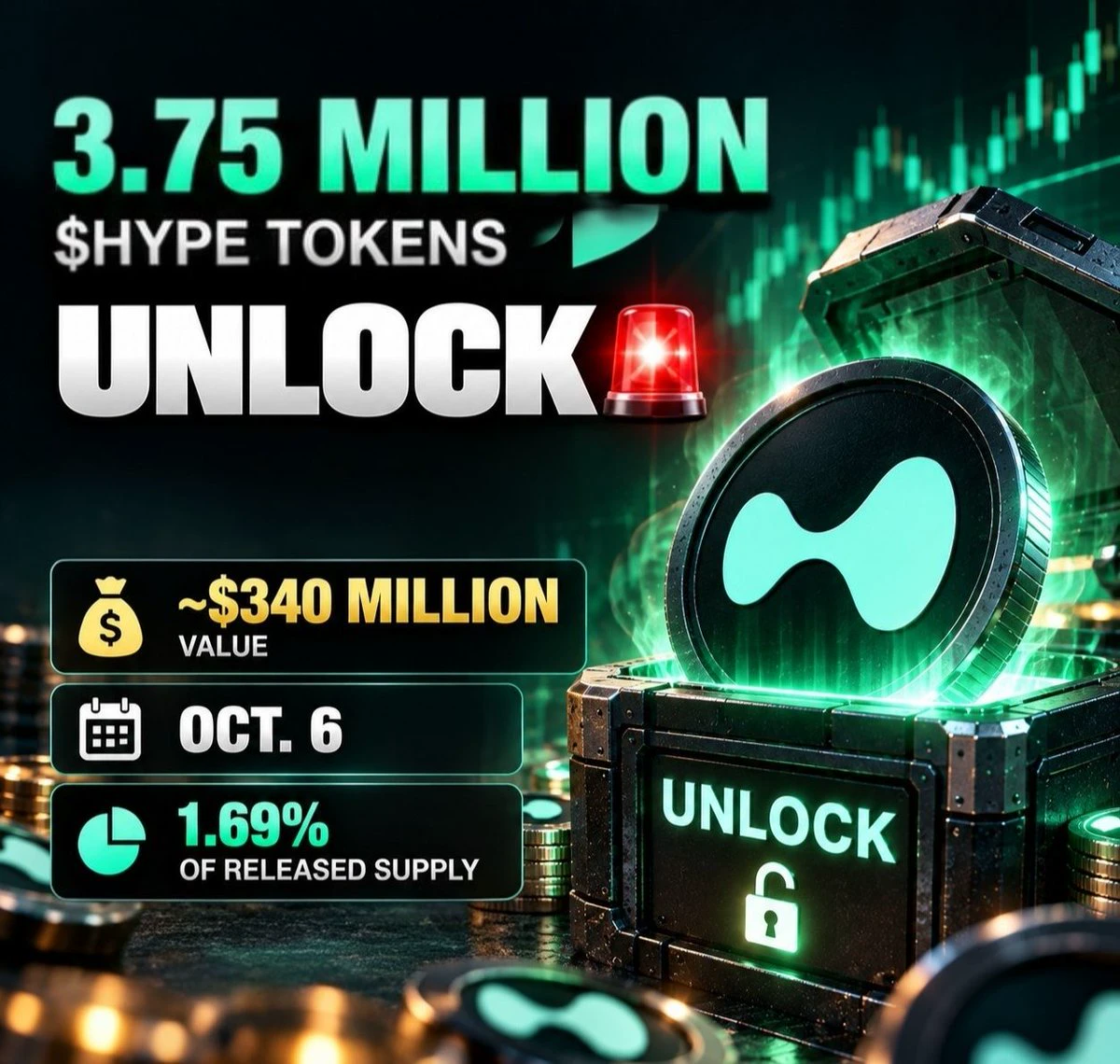
$HYPE unlock: 3.75 million tokens, about $340 million
Hyperliquid was set to unlock 3.75 million $HYPE on Oct. 6, worth about $340 million, or 1.69% of released supply (released supply listed at 474.83 million of a 1 billion total).
The team mentioned those tokens are going to one institutional buyer. That's the biggest single unlock happening in early October.
repost-content-media
HYPE-1.01%
🧧 Today's Gate red packet rain—grab yours right on time!
The full moon shines over the Mid-Autumn Festival; don't miss out on the benefits
No trading required. Complete event registration and identity verification to enter the event page during the open periods and click the red packet pop-up to unlock your surprise!
🎁 Random tokens, contract position trial vouchers, prediction market trial vouchers, trading fee cashback vouchers, fractional shares of popular stocks, and more are waiting for you to unpack
⏰ Today's open periods
12:00–15:00, 20:00–23:00 (UTC+8)
Limited quantity, first come, f
discovery
🧧 Today's Gate red packet rain—grab yours right on time!
The full moon shines over the Mid-Autumn Festival; don't miss out on the benefits
No trading required. Complete event registration and identity verification to enter the event page during the open periods and click the red packet pop-up to unlock your surprise!
🎁 Random tokens, contract position trial vouchers, prediction market trial vouchers, trading fee cashback vouchers, fractional shares of popular stocks, and more are waiting for you to unpack
⏰ Today's open periods
12:00–15:00, 20:00–23:00 (UTC+8)
Limited quantity, first come, first served
Each user may participate only 3 times during the event. Users who have already claimed cannot claim again
👉 Enter now and catch your Mid-Autumn Festival good luck: https://www.gate.com/campaigns/mid-autumn-2026
‍#Gate #Gate月满交易节 #MidAutumnRedPacketRain
Web3 Narratives — Data Snapshot: October 7, 2026
A factual look at the trends shaping the market right now.
📉 Memecoins
· 3% of total altcoin market cap — approximately $35.1B
· DOGE: ~$14.7B
· SHIB: ~$3.4B
· PEPE: ~$1.8B
· Robinhood Chain memecoin daily volume: $443M in early September, followed by a 96% drop
🏗️ Layer 1
· 71% of tracked blockchains had zero fees in 24 hours on October 3
· Tokenized securities: $3.2B, projected to reach $2T by 2028
· Ethereum L1: almost no tokenized stock DEX volume
🤖 AI Agents
· BlackRock expects AI agents to increase crypto demand
· Robinhood launched AI
KatyPaty
Web3 Narratives — Data Snapshot: October 7, 2026
A factual look at the trends shaping the market right now.
📉 Memecoins
· 3% of total altcoin market cap — approximately $35.1B
· DOGE: ~$14.7B
· SHIB: ~$3.4B
· PEPE: ~$1.8B
· Robinhood Chain memecoin daily volume: $443M in early September, followed by a 96% drop
🏗️ Layer 1
· 71% of tracked blockchains had zero fees in 24 hours on October 3
· Tokenized securities: $3.2B, projected to reach $2T by 2028
· Ethereum L1: almost no tokenized stock DEX volume
🤖 AI Agents
· BlackRock expects AI agents to increase crypto demand
· Robinhood launched AI trading agents
🔒 Privacy
· Zcash: +700% YTD, trading between $1,300–$1,370
· 4.9M ZEC in shielded pool
· Privacy coins: +205% since April
💰 DeFi & RWA
· Since April: UNI +189%, AERO +157%, KAMINO +129%, AAVE +93%
· BTC over the same period: +27%
· Tokenized stocks: over $3B
· Ondo tokenizes pre-IPO AI exposure
· Stablecoin market: $300.9B as of October 1
🎯 Conclusion
The narratives most likely to lead going forward are AI agents, privacy, tokenized RWAs, and Layer 1s with real fee revenue. Speculation alone is no longer enough. Capital is moving toward protocols with actual usage, cash flow, and systemic integration.
Let’s discuss on the stream: which narratives are you expecting? Join us live and share your thesis.
#BTC
DOGE-0.98%
SHIB-1.44%
PEPE-2.25%
HOOD-4.94%
$AMD ‌
AMD is preparing a major expansion of its supply chain in Asia, with Chief Executive Lisa Su saying the company plans to invest tens of billions of dollars to secure the manufacturing capacity needed for its next generation of AI chips. The commitment builds on a $10 billion investment in Taiwan announced in May 2026, which Su confirmed remains on track and is now expected to increase as demand continues to outpace supply.
The centerpiece of the effort is a push to expand advanced packaging capacity with long-time manufacturing partner TSMC. Advanced packaging is the process of combini
User_any
$AMD ‌
AMD is preparing a major expansion of its supply chain in Asia, with Chief Executive Lisa Su saying the company plans to invest tens of billions of dollars to secure the manufacturing capacity needed for its next generation of AI chips. The commitment builds on a $10 billion investment in Taiwan announced in May 2026, which Su confirmed remains on track and is now expected to increase as demand continues to outpace supply.
The centerpiece of the effort is a push to expand advanced packaging capacity with long-time manufacturing partner TSMC. Advanced packaging is the process of combining multiple chips into a single package, a step that has become a critical bottleneck for AI accelerators. AMD's Helios rack-scale platform, which pairs its Venice server processors with the Instinct MI450X GPU, relies on this technology and is scheduled to begin multi-gigawatt deployments in the second half of 2026. Su said AMD is coordinating capacity across fabrication, packaging, and substrate suppliers, and that the company is planning three to five years ahead with its partners.
In South Korea, Su met with Samsung and SK Hynix, describing them as key AI partners and calling the country's supply chain indispensable. The focus of those discussions was high-bandwidth memory, or HBM, a specialized type of memory that sits next to AI processors and feeds them data at extremely high speeds. The latest generation, HBM4, is in short supply, and Su said AMD is encouraging memory producers to expand capacity as quickly as possible. Samsung has said it will triple its HBM production capacity by the end of 2026, while SK Hynix is also ramping its output.
The scale of the investment reflects the economics of the AI buildout. AMD's data center segment has become its largest source of revenue, and the company has secured multi-gigawatt deployment commitments from major customers. Those commitments cannot be fulfilled without a corresponding increase in manufacturing capacity, and capacity cannot be added quickly. Building a new fabrication line or a new packaging facility takes years, which is why AMD is locking in arrangements now for supply that will not be available until 2027 and beyond.
The strategy carries execution risk. AMD's investment commitment is large relative to its historical capital spending, and it depends on partners delivering on their own expansion plans. The memory market in particular has a history of sharp cycles, and a surge in capacity that arrives after demand has peaked can weigh on prices and margins across the industry. Su acknowledged that the company can use more supply than it currently has, even as it increases its output, which suggests that the near-term constraint is unlikely to be resolved quickly.
The move also places AMD in more direct competition with Nvidia for the same limited pool of advanced manufacturing capacity. Both companies rely on TSMC for leading-edge chips and on a small group of memory suppliers for HBM. When two of the largest AI chip designers are competing for the same capacity, the advantage goes to the one with the deepest relationships and the most credible volume commitments. AMD's tour of Asia is, in part, an effort to ensure it is not the one left waiting.
This article is not investment advice. Analysis is based on publicly available information and does not guarantee future outcomes.
repost-content-media
AMD-5.98%
TSM-2.33%
NVDA-1.42%
SK Hynix+0.79%
$XAUUSD ‌
Gold is trading near $4,102, down about 1.47% on the day, after touching $4,066 at its lowest point. The metal has fallen to its weakest level in two months, and the move is being driven by two forces that have little to do with gold itself: a strengthening dollar and rising Treasury yields. The dollar index climbed to 102.07, recovering from a brief slide, and the 10-year Treasury yield pushed back above 5.3%. When the risk-free rate is that elevated, the opportunity cost of holding an asset that pays no yield rises, and gold has paid the price.
The pressure on gold is not uniform
User_any
$XAUUSD ‌
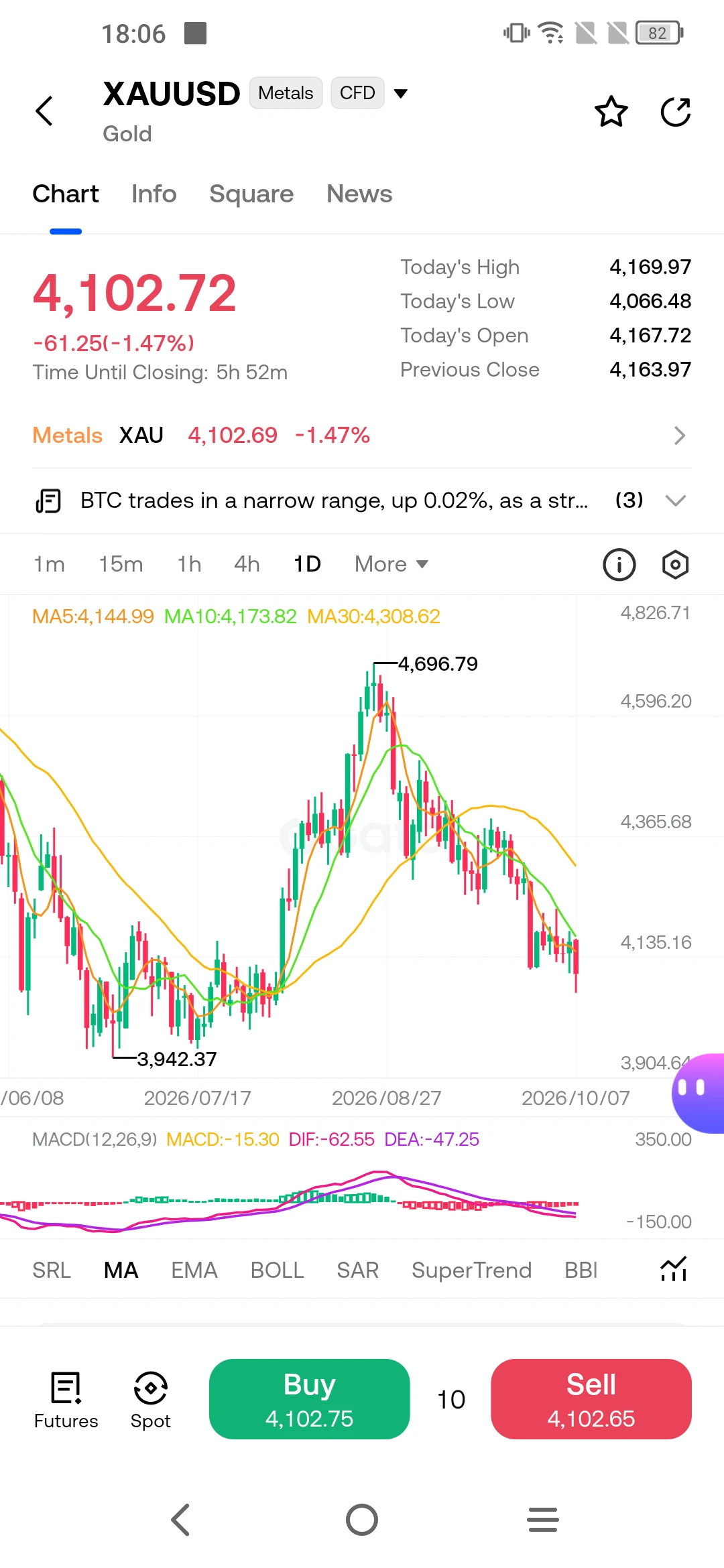
Gold is trading near $4,102, down about 1.47% on the day, after touching $4,066 at its lowest point. The metal has fallen to its weakest level in two months, and the move is being driven by two forces that have little to do with gold itself: a strengthening dollar and rising Treasury yields. The dollar index climbed to 102.07, recovering from a brief slide, and the 10-year Treasury yield pushed back above 5.3%. When the risk-free rate is that elevated, the opportunity cost of holding an asset that pays no yield rises, and gold has paid the price.
The pressure on gold is not uniform across all buyers. While the paper market sells off, central banks continue to accumulate. China's central bank added another 740,000 ounces of gold to its reserves in September, extending its buying streak to 23 consecutive months. Total purchases for 2026 have reached roughly 103 tonnes, and the People's Bank of China is now approaching two full years of uninterrupted accumulation. That buying is happening while prices fall, not while they rise, which is a different pattern from momentum-driven demand. Central banks are reserve managers, and their purchases are driven by long-term allocation decisions rather than short-term price action.
The divergence between paper and physical demand is the central tension in the gold market. The selloff is being driven by the dollar and yields, both of which are responding to the same macro forces: elevated oil prices, a Federal Reserve that has raised rates and may do so again, and a bond market that is repricing the entire rate path. The buying is coming from central banks and from institutional investors who view gold as a hedge against fiscal deterioration and currency debasement. These two groups are operating on different time horizons, and the paper market is currently setting the price.
Analysts have been adjusting their forecasts to reflect the new rate environment. HSBC lowered its average 2026 gold price forecast to $4,490 per ounce from $4,560, citing expectations of further rate hikes and higher oil prices, while keeping its longer-term view positive. The bank's 2027 forecast sits at $4,825 and its 2028 forecast at $5,200. At a precious metals conference, delegates surveyed for a 12-month outlook pointed to a price above $5,000. These forecasts are estimates, not guarantees, and they reflect a view that the current pressure is cyclical rather than structural.
The technical picture shows gold testing a support zone that has held for weeks. The immediate resistance sits at $4,165 to $4,185, and a four-hour close above that band would open the way toward $4,240 to $4,260. On the downside, the $4,110 level is the line that matters most. A sustained break below it would shift focus toward $4,027, the next target identified by technical analysts. The RSI is in oversold territory, which increases the likelihood of a short-term bounce, but oversold conditions can persist when the macro backdrop is unfavorable.
The net read is that gold is caught between two opposing forces. The dollar and Treasury yields are pushing prices lower in the short term, and those forces are unlikely to reverse quickly given the inflation and fiscal pressures that are driving them. At the same time, central banks are buying at a pace that has no recent precedent, and that provides a structural floor under the market that paper selling cannot easily break. The $4,110 support level is the variable to watch. If it holds, the metal can stabilize and wait for the macro pressure to ease. If it breaks, the correction extends toward the $4,000 area that central bank buyers have been targeting.
This article is not investment advice. Analysis is based on publicly available information and does not guarantee future outcomes.
repost-content-media
XAUUSD-0.12%
U.S. information sector employment fell by another 10,000 jobs in September, dropping to 2.739 million, the lowest level since December 2020. If the pandemic period is set aside, this is the weakest reading since December 2014. The sector has now lost 376,000 jobs, or 12.1 percent of its workforce, since its peak in November 2022.
The decline is concentrated in specific areas of the information sector. Motion picture and sound recording employment has fallen from about 456,000 to 329,000 since late 2022, a drop of 28 percent. Telecommunications has shed roughly 100,000 positions over the same
User_any
U.S. information sector employment fell by another 10,000 jobs in September, dropping to 2.739 million, the lowest level since December 2020. If the pandemic period is set aside, this is the weakest reading since December 2014. The sector has now lost 376,000 jobs, or 12.1 percent of its workforce, since its peak in November 2022.
The decline is concentrated in specific areas of the information sector. Motion picture and sound recording employment has fallen from about 456,000 to 329,000 since late 2022, a drop of 28 percent. Telecommunications has shed roughly 100,000 positions over the same period. The broader tech industry has cut 165,925 jobs this year, up 54 percent compared to the same period in 2025.
The pattern is not limited to the information sector. Financial activities shed 7,000 jobs in September and have lost 129,000 positions since peaking in May 2025. Professional and business services have lost 292,000 jobs since the end of 2022. These three sectors together account for the bulk of the weakness in the September employment report, which showed the U.S. economy added only 29,000 jobs overall.
Economists point to several factors behind the decline. Gregory Daco, chief economist at EY-Parthenon, noted that the trend reflects selective hiring rather than mass layoffs. "This doesn't show up as much in mass layoffs, but in more selective hiring," he said. "Business leaders are rethinking their approach to talent in this new AI-dominated world." Joe Brusuelas, chief economist at RSM, added that the tech sector is always at the forefront of adopting new technologies and does not need as much labor to drive overall activity.
The AI narrative is present but not dominant in the layoff data. AI was cited as the reason for only 3,961 of the 43,281 job cuts announced in September, about 9 percent of the total. For the year so far, AI has been cited for 120,136 job cuts, or 21 percent of all cuts. Meanwhile, employers posted 272,040 new IT job openings in September, an increase of 16 percent from a year earlier. That mismatch between job losses and job openings indicates a search for specific skills rather than a broad contraction in demand for tech talent.
Tech worker unemployment ticked up to 3.3 percent in September, still below the national rate of 4.2 percent. The number of people employed in tech occupations remains above 7 million. The pattern is one of a sector shedding some roles while struggling to fill others, rather than a uniform decline across the board.
This article is not investment advice. Analysis is based on publicly available information and does not guarantee future outcomes.
$BTC $GT $ETH
repost-content-media
BTC+0.69%
GT-2.81%
ETH-0.40%
Three separate developments within the same week indicate a significant milestone in global crypto regulations. Russia's largest bank, Sberbank, received regulatory approval to offer digital asset custody services. Hong Kong officially confirmed it will submit a comprehensive licensing bill for crypto service providers to its legislature later this year. China, while maintaining its restrictive stance on cryptocurrency activities, is preparing to take new steps to oversee cross-border digital asset initiatives. These developments coincide with the failure of the comprehensive market structure
User_any
Three separate developments within the same week indicate a significant milestone in global crypto regulations. Russia's largest bank, Sberbank, received regulatory approval to offer digital asset custody services. Hong Kong officially confirmed it will submit a comprehensive licensing bill for crypto service providers to its legislature later this year. China, while maintaining its restrictive stance on cryptocurrency activities, is preparing to take new steps to oversee cross-border digital asset initiatives. These developments coincide with the failure of the comprehensive market structure law to pass Congress in the US.
The development in Russia shows the country's largest state-owned bank directly entering the crypto infrastructure. Sberbank obtained a digital custody license from the Central Bank of Russia, authorizing it to hold assets such as Bitcoin, Ethereum, and USDT on behalf of its clients. The bank plans to launch its first crypto products on December 1, 2026; these products will initially support Bitcoin, Ethereum, and USDT and will be accessible through the SberBank Online and SberInvestments platforms. The custody license, unlike trading or issuance authorization, only covers the secure holding of assets. Customer eligibility criteria and terms of service are not yet clear. This step, considered alongside Russia's recent amendments to its crypto tax legislation, indicates the country's progress toward establishing a digital asset infrastructure at the corporate level.
Meanwhile, a formal timetable has been established for expanding the regulatory framework in Hong Kong. Financial Services and Treasury Secretary Christopher Hui announced that the government will submit a licensing bill to parliament this year covering crypto asset trading, custody, advisory, and asset management services. The bill is being prepared as an amendment to the Anti-Money Laundering and Counter-Terrorism Financing Ordinance, and all four license categories will be under the oversight of the Securities and Futures Commission. There is no transition period for firms without existing licenses; these firms may be required to cease operations once the rules come into effect. Hong Kong issued its first stablecoin issuer licenses in April 2026 under the Stablecoin Ordinance, which came into effect in August 2025; the new bill expands this framework to include trading and custody.
China's position, however, is shaping up in a different direction. A joint statement released in February 2026 by eight government agencies reiterated that crypto assets such as Bitcoin, Ethereum, and USDT do not have legal tender status and that cryptocurrency activities within the country are strictly prohibited as illegal financial activity. The statement also prohibits foreign entities from offering crypto services to residents of China and restricts the issuance of yuan-denominated stablecoins on grounds of monetary sovereignty. The tokenization of real-world assets is also prohibited; only activities conducted through specific financial infrastructures with the approval of authorized institutions are exempt. This strict stance demonstrates China's focus on increasing its capacity to oversee cross-border digital asset initiatives while maintaining its ban on cryptocurrency trading.
These three developments coincide with the failure of the comprehensive market structure law to pass Congress in the US. Due to the legislative deadlock, US regulators have resorted to creating their own frameworks using existing legal powers. The actions taken by Russia, Hong Kong, and China are shaped within different legal and political contexts; each proceeding according to its own internal dynamics and priorities. The common thread in these developments is that the regulation of digital assets is no longer a debate limited to a few major economies, but that different approaches are simultaneously taking shape on a global scale.
This article is not investment advice. The analysis is based on publicly available information and does not guarantee future results.
$BTC ‌
repost-content-media
BTC+0.69%
ETH-0.40%