Square
Following
Hot
News
Profile

TokenomicsMechanic

vip
Active for: 0.6y
Peak Tier 0
Dissecting a token model is like fixing an engine: you need to consider release, buyback, and incentives. The worst thing is relying on passion alone.
64
Following
10
Followers
7
Liked
This candle chart is making my eyes hurt—84292 has been hanging there all day. The range-bound extreme sports athlete is applying to enter the battle 🧗‍♂️☕️
CryptoOnline
Another day of staring at candles that refuse to move the way we want them to. BTC is sitting at 84292.36 with a 1.445 percent dip after swinging between 83577.0 and 86698.99. DYOR and not financial advice. ☕️ Screen time is way up today. 📊 Range trading is an extreme sport. 🧗‍♂️ $BTC #GateIdleEarnAutoYieldUpTo3% #GateLaunchesTrenchesWith0GasFee #ShareWeekly #WeekendMarketBullishOrBearish
It’s at 86k; volatility is shaking people out, so order-book depth needs to be watched closely.
CryptoOnline
BTC trading at 86460.0 up 1.89 percent today. Daily extremes span from 84719.99 to 86800.0. Volatility tests patience before it rewards execution. Keep eyes on order book depth around the session high. Not financial advice and DYOR. $BTC #GateIdleEarnAutoYieldUpTo3% #GateLaunchesTrenchesWith0GasFee #ShareWeekly #WeekendMarketBullishOrBearish
The market-entry order is set—this trade will either take us to a nightclub or a construction site.
MysticAbyssGold
🖥 Trading Signal 🖥
#ONE (20x Long 🚀🚀🚀)
✏️Entry: Market Price 0.0021974$ONE ‌
ZRO is in a rather delicate position; whether the structure can hold is more important than the price movement figures.
Rock95
$ZRO is around $1.6124, up 1.21%. Buyers still have a slight edge. I’d watch whether price can maintain the current structure and build above $1.60; losing that area would weaken the short-term setup.
#ZRO #LayerZero #Crypto:
ZRO-10.09%
I’m just someone who looks at tokenomics. I originally only wanted to quietly calculate the vesting curve, but the group can churn out 2,000 messages a day, with RWA, U.S. Treasuries, and on-chain yield products all competing on returns, while KOLs keep shouting, “Get in now or you’ll be too late.”
Seriously, when information overload hits, who should be held more accountable for impulsive buying? I think it’s the KOLs. With group messages, you at least know they’re noise; KOLs package it to look like analysis, when in reality they’re selling you anxiety. I’ve learned my lesson now: when I see
RWA-4.08%
LSTs, put simply, mean locking up ETH in exchange for a token you can keep using, with yields stacked on top of one another. But whenever someone in the group asks, “Where does the 8% annualized yield come from?” I can’t be bothered to type it all out—the staking rewards, restaking rewards, and points airdrops are all rent paid by someone else when you break them down, not something printed out of thin air.
Lately, rumors of stablecoins depegging have been flying around again. Whether USDe’s reserves are actually sufficient or not, screenshots are being forwarded in the group faster than code.
ETH-6.07%
USDE-0.07%
EIGEN-7.12%
The hole created by the earlier unlock-induced dump is starting to be filled, with $SPCX bulls re-entering. If buying pressure continues to keep up and sentiment turns around, this rebound will likely attract more traders’ attention, so it is worth watching closely.
HECTOR
$SPCX Bulls Are Back in Action
$SPCX has started recovering after the selling pressure caused by the unlock. If buyers continue to step in, the stock could regain stronger momentum and attract fresh attention from traders.
#GateStockInsightsChallenge
SPCX-5.30%
Everyone says Layer2 is cheap. I’ve used it for quite a while too, but whenever I’m bridging, funding a contract, or unstaking, I still instinctively switch back to mainnet. It’s more expensive, but I feel safer. Sometimes saving a few dollars in gas means taking several extra detours through places where L2 liquidity is fragmented. Time is a cost too, and it’s annoying.
Recently, a lot of people have been comparing RWA and U.S. Treasury yields with on-chain returns, and I just find it rather dull. If you’re talking about risk, sure, it’s lower; but if you’re asking whether it has anything to
After muting the group chat, the world has become much quieter. I used to be unable to resist clicking on the red notification dots to watch people make trading calls, argue, and share all kinds of “irrefutable evidence” and “inside information.” My hands would itch, especially when I saw others showing off their profits. But honestly, after scrolling through it all, nothing remained except anxiety. I hadn’t digested much information, but my emotions had been fed to the brim.
Now I ask myself instead: Is this position being driven by information or by emotion? If it’s the former, I’ll consider
Low-risk arbitrage has become harder to do, which instead suggests that the Bitcoin market is becoming more mature: with easier money becoming less available, capital can only work more intelligently.
DanniéX
Most traders focus on price.
Smart traders watch the spread.
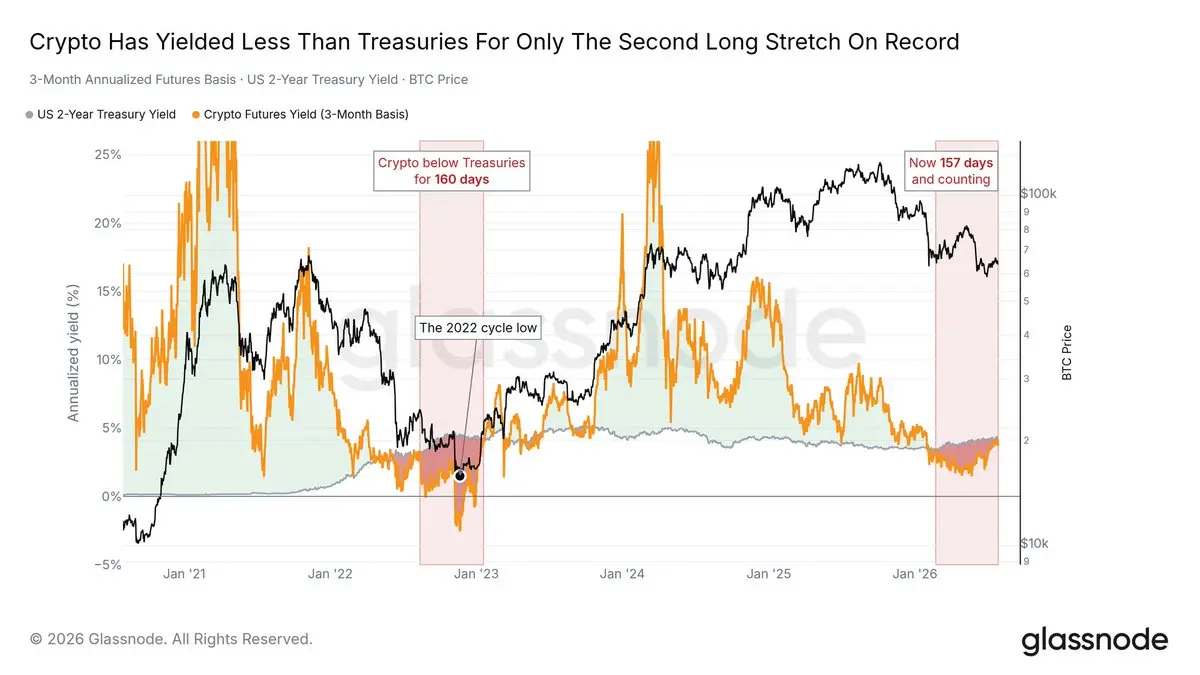
Right now, the 3-month $BTC futures premium has stayed below 2-year Treasury yields for over five months—an uncommon signal.
That reduces the appeal of low-risk arbitrage, leading to lighter leverage and slower derivatives activity.
At the same time, it shows Bitcoin's market is becoming more efficient, where easy returns are harder to find and capital has to work smarter.
Less easy money. More mature markets.
#GateReserveRatio117% #BitcoinSmallTransfersHitPostFTXHigh
repost-content-media
BTC-3.07%
Just checked the on-chain mempool and it’s completely jammed—gas is skyrocketing. Honestly, whenever I watch those token models patch and tweak things, it usually doesn’t feel as intuitive as it does when you actually end up in a queue: the fee you set is like an auction bid. The people who are in a rush keep cranking the price higher and higher, while the ones who aren’t can only stare blankly as your transaction just sits there, bubbling away in the mempool. If back then I had set a low gas to “run the deal,” I’m guessing I’d still be stuck in the pending pool, collecting dust.
Lately, haven
After scrolling for a while, I realized that many projects are doing PFPs and memberships. In essence, they’re just selling “social entry tickets.” Put plainly, it’s a traffic business: first they capture a wave of attention, and as for how the tokens will be released later or how buybacks will work—looks like they haven’t thought it through.
I’m more of a slow burner, and I don’t really chase hot trends. So when I see something that starts by dumping a bunch of NFTs and urging you to buy right away, I always feel a bit uneasy. For long-term value, you need to see whether the brand actually ha
Honestly, I also joined in a few times when that Meme wave was at its liveliest. But now I’m increasingly feeling that even if the narrative blows up, there has to be a stop-loss point. I’m not saying you have to be ruthless and cut. You just need to think it through: are you betting on emotion, or is there really someone willing to be the next buyer?
Social mining and fan tokens—plainly put, they’re all part of the attention economy. But the shelf life of attention is even shorter than fruit. I’ve read a lot of tutorials: everything from technical indicators to on-chain analysis. Still, hones
MEME-8.69%
I just came across a guy complaining. He said his restaking position shows the earnings are going up, but when he tried to make a move, he couldn’t get it to execute for half a day. In the end, he found it was a delay on the node side. Honestly, this is pretty common.
I’ve run into it a few times too—on-chain data being delayed isn’t unusual. For example, with the RPC node you see, sometimes it’s because the cache or the index hasn’t finished running. You panic and think the transaction didn’t go through, but the chain has already confirmed it. Last time, this almost made me resend a transacti
To be honest, I tried a few address profiling tools recently—looking at label clustering and fund flows—and it still feels like there’s quite a bit of “water” in the analysis. Some addresses look spotless on the ledger at first glance, but if you dig into where the funds actually go, it’s all that kind of token shuffling back and forth between new accounts… you know the drill. Even though the AI Agents are getting a lot of hype and automated trading runs fast, as far as on-chain security goes, I just feel that there aren’t many teams that really obsess over the details. How much can address pr
Over the past couple of days, reading the team’s financial reports has gotten a bit overwhelming for me. To put it plainly, there’s one thing I really care about: whether the project team’s spending pace matches the milestones they keep talking about. I’m not just looking at how much they spent today—I’m looking at whether, after spending it, they actually built the walls that needed to be built and ran the tests that needed to be run. You can just say, “We have money,” but where did the money go? Did they hire people to genuinely write code, or did they dump everything into point expectations
I just glanced at my wallet and suddenly remembered something: contract approvals with unlimited amounts—this is really like not locking the door before bed. It looks fine, but it still doesn’t make me feel at ease.
After a few recent cross-chain bridges were stolen and oracle quotes went abnormal, everyone only then realized that confirming consensus is actually pretty important. But many people’s approvals are still set to unlimited. If a protocol gets hacked, or contract permissions are abused, your money could be drained overnight.
I, for one, always go revoke after using a new protocol. T
Recently when I opened groups and Twitter, it felt like everyone was discussing whether, after a certain public chain upgrade, projects would migrate. All kinds of PFPs, membership cards, and brand “team-up” posts got spammed through another round of hype. Honestly, it gets a little exhausting to keep seeing it. You click on someone’s profile signature and they hype the community’s value like it’s real.
Sometimes I think: pause. Don’t rush to follow. The public chain upgrade is making all the noise, but when you break down those so-called “long-term value” token models, how many of them can tr
To be honest, after talking about modularity for so long, what has it really changed for end users? In my view, in day-to-day interactions there hasn’t really been any obvious leap you can see with the naked eye. Back then, one L1 could handle everything—now it’s broken up and outsourced, but don’t users still have to connect to different RPCs and put up with all those bridges going back and forth? The experience actually adds a few extra steps, and if something goes wrong, you still have to figure out which layer failed.
Recently I saw news about a certain region raising taxes and tightenin
Yeah, a lot of people are always talking nonstop about how cheap Layer 2 is, and how clogged the mainnet is. I get it, I get it.
But honestly, lately I’ve been looking at that staking unlock calendar, and there are a bunch of people there calculating sell-pressure anxiety—now it’s got me annoyed too. You know, I don’t even make many transfers day to day. I moved to Arbitrum to save on a bit of gas, and the experience wasn’t that smooth either. Sometimes after bridging back, I have to wait for half a day.
Anyway, I’m doing things based on the situation now. For small liquidity operations, I’d r
ARB-9.84%