#SpaceXQ3Earnings #ShareWeekly
SpaceX Q3 Earnings Preview: $12.9B Revenue, AI Spending, and SPCX’s Next Move
SpaceX faces a crucial test: Can it turn explosive revenue growth into sustainable profits, or will massive AI spending continue to pressure its finances?
Investors are watching Starlink’s recurring revenue, AI computing expansion, and rocket operations ahead of SpaceX’s Q3 2026 earnings report. The results could influence whether SPCX gains momentum or faces another sell-off.
SpaceX is scheduled to report results on October 20 after the US market close, with a management webcast at 4:30 p.m. ET. The Q3 figures discussed below are analyst forecasts, not confirmed results.
1. SPCX Price: What Should Investors Watch?
Using the reported October 19 closing price:
Share price: $147.96
IPO offering price: $135
Gain above IPO price: Approximately 9.6%
Reported 52-week range: $104.83–$225.64
Distance below the 52-week high: Approximately 34.4%
Approximate market capitalization: $2 trillion, depending on share-count methodology
These are historical reference figures, not live quotes.
SPCX remains above its IPO price but well below its reported high. Earnings must demonstrate that future growth can justify the market’s expectations. A return to previous highs is not guaranteed.
2. Revenue Forecast: Approximately $12.9 Billion
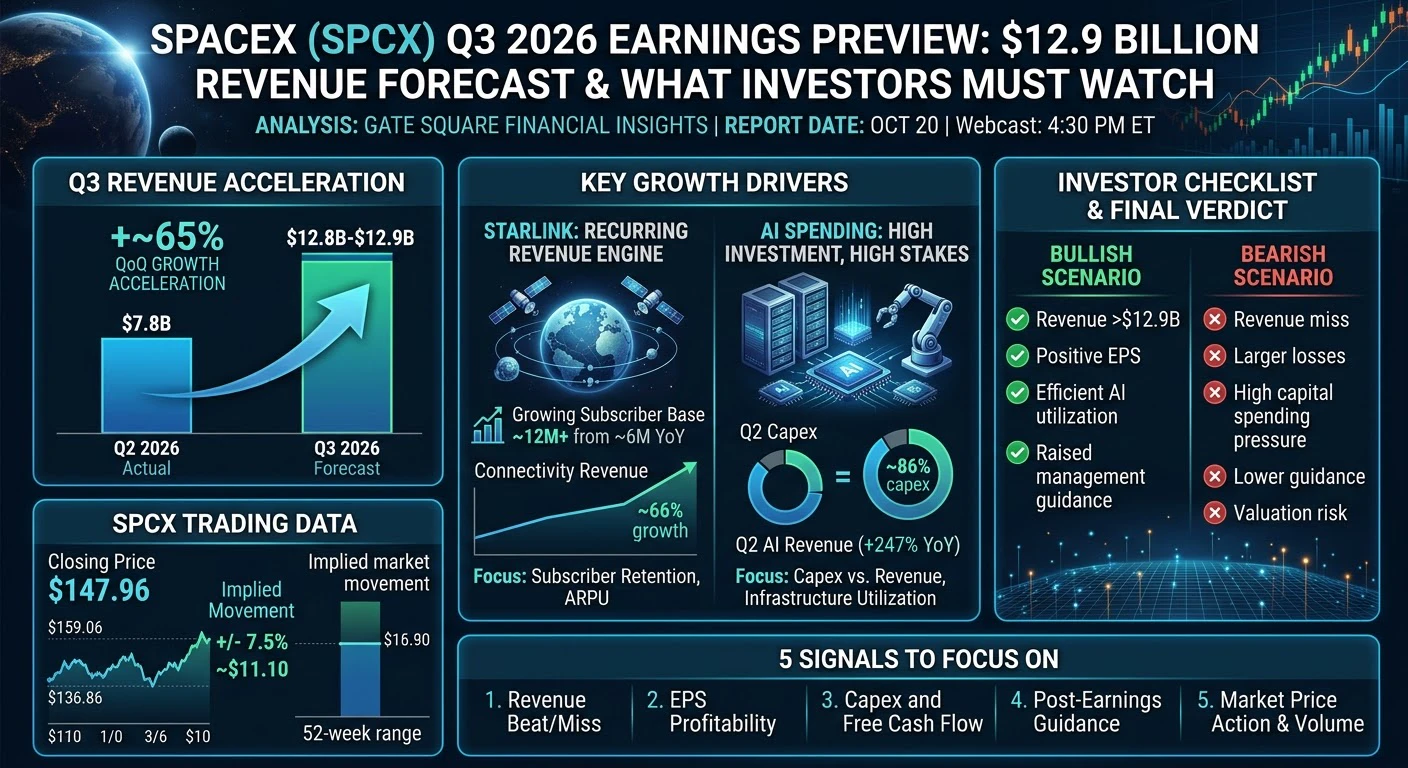
Analysts expect Q3 revenue of approximately $12.84–$12.89 billion, compared with reported Q2 revenue of $7.814 billion.
That implies potential quarter-over-quarter growth of approximately 64%–65%, or more than $5 billion in additional quarterly revenue.
For context, Q2 revenue increased approximately 92% year over year.
My view: Revenue above $12.9 billion would be encouraging, but growth alone is not enough. Investors need to see whether margins, earnings, and cash generation are improving alongside sales.
3. Q2 Results Reveal the Main Challenge
SpaceX’s previously reported Q2 figures included:
Revenue: $7.814 billion
Net loss: $541 million
Adjusted EBITDA: Approximately $3.538 billion
Capital expenditure: Approximately $18.369 billion
Connectivity revenue: Approximately $4.3 billion
AI segment revenue: Approximately $2.6 billion
Strong adjusted EBITDA does not automatically mean net profitability because it excludes certain expenses and accounting items.
Despite substantial revenue growth, SpaceX recorded a net loss while investing heavily in infrastructure.
The main Q3 test is whether revenue growth can outpace rising costs and move the business toward sustainable profitability.
4. Starlink: A Major Growth Engine
Starlink provides satellite internet services to households, businesses, airlines, maritime customers, and government organizations.
SpaceX reported approximately 12 million subscribers at the end of Q2, compared with around 6 million a year earlier. Connectivity revenue reached approximately $4.3 billion, up around 66% year over year.
Investors should watch subscriber growth, average revenue per user, customer retention, network costs, and connectivity margins.
Bullish signal: Subscriber growth remains strong while profitability improves.
Bearish signal: Customer growth slows, pricing pressures revenue per user, or infrastructure costs rise faster than income.
Recurring subscription revenue can improve business visibility, but subscriber numbers alone do not guarantee higher profits.
5. AI Spending: Opportunity and Risk
SpaceX’s AI segment generated approximately $2.6 billion in Q2 revenue, representing reported year-over-year growth of roughly 247%.
However, AI-related capital expenditure reached approximately $15.828 billion, around 86% of total Q2 capital expenditure.
This massive investment could support future growth, but it creates pressure on cash flow.
Three questions matter:
Is AI revenue growing fast enough to justify spending?
Are computing assets being used efficiently?
Can customer demand translate into sustainable cash flow?
My view: AI is a major long-term opportunity, but investors need evidence that the returns can justify the enormous investment.
6. Rocket Business and Profitability
SpaceX’s traditional operations include Falcon launches, Dragon missions, government contracts, and Starship development.
Financial performance depends on launch activity, contract milestones, mission costs, and recognized revenue. Starship offers long-term potential but requires substantial development spending.
Ahead of Q3, analyst EPS estimates ranged around $0.14–$0.17, with some forecasts anticipating a profitable quarter. These remain estimates, not confirmed earnings.
Investors should compare actual revenue and EPS with consensus, then examine net income, operating margins, capital expenditure, free cash flow, and forward guidance.
A revenue beat alongside widening losses could disappoint the market. Improving profitability and cash generation could be more valuable than revenue growth alone.
7. SPCX Post-Earnings Trading Scenarios
Options-market analysis suggested a potential move of approximately 7.5% in either direction. This is an implied move estimate, not a guaranteed outcome.
Using $147.96 as the reference price:
+3%: $152.40
+5%: $155.36
+7.5%: $159.06
-3%: $143.52
-5%: $140.56
-7.5%: $136.86
These are mathematical scenarios, not confirmed support or resistance levels.
Bullish scenario: Revenue beats expectations, earnings improve, AI spending becomes more efficient, and management raises its outlook. Sustained buying and strong volume would help confirm upward momentum.
Bearish scenario: Revenue misses, losses widen, spending accelerates, or guidance weakens. Continued selling below the post-earnings low could indicate further downside.
Neutral scenario: Results are strong but already priced in. SPCX could move sideways or decline if guidance fails to exceed expectations.
The market reaction depends on the difference between actual results and expectations—not simply whether revenue increases.
8. Valuation: Is Growth Already Priced In?
At approximately $147.96 per share and a reported market capitalization near $2 trillion, SpaceX faces exceptionally high expectations.
Annualizing the $12.9 billion quarterly revenue forecast produces approximately $51.6 billion. This is an illustration, not company guidance.
Compared with a roughly $2 trillion valuation, that implies a valuation-to-sales ratio near 39 times, subject to differences in valuation methodology and reporting periods.
Such a valuation increases the risk of disappointment if growth, margins, or guidance fall short. Exceptional execution could support further gains, but high expectations can amplify volatility.
9. My Trading View and Final Conclusion
I am cautiously constructive on SpaceX’s long-term growth potential, particularly through Starlink’s recurring revenue and AI computing. However, heavy capital expenditure and valuation remain major risks.
Before trading, I would focus on five signals:
Revenue versus the $12.9 billion forecast.
EPS and net profitability.
Capital expenditure and cash flow.
Management’s forward guidance.
Price action and volume after the release.
Avoid chasing the first price spike. Earnings volatility can trigger rapid reversals, so position sizing and risk management are essential.
My conclusion: SpaceX has substantial growth opportunities, but the Q3 report must demonstrate that expansion is translating into stronger financial performance.
SpaceX Q3 Earnings Preview: $12.9B Revenue, AI Spending, and SPCX’s Next Move
SpaceX faces a crucial test: Can it turn explosive revenue growth into sustainable profits, or will massive AI spending continue to pressure its finances?
Investors are watching Starlink’s recurring revenue, AI computing expansion, and rocket operations ahead of SpaceX’s Q3 2026 earnings report. The results could influence whether SPCX gains momentum or faces another sell-off.
SpaceX is scheduled to report results on October 20 after the US market close, with a management webcast at 4:30 p.m. ET. The Q3 figures discussed below are analyst forecasts, not confirmed results.
1. SPCX Price: What Should Investors Watch?
Using the reported October 19 closing price:
Share price: $147.96
IPO offering price: $135
Gain above IPO price: Approximately 9.6%
Reported 52-week range: $104.83–$225.64
Distance below the 52-week high: Approximately 34.4%
Approximate market capitalization: $2 trillion, depending on share-count methodology
These are historical reference figures, not live quotes.
SPCX remains above its IPO price but well below its reported high. Earnings must demonstrate that future growth can justify the market’s expectations. A return to previous highs is not guaranteed.
2. Revenue Forecast: Approximately $12.9 Billion
Analysts expect Q3 revenue of approximately $12.84–$12.89 billion, compared with reported Q2 revenue of $7.814 billion.
That implies potential quarter-over-quarter growth of approximately 64%–65%, or more than $5 billion in additional quarterly revenue.
For context, Q2 revenue increased approximately 92% year over year.
My view: Revenue above $12.9 billion would be encouraging, but growth alone is not enough. Investors need to see whether margins, earnings, and cash generation are improving alongside sales.
3. Q2 Results Reveal the Main Challenge
SpaceX’s previously reported Q2 figures included:
Revenue: $7.814 billion
Net loss: $541 million
Adjusted EBITDA: Approximately $3.538 billion
Capital expenditure: Approximately $18.369 billion
Connectivity revenue: Approximately $4.3 billion
AI segment revenue: Approximately $2.6 billion
Strong adjusted EBITDA does not automatically mean net profitability because it excludes certain expenses and accounting items.
Despite substantial revenue growth, SpaceX recorded a net loss while investing heavily in infrastructure.
The main Q3 test is whether revenue growth can outpace rising costs and move the business toward sustainable profitability.
4. Starlink: A Major Growth Engine
Starlink provides satellite internet services to households, businesses, airlines, maritime customers, and government organizations.
SpaceX reported approximately 12 million subscribers at the end of Q2, compared with around 6 million a year earlier. Connectivity revenue reached approximately $4.3 billion, up around 66% year over year.
Investors should watch subscriber growth, average revenue per user, customer retention, network costs, and connectivity margins.
Bullish signal: Subscriber growth remains strong while profitability improves.
Bearish signal: Customer growth slows, pricing pressures revenue per user, or infrastructure costs rise faster than income.
Recurring subscription revenue can improve business visibility, but subscriber numbers alone do not guarantee higher profits.
5. AI Spending: Opportunity and Risk
SpaceX’s AI segment generated approximately $2.6 billion in Q2 revenue, representing reported year-over-year growth of roughly 247%.
However, AI-related capital expenditure reached approximately $15.828 billion, around 86% of total Q2 capital expenditure.
This massive investment could support future growth, but it creates pressure on cash flow.
Three questions matter:
Is AI revenue growing fast enough to justify spending?
Are computing assets being used efficiently?
Can customer demand translate into sustainable cash flow?
My view: AI is a major long-term opportunity, but investors need evidence that the returns can justify the enormous investment.
6. Rocket Business and Profitability
SpaceX’s traditional operations include Falcon launches, Dragon missions, government contracts, and Starship development.
Financial performance depends on launch activity, contract milestones, mission costs, and recognized revenue. Starship offers long-term potential but requires substantial development spending.
Ahead of Q3, analyst EPS estimates ranged around $0.14–$0.17, with some forecasts anticipating a profitable quarter. These remain estimates, not confirmed earnings.
Investors should compare actual revenue and EPS with consensus, then examine net income, operating margins, capital expenditure, free cash flow, and forward guidance.
A revenue beat alongside widening losses could disappoint the market. Improving profitability and cash generation could be more valuable than revenue growth alone.
7. SPCX Post-Earnings Trading Scenarios
Options-market analysis suggested a potential move of approximately 7.5% in either direction. This is an implied move estimate, not a guaranteed outcome.
Using $147.96 as the reference price:
+3%: $152.40
+5%: $155.36
+7.5%: $159.06
-3%: $143.52
-5%: $140.56
-7.5%: $136.86
These are mathematical scenarios, not confirmed support or resistance levels.
Bullish scenario: Revenue beats expectations, earnings improve, AI spending becomes more efficient, and management raises its outlook. Sustained buying and strong volume would help confirm upward momentum.
Bearish scenario: Revenue misses, losses widen, spending accelerates, or guidance weakens. Continued selling below the post-earnings low could indicate further downside.
Neutral scenario: Results are strong but already priced in. SPCX could move sideways or decline if guidance fails to exceed expectations.
The market reaction depends on the difference between actual results and expectations—not simply whether revenue increases.
8. Valuation: Is Growth Already Priced In?
At approximately $147.96 per share and a reported market capitalization near $2 trillion, SpaceX faces exceptionally high expectations.
Annualizing the $12.9 billion quarterly revenue forecast produces approximately $51.6 billion. This is an illustration, not company guidance.
Compared with a roughly $2 trillion valuation, that implies a valuation-to-sales ratio near 39 times, subject to differences in valuation methodology and reporting periods.
Such a valuation increases the risk of disappointment if growth, margins, or guidance fall short. Exceptional execution could support further gains, but high expectations can amplify volatility.
9. My Trading View and Final Conclusion
I am cautiously constructive on SpaceX’s long-term growth potential, particularly through Starlink’s recurring revenue and AI computing. However, heavy capital expenditure and valuation remain major risks.
Before trading, I would focus on five signals:
Revenue versus the $12.9 billion forecast.
EPS and net profitability.
Capital expenditure and cash flow.
Management’s forward guidance.
Price action and volume after the release.
Avoid chasing the first price spike. Earnings volatility can trigger rapid reversals, so position sizing and risk management are essential.
My conclusion: SpaceX has substantial growth opportunities, but the Q3 report must demonstrate that expansion is translating into stronger financial performance.